ZetaChain is a foundational omnichain blockchain protocol launched in 2024 that addresses cross-chain fragmentation through universal smart contracts and messaging capabilities. This comprehensive guide explores ZetaChain's decentralized architecture, consensus mechanisms, and secure transaction protocols that enable seamless interoperability across multiple blockchains without requiring wrapped tokens or bridges. As of January 2026, ZETA tokens show active market participation with 78,875 holders and trading on Gate and other major exchanges. The article details ZetaChain's market performance, ecosystem applications spanning DeFi and cross-chain development, and community engagement while addressing regulatory challenges and competitive pressures. Whether you're a developer, investor, or crypto enthusiast, this guide equips you with essential insights into ZetaChain's technology, tokenomics, and role in building the interconnected blockchain future.
ZetaChain's Positioning and Significance
In 2024, the ZetaChain team launched ZetaChain (ZETA), aiming to address cross-chain fragmentation and inefficiencies in multi-chain interoperability.
As the first foundational public blockchain enabling omnichain, generic smart contracts and messaging, ZetaChain plays a critical role in blockchain interoperability, DeFi, and cross-chain applications.
As of 2026, ZetaChain has established itself as an emerging cross-chain infrastructure project, with 78,875 holders and an active developer community.
This article will provide an in-depth analysis of its technical architecture, market performance, and future potential.
Origin and Development History
Birth Background
ZetaChain was created by its founding team in 2024, aiming to solve the fragmentation of blockchain ecosystems and the limitations of existing cross-chain solutions.
It emerged during the rapid expansion of multi-chain ecosystems, with the goal of enabling seamless interoperability and universal smart contract deployment across any blockchain to transform the status quo.
The launch of ZetaChain brought new possibilities to developers, DeFi protocols, and users seeking frictionless multi-chain experiences.
Key Milestones
- February 2024: Mainnet launched, implementing omnichain smart contract functionality and cross-chain messaging capabilities.
- 2024: Listed on Gate.com, expanding accessibility to global users.
- 2024-2025: Ecosystem expansion with integration of multiple blockchain networks and deployment of cross-chain applications.
- 2025: Continued development of developer tools and infrastructure to support omnichain applications.
With the support of its core development team and community, ZetaChain continues to optimize its technology, security, and real-world applications.
How ZetaChain Works
Decentralized Network
ZetaChain operates on a globally distributed network of decentralized nodes, free from control by banks or governments.
These nodes collaboratively validate transactions, ensuring system transparency and attack resistance, granting users greater autonomy and enhancing network resilience.
Blockchain Foundation
ZetaChain's blockchain serves as a public, immutable digital ledger recording every transaction.
Transactions are grouped into blocks and linked through cryptographic hashing to form a secure chain.
Anyone can view the records, establishing trust without intermediaries.
The platform's omnichain architecture enables universal smart contract deployment across any connected blockchain, significantly enhancing cross-chain functionality.
Consensus Mechanism
ZetaChain employs a consensus mechanism to validate transactions and prevent fraudulent activities such as double-spending.
Validators maintain network security through node operation and transaction verification, receiving ZETA token rewards.
Its innovation includes enabling native cross-chain transactions without wrapped tokens or bridges.
Secure Transactions
ZetaChain utilizes public-private key cryptography to protect transactions:
- Private keys (like secret passwords) are used to sign transactions
- Public keys (like account numbers) are used to verify ownership
This mechanism ensures fund security while maintaining transaction integrity across multiple blockchain networks.
The platform's architecture supports secure cross-chain messaging and asset transfers without requiring intermediary trust assumptions.
Circulation Overview
As of January 17, 2026, ZetaChain's circulating supply stands at 1,218,000,000 ZETA tokens, with a total supply of 2,100,000,000 ZETA and a maximum supply cap of 2,100,000,000 ZETA, indicating a fixed supply model.
The circulating supply represents approximately 58% of the total supply, suggesting a gradual token release mechanism that influences supply-demand dynamics in the market.
Price Volatility
ZetaChain experienced significant price movements since its market debut. The token reached a notable price level of $2.87 on February 15, 2024, driven by initial market enthusiasm and trading activity following its launch.
The lowest recorded price was $0.05735, occurring on October 10, 2025, reflecting broader market corrections and sentiment shifts in the cryptocurrency ecosystem.
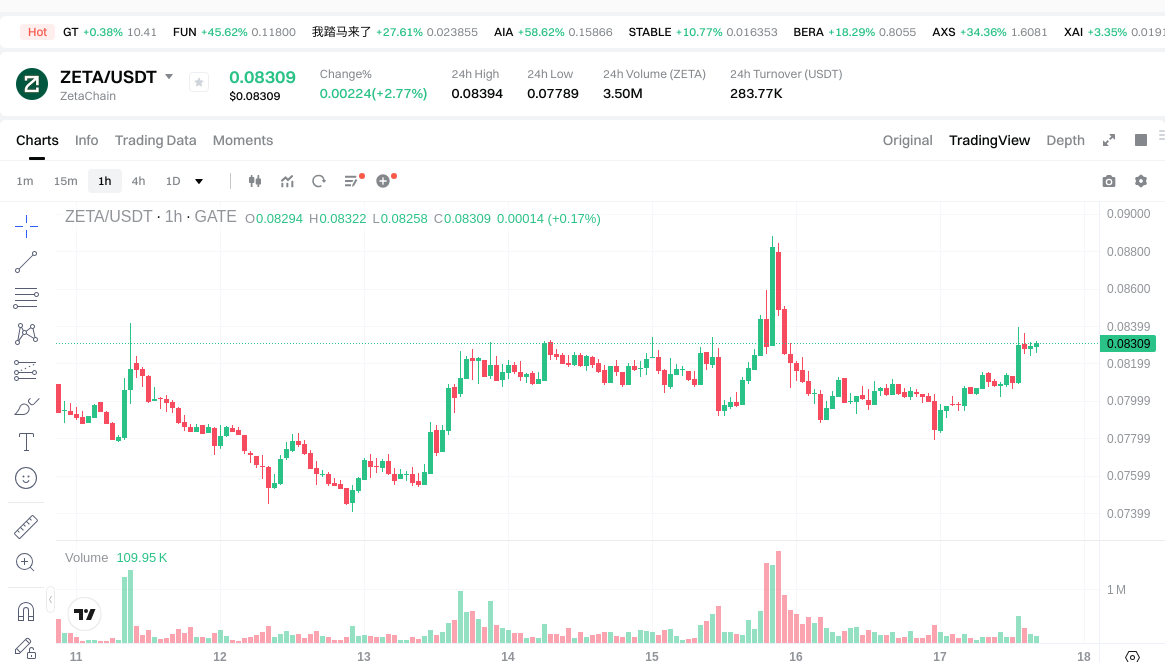
As of January 17, 2026, ZETA is trading at $0.08262, showing a 2.53% increase over the past 24 hours. Recent price trends indicate:
- 1-hour change: -0.21%
- 7-day change: +6.88%
- 30-day change: +18.92%
- 1-year change: -84.28%
These fluctuations reflect evolving market sentiment, adoption patterns, and external factors affecting the broader cryptocurrency market.
Check the current ZETA market price
On-Chain Metrics
- Holder Count: Approximately 78,875 addresses hold ZETA tokens, indicating growing community participation and distribution across the user base
- Trading Volume (24h): $285,333.68, demonstrating active market engagement
- Market Capitalization: $100,631,160, representing 0.0051% of the total cryptocurrency market share
ZetaChain Ecosystem Applications and Partners
Core Use Cases
ZetaChain's ecosystem supports multiple applications:
- Cross-Chain DeFi: Omnichain decentralized finance protocols enable seamless liquidity flow and asset management across different blockchains.
- Universal Messaging: Native cross-chain messaging infrastructure facilitates communication between disparate blockchain networks.
- Multi-Chain Smart Contracts: Developers can build applications that natively interact with assets and data across multiple chains without bridges.
Strategic Collaborations
ZetaChain's technical architecture enables integration with various blockchain ecosystems, expanding its interoperability capabilities and market reach. These partnerships provide a solid foundation for ZetaChain's ecosystem expansion.
Controversies and Challenges
ZetaChain faces the following challenges:
- Technical Complexity: Building truly universal cross-chain infrastructure requires solving complex consensus and security challenges across heterogeneous blockchain architectures.
- Regulatory Uncertainty: Cross-chain protocols may face evolving regulatory scrutiny as governments develop frameworks for blockchain interoperability.
- Competitive Landscape: The emergence of other interoperability solutions creates ongoing pressure for innovation and differentiation.
These issues have sparked discussions within the community and market, while also driving ZetaChain's continuous innovation.
ZetaChain's community shows notable activity with over 78,875 token holders. Social media discussions around ZetaChain topics reflect interest in omnichain technology and cross-chain applications. The project's development progress and ecosystem expansion initiatives generate ongoing community attention.
Sentiment on X displays varied perspectives:
- Supporters praise ZetaChain's universal smart contract capabilities and its potential to simplify cross-chain interactions, viewing it as infrastructure for a truly interconnected blockchain future.
- Critics focus on market volatility, technical execution risks, and competition from established interoperability protocols.
Recent trends indicate mixed sentiment reflecting broader market conditions.
Popular Topics
X users actively discuss ZetaChain's technical architecture, cross-chain messaging capabilities, and ecosystem development, showcasing both its transformative potential and the challenges of achieving seamless multi-chain interoperability.
- Official Website: Visit ZetaChain official website for features, use cases, and latest updates.
- White Paper: ZetaChain White Paper details its technical architecture, objectives, and vision for omnichain smart contracts.
- X Activity: On X platform, ZetaChain maintains an active presence through @zetablockchain, with posts covering technical upgrades, ecosystem developments, and partnership announcements that generate community engagement.
ZetaChain Future Roadmap
- Ongoing Development: Continue enhancing omnichain smart contract capabilities and expanding supported blockchain networks.
- Ecosystem Goals: Foster development of cross-chain applications and increase developer adoption of universal messaging infrastructure.
- Long-Term Vision: Establish itself as foundational infrastructure for seamless multi-chain cryptocurrency ecosystem.
How to Participate in ZetaChain?
- Purchase Channels: Acquire ZETA on Gate.com and other supported exchanges.
- Storage Solutions: Securely store ZETA using compatible wallets; the token operates on Ethereum network (contract: 0xf091867ec603a6628ed83d274e835539d82e9cc8).
- Ecosystem Participation: Explore ZetaChain documentation to understand cross-chain development opportunities.
- Development Contribution: Visit ZetaChain GitHub to contribute to the protocol or build omnichain applications.
Summary
ZetaChain redefines blockchain interoperability through its omnichain architecture, providing universal smart contract execution and messaging across any blockchain network. Its innovative approach to solving cross-chain challenges, combined with active community support and clear technical vision, positions it as notable infrastructure in the cryptocurrency space. Despite facing regulatory uncertainty and technical complexity, ZetaChain's commitment to seamless multi-chain functionality makes it relevant for those interested in blockchain interoperability. Whether you're new to crypto or an experienced participant, ZetaChain's approach to connecting blockchain ecosystems merits attention.
FAQ
What is ZETA crypto and what is its main purpose?
ZETA is the core digital asset of ZetaChain, used for funding transactions, validator staking, and network security. Its main purpose is to facilitate cross-chain interoperability and enable users to participate in network delegation and governance.
How can I buy and store ZETA tokens?
Purchase ZETA tokens through decentralized platforms or DEXs. Store them securely in a Web3 wallet like MetaMask or hardware wallets for optimal security and control.
What are the risks and security considerations when investing in ZETA?
ZETA investments face market volatility, smart contract vulnerabilities, and regulatory uncertainty. Ensure secure wallet practices, verify protocol audits, and research team credibility before investing.
What is the total supply and tokenomics of ZETA?
ZETA has a capped total supply of 2.1 billion tokens. The tokenomics feature a transition to a target supply model, designed to ensure sustainable long-term growth and ecosystem incentives.
Which exchanges support ZETA trading?
ZETA is supported on major exchanges including KuCoin, Kraken, Bybit, and OKX. For the most current list of supported exchanges and trading pairs, please check the official channels.
What projects or partnerships does ZETA have?
ZETA maintains partnerships focused on community development, including Elder Care, Adopt-A-School, and Adopt-A-Highway initiatives. The project collaborates with national organizations to expand its ecosystem and community impact.
* The information is not intended to be and does not constitute financial advice or any other recommendation of any sort offered or endorsed by Gate.