ZEUS is a revolutionary cross-chain communication layer built on Solana Virtual Machine, connecting Bitcoin liquidity to the Solana DeFi ecosystem since 2024. This comprehensive guide explores ZEUS's technical architecture, decentralized governance through Proof of Stake consensus, and secure transaction mechanisms using public-private key cryptography. As of January 2026, ZEUS demonstrates significant market presence with 79,882 token holders and a market capitalization of $10.2 million. The article covers its core applications including APOLLO DApp for Bitcoin bridging, ecosystem partnerships, current challenges in cross-chain security, and community engagement. Learn how to purchase ZEUS on Gate, store tokens in Solana-compatible wallets, and participate in this transformative cross-chain infrastructure project reshaping DeFi possibilities.
ZEUS's Positioning and Significance
In 2024, the Zeus Network team launched ZEUS (ZEUS), aiming to address fragmented liquidity across blockchain ecosystems and limited interoperability between Bitcoin and Solana.
As a cross-chain communication layer implemented on SVM (Solana Virtual Machine), ZEUS plays a critical role in DeFi and cross-chain infrastructure.
As of 2026, ZEUS has established itself as a key infrastructure component in the Solana ecosystem, with over 79,882 holders and an active developer community.
This article will provide an in-depth analysis of its technical architecture, market performance, and future potential.
Origin and Development Timeline
Birth Background
ZEUS was created by the Zeus Network team in 2024, aiming to solve the challenge of bringing Bitcoin liquidity into the Solana ecosystem and enabling seamless cross-chain communication.
It emerged during the rapid expansion of Solana's DeFi landscape, with the goal of bridging the gap between Bitcoin's massive liquidity and Solana's high-performance infrastructure to transform the current state.
The launch of ZEUS brought entirely new possibilities to DeFi protocols, cross-chain developers, and Bitcoin holders seeking yield opportunities.
Major Milestones
- 2024: Mainnet launch with the release of APOLLO, the first DApp designed to introduce Bitcoin liquidity to Solana.
- 2024: Token deployment on Solana blockchain, establishing the foundation for cross-chain communication infrastructure.
- 2026: The token holder base grew to over 79,882, demonstrating increasing adoption within the ecosystem.
With the support of the Zeus Network development team and the broader Solana community, ZEUS continues to optimize its technology, security, and real-world applications.
How Does ZEUS Work?
No Central Control
ZEUS operates on a decentralized computer network (nodes) distributed globally, free from control by banks or governments.
These nodes collaborate to verify transactions, ensuring system transparency and attack resistance, granting users greater autonomy and enhancing network resilience.
Blockchain Core
ZEUS's blockchain is a public, immutable digital ledger that records every transaction.
Transactions are grouped into blocks and linked through cryptographic hashes to form a secure chain.
Anyone can view the records, establishing trust without intermediaries.
Built on Solana's high-performance infrastructure, the network leverages SPL token standards to further enhance performance and interoperability.
Ensuring Fairness
ZEUS operates within Solana's Proof of Stake (PoS) consensus mechanism to verify transactions and prevent fraud such as double-spending.
Validators maintain network security through staking SOL tokens and validating transactions, earning rewards in the process.
Its innovation includes leveraging Solana's high throughput capacity and low transaction costs.
Secure Transactions
ZEUS utilizes public-private key cryptography to protect transactions:
- Private keys (similar to secret passwords) are used to sign transactions
- Public keys (similar to account numbers) are used to verify ownership
This mechanism ensures fund security while maintaining pseudonymous transactions.
The SPL token standard on Solana provides additional security features for token operations.
Circulation Overview
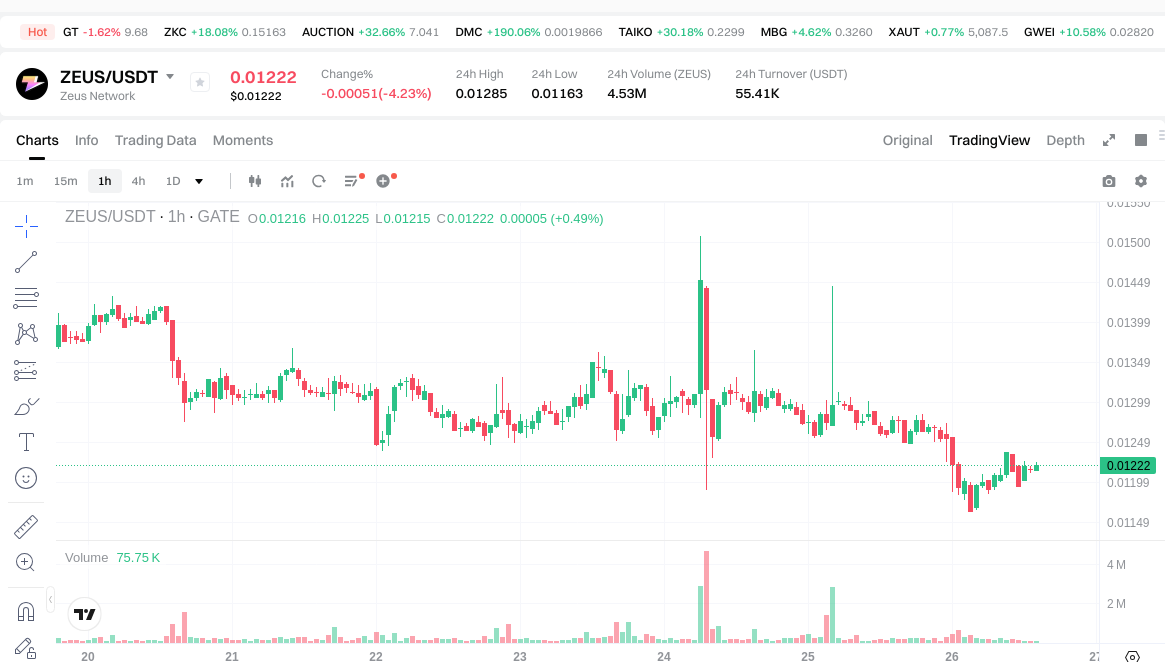
As of January 26, 2026, ZEUS's circulating supply is 833,685,701.59 tokens, with a total supply of 999,995,473.27 tokens. The maximum supply is capped at 1,000,000,000 tokens, representing a fixed supply model. The circulating supply accounts for approximately 83.37% of the total supply, indicating a relatively high circulation ratio in the market.
Price Volatility
ZEUS reached its all-time high of $1.1485 on April 8, 2024, during a period of favorable market conditions. The token's lowest price of $0.01163 was recorded on January 25, 2026, reflecting recent market challenges. Over the past year, the token has experienced a significant decline of 97.83%, demonstrating substantial price volatility. Recent short-term performance shows a 0.25% increase over 1 hour, but declines of 3.77% over 24 hours, 11.82% over 7 days, and 29.57% over 30 days. These fluctuations reflect evolving market sentiment, adoption trends, and external factors affecting the crypto asset sector.
Click to view current ZEUS market price
On-chain Metrics
- Holder Addresses: 79,882 addresses (reflecting community participation and distribution)
- 24-hour Trading Volume: $55,385.61 (indicating current market activity)
- Market Capitalization: $10,212,649.84 (representing current market valuation)
- Market Cap to FDV Ratio: 83.37% (showing the proportion of circulating supply relative to total potential supply)
Zeus Network Ecosystem Applications and Partners
Core Use Cases
Zeus Network's ecosystem supports multiple applications:
- Cross-Chain Communication: APOLLO, the first DApp on Zeus Network, provides Bitcoin liquidity bridging to Solana.
- DeFi Integration: Projects built on Zeus Network facilitate decentralized financial services across different blockchain networks.
Strategic Partnerships
Zeus Network operates on the SVM (Solana Virtual Machine) infrastructure, leveraging Solana's high-performance blockchain to enhance its technical capabilities.
These partnerships provide a solid foundation for Zeus Network's ecosystem expansion.
Challenges and Controversies
Zeus Network faces the following challenges:
- Technical Hurdles: Cross-chain communication complexity and security concerns in bridging assets between different blockchains
- Market Competition: Competition from other cross-chain solutions and bridge protocols in the rapidly evolving blockchain space
- Adoption Barriers: Building trust and user base for Bitcoin-to-Solana liquidity bridging
These issues have sparked discussions within the community and market, while also driving Zeus Network's continuous innovation.
Zeus Network's community shows active participation, with 79,882 token holders as of January 26, 2026.
On X platform, related posts and hashtags (such as #ZEUS and #ZeusNetwork) generate regular engagement.
The launch of APOLLO and Bitcoin liquidity integration has energized community enthusiasm.
Sentiment on X shows mixed perspectives:
- Supporters praise Zeus Network's cross-chain innovation and Bitcoin-Solana bridging solution, viewing it as "a bridge connecting Bitcoin liquidity to DeFi ecosystems".
- Critics focus on price volatility and early-stage development risks.
Recent trends reflect cautious optimism about the project's technical approach.
Hot Topics
X users actively discuss Zeus Network's Bitcoin integration strategy, cross-chain security, and competition with other bridge solutions,
showcasing both its transformative potential and the obstacles toward mainstream adoption.
- Official Website: Visit Zeus Network Official Site for features, use cases, and latest updates.
- Documentation: Zeus Network Documentation provides detailed information about its technical architecture, goals, and vision.
- X Updates: On X platform, Zeus Network actively engages through @ZeusNetworkHQ,
with posts covering technical upgrades, community events, and partnership announcements.
Zeus Network Future Roadmap
- Ongoing Development: Expansion of cross-chain communication capabilities to enhance transaction efficiency and security
- Ecosystem Goals: Building a comprehensive cross-chain infrastructure connecting multiple blockchain networks
- Long-term Vision: Becoming a leading cross-chain communication layer for Bitcoin and Solana ecosystems
How to Participate in Zeus Network?
- Purchase Options: Buy ZEUS on Gate.com and other supported exchanges
- Storage Solutions: Use Solana-compatible wallets to securely store ZEUS tokens
- Explore Applications: Engage with APOLLO and other DApps built on Zeus Network
- Build on the Ecosystem: Visit the developer documentation to contribute to the cross-chain infrastructure
Summary
Zeus Network is redefining cross-chain communication through blockchain technology, providing Bitcoin liquidity access to Solana's DeFi ecosystem.
Its active community, technical documentation, and market presence make it a notable project in the cryptocurrency space.
Despite facing technical complexity and market competition challenges, Zeus Network's innovative approach and clear development direction position it as an important player in cross-chain technology's future.
Whether you're a newcomer or an experienced participant, Zeus Network merits attention and engagement.
FAQ
What is ZEUS cryptocurrency? What are its core functions and features?
ZEUS is a decentralized blockchain token designed for ecosystem governance and utility. Its core features include smart contract functionality, fast transaction processing, low fees, and community-driven development. ZEUS enables users to participate in network decisions and access exclusive DeFi opportunities within its ecosystem.
How to purchase and store ZEUS tokens? What exchanges and wallets are supported?
ZEUS tokens can be purchased through major cryptocurrency exchanges and stored in compatible wallets. Use any ERC-20 compatible wallet such as MetaMask, Trust Wallet, or hardware wallets like Ledger. Transfer your tokens to your preferred wallet for secure storage and full control of your assets.
How is the security of the ZEUS project? What risks should be noted?
ZEUS maintains robust security through smart contract audits, multi-signature protocols, and decentralized governance. Key considerations include market volatility, regulatory changes, and liquidity risks. The project implements continuous security monitoring and community oversight to mitigate potential threats.
What is the difference between ZEUS and other mainstream cryptocurrencies like Bitcoin and Ethereum?
ZEUS differentiates itself through advanced smart contract capabilities, faster transaction speeds, and lower fees compared to Bitcoin and Ethereum. It offers enhanced scalability and innovative DeFi features designed for modern blockchain applications and user accessibility.
What is the price trend and market outlook for ZEUS?
ZEUS demonstrates strong upward momentum with increasing trading volume. The token shows promising fundamentals supported by growing community adoption and ecosystem development. Market sentiment remains bullish, with potential for continued appreciation as the project expands its utility and partnerships in the Web3 space.
What is the team background and technical foundation of the ZEUS project?
ZEUS is built by experienced blockchain developers with strong cryptography expertise. The team combines deep DeFi protocol knowledge with advanced security architecture, focusing on decentralized finance innovation and smart contract excellence.
* The information is not intended to be and does not constitute financial advice or any other recommendation of any sort offered or endorsed by Gate.