This comprehensive guide explores zkSync (ZK), a prominent Layer 2 scaling solution built on Ethereum's foundation using zero-knowledge proof technology. The article examines zkSync's technical architecture, market performance, and ecosystem development since its 2024 launch. Key sections cover how zkSync addresses Ethereum's scalability challenges through decentralized node networks and cryptographic security mechanisms, ensuring fast, cost-effective transactions while maintaining mathematical security guarantees. Current market metrics show 8.57 billion circulating ZK tokens, 338,638 token holders, and $309.47 million market capitalization. The guide details ecosystem applications, DeFi integrations, active community engagement on social platforms, and strategic partnerships driving adoption. Additionally, it addresses technical challenges, competitive pressures, and community sentiment. Perfect for blockchain enthusiasts and investors seeking to understand Layer 2 solutions, zkSync's innovative approach, a
zkSync's Positioning and Significance
In 2024, the zkSync team launched zkSync (ZK), aiming to address scalability limitations and high transaction costs on Ethereum.
As an ever-expanding verifiable blockchain network secured by math, zkSync plays a critical role in Layer 2 scaling solutions and blockchain verification.
As of 2026, zkSync has become a prominent Layer 2 solution in the Ethereum ecosystem, holding a market capitalization of approximately $309.47 million with 338,638 holders and an active developer community.
This article will provide an in-depth analysis of its technical architecture, market performance, and future potential.
Origin and Development History
Birth Background
zkSync was created by the zkSync team in 2024, aiming to solve Ethereum's scalability challenges, including network congestion and prohibitively high gas fees.
It emerged during the evolution of Layer 2 scaling technologies, with the goal of providing fast, secure, and cost-effective transactions while maintaining Ethereum's security guarantees to transform the blockchain user experience.
The launch of zkSync brought new possibilities for decentralized applications and users seeking efficient blockchain interactions.
Important Milestones
- June 2024: Mainnet launch with an initial price of $0.282, achieving mathematical security through zero-knowledge proof technology.
- June 2024: Token reached an all-time high of $0.367 shortly after launch.
- 2024-2025: Ecosystem expansion as zkSync continued to develop its Layer 2 infrastructure and verifiable blockchain network.
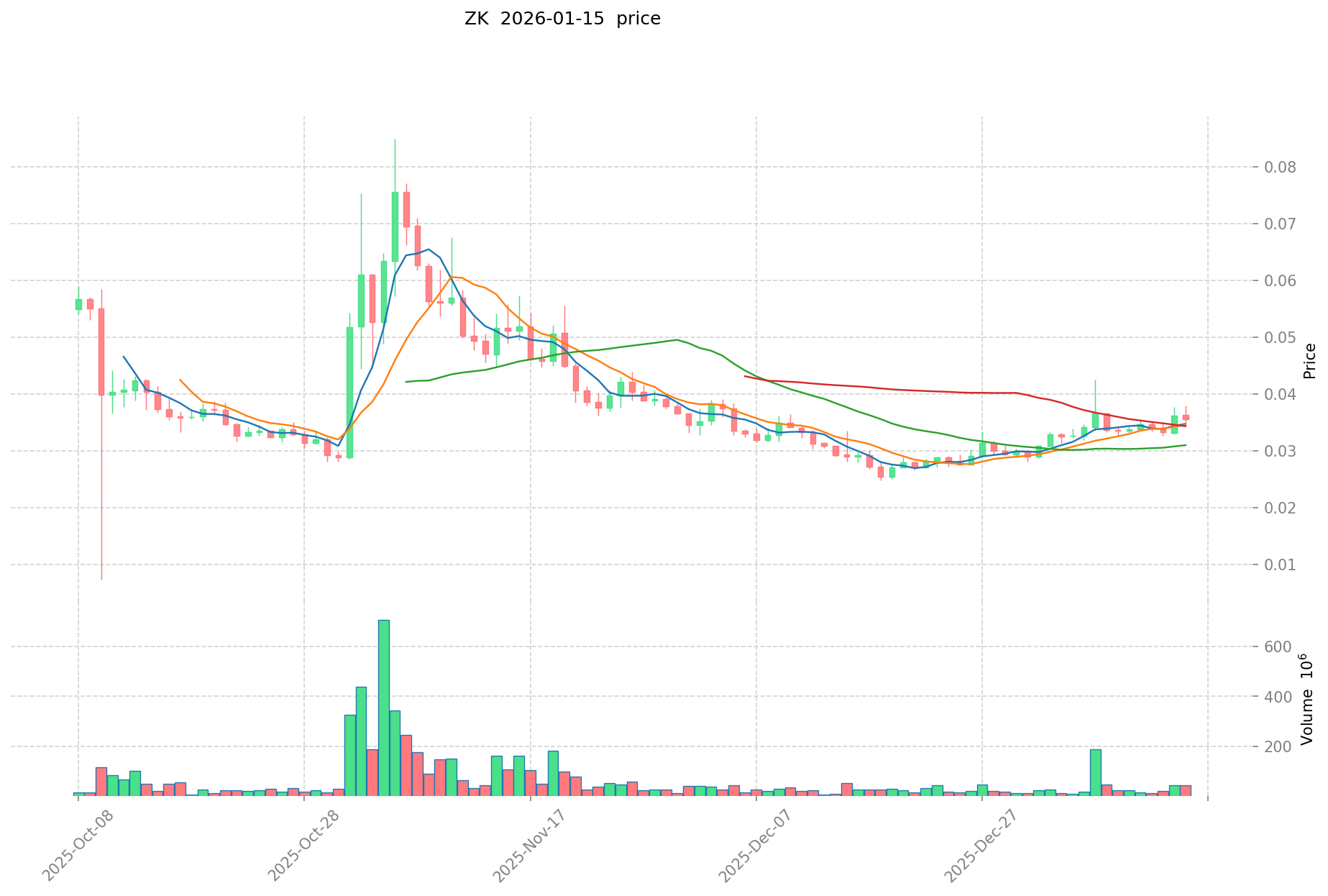
- October 2025: Token reached its historical low of $0.00736, representing a significant market correction.
- January 2026: Current trading around $0.03612 with a circulating supply of approximately 8.57 billion tokens.
With community and foundation support, zkSync continues to optimize its technology, security, and real-world applications.
How zkSync Works
No Central Control
zkSync operates on a decentralized network of nodes distributed globally, free from control by banks or governments.
These nodes collaborate to verify transactions, ensuring system transparency and attack resistance, granting users greater autonomy and enhancing network resilience.
Blockchain Core
zkSync's blockchain is a public, immutable digital ledger that records every transaction.
Transactions are grouped into blocks and linked through cryptographic hashes to form a secure chain.
Anyone can view the records, establishing trust without intermediaries.
The platform utilizes zero-knowledge rollup technology to further enhance performance by processing transactions off-chain while maintaining Ethereum-level security.
Ensuring Fairness
zkSync employs zero-knowledge proof technology to verify transactions and prevent fraud such as double-spending.
Validators maintain network security through transaction verification and proof generation, ensuring mathematical correctness.
Its innovation includes significantly reduced transaction costs and increased throughput while maintaining Ethereum's security guarantees.
Secure Transactions
zkSync uses cryptographic technology to protect transactions:
- Private keys (similar to secret passwords) are used to sign transactions
- Public keys (similar to account numbers) are used to verify ownership
This mechanism ensures fund security while transactions maintain pseudonymous privacy.
The platform incorporates zero-knowledge proof technology to provide additional security and privacy features without revealing transaction details.
Circulating Supply Overview
As of January 15, 2026, zkSync has a circulating supply of 8.57 billion ZK tokens, with a total supply of 21 billion ZK. The token operates under a fixed supply model with a maximum cap of 21 billion tokens.
The current circulating supply represents approximately 40.80% of the total supply, indicating a controlled release strategy. This phased distribution approach may influence the token's supply-demand dynamics over time.
Price Fluctuations
zkSync (ZK) reached a notable price level of $0.367 on June 17, 2024, driven by initial market enthusiasm following its token launch. The price movement reflected heightened interest in Layer 2 scaling solutions and zero-knowledge technology within the blockchain ecosystem.
The token experienced its lower price point of $0.00736 on October 10, 2025, influenced by broader market conditions and sector-wide adjustments in the cryptocurrency space.
These price variations demonstrate the token's sensitivity to market sentiment, technological developments, and external market factors affecting the Layer 2 ecosystem.
Check current ZK market price
On-Chain Metrics
- Holder Addresses: 338,638 addresses currently hold ZK tokens, reflecting community distribution and user participation in the zkSync ecosystem
- 24-Hour Trading Volume: $1.64 million, indicating active market engagement and liquidity
- Market Capitalization: $309.47 million with a fully diluted valuation of $758.52 million, representing the market's current assessment of the project's value
zkSync (ZK) Ecosystem Applications and Partners
Core Use Cases
zkSync's ecosystem supports multiple applications:
- Layer 2 Scaling: zkSync provides zero-knowledge rollup technology, offering high-throughput transactions with reduced costs on Ethereum.
- DeFi Integration: Various decentralized finance protocols leverage zkSync's infrastructure, enabling faster and cheaper trading experiences.
Strategic Partnerships
zkSync continues to expand its technical capabilities and market presence through ecosystem collaborations.
These partnerships provide a solid foundation for zkSync's ecosystem expansion.
Challenges and Controversies
zkSync faces the following challenges:
- Technical Difficulties: Scaling solutions require continuous optimization to maintain network efficiency
- Competitive Pressure: Other layer 2 solutions and blockchain platforms present ongoing competition
These issues have sparked discussions within the community and market, while also driving zkSync's continuous innovation.
zkSync's community demonstrates strong vitality, with 338,638 token holders as of January 15, 2026.
On X platform, related posts and hashtags (such as #zkSync) frequently trend, reflecting active community engagement.
Technological developments and ecosystem growth continue to fuel community enthusiasm.
Sentiment on X shows diverse perspectives:
- Supporters praise zkSync's scalability solutions and Ethereum compatibility, viewing it as a key infrastructure for Web3 applications.
- Critics focus on market volatility and adoption challenges.
Recent trends indicate mixed sentiment following the token's price movements.
Popular Topics
X users actively discuss zkSync's technological innovations, ecosystem development, and market performance,
showcasing both its transformative potential and the challenges on its path to mainstream adoption.
- Official Website: Visit zkSync Official Website for features, use cases, and latest updates.
- Documentation: zkSync Documentation provides detailed information about its technical architecture, objectives, and vision.
- X Updates: On X platform, zkSync maintains an active presence using @zksync, with posts covering technical upgrades, community events, and ecosystem news, generating significant engagement.
zkSync (ZK) Future Roadmap
- Ongoing Development: Continuous enhancement of zero-knowledge proof technology, improving transaction throughput and security
- Ecosystem Goals: Expanding the network of decentralized applications and developer tools
- Long-term Vision: Establishing itself as a leading layer 2 scaling solution for Ethereum
How to Participate in zkSync (ZK)?
- Purchase Options: Buy ZK on Gate.com and other cryptocurrency exchanges
- Storage Solutions: Securely store ZK using compatible Web3 wallets
- Participate in Governance: Engage with community discussions through official channels
- Build on the Ecosystem: Visit the developer documentation to develop DApps or contribute to the codebase
Summary
zkSync (ZK) leverages blockchain technology to provide layer 2 scaling solutions, offering enhanced transaction speed, reduced costs, and Ethereum compatibility.
Its active community, comprehensive resources, and market presence establish its position in the cryptocurrency space.
Despite facing regulatory uncertainties and competitive pressures, zkSync's innovative approach and development trajectory position it as a notable player in decentralized technology.
Whether you are a newcomer or experienced participant, zkSync presents opportunities worth exploring.
FAQ
What is Zero Knowledge Proof (ZK)? What is its role in cryptocurrency?
Zero Knowledge Proof is a cryptographic technique enabling one party to prove information validity without revealing underlying details. In cryptocurrency, it enhances transaction privacy and security while maintaining blockchain verification capabilities.
How does zero knowledge proof protect privacy? What is the difference from traditional encryption technology?
Zero knowledge proof protects privacy by allowing verification of information authenticity without revealing any details. Unlike traditional encryption involving plaintext, ZKP proves claims without exposing underlying data, providing superior privacy protection in blockchain transactions.
Which cryptocurrency projects use zero-knowledge proof technology?
Major projects using zero-knowledge proof technology include Mina, Polygon, and zkSync. These projects enhance privacy and scalability while maintaining security through advanced cryptographic techniques.
How is the security of zero-knowledge proofs? What risks or limitations exist?
ZK proofs offer high cryptographic security with strong mathematical foundations. Main limitations include high computational complexity, longer proof generation times, and potential implementation vulnerabilities. Scalability remains a challenge for large-scale applications.
What are the advantages of zero-knowledge proofs compared to other privacy protection schemes (such as mixers)?
Zero-knowledge proofs offer superior privacy without relying on real-time user cooperation or centralized intermediaries. They provide stronger anonymity guarantees, don't leak any unintended information, and eliminate counterparty risk inherent in traditional mixers.
What are the practical application scenarios of zero-knowledge proofs in Web3 and DeFi?
Zero-knowledge proofs protect transaction privacy and enable decentralized identity verification in Web3 and DeFi. They allow users to verify identity or transactions without revealing details, enhancing system security and user privacy protection.
* The information is not intended to be and does not constitute financial advice or any other recommendation of any sort offered or endorsed by Gate.











