Boundless (ZKC) is a universal zero-knowledge proof protocol launched in 2025 to address blockchain scalability limitations through its innovative Proof of Verifiable Work (PoVW) mechanism. This comprehensive guide explores Boundless's decentralized architecture, where global prover nodes generate verifiable proofs for Layer 1 blockchains, rollups, and cross-chain bridges. The native ZKC token operates as an ERC-20 asset on Ethereum, incentivizing prover participation while enabling internet-scale blockchain expansion. With 21,382 token holders and active community engagement, Boundless transforms computational scarcity into abundance. The article covers technical implementation, current market metrics, ecosystem applications, and practical guidance for purchasing ZKC through Gate and participating in the growing network.
Boundless's Positioning and Significance
In 2025, the Boundless team launched Boundless (ZKC), aiming to address the scalability limitations of blockchain infrastructure and the scarcity of computational resources.
As a universal ZK protocol with a novel Proof of Verifiable Work (PoVW) incentive mechanism, Boundless plays a key role in zero-knowledge proof generation, Layer 1 scaling, and cross-ecosystem interoperability.
As of 2026, Boundless has established itself as an emerging player in the ZK infrastructure space, with 21,382 holders and an active developer community.
This article will provide an in-depth analysis of its technical architecture, market performance, and future potential.
Origin and Development History
Background
Boundless was created by its development team in 2025, aiming to solve the computational bottlenecks that limit blockchain scalability to internet-level throughput.
It emerged during the rapid evolution of zero-knowledge proof technology and the growing demand for scalable blockchain solutions, with the goal of transforming computational resources from scarce to abundant through decentralized proof generation.
The launch of Boundless brought new possibilities to blockchain ecosystems, rollups, and cross-chain bridges.
Key Milestones
- 2025: Mainnet launch on Ethereum, introducing the Proof of Verifiable Work (PoVW) mechanism to incentivize prover nodes.
- 2025: Token deployment on Ethereum (ERC-20 standard at address 0x000006c2a22ff4a44ff1f5d0f2ed65f781f55555).
- 2025: Ecosystem expansion with integration support for multiple Layer 1 blockchains, rollups, and decentralized applications.
- 2026: Continued network growth with increasing prover participation and capacity expansion.
With the support of its community and development team, Boundless continues to optimize its technology, security, and real-world applications.
How Boundless Works?
Decentralized Architecture
Boundless operates on a decentralized network of prover nodes distributed globally, eliminating reliance on centralized computational providers.
These nodes collaborate to generate zero-knowledge proofs for various blockchain ecosystems, ensuring transparency and resilience while giving users and developers greater autonomy over scalable infrastructure.
Blockchain Foundation
Boundless leverages Ethereum as its deployment layer, with its native token ZKC operating as an ERC-20 asset.
The protocol offloads computational execution to its prover network and verifies proofs on-chain, creating a verifiable and scalable infrastructure layer.
Anyone can participate in the network by running prover nodes or utilizing the generated proofs for their applications.
This architecture transforms blockchain computational capacity from limited to potentially unlimited.
Ensuring Fairness Through PoVW
Boundless introduces Proof of Verifiable Work (PoVW), a novel consensus mechanism that validates proof generation activities and prevents malicious behavior.
Prover nodes maintain network security by generating zero-knowledge proofs for various blockchain applications and receive ZKC token rewards for their contributions.
The innovation lies in creating an incentive-aligned ecosystem where computational capacity can scale horizontally as more provers join the network.
Secure Token Management
Boundless uses standard cryptographic techniques to protect ZKC token transactions:
- Private keys (similar to secret passwords) are used to sign transactions
- Public keys (similar to account numbers) are used to verify ownership
This mechanism ensures fund security while transactions maintain pseudonymity on the Ethereum blockchain.
The protocol benefits from Ethereum's established security infrastructure while focusing on scalable proof generation.
Circulation Overview
As of January 23, 2026, Boundless has a circulating supply of 200,937,056 ZKC tokens, with a total supply of 1,000,000,000 tokens. The maximum supply is unlimited, indicating an inflationary token model.
New tokens enter the market through the network's novel incentive mechanism, Proof of Verifiable Work (PoVW), which rewards prover nodes with the native token $ZKC for generating proofs that power L1s, rollups, bridges, and applications across various ecosystems. The current circulating supply represents approximately 20.09% of the total supply, influencing the supply-demand dynamics of the token.
Price Fluctuations
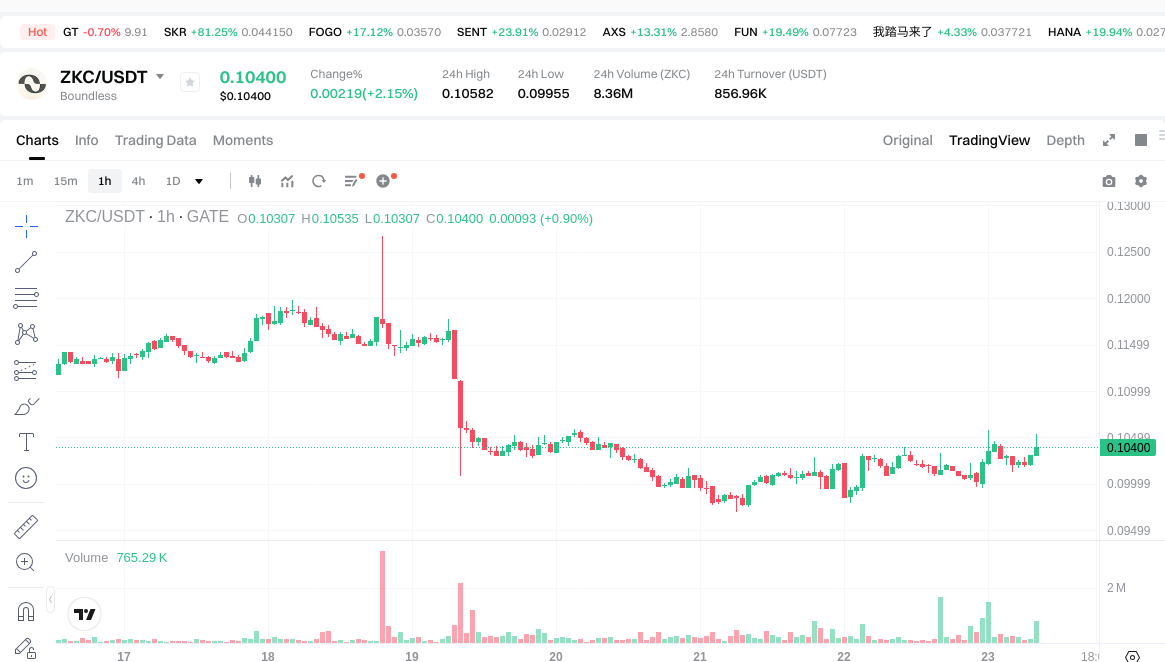
Boundless reached a notable price point of $1.65 on September 15, 2025, driven by market interest and the project's positioning as a universal ZK protocol for internet-scale blockchain expansion.
The lowest recorded price was $0.094, occurring on December 18, 2025, reflecting broader market corrections and volatility in the cryptocurrency sector.
As of the latest update, ZKC is trading at $0.10417, showing a 2.89% increase over the past 24 hours, with a 24-hour high of $0.10582 and a low of $0.09955. Over the past week, the token has experienced a -7.84% decline, while demonstrating a 2.13% gain over the 30-day period. These fluctuations reflect evolving market sentiment, adoption trends, and external factors affecting the broader blockchain infrastructure sector.
Click to view the current ZKC market price
On-Chain Metrics
- Market Capitalization: $20,931,613 (as of January 23, 2026)
- 24-Hour Trading Volume: $843,988.36 (indicating active market participation)
- Holder Count: 21,382 addresses (reflecting user engagement and community growth)
- Fully Diluted Valuation: $104,170,000
- Market Dominance: 0.0032% of the total cryptocurrency market
These metrics demonstrate network activity and the growing adoption of Boundless as infrastructure for verifiable, scalable blockchain solutions.
Boundless Ecosystem Applications and Partners
Core Use Cases
Boundless's ecosystem supports multiple applications:
- Zero-Knowledge Proof Infrastructure: Boundless provides verifiable computation services for L1 blockchains, rollups, and cross-chain bridges through its Proof of Verifiable Work (PoVW) mechanism.
- Scalability Solutions: The protocol offers internet-scale expansion capabilities by offloading execution to the Boundless network and verifying proofs on-chain.
Strategic Partnerships
Boundless collaborates with various blockchain ecosystems to enhance its technical capabilities and market presence.
These partnerships provide a solid foundation for Boundless's ecosystem expansion.
Challenges and Considerations
Boundless faces the following challenges:
- Technical Complexity: Implementing universal ZK protocols across different blockchain ecosystems requires sophisticated coordination.
- Competition Pressure: The emergence of alternative zero-knowledge proof solutions in the blockchain space.
- Market Adoption: Convincing projects to integrate ZK proof generation services requires demonstrating clear value propositions.
These issues have sparked discussions within the community and market, while also driving continuous innovation at Boundless.
Boundless's community demonstrates notable activity, with the token holder count reaching 21,382 addresses.
On X platform, related posts and hashtags (such as #Boundless) generate consistent engagement.
The launch of the PoVW mechanism and the introduction of the native token $ZKC have energized community participation.
Sentiment on X shows diverse perspectives:
- Supporters praise Boundless's innovative approach to blockchain scalability and its universal ZK protocol architecture, viewing it as infrastructure for verifiable computation.
- Observers monitor the project's technological implementation and its ability to attract prover nodes to the network.
Recent trends indicate interest in the protocol's scalability solutions and proof generation capabilities.
Trending Topics
X users actively discuss Boundless's Proof of Verifiable Work mechanism, its potential to transform blockchain computational limitations, and the protocol's approach to making blockchains internet-scale.
- Official Website: Visit Boundless Official Website for features, use cases, and latest developments.
- Whitepaper: Boundless Whitepaper details its technical architecture, objectives, and vision.
- X Platform: Boundless maintains an active presence on X using @boundless_xyz, sharing updates about technical developments, community activities, and ecosystem news.
Boundless Future Roadmap
- Ecosystem Goals: Expand the prover network to increase proof generation capacity and support more blockchain ecosystems.
- Long-term Vision: Establish Boundless as the universal ZK protocol infrastructure that enables blockchains to scale without computational limits.
How to Participate in Boundless?
- Purchase Options: Acquire ZKC through Gate.com and other supporting exchanges.
- Storage Solutions: Store ZKC securely using ERC-20 compatible wallets, as the token is deployed on the Ethereum network (contract address: 0x000006c2a22ff4a44ff1f5d0f2ed65f781f55555).
- Network Participation: Join the Boundless community through Discord to stay informed about prover node opportunities and network developments.
- Ecosystem Building: Explore integration opportunities by visiting the official documentation to understand how to leverage Boundless's ZK proof generation services.
Summary
Boundless is redefining blockchain scalability through its universal ZK protocol, offering verifiable computation infrastructure that transforms computational scarcity into abundance.
Its innovative Proof of Verifiable Work mechanism, growing community of 21,382+ token holders, and clear technical vision position it uniquely in the cryptocurrency space.
While facing challenges in technical implementation and market adoption, Boundless's commitment to making blockchains internet-scale through verifiable infrastructure makes it a noteworthy project in the decentralized technology landscape.
Whether you are a newcomer or an experienced participant, Boundless presents opportunities worth exploring and engaging with.
FAQ
What is ZKC? What is its full name and basic definition?
ZKC stands for Zero Knowledge Coin, a cryptocurrency token designed to leverage zero-knowledge proof technology for enhanced privacy and security in blockchain transactions. It enables users to verify transactions without revealing sensitive information, combining cryptographic innovation with decentralized finance functionality.
What technology does ZKC use? What is the role of Zero-Knowledge Proof (ZKP) in it?
ZKC leverages zero-knowledge proof technology to enable privacy-preserving transactions and smart contracts. ZKP allows users to verify transactions without revealing sensitive data, ensuring transaction privacy while maintaining blockchain security and auditability.
How to buy and store ZKC tokens?
Purchase ZKC through major cryptocurrency platforms using fiat or crypto. Transfer tokens to a secure wallet supporting ERC-20 standards. For long-term holding, use hardware wallets. Always enable two-factor authentication and backup your private keys safely.
What are the main application scenarios and use cases of ZKC?
ZKC primarily serves privacy-enhanced transactions, smart contract verification, and decentralized identity solutions. It enables zero-knowledge proofs for secure data verification without exposing sensitive information, making it ideal for confidential DeFi protocols and cross-chain interoperability applications.
What are the risks of investing in ZKC? What issues should I pay attention to?
ZKC investment risks include market volatility, liquidity fluctuations, and technology development uncertainties. Monitor your portfolio regularly, invest only disposable capital, diversify holdings, and stay updated on project developments and market conditions.
What is the difference between ZKC and other privacy coins like Monero and Zcash?
ZKC utilizes advanced zero-knowledge proof technology for enhanced privacy and scalability. Unlike Monero's ring signatures or Zcash's selective privacy, ZKC offers mandatory privacy with superior transaction throughput and lower fees, providing stronger anonymity by default while maintaining better performance efficiency.
* The information is not intended to be and does not constitute financial advice or any other recommendation of any sort offered or endorsed by Gate.