Polyhedra Network (ZKJ) is a zero-knowledge proof infrastructure provider revolutionizing blockchain interoperability through its flagship zkBridge protocol. This comprehensive guide explores how ZKJ enables secure, trustless cross-chain transactions across 25+ Layer-1 and Layer-2 blockchains, facilitating over 20 million cross-chain transactions. Discover ZKJ's technical architecture built on advanced cryptographic protocols, current market performance with 432.6M circulating tokens and $15.53M market cap, and its strategic ecosystem applications. Learn how to participate via Gate.com, understand the community sentiment, and explore the project's ambitious roadmap for becoming Web3's underlying interoperability infrastructure despite facing technical complexity and market competition challenges.
Polyhedra Network's Positioning and Significance
In 2024, the Polyhedra Network team launched Polyhedra Network (ZKJ), aiming to address the challenges of blockchain interoperability and scalability in the Web3 ecosystem.
As a leading zero-knowledge proof infrastructure provider, Polyhedra Network plays a crucial role in cross-chain communication and Web3 infrastructure.
As of 2026, Polyhedra Network has become a key player in the blockchain interoperability space, with over 20 million cross-chain transactions facilitated across more than 25 Layer-1 and Layer-2 blockchains and an active developer community.
This article will provide an in-depth analysis of its technical architecture, market performance, and future potential.
Origin and Development History
Birth Background
Polyhedra Network was created by its development team in 2024, aiming to solve the inefficiencies and security vulnerabilities in blockchain interoperability.
It emerged during the rapid expansion of multi-chain ecosystems, with the goal of providing the fastest zero-knowledge proofs to enable secure and trustless cross-chain transactions.
Polyhedra Network's launch brought new possibilities to Web3 developers and blockchain networks seeking seamless interoperability.
Important Milestones
- 2024: Token launched on Gate.com at a publish price of $1, introducing the zkBridge protocol for cross-chain interoperability.
- 2024-2026: Ecosystem expansion with zkBridge facilitating over 20 million cross-chain transactions across more than 25 Layer-1 and Layer-2 blockchains.
- 2026: The project continues to enhance its zero-knowledge proof technology and expand its infrastructure services.
With support from its development team and growing ecosystem partnerships, Polyhedra Network continues to optimize its technology, security, and real-world applications.
How Does Polyhedra Network Operate?
Decentralized Infrastructure
Polyhedra Network operates as a decentralized infrastructure layer serving the Web3 ecosystem, without central control by any single entity.
The network enables trustless cross-chain communication through its zkBridge protocol, ensuring transparency and resistance to manipulation while empowering users with greater control over their cross-chain operations.
Blockchain Foundation
Polyhedra Network's technology is built on zero-knowledge proof protocols that enable secure and efficient cross-chain transactions.
The zkBridge protocol creates cryptographically verified connections between different blockchains, allowing assets and data to move across chains without requiring trust in third parties.
Anyone can utilize the infrastructure, establishing trust through mathematical proofs rather than intermediaries.
The network's cutting-edge ZK protocols enhance performance and security for cross-chain operations.
Network Security
Polyhedra Network employs zero-knowledge proof technology to validate cross-chain transactions, preventing fraudulent activities and ensuring data integrity.
Network participants maintain security through running infrastructure nodes and validating ZK proofs, contributing to the ecosystem's reliability.
Its innovation includes delivering some of the fastest zero-knowledge proofs in the industry, enabling efficient cross-chain operations at scale.
Secure Transactions
Polyhedra Network uses advanced cryptographic techniques to protect cross-chain transactions:
- Private keys (similar to secret passwords) are used to authorize transactions
- Public verification (through zero-knowledge proofs) confirms transaction validity without exposing sensitive data
This mechanism ensures fund security while maintaining cryptographic privacy for cross-chain operations.
The zkBridge protocol adds additional security layers through trustless verification of cross-chain messages.
Circulation Overview
As of 24 January 2026, Polyhedra Network (ZKJ) has a circulating supply of 432,611,110 tokens, with a total supply of 1,000,000,000 tokens, representing a circulating ratio of approximately 43.26%. The maximum supply is capped at 1,000,000,000 tokens, indicating a fixed supply model.
Price Fluctuation
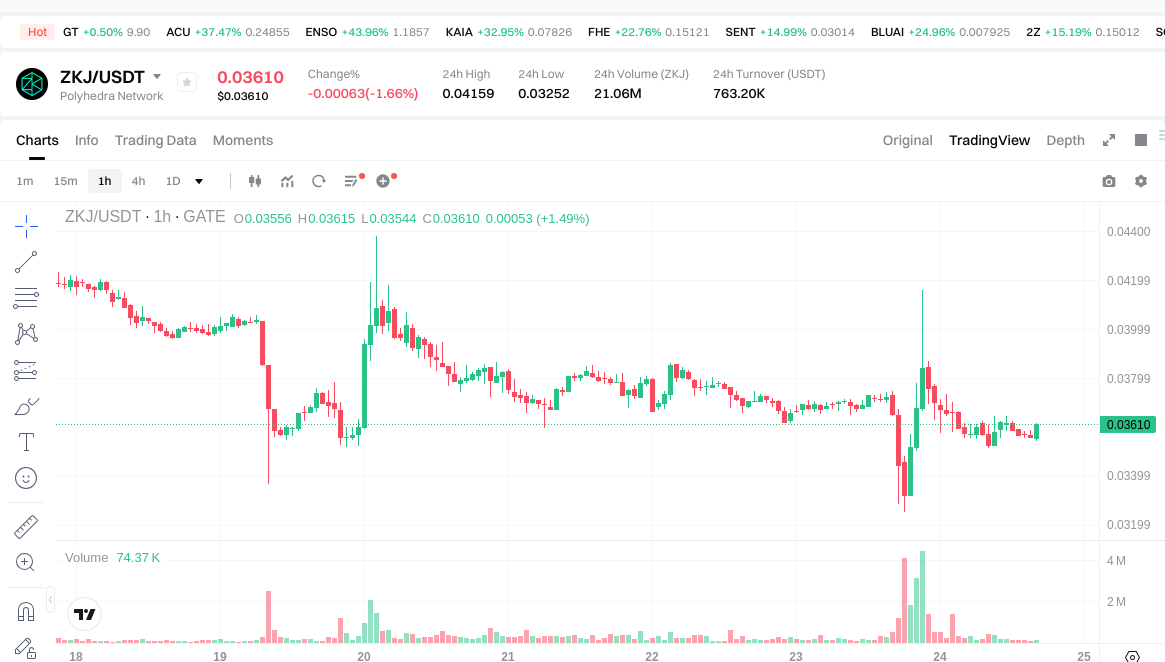
Polyhedra Network (ZKJ) reached a notable price level of $100 on 19 March 2024, during a period of significant market activity in the Web3 and zero-knowledge proof infrastructure sector. The token experienced its lowest price of $0.02323 on 10 October 2025, reflecting broader market corrections and shifts in investor sentiment during that period. These price movements illustrate the dynamic nature of the cryptocurrency market and the impact of various factors on token valuation.
Click to view the current ZKJ market price
On-Chain Metrics
- Holder Count: Approximately 44,238 addresses hold ZKJ tokens, indicating a distributed holder base and community engagement with the Polyhedra Network ecosystem
- 24-Hour Trading Volume: The token recorded a trading volume of approximately $770,079 over the past 24 hours, reflecting ongoing market activity
- Market Capitalization: The current market capitalization stands at approximately $15.53 million, with a fully diluted valuation of $35.89 million
Polyhedra Network (ZKJ) Ecosystem Applications and Partners
Core Use Cases
Polyhedra Network's ecosystem supports multiple applications:
- Cross-chain Interoperability: zkBridge, the flagship invention, provides secure and fast cross-chain transactions.
- Web3 Infrastructure: Over 25 Layer-1 and Layer-2 blockchains, enabling scalability and interoperability across the Web3 ecosystem.
Strategic Partnerships
Polyhedra Network has facilitated over 20 million cross-chain transactions across a network of more than 25 Layer-1 and Layer-2 blockchains, demonstrating its commitment to ecosystem expansion.
These partnerships provide a solid foundation for ZKJ's ecological growth.
Challenges and Controversies
Polyhedra Network faces the following challenges:
- Technical Complexity: Implementing cutting-edge Zero-Knowledge protocols requires continuous innovation and optimization
- Market Competition: The blockchain interoperability space includes various competing solutions
- Regulatory Uncertainty: The evolving regulatory landscape for Web3 infrastructure presents ongoing considerations
These issues have sparked discussions within the community and market, while also driving ZKJ's continuous innovation.
Polyhedra Network's community demonstrates notable activity, with 44,238 holders as of January 2026.
zkBridge has facilitated over 20 million cross-chain transactions, reflecting significant ecosystem participation.
Cross-chain transaction milestones and protocol innovations have energized community enthusiasm.
Sentiment on X displays varied perspectives:
- Supporters praise ZKJ's advanced Zero-Knowledge technology and cross-chain capabilities, recognizing it as "foundational infrastructure for Web3 interoperability".
- Observers focus on price fluctuations and market performance dynamics.
Recent trends indicate mixed sentiment influenced by broader market conditions.
Trending Topics
X users actively discuss Polyhedra Network's Zero-Knowledge proof technology, zkBridge functionality, and cross-chain interoperability solutions,
showcasing both its transformative potential and the considerations for mainstream adoption.
- Official Website: Visit Polyhedra Network Official Website for features, use cases, and latest updates.
- White Paper: Polyhedra Network Academic Paper details its technical architecture, objectives, and vision.
- X Updates: On X platform, Polyhedra Network actively engages using @PolyhedraZK,
with posts covering protocol developments, cross-chain milestones, and ecosystem updates, generating substantial community interaction.
Polyhedra Network (ZKJ) Future Roadmap
- Ongoing Development: Enhancement of Zero-Knowledge proof protocols, improving cross-chain transaction speed and security
- Ecosystem Goals: Expansion across additional Layer-1 and Layer-2 blockchain networks
- Long-term Vision: Becoming the underlying infrastructure for Web3 ecosystem interoperability
How to Participate in Polyhedra Network (ZKJ)?
- Purchase Channels: Acquire ZKJ on Gate.com and other supporting exchanges
- Storage Solutions: Securely store using compatible wallets supporting ERC20 tokens
- Ecosystem Engagement: Explore zkBridge functionality for cross-chain transactions
- Development Contribution: Visit developer resources to build applications leveraging Polyhedra Network's infrastructure
Summary
Polyhedra Network (ZKJ) is redefining blockchain interoperability through Zero-Knowledge technology, providing security, speed, and trustless cross-chain transactions.
Its active community, comprehensive resources, and demonstrated ecosystem performance distinguish it in the cryptocurrency space.
Despite facing technical complexity and market competition, Polyhedra Network's innovative approach and clear development trajectory position it as a significant player in the future of decentralized technology.
Whether you are a newcomer or an experienced participant, Polyhedra Network merits attention and engagement.
FAQ
What is ZKJ cryptocurrency and how does it work?
ZKJ is a blockchain token designed for decentralized applications and smart contracts. It operates on a proof-of-stake consensus mechanism, enabling fast transactions and low fees. ZKJ holders can stake tokens to earn rewards and participate in network governance.
What are the main use cases and features of ZKJ token?
ZKJ token enables privacy-focused transactions, smart contract functionality, and decentralized governance. Key features include zero-knowledge proofs for enhanced security, low transaction fees, fast settlement, and ecosystem participation rewards. It supports DeFi applications and cross-chain interoperability for broader blockchain integration.
How can I buy and store ZKJ crypto?
You can purchase ZKJ through major cryptocurrency platforms using fiat or other cryptocurrencies. For storage, use hardware wallets like Ledger or Trezor for maximum security, or reputable custodial wallets for convenience. Always enable two-factor authentication and backup your private keys securely.
What is the total supply and tokenomics of ZKJ?
ZKJ has a maximum total supply of 1 billion tokens. The tokenomics include allocation for ecosystem development, community rewards, and team reserves with a gradual release schedule over multiple years to ensure sustainable growth and market stability.
Is ZKJ safe to invest in and what are the associated risks?
ZKJ operates on advanced blockchain technology with strong security protocols. Like all cryptocurrencies, it carries market volatility and regulatory risks. Investors should conduct thorough research and only invest what they can afford to lose.
Which exchanges list ZKJ and how do I trade it?
ZKJ is available on major cryptocurrency exchanges. You can trade ZKJ by creating an account, completing verification, depositing funds, and placing buy or sell orders on the trading platform. Check the official ZKJ website for current exchange listings and real-time trading volume data.
What is the project roadmap and future development plan for ZKJ?
ZKJ is committed to expanding zero-knowledge proof technology adoption. The roadmap includes enhanced privacy features, cross-chain interoperability, and ecosystem partnerships. Future development focuses on scaling solutions and institutional adoption throughout 2026-2027.
* The information is not intended to be and does not constitute financial advice or any other recommendation of any sort offered or endorsed by Gate.