This comprehensive guide explores zkPass, a privacy-preserving data verification protocol that bridges Web2 and Web3 environments using advanced zero-knowledge proof technology. The article examines zkPass's technical architecture, including three-party TLS, multi-party computation, and interactive zero-knowledge proofs that enable secure data verification without exposing sensitive information. It covers the project's evolution from 2024 launch to its current status with 27,988 holders and listing on Gate, analyzes market performance with detailed on-chain metrics, and showcases ecosystem applications in decentralized identity verification and privacy-protected data sharing. The guide addresses implementation challenges, community sentiment on social platforms, and provides practical participation methods through Gate exchange and official channels. Whether assessing investment potential or understanding cryptographic innovation, this resource delivers insights into zkPass's role in modern privacy-focused bl
zkPass's Position and Significance
In 2024, the zkPass team launched zkPass (ZKP), aiming to address data privacy leakage and the difficulty of verifying Web 2.0 data in Web 3.0 environments.
As a privacy-preserving data verification protocol bridging Web 2.0 and Web 3.0, zkPass plays a key role in decentralized identity verification and privacy-protected data sharing.
As of 2026, zkPass has become an emerging cryptographic infrastructure asset, with 27,988 holders and an active developer community.
This article will provide an in-depth analysis of its technical architecture, market performance, and future potential.
Origin and Development History
Birth Background
zkPass was created by the zkPass team in 2024, aiming to solve the challenge of proving ownership of data accessed via HTTPS without exposing sensitive information.
It was born during the era of increasing demand for privacy protection in blockchain applications, with the goal of enabling users to verifiably prove statements about their private data from centralized web servers in a zero-knowledge manner.
The launch of zkPass brought new possibilities to decentralized identity verification and privacy-protected credential systems.
Key Milestones
- January 2026: Listed on Gate.com, expanding market accessibility and liquidity.
- 2024-2026: Protocol development and ecosystem growth, with the holder count reaching 27,988.
With the support of the zkPass development team and community, zkPass continues to optimize its technology, security, and real-world applications.
How Does zkPass Work?
No Central Control
zkPass operates on a decentralized network of nodes distributed globally, eliminating control by banks or governments.
These nodes collaborate to verify transactions, ensuring the system is transparent and attack-resistant, granting users greater autonomy and enhancing network resilience.
Blockchain Core
zkPass's blockchain is a public, immutable digital ledger that records every transaction.
Transactions are grouped into blocks and linked through cryptographic hashes to form a secure chain.
Anyone can view the records, establishing trust without intermediaries.
Ensuring Fairness
zkPass employs cryptographic protocols including three-party Transport Layer Security (TLS), Multi-Party Computation (MPC), and Interactive Zero-Knowledge Proof (IZK) to verify data authenticity and maintain privacy.
Validators and network participants maintain network security through operating nodes and processing verification requests, earning ZKP rewards.
Its innovation includes enabling privacy-preserving verification of HTTPS-accessed data without revealing sensitive information.
Secure Transactions
zkPass uses public-private key cryptography to protect transactions:
- Private keys (similar to secret passwords) are used to sign transactions
- Public keys (similar to account numbers) are used to verify ownership
This mechanism ensures fund security while transactions maintain privacy protection through zero-knowledge proofs.
The protocol incorporates advanced cryptographic techniques including MPC and IZK to prevent sensitive data exposure.
Circulation Overview
As of 22 January 2026, zkPass's circulating supply is 201,666,667 tokens, with a total supply of 1,000,000,000. The maximum supply is capped at 1,000,000,000 tokens, representing a fixed supply model.
The current circulating supply accounts for approximately 20.17% of the total supply, with new tokens entering the market according to the project's token distribution schedule.
Price Fluctuations
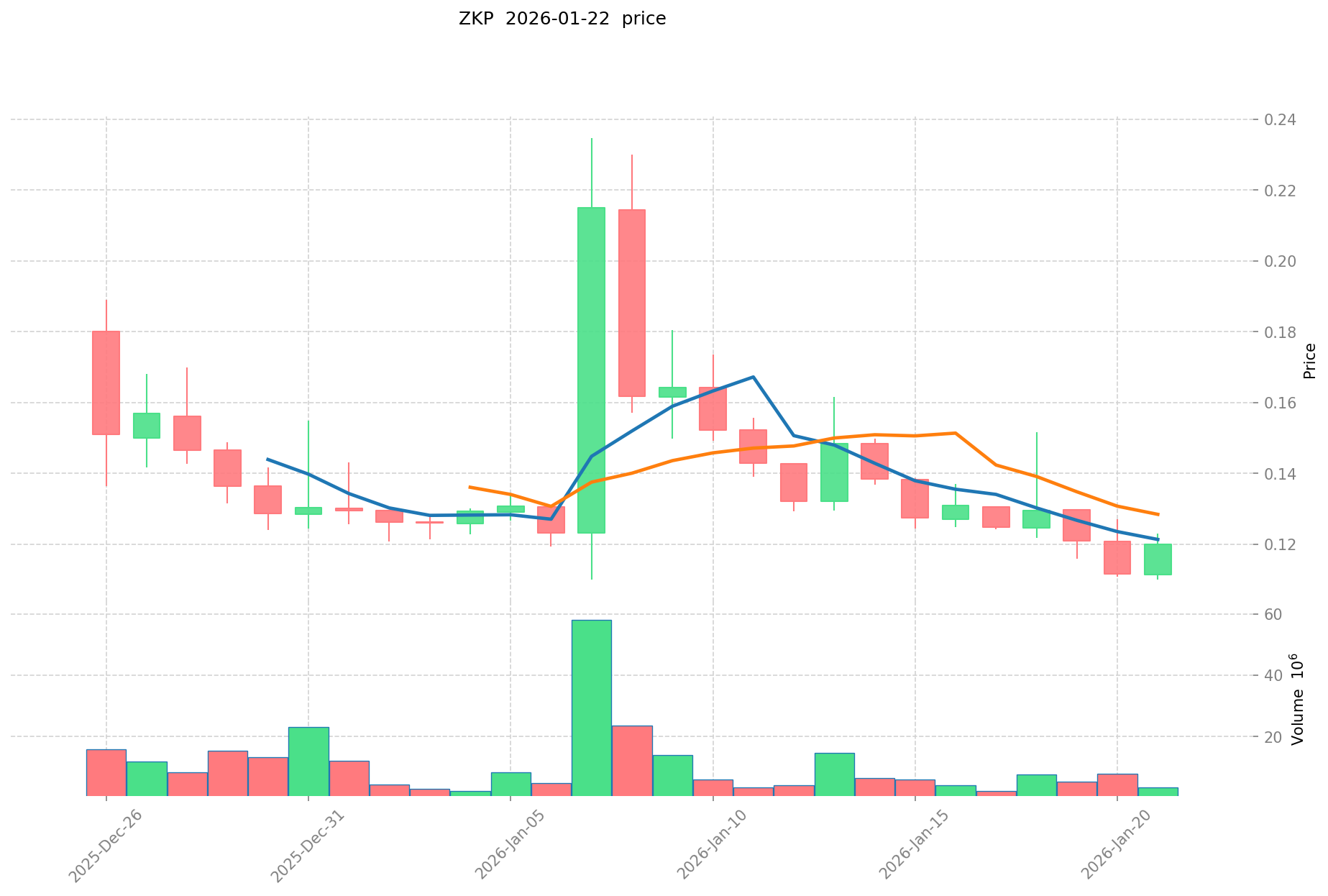
zkPass reached a price level of $0.2346 on 7 January 2026, reflecting certain market conditions during that period. The token's lowest recorded price was $0.11, also occurring on 7 January 2026, demonstrating notable volatility during its early trading phase.
These price movements reflect various factors including market sentiment, adoption trends, and broader cryptocurrency market dynamics. As of the latest data, zkPass is trading at $0.1158, showing a 24-hour change of 0.95%, a 7-day decline of -13.38%, and a 30-day decrease of -19.75%.
Click to view the current ZKP market price
On-Chain Metrics
- Market Capitalization: $23,353,000.04 (representing approximately 0.0036% market dominance)
- 24-Hour Trading Volume: $315,155.40 (indicating current market activity levels)
- Holder Count: 27,988 addresses (reflecting user participation)
- Fully Diluted Market Cap: $115,800,000.00 (representing potential valuation at maximum supply)
zkPass Ecosystem Applications and Partners
Core Use Cases
zkPass's ecosystem supports multiple applications:
- Privacy-Preserving Data Verification: zkPass Protocol enables users to prove data authenticity from HTTPS sources without revealing sensitive information, leveraging three-party TLS, MPC, and IZK technologies.
- Web2 to Web3 Bridge: The protocol facilitates seamless migration of private data from centralized web servers to decentralized environments.
Strategic Partnerships
zkPass is building its ecosystem through strategic collaborations to enhance technical capabilities and market presence.
These partnerships provide a solid foundation for zkPass's ecosystem expansion.
Controversies and Challenges
zkPass faces the following challenges:
- Technical Complexity: Implementing three-party TLS and MPC in production environments
- Market Competition: Other privacy-focused blockchain solutions competing for adoption
These issues have sparked discussions within the community and market, while also driving zkPass's continuous innovation.
zkPass's community demonstrates notable activity, with approximately 27,988 holders as of January 2026.
On X platform, related posts and hashtags (such as #zkPass) generate engagement within the privacy and Web3 communities.
Sentiment on X shows varied perspectives:
- Supporters praise zkPass's privacy-preserving capabilities and innovative cryptographic approach, viewing it as a crucial bridge between Web2 and Web3.
- Critics focus on price volatility and market performance concerns.
Recent trends indicate mixed sentiment as the token navigates market conditions.
Trending Topics
X users actively discuss zkPass's privacy technology implementation, data verification mechanisms, and Web3 integration potential,
showcasing both its transformative capabilities and the challenges toward mainstream adoption.
- Official Website: Visit zkPass Official Website for features, use cases, and latest updates.
- White Paper: zkPass White Paper details its technical architecture, objectives, and vision.
- X Updates: On X platform, zkPass maintains an active presence through @zkPass,
sharing updates on technical developments, community activities, and ecosystem news.
zkPass Future Roadmap
zkPass continues to develop its privacy-preserving data verification protocol, focusing on enhancing capabilities and expanding ecosystem adoption.
How to Participate in zkPass?
- Purchase Options: Acquire ZKP on Gate.com and other supported exchanges
- Storage Solutions: Securely store tokens using compatible wallets supporting BEP-20 and ERC-20 standards
- Community Engagement: Join zkPass Discord to participate in community discussions
- Ecosystem Building: Visit official documentation to explore integration opportunities
Summary
zkPass leverages innovative cryptographic technology to redefine privacy-preserving data verification, offering zero-knowledge proofs, multi-party computation, and secure data bridging between Web2 and Web3.
Its active community, technical resources, and clear focus on privacy make it a notable project in the cryptocurrency space.
While facing market volatility and adoption challenges, zkPass's innovative approach and technical foundation position it as a significant player in decentralized privacy technology.
Whether you are a newcomer or experienced participant, zkPass represents an interesting development worth monitoring.
FAQ
What is Zero Knowledge Proof (ZKP) and how does it work?
Zero Knowledge Proof is a cryptographic method allowing one party to prove possession of information without revealing the information itself. It enables verification of claims while maintaining complete privacy, using mathematical algorithms to confirm validity without exposing underlying data.
What are the main applications of ZKP in blockchain and cryptocurrency?
ZKP enables privacy-preserving transactions, identity verification without data disclosure, scalable layer-2 solutions through proof compression, and secure smart contract validation. It protects user privacy while maintaining blockchain transparency and security.
How does ZKP improve privacy and security compared to traditional verification methods?
ZKP enables verification without revealing underlying data, ensuring privacy while maintaining security. Unlike traditional methods requiring full information disclosure, ZKP allows users to prove knowledge without exposing sensitive details, reducing fraud risks and enhancing confidentiality in transactions.
What are the different types of zero knowledge proofs?
Main types include Interactive ZKPs (requiring back-and-forth communication), Non-Interactive ZKPs (single message), zk-SNARKs (succinct, non-interactive), and zk-STARKs (transparent, post-quantum resistant). Each serves different applications in privacy and verification.
What are the advantages and limitations of using ZKP?
Advantages: ZKP enables privacy by proving transactions without revealing data, enhances security through cryptographic verification, and improves scalability via off-chain computations. Limitations: complex implementation, higher computational overhead, and longer verification times compared to traditional methods.
How is ZKP used in privacy-focused cryptocurrencies like Zcash?
ZKP enables Zcash users to prove transaction validity without revealing sender, receiver, or amount. shielded pools use zero-knowledge proofs to verify transactions privately on the blockchain, ensuring complete anonymity while maintaining cryptographic security.
* The information is not intended to be and does not constitute financial advice or any other recommendation of any sort offered or endorsed by Gate.