LayerZero (ZRO) is a pioneering omnichain interoperability protocol launched in 2021 to address cross-chain communication fragmentation. This comprehensive guide explores ZRO's technical architecture featuring decentralized validators, Ultra Light Nodes, and configurable security models that enable trustless message passing across blockchains. The article examines ZRO's market performance, including its trading history on Gate, current token metrics with 202.6M circulating supply, and ecosystem applications spanning DeFi and cross-chain messaging. You'll discover LayerZero's strategic partnerships, community engagement reaching 22,504 token holders, and competitive challenges in the interoperability landscape. Whether you're a developer, investor, or blockchain enthusiast, this guide provides actionable insights into ZRO's role as foundational infrastructure for decentralized cross-chain communication and its potential impact on blockchain scalability.
LayerZero's Positioning and Significance
In 2021, LayerZero Labs launched LayerZero (ZRO), aiming to address the fragmentation and inefficiency of cross-chain communication in the blockchain ecosystem.
As a pioneering omnichain interoperability protocol, LayerZero plays a critical role in decentralized finance (DeFi), cross-chain applications, and multi-chain ecosystems.
As of 2026, LayerZero has established itself as a key infrastructure provider in the cross-chain interoperability space, supporting lightweight message passing across multiple blockchain networks and fostering an active developer community.
This article will provide an in-depth analysis of its technical architecture, market performance, and future potential.
Origin and Development History
Birth Background
LayerZero was created by LayerZero Labs in 2021, aiming to solve the challenges of secure, efficient, and trustless cross-chain communication.
It emerged during the rapid expansion of multi-chain ecosystems, with the goal of enabling seamless interoperability between different blockchain networks through lightweight messaging.
The launch of LayerZero brought new possibilities for developers and users seeking to build and interact with cross-chain applications.
Key Milestones
- 2021: Protocol development initiated, focusing on omnichain interoperability solutions.
- 2024: Token (ZRO) launched on Gate.com on June 20, 2024, with an initial price of $4.41.
- 2024: Achieved all-time high price of $7.557 on December 6, 2024.
- 2026: The ecosystem continues to evolve with over 22,504 token holders and growing adoption across various blockchain networks.
With the support of LayerZero Labs and its community, LayerZero continues to optimize its technology, security features, and real-world applications.
How LayerZero Works
No Central Control
LayerZero operates through a decentralized network of validators and relayers distributed globally, eliminating dependence on centralized authorities.
These participants collaborate to facilitate cross-chain message verification and delivery, ensuring system transparency and resistance to attacks, granting users greater autonomy and enhancing network resilience.
Blockchain Core
LayerZero's protocol enables lightweight message passing across different blockchain networks through its omnichain architecture.
The protocol maintains security and authenticity through independent verification layers, allowing trustless communication between chains without requiring wrapped tokens or liquidity pools.
Anyone can verify message delivery across chains, establishing trust without intermediaries.
The protocol's unique Ultra Light Node (ULN) design reduces the cost and complexity of cross-chain operations while maintaining security guarantees.
Ensuring Fairness
LayerZero utilizes a configurable security model combining independent oracles and relayers to verify cross-chain messages and prevent fraudulent activities.
Oracles and relayers work independently to ensure message integrity, with users able to configure their preferred security parameters.
Participants maintain network security by operating oracle or relayer nodes and can receive compensation for their services.
Its innovation includes configurable trustlessness and gas-efficient message passing.
Secure Transactions
LayerZero employs cryptographic verification mechanisms to protect cross-chain messages:
- Message signing ensures authenticity of cross-chain communications
- Independent verification by oracles and relayers confirms message delivery
This mechanism ensures secure cross-chain operations while maintaining transparency and verifiability.
The protocol implements additional security features through its non-upgradable smart contract design and configurable trust settings.
Circulation Overview
As of January 15, 2026, LayerZero's circulating supply stands at 202,629,028 ZRO, with a total supply of 1,000,000,000 ZRO. The token operates under a fixed supply model with a maximum cap of 1 billion tokens. Currently, approximately 20.26% of the total supply is in circulation, indicating a controlled release strategy that may influence supply-demand dynamics over time.
Price Fluctuations
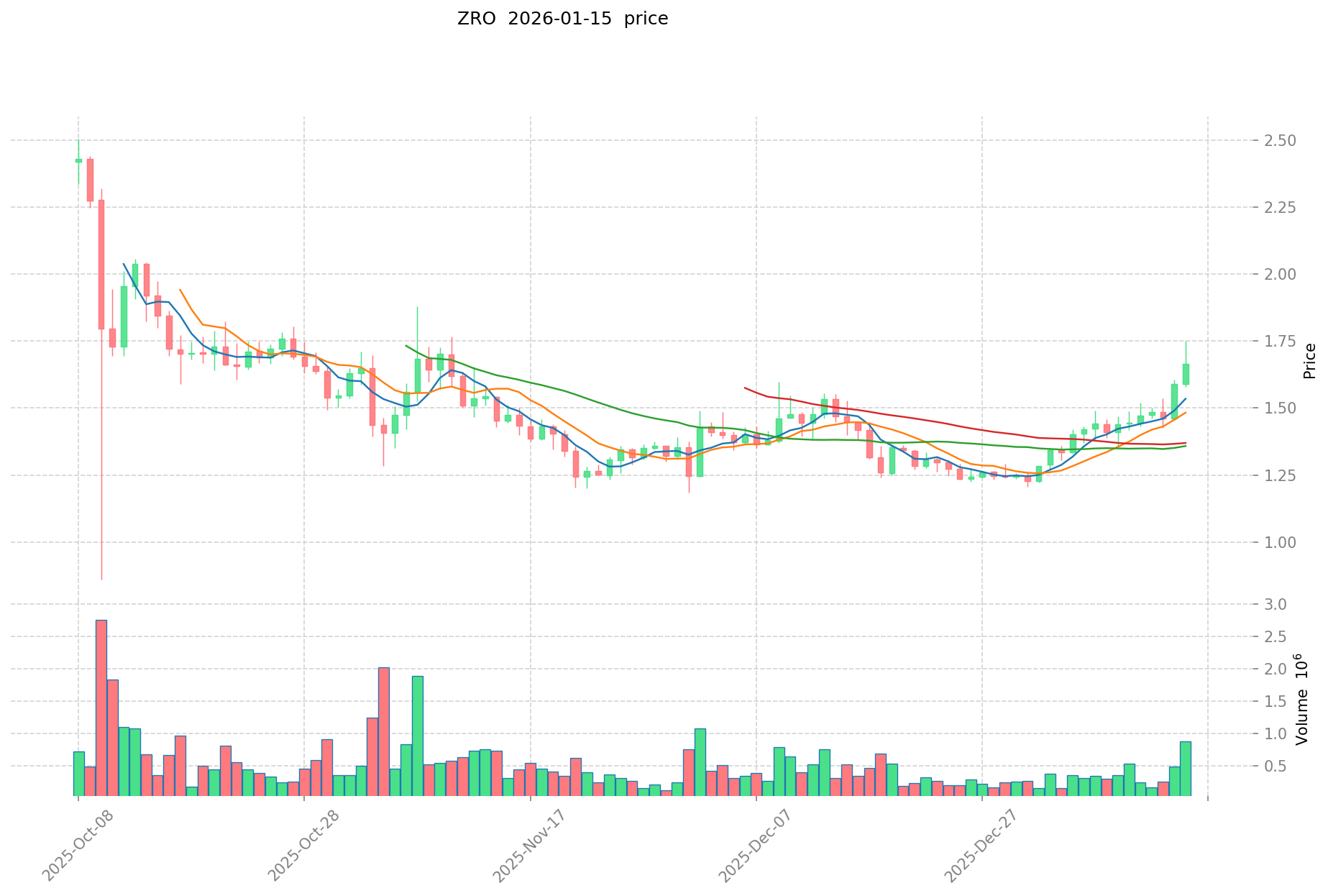
LayerZero reached its all-time high of $7.557 on December 6, 2024, driven by market enthusiasm and adoption momentum during a period of heightened interest in cross-chain interoperability solutions. The token subsequently experienced its lowest price of $0.859 on October 10, 2025, reflecting broader market corrections and potential profit-taking activities.
As of the current date, ZRO is trading at $1.612, showing notable recovery with a 15.4% increase over the past 7 days and a 14.49% gain over the past 30 days. However, the token remains 63.71% below its historical peak, illustrating the volatility characteristic of emerging blockchain infrastructure projects. These price movements reflect evolving market sentiment, adoption patterns, and the broader cryptocurrency market environment.
Click to view the current ZRO market price
On-Chain Metrics
- 24-Hour Trading Volume: Approximately $1.50 million, demonstrating active market participation and liquidity.
- Holder Addresses: 22,504 addresses currently hold ZRO tokens, reflecting a growing user base engaging with the LayerZero ecosystem.
- Market Capitalization: The circulating market cap stands at approximately $326.64 million, while the fully diluted valuation reaches $1.61 billion, indicating significant potential value as more tokens enter circulation.
LayerZero Ecosystem Applications and Partners
Core Use Cases
LayerZero's ecosystem supports multiple application scenarios:
- Cross-chain DeFi: Projects leverage LayerZero's omnichain interoperability protocol to enable seamless asset transfers and liquidity sharing across different blockchains.
- Cross-chain Messaging: Applications utilize LayerZero for lightweight message passing, facilitating communication between disparate blockchain networks.
Strategic Collaborations
LayerZero continues to expand its technical capabilities and market presence through ecosystem partnerships.
These collaborative relationships provide a solid foundation for LayerZero's ecosystem expansion.
Controversies and Challenges
LayerZero faces the following challenges:
- Technical Complexity: Managing cross-chain message delivery while maintaining configurable trustlessness
- Market Competition: Competing interoperability solutions in the blockchain space
- Integration Barriers: Encouraging widespread adoption across various blockchain networks
These issues have sparked discussions within the community and market, while also driving LayerZero's continuous innovation.
LayerZero's community demonstrates notable activity, with the token holder count reaching 22,504 addresses.
On X platform, related posts and hashtags frequently generate engagement among blockchain interoperability enthusiasts.
Protocol developments and cross-chain functionality updates have energized community participation.
Sentiment on X shows diverse perspectives:
- Supporters praise LayerZero's innovative approach to cross-chain communication and its lightweight message passing architecture, viewing it as "a foundational protocol for blockchain interoperability".
- Critics focus on price volatility and the competitive landscape of interoperability solutions.
Recent trends indicate growing interest in cross-chain solutions within the broader market context.
Trending Topics
X platform users actively discuss LayerZero's technical architecture, adoption metrics, and position within the evolving interoperability landscape,
showcasing both its transformative potential and the challenges facing mainstream adoption.
- Official Website: Visit LayerZero official site for features, use cases, and latest developments.
- White Paper: LayerZero White Paper details its technical architecture, objectives, and vision.
- X Updates: On X platform, LayerZero maintains an active presence through @LayerZero_Labs,
with posts covering technical upgrades, ecosystem developments, and partnership announcements, generating substantial community engagement.
LayerZero Future Roadmap
- Ongoing Development: Enhancement of omnichain messaging capabilities, improving protocol efficiency and security
- Ecosystem Goals: Expanding cross-chain application support and developer adoption
- Long-term Vision: Establishing itself as a standard protocol for blockchain interoperability
How to Participate in LayerZero?
- Purchase Channels: Acquire ZRO on Gate.com and other supporting exchanges
- Storage Solutions: Securely store ZRO using compatible wallets that support ERC-20 tokens
- Ecosystem Engagement: Explore developer documentation to build cross-chain applications leveraging LayerZero's protocol
- Community Participation: Follow official channels for updates on protocol developments and ecosystem growth
Summary
LayerZero redefines blockchain interoperability through its innovative protocol, providing authentic and guaranteed cross-chain message delivery with configurable trustlessness.
Its growing community, comprehensive resources, and market positioning distinguish it within the cryptocurrency sector.
Despite facing competitive pressures and integration challenges, LayerZero's technical innovation and clear development direction position it as a notable player in the future of decentralized cross-chain communication.
Whether you are a newcomer or experienced participant, LayerZero merits attention and engagement.
FAQ
What is ZRO and how does it work?
ZRO is LayerZero's native token enabling cross-chain messaging between different blockchains. It facilitates interoperability by allowing applications to communicate across chains. Users pay ZRO fees for cross-chain transactions, enabling seamless blockchain communication.
What are the uses and practical applications of ZRO token?
ZRO token powers the LayerZero protocol, enabling seamless cross-chain messaging and asset transfers across multiple blockchains. It facilitates interoperability, supports decentralized applications, and is used for governance and network participation in the LayerZero ecosystem.
How to buy and store ZRO tokens?
You can purchase ZRO tokens using debit cards, bank transfers, or peer-to-peer trading. After purchasing, store your tokens securely in a digital wallet or on a reliable platform. Always enable two-factor authentication to protect your assets.
What are the differences between ZRO and other mainstream cryptocurrencies?
ZRO is LayerZero's native token focusing on cross-chain interoperability, while mainstream cryptocurrencies like Bitcoin and Ethereum serve different purposes. ZRO enables seamless communication between blockchains, whereas ETH powers smart contracts and Bitcoin functions as digital currency.
What risks should I be aware of when investing in ZRO?
ZRO investment carries market volatility risks. Price fluctuations are significant due to crypto market conditions. Conduct thorough research and assess your risk tolerance before investing. Market sentiment and regulatory changes can impact ZRO performance.
What are ZRO's development prospects and future plans?
LayerZero (ZRO) aims to expand cross-chain interoperability and ecosystem adoption. Future plans include strengthening partnerships, enhancing network infrastructure, and increasing utility through governance participation and staking rewards. ZRO's long-term value depends on broader ecosystem growth and market adoption trends.
* The information is not intended to be and does not constitute financial advice or any other recommendation of any sort offered or endorsed by Gate.