Zenchain (ZTC) is a Layer 1 blockchain launched in 2025 that uniquely combines Bitcoin-level security with Ethereum's programmability through a hybrid consensus mechanism and native protocol-level AI layer. This comprehensive guide explores how Zenchain addresses fragmentation between blockchain security and smart contract capabilities without relying on traditional rollups or bridges. As of January 2026, ZTC has achieved 695 holders and active trading on Gate and other exchanges, with market capitalization of $9.95 million. The article covers Zenchain's technical architecture including decentralized node operations, immutable ledger systems, and secure cryptography, alongside current market metrics showing 24-hour trading volume of $891,563. Key sections examine ecosystem applications in DeFi and AI-powered dApps, market challenges including price volatility and competition, community sentiment on social platforms, and practical participation methods through Gate exchanges and compatible wallets. Whether you
Zenchain's Position and Significance
In 2025, the Zenchain team launched Zenchain (ZTC), aiming to address the fragmentation between Bitcoin's security and Ethereum's programmability, as well as the limitations of traditional rollups and bridges.
As a Layer 1 blockchain that natively integrates Bitcoin-level security with EVM compatibility, Zenchain plays a key role in smart contract deployment and AI-powered decentralized applications.
As of 2026, Zenchain has become an emerging Layer 1 blockchain with active development, featuring 695 holders and trading across 11 exchanges, along with an engaged developer community.
This article will provide an in-depth analysis of its technical architecture, market performance, and future potential.
Origin and Development History
Birth Background
Zenchain was created by the Zenchain development team in 2025, aiming to solve the challenge of combining Bitcoin's security with Ethereum's smart contract capabilities without relying on traditional rollups or cross-chain bridges.
It emerged during the evolution of Layer 1 blockchain technology, with the goal of enabling developers to deploy autonomous, intelligent dApps with Bitcoin-level security, low fees, and fast transactions.
The launch of Zenchain brought new possibilities to blockchain developers and DeFi innovators.
Key Milestones
- 2025: Mainnet preparation and initial development of the hybrid consensus mechanism.
- January 2026: Official listing on Gate.com and other exchanges on January 6, 2026.
- January 2026: Price reached an all-time high of $0.012675 on January 7, 2026.
- January 2026: Growing ecosystem with increasing holder base reaching 695 addresses.
With support from the community and development team, Zenchain continues to optimize its technology, security, and real-world applications.
How Does Zenchain Work?
No Central Control
Zenchain operates on a decentralized network of computers (nodes) distributed globally, free from control by banks or governments.
These nodes collaborate to verify transactions, ensuring the system remains transparent and attack-resistant, granting users greater autonomy and enhancing network resilience.
Blockchain Core
Zenchain's blockchain is a public, immutable digital ledger that records every transaction.
Transactions are grouped into blocks and linked through cryptographic hashes to form a secure chain.
Anyone can view the records, establishing trust without intermediaries.
The hybrid consensus mechanism further enhances performance by combining high throughput with fast finality.
Ensuring Fairness
Zenchain employs a hybrid consensus mechanism to verify transactions and prevent fraud such as double-spending.
Validators maintain network security through operating nodes and validating blocks, earning ZTC rewards.
Its innovation includes integrating a native protocol-level AI layer for fraud detection, execution optimization, and adaptive network management.
Secure Transactions
Zenchain uses public-private key cryptography to protect transactions:
- Private keys (like secret passwords) are used to sign transactions
- Public keys (like account numbers) are used to verify ownership
This mechanism ensures fund security while maintaining pseudonymous transactions.
The EVM compatibility allows developers to deploy smart contracts with enhanced security features inherited from Bitcoin's proven security model.
Circulation Overview
As of January 26, 2026, Zenchain's circulating supply is 4,893,000,000 tokens, with a total supply of 21,000,000,000 tokens. The maximum supply is capped at 21,000,000,000 tokens, representing a fixed supply model.
The circulating supply accounts for approximately 23.3% of the total supply. The current market capitalization stands at $9,952,362, while the fully diluted valuation reaches $42,714,000.
Price Volatility
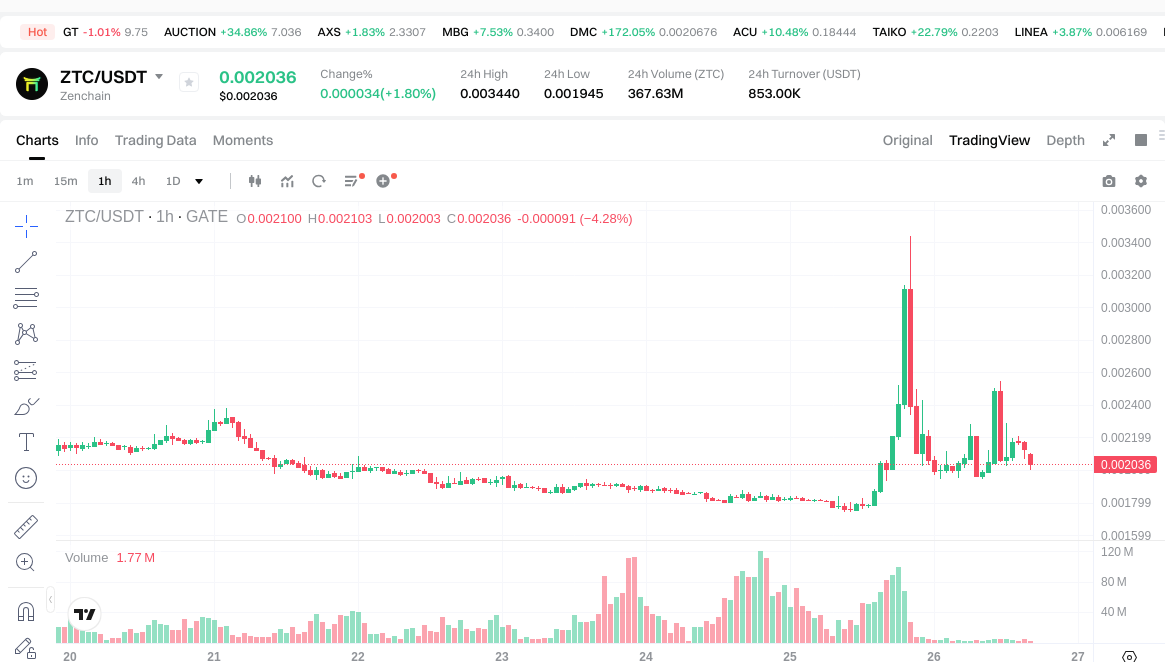
Zenchain reached its all-time high of $0.012675 on January 7, 2026, during its initial trading period following market launch.
Its lowest price was $0.001742, recorded on January 25, 2026, reflecting market volatility and price discovery dynamics in the early trading phase.
As of the latest update, ZTC is trading at $0.002034, showing a 0.74% increase over the past 24 hours. However, the token has experienced a -70.64% decline over the past 30 days from its all-time high, indicating significant price correction following its initial listing period.
These fluctuations reflect market sentiment, adoption trends, and the natural price discovery process for newly launched tokens.
Click to view the current ZTC market price
On-Chain Metrics
- 24-hour Trading Volume: $891,563 (indicating active trading interest)
- Token Holders: 695 addresses (reflecting early-stage user participation)
- Market Share: 0.0013% of the total cryptocurrency market capitalization
Zenchain Ecosystem Applications and Partners
Core Use Cases
Zenchain's ecosystem supports multiple applications:
- DeFi: Leveraging its EVM compatibility, Zenchain enables decentralized trading and liquidity provision with Bitcoin-level security and low transaction fees.
- AI-Powered dApps: The native protocol-level AI layer facilitates fraud detection and execution optimization, unlocking autonomous intelligent decentralized applications.
Strategic Partnerships
While specific partnership details are not available in the provided materials, Zenchain's technical architecture combining Bitcoin's security with Ethereum's programmability positions it to attract collaborations that enhance its technological capabilities and market reach.
Controversies and Challenges
Zenchain faces several challenges:
- Technical Hurdles: As a new Layer 1 blockchain launched in January 2026, maintaining high throughput while ensuring fast finality requires continuous optimization.
- Market Competition: Competing against established Layer 1 blockchains and Bitcoin Layer 2 solutions presents significant pressure.
- Price Volatility: The token has experienced substantial price fluctuations, with a 70.64% decline over 30 days since launch.
These issues have sparked discussions within the community and drive Zenchain's ongoing innovation efforts.
Fan Enthusiasm
Zenchain's community shows growing engagement with 695 holders as of January 26, 2026. The project maintains an active presence on X platform through its handle, fostering discussions around its hybrid consensus mechanism and AI-integrated features.
Sentiment on X presents a mixed picture:
- Supporters praise Zenchain's innovative combination of Bitcoin security and Ethereum programmability, viewing it as a breakthrough in blockchain technology that enables new types of intelligent dApps.
- Critics focus on significant price volatility and the challenges of establishing a new Layer 1 in a competitive market.
Recent trends show cautious optimism as the community evaluates the project's technical capabilities against market performance.
Hot Topics
X users actively discuss Zenchain's native AI layer for fraud detection, hybrid consensus mechanism, and EVM compatibility, highlighting both its transformative potential and the obstacles in gaining mainstream adoption.
- Official Website: Visit Zenchain Official Website for features, use cases, and latest developments.
- Documentation: Zenchain Documentation provides detailed technical architecture, objectives, and vision.
- X Updates: Zenchain actively engages on X platform at @zen_chain, sharing updates on technical developments, community activities, and ecosystem growth.
- Community Hub: Join discussions on Discord to connect with developers and enthusiasts.
Zenchain Future Roadmap
While specific roadmap details are not available in the provided materials, Zenchain's vision focuses on:
- Enhancing its AI layer capabilities for more sophisticated fraud detection and execution optimization
- Expanding EVM-compatible smart contract deployment with Bitcoin-level security
- Building a robust ecosystem of autonomous intelligent dApps
How to Participate in Zenchain?
- Purchase Channels: Buy ZTC on Gate.com and other supporting exchanges
- Storage Solutions: Use ERC-20 compatible wallets such as MetaMask for secure storage (Contract Address: 0xa6773c4f26c80c86bc04aa6506533693a39d1195)
- Explore Documentation: Visit Zenchain Documentation to understand its technical architecture
- Join Community: Connect with the community through Discord to participate in discussions and development
Summary
Zenchain represents an innovative approach to blockchain technology by combining Bitcoin's security with Ethereum's programmability, offering high throughput, fast finality, and EVM compatibility with low transaction fees. Its native protocol-level AI layer for fraud detection and execution optimization distinguishes it from traditional rollups and bridges.
The project's active community, comprehensive documentation, and unique technical architecture position it as a noteworthy player in the Layer 1 blockchain space. Despite facing market volatility and competitive pressure from established blockchains, Zenchain's innovative hybrid consensus mechanism and AI integration demonstrate its potential in the decentralized technology landscape.
Whether you are a newcomer or experienced participant in the crypto space, Zenchain's approach to merging Bitcoin security with Ethereum programmability warrants attention and exploration.
FAQ
What is ZTC crypto and how does it work?
ZTC is a blockchain-based cryptocurrency token designed for decentralized transactions and smart contract operations. It utilizes proof-of-stake consensus mechanism to validate network transactions, enabling fast settlement, low fees, and enhanced security for users participating in the Web3 ecosystem.
Where can I buy ZTC cryptocurrency and what exchanges support it?
ZTC is available on major cryptocurrency exchanges. You can purchase ZTC through spot trading, futures, or margin trading on leading platforms. Check the official ZTC website or community channels for the most current list of supported exchanges and trading pairs available in your region.
What are the main use cases and benefits of ZTC?
ZTC serves as a decentralized utility token enabling smart contracts, DeFi protocols, and cross-chain transactions. Key benefits include lower transaction fees, enhanced security through blockchain validation, and faster settlement times compared to traditional systems. Users gain access to governance rights and staking rewards within the ZTC ecosystem.
Is ZTC a safe investment and what are the associated risks?
ZTC offers solid fundamentals with strong community support and transparent tokenomics. Like all cryptocurrencies, it carries market volatility risks. Success depends on your research, risk tolerance, and long-term conviction in the project's vision and adoption potential.
How does ZTC compare to other cryptocurrencies like Bitcoin or Ethereum?
ZTC offers faster transaction speeds and lower fees compared to Bitcoin and Ethereum. While Bitcoin focuses on security and Ethereum on smart contracts, ZTC prioritizes efficiency and scalability, making it ideal for high-volume transactions in the Web3 ecosystem.
What is the current market price and total supply of ZTC tokens?
ZTC token current market price fluctuates based on market demand and trading volume. Total supply is fixed at the genesis block. For real-time pricing data, please check major cryptocurrency data aggregators or the official ZTC project website.
* The information is not intended to be and does not constitute financial advice or any other recommendation of any sort offered or endorsed by Gate.