This comprehensive analysis compares WIF and VET, two distinct cryptocurrency assets operating in different market segments. WIF, a community-driven memecoin on the Solana blockchain trading at $0.4117, contrasts sharply with VET, a utility-focused enterprise token at $0.012194, each serving different investor profiles and use cases. The article examines critical factors including tokenomics, institutional adoption, technology infrastructure, and market performance through January 2026. Readers will discover detailed price data, supply mechanics comparisons, and ecosystem applications that differentiate these assets. Investment strategies tailored for conservative, aggressive, and institutional investors address portfolio allocation approaches and risk management techniques. Whether you seek sentiment-driven trading opportunities or enterprise blockchain exposure, this guide provides actionable insights for comparing WIF and VET through Gate's market data and pricing tools.
Introduction: WIF Investment Value, Price Prediction, and Risk Analysis
In the cryptocurrency market, dogwifhat (WIF) represents a distinct category of digital assets that has attracted significant attention from investors. As a memecoin on the Solana chain, WIF occupies a unique position in the crypto ecosystem, differing substantially from utility-focused or institutional-grade blockchain projects.
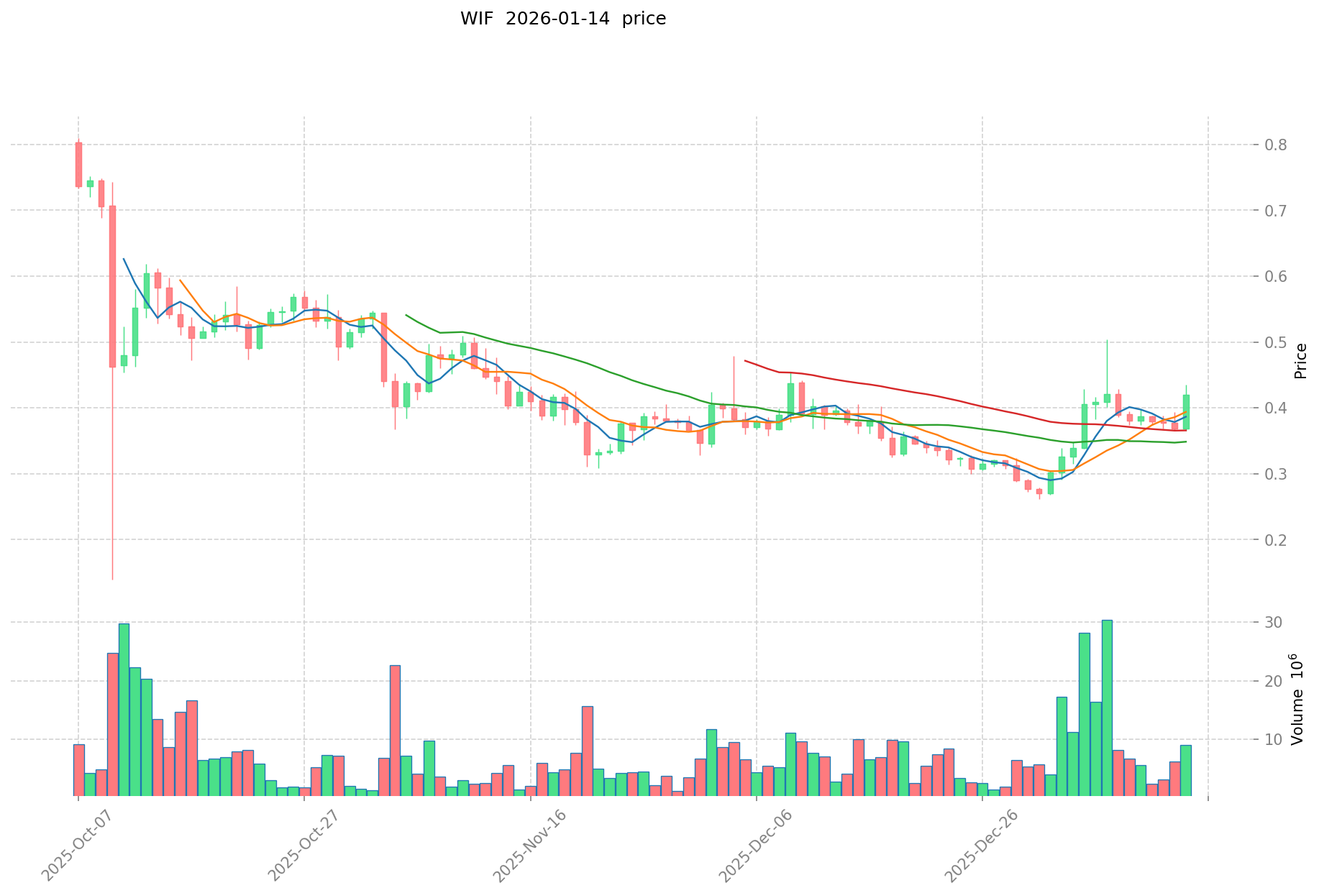
WIF (dogwifhat): Launched in December 2023, this memecoin has established itself within the Solana ecosystem. As of January 15, 2026, WIF ranks 152nd by market capitalization with a current price of $0.4117, representing a 72.36% decline over the past year from its previous levels. The token maintains a fully circulating supply of 998,926,392 tokens, with a market cap of approximately $411 million.
This article will provide a comprehensive analysis of WIF's investment characteristics, examining its price history, supply mechanics, market performance, and associated risks. The analysis aims to address key questions investors commonly consider:
"What factors influence WIF's price dynamics, and what considerations should inform investment decisions in this asset class?"
I. Historical Price Comparison and Current Market Status
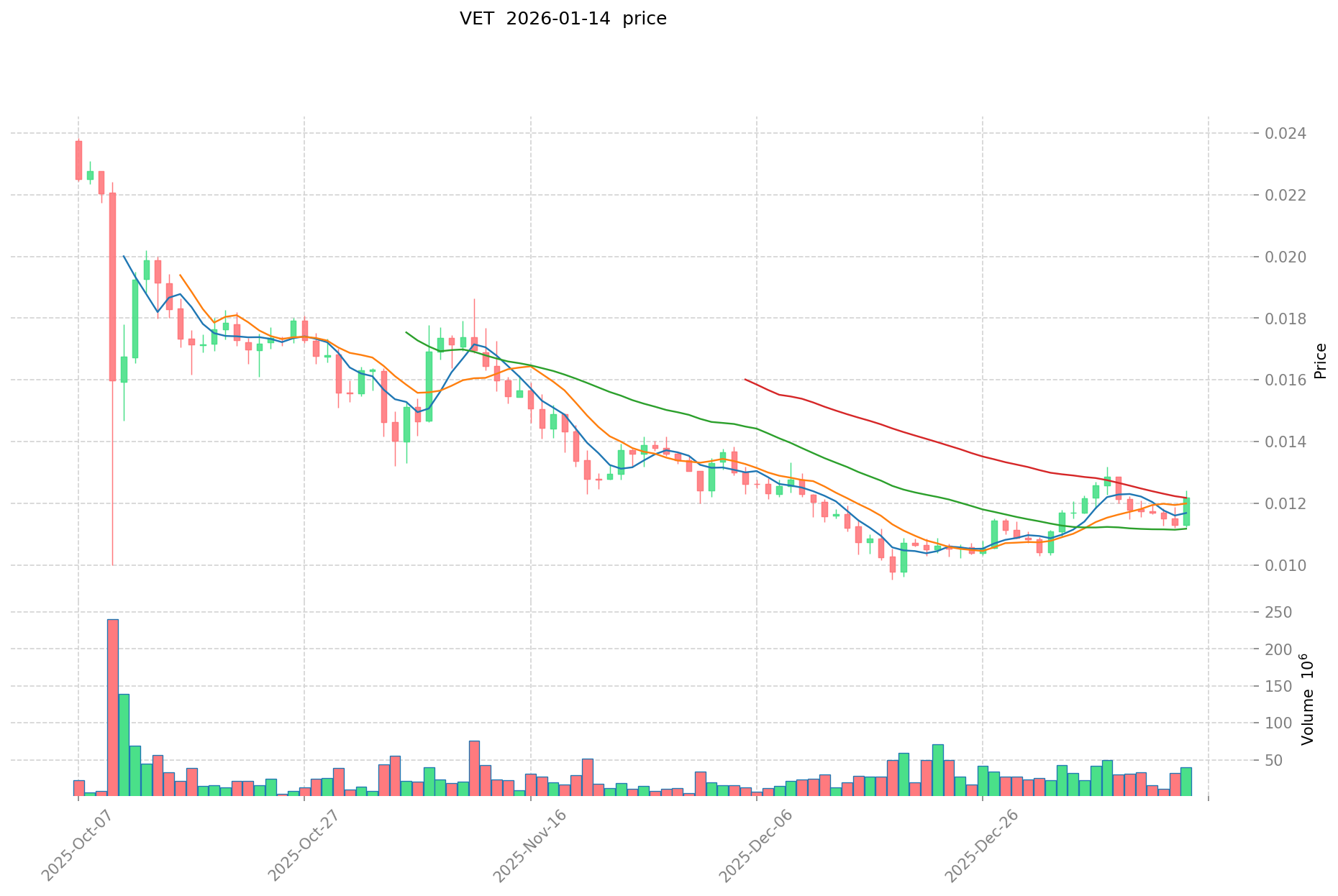
WIF and VET Historical Price Trends
- 2024: WIF experienced notable volatility, reaching a peak of $4.8603 in March 2024 before declining substantially. The token launched in December 2023 at $0.26 and demonstrated rapid price appreciation during its early months.
- 2021: VET reached its peak price of $0.280991 in April 2021 during the broader cryptocurrency market rally. The token has since experienced extended price consolidation.
- Comparative Analysis: During the 2024 market cycle, WIF declined from its peak of $4.8603 to current levels around $0.4117, representing a substantial correction. In contrast, VET has maintained a more stable trading range, operating significantly below its 2021 peak throughout the same period.
Current Market Status (2026-01-15)
- WIF Current Price: $0.4117
- VET Current Price: $0.012194
- 24-Hour Trading Volume: WIF recorded $4.53 million vs VET recorded $633,547
- Market Sentiment Index (Fear & Greed Index): 48 (Neutral)
View Real-Time Prices:
II. Core Factors Influencing WIF vs VET Investment Value
Supply Mechanism Comparison (Tokenomics)
-
WIF: According to reference materials, WIF's significance lies in three main factors: enhanced stability, increased liquidity through numerous exchange products, and effectiveness as an independent marketing force through shared community concepts. The meme asset attracts investors through humor and entertainment-oriented meme images and concepts, with community engagement playing a central role in its value proposition.
-
VET: VET operates within the VeChain Thor blockchain ecosystem, utilizing a dual-token model where VET holders generate VTHO (VeThor) tokens. The economic model includes supply and demand estimations for VTHO, with VET serving as the primary value storage token while VTHO functions as the transaction cost medium. The governance structure incorporates voting mechanisms for VET holders, smart contract owners, and authority masternode holders.
-
📌 Historical Pattern: Supply mechanisms influence price cycles through different approaches - meme assets like WIF rely heavily on community sentiment and liquidity dynamics, while utility-focused tokens like VET depend on ecosystem adoption and transaction demand.
Institutional Adoption and Market Application
-
Institutional Holdings: Reference materials indicate that both assets are available through major exchanges, with VET showing presence on platforms like Kraken Pro offering futures trading services. WIF demonstrates liquidity enhancement through multiple exchange product listings.
-
Enterprise Adoption: VET shows application scenarios across multiple industries including fashion and luxury goods, food safety traceability platforms, and automotive digital maintenance logs. The VeChain platform architecture supports IoT integration and enterprise-level blockchain applications. WIF's adoption primarily centers around community-driven engagement and meme culture appeal.
-
Regulatory Environment: VET futures trading is available in regions outside the United States through Kraken Pro, while US customers can access CME-listed VeChain futures through regulated frameworks. Regulatory attitudes vary by jurisdiction for both assets.
Technology Development and Ecosystem Building
-
WIF Technology: As a meme asset, WIF's technical foundation focuses on stability improvements and liquidity mechanisms through exchange integration rather than protocol-level innovations.
-
VET Technology: VeChain Thor blockchain implements Proof of Authority (PoA) consensus mechanism, featuring multi-task transactions, transaction dependency management, and transaction-based proof of work. The platform architecture includes four-layer technical structure with blockchain abstraction layer and business application abstraction layer. IoT integration capabilities enable device connectivity and data verification through blockchain.
-
Ecosystem Comparison: VET demonstrates broader ecosystem applications including DeFi infrastructure, enterprise supply chain solutions, digital identity verification (VID), and smart contract deployment capabilities. WIF's ecosystem primarily revolves around meme culture community engagement and trading activity.
Macroeconomic Factors and Market Cycles
-
Performance in Inflationary Environments: Both assets show characteristics of yield potential according to price prediction analyses mentioned in reference materials, though specific inflation hedge properties require ongoing market observation.
-
Macroeconomic Monetary Policy: Both WIF and VET demonstrate sensitivity to broader cryptocurrency market trends. Reference materials note that advanced machine learning-based price predictions help users gauge crypto market trends before investment decisions.
-
Geopolitical Factors: VET's enterprise application focus in supply chain transparency and cross-border traceability may provide utility during periods requiring enhanced verification systems. Both assets remain subject to overall cryptocurrency market sentiment influenced by international developments.
III. 2026-2031 Price Prediction: WIF vs VET
Short-term Prediction (2026)
- WIF: Conservative $0.327 - $0.414 | Optimistic $0.414 - $0.596
- VET: Conservative $0.0072 - $0.0122 | Optimistic $0.0122 - $0.0143
Medium-term Prediction (2028-2029)
- WIF may enter a growth phase with estimated price range of $0.340 - $0.757, showing approximately 35-43% annual price changes
- VET may enter an expansion stage with estimated price range of $0.0085 - $0.024, demonstrating potential annual variations of 27-55%
- Key drivers: institutional capital inflows, ETF developments, ecosystem expansion
Long-term Prediction (2030-2031)
- WIF: Baseline scenario $0.560 - $0.674 | Optimistic scenario $0.735 - $0.980
- VET: Baseline scenario $0.015 - $0.025 | Optimistic scenario $0.026 - $0.029
View detailed price predictions for WIF and VET
Disclaimer: Price predictions are based on historical data analysis and market trends. Cryptocurrency markets are highly volatile and subject to various risks. These predictions should not be considered as investment advice. Always conduct thorough research and consult with financial professionals before making investment decisions.
WIF:
| Year |
Predicted High Price |
Predicted Average Price |
Predicted Low Price |
Price Change |
| 2026 |
0.59616 |
0.414 |
0.32706 |
0 |
| 2027 |
0.6111468 |
0.50508 |
0.2979972 |
22 |
| 2028 |
0.625087008 |
0.5581134 |
0.340449174 |
35 |
| 2029 |
0.75724826112 |
0.591600204 |
0.39045613464 |
43 |
| 2030 |
0.7351224134904 |
0.67442423256 |
0.5597721130248 |
63 |
| 2031 |
0.979634919005028 |
0.7047733230252 |
0.613152791031924 |
71 |
VET:
| Year |
Predicted High Price |
Predicted Average Price |
Predicted Low Price |
Price Change |
| 2026 |
0.01425879 |
0.012187 |
0.00719033 |
0 |
| 2027 |
0.01785090825 |
0.013222895 |
0.00727259225 |
8 |
| 2028 |
0.02237313834 |
0.015536901625 |
0.00854529589375 |
27 |
| 2029 |
0.0242624255776 |
0.0189550199825 |
0.015353566185825 |
55 |
| 2030 |
0.029171775753067 |
0.02160872278005 |
0.020096112185446 |
77 |
| 2031 |
0.026405859237221 |
0.025390249266558 |
0.0154880520526 |
108 |
IV. Investment Strategy Comparison: WIF vs VET
Long-term vs Short-term Investment Strategies
-
WIF: May appeal to investors interested in meme asset dynamics and community-driven value propositions. The token's price history shows considerable volatility, with short-term trading opportunities potentially arising from sentiment shifts and liquidity changes. Long-term holders may consider the asset's community engagement strength and exchange integration expansion as factors in their decision-making process.
-
VET: May suit investors focused on enterprise blockchain adoption and ecosystem utility development. The dual-token economic model and applications across supply chain, IoT integration, and digital identity verification provide different value drivers compared to meme-oriented assets. Long-term strategies may involve monitoring enterprise partnership expansion and blockchain adoption metrics.
Risk Management and Asset Allocation
-
Conservative Investors: A potential allocation approach might consider 20-30% WIF vs 70-80% VET, reflecting VET's utility-focused foundation and established enterprise applications. Conservative portfolios typically emphasize assets with demonstrated use cases and ecosystem development over sentiment-driven instruments.
-
Aggressive Investors: A potential allocation approach might consider 50-60% WIF vs 40-50% VET, acknowledging WIF's higher volatility profile and potential for sentiment-driven price movements. Aggressive strategies may accept increased volatility in exchange for possible short-term price appreciation opportunities.
-
Hedging Tools: Portfolio risk management may incorporate stablecoin allocations for liquidity preservation, options strategies where available for volatility management, and cross-asset diversification including positions in both meme assets and utility-focused tokens to balance different market cycle sensitivities.
V. Potential Risk Comparison
Market Risk
-
WIF: The meme asset category demonstrates sensitivity to social media sentiment, community engagement levels, and broader cryptocurrency market trends. Price volatility remains substantial, as evidenced by the 72.36% decline over the past year from peak levels. Trading volume fluctuations and liquidity variations across exchanges may impact price stability.
-
VET: Market performance shows correlation with enterprise blockchain adoption rates and cryptocurrency sector sentiment. The token operates significantly below its 2021 peak levels, indicating extended consolidation periods. Market risk includes dependency on continued ecosystem development and enterprise partnership expansion to support valuation.
Technology Risk
-
WIF: Technical considerations center on Solana network performance and stability, as WIF operates within this blockchain ecosystem. The meme asset's technology focus emphasizes exchange integration and liquidity mechanisms rather than protocol-level innovations, creating dependency on infrastructure providers.
-
VET: The VeChain Thor blockchain's Proof of Authority consensus mechanism introduces considerations around authority masternode distribution and network validator concentration. Technology risk factors include smart contract security, IoT integration complexity, and continued development of the four-layer technical architecture. Network performance during high-demand periods and cross-chain interoperability development remain ongoing considerations.
Regulatory Risk
- Different jurisdictions maintain varying approaches to meme assets versus utility-focused blockchain platforms. VET futures trading availability differs by region, with US markets accessing CME-listed products through regulated frameworks while other jurisdictions utilize platforms like Kraken Pro. WIF faces regulatory considerations common to meme assets, including potential classification questions and exchange listing requirements. Both assets remain subject to evolving cryptocurrency regulatory frameworks across global markets, with potential impacts on trading accessibility, institutional participation, and market infrastructure development.
VI. Conclusion: Which Is the Better Buy?
📌 Investment Value Summary:
-
WIF Characteristics: Community-driven engagement model, exchange integration across multiple platforms, meme culture appeal creating distinct market positioning. The asset demonstrates liquidity enhancement through trading product availability and maintains fully circulating supply structure.
-
VET Characteristics: Enterprise blockchain applications across supply chain, IoT integration, and digital identity sectors. Dual-token economic model with VET value storage and VTHO transaction cost functions. Established presence in fashion, food safety, and automotive industries with ongoing ecosystem development.
✅ Investment Considerations:
-
Novice Investors: May benefit from understanding fundamental differences between meme assets and utility-focused tokens before allocation decisions. Starting with smaller position sizes while developing familiarity with cryptocurrency market dynamics and risk characteristics of different asset categories could support learning objectives.
-
Experienced Investors: May evaluate portfolio diversification approaches incorporating both sentiment-driven and utility-based assets according to individual risk tolerance and investment timeframes. Monitoring ecosystem developments, adoption metrics, and market cycle positioning could inform tactical allocation adjustments.
-
Institutional Investors: May assess regulatory framework compatibility, liquidity depth, enterprise adoption trajectories, and technology infrastructure maturity when considering positions in either asset category. Due diligence processes might examine custody solutions, counterparty risks, and alignment with institutional investment mandates.
⚠️ Risk Disclosure: Cryptocurrency markets exhibit substantial volatility and carry significant risks including potential loss of invested capital. This analysis does not constitute investment advice, financial recommendations, or solicitation to buy or sell any assets. Investors should conduct comprehensive research, assess personal financial circumstances, and consult qualified financial professionals before making investment decisions.
VII. FAQ
Q1: What is the fundamental difference between WIF and VET as investment assets?
WIF is a meme asset driven by community engagement and social sentiment, while VET is a utility-focused blockchain token with enterprise applications. WIF operates primarily through humor-oriented community concepts and trading dynamics on the Solana blockchain, whereas VET functions within the VeChain Thor ecosystem serving enterprise use cases across supply chain management, IoT integration, and digital identity verification. This fundamental distinction creates different value drivers—WIF relies on sentiment shifts and liquidity patterns, while VET depends on enterprise adoption rates and ecosystem development.
Q2: How do the supply mechanisms of WIF and VET impact their price dynamics?
WIF maintains a fully circulating supply of 998,926,392 tokens with value derived from exchange liquidity and community engagement strength. VET operates a dual-token model where VET serves as the value storage token and generates VTHO for transaction costs, creating supply-demand dynamics based on network usage. WIF's supply mechanism emphasizes liquidity stability through exchange integrations, while VET's tokenomics incorporate governance participation and utility generation, making each responsive to different market forces—sentiment for WIF versus ecosystem activity for VET.
Q3: Which asset demonstrates better risk-adjusted returns for long-term investors?
The appropriate choice depends on investor risk tolerance and objectives. VET may suit conservative long-term investors seeking utility-driven value appreciation through enterprise adoption, having established applications across multiple industries and a proven blockchain infrastructure. WIF presents higher volatility with a 72.36% decline from peak levels, potentially appealing to investors comfortable with sentiment-driven price movements and community engagement dynamics. Long-term VET strategies may emphasize ecosystem development monitoring, while WIF approaches might focus on community strength and exchange integration expansion.
Q4: How do regulatory considerations differ between WIF and VET investments?
VET demonstrates structured regulatory engagement through CME-listed futures in US markets and Kraken Pro offerings in other jurisdictions, reflecting its utility token classification and enterprise focus. WIF faces regulatory considerations common to meme assets, including potential classification questions and exchange listing requirements across different jurisdictions. Both assets remain subject to evolving cryptocurrency regulatory frameworks, but VET's enterprise blockchain applications and established trading infrastructure may provide clearer regulatory positioning compared to WIF's community-driven meme asset categorization.
Q5: What technological risks should investors evaluate when comparing WIF and VET?
WIF's technology risk centers on Solana network performance and exchange infrastructure dependency, as its value proposition emphasizes liquidity mechanisms rather than protocol innovations. VET presents different technology considerations including Proof of Authority consensus mechanism validator concentration, smart contract security across its four-layer architecture, and IoT integration complexity. WIF investors should monitor Solana network stability and exchange integration continuity, while VET investors may evaluate authority masternode distribution, network performance during high-demand periods, and ongoing development of cross-chain interoperability capabilities.
Q6: How do macroeconomic conditions affect WIF versus VET differently?
Both assets demonstrate sensitivity to cryptocurrency market trends, but through distinct channels. WIF responds primarily to retail investor sentiment and liquidity conditions, making it reactive to social media trends and community engagement shifts during various macroeconomic environments. VET's performance correlates with enterprise blockchain adoption rates and B2B spending patterns, potentially showing different sensitivity to monetary policy changes and corporate investment cycles. During inflationary periods, VET's utility in supply chain transparency may provide differentiated positioning compared to WIF's sentiment-driven dynamics.
Q7: What portfolio allocation strategies might investors consider when holding both WIF and VET?
Conservative investors might consider 20-30% WIF and 70-80% VET allocations, emphasizing VET's utility foundation and enterprise applications while maintaining limited meme asset exposure. Aggressive investors might evaluate 50-60% WIF and 40-50% VET splits, accepting higher volatility for potential sentiment-driven appreciation opportunities. Both approaches should incorporate risk management through stablecoin liquidity reserves, cross-asset diversification beyond these two tokens, and regular rebalancing based on market cycle positioning and individual investment objectives. Portfolio strategies require ongoing assessment of community engagement metrics for WIF and enterprise adoption developments for VET.
Q8: What timeframe considerations should inform WIF versus VET investment decisions?
Short-term traders (weeks to months) may find WIF's volatility and sentiment-driven price movements create tactical opportunities, though with substantial downside risk as demonstrated by recent price history. Medium-term investors (1-3 years) might evaluate VET's ecosystem development trajectory and enterprise partnership expansion as value drivers with potentially lower volatility. Long-term holders (3+ years) should assess fundamental differences—WIF's community engagement sustainability versus VET's blockchain utility adoption—recognizing that meme assets and utility tokens perform differently across market cycles. Investment timeframes should align with risk tolerance and the distinct value proposition of each asset category.
* The information is not intended to be and does not constitute financial advice or any other recommendation of any sort offered or endorsed by Gate.