This article provides comprehensive analysis of the current crypto market winter cycle, examining Bitcoin's 7.5% decline to $83,880 and its ripple effects across altcoins including BNB, Solana, and Cardano. The piece explores how extreme fear, reflected in the CMC Fear and Greed Index at historic lows, drives synchronized selloffs across major cryptocurrencies. Key drivers include Bitcoin momentum reversal, outflows from institutional investment vehicles, and macroeconomic headwinds affecting risk assets globally. The article clarifies that current declines stem from market-wide sentiment shifts rather than fundamental weaknesses, offering investors strategic guidance on capital preservation during bear markets. Essential reading for understanding crypto cycle dynamics and positioning for market recovery on trading platforms like Gate.
Bitcoin Sets the Tone Under Record Fear
Bitcoin is currently trading near $83,880, marking a significant decline of approximately 7.5% over the past 24 hours, after briefly testing levels near $80,000. This sharp retreat from recent six-figure price levels has sent shockwaves through the broader crypto market, setting a bearish tone that has influenced the entire digital asset ecosystem.
Derivatives activity reveals a troubling picture of market dynamics. Rising long liquidations and negative funding rates point to a rapid reduction of leveraged positioning, as traders who bet on continued price increases are being forced out of their positions. This cascading effect of liquidations has amplified the downward pressure, creating a self-reinforcing cycle of selling that has pushed prices even lower.
The move should be viewed as an extension of a wider market reset that began following October's price highs. During that period, Bitcoin reached new milestones, attracting significant speculative interest and leveraged positions. However, as financial conditions have tightened globally and uncertainty has increased, market participants have been systematically locking in gains and reducing their exposure to volatile assets.
The drop in sentiment indicators conveys more than just price movement alone. The CMC Crypto Fear and Greed Index currently sits at 11, representing the lowest reading since the index's launch and indicating extreme fear in the market.
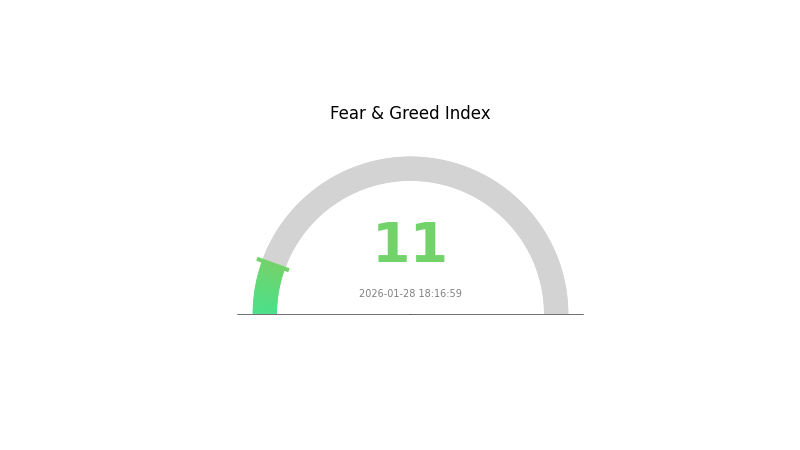 This level of fear suggests that risk tolerance has narrowed sharply across the board, which typically results in slower capital rotation, fewer speculative trades, and a greater focus on capital preservation among investors.
In such defensive phases, Bitcoin's price direction tends to dominate flows across the entire crypto market. As the largest and most liquid cryptocurrency, Bitcoin serves as a barometer for overall market sentiment, leaving secondary tokens little room to diverge meaningfully from its trajectory. When Bitcoin struggles, the entire market typically follows suit, reinforcing the interconnected nature of crypto assets.
Large Caps Follow the Broader Retreat
Altcoins have tracked the same downward path as Bitcoin, with major tokens experiencing substantial losses. BNB is trading near $821, Solana around $126, and Cardano close to $0.404, with each posting sharp declines of up to 12% within the past 24 hours. These significant drops across established cryptocurrencies demonstrate that the current market weakness is not isolated to Bitcoin alone but represents a broader shift in investor sentiment.
While liquidity on major trading venues remains workable and functional, order flows increasingly skew toward sellers and systematic reduction of exposure. This pattern indicates that the downward pressure stems more from macroeconomic forces and sentiment shifts rather than from token-specific developments or fundamental weaknesses in individual blockchain networks.
The uniform nature of these declines is particularly noteworthy. Rather than showing new weakness specific to these networks or their underlying technologies, the price drops reflect how even well-established ecosystems with strong fundamentals struggle when fear takes hold of the market. Projects with active development, growing user bases, and solid technological foundations are not immune to broader market sentiment shifts.
In market conditions where Bitcoin loses ground and confidence fades, large-cap altcoins often move in tandem with the leading cryptocurrency. This correlation is shaped by a market-wide desire to reduce risk exposure rather than by changes in the underlying structures, adoption metrics, or technological developments of individual projects. The current environment demonstrates that during periods of extreme fear, fundamental analysis often takes a backseat to risk management and capital preservation strategies.
This synchronized decline across major cryptocurrencies also reflects the reality that institutional and retail investors alike tend to reduce their overall crypto exposure during uncertain times, rather than rotating between different tokens. The result is a broad-based selloff that affects nearly all segments of the crypto market, regardless of individual project merits.
What Is Driving the Extreme Fear in Altcoin Season
Several interconnected factors converge behind this period of extreme fear and market depression. Bitcoin's reversal from recent peak levels has fundamentally unsettled momentum-driven positioning strategies that had become prevalent during the previous rally phase. Many traders and investors who entered positions expecting continued upward movement have been caught off guard by the sudden shift in market direction.
Outflows from spot Bitcoin exchange-traded products and other institutional investment vehicles have removed a key source of incremental demand that had been supporting prices. These products had been attracting significant capital inflows during the bull phase, providing consistent buying pressure. The reversal of these flows has left a vacuum in demand that has contributed to price weakness.
At the same time, global macroeconomic tensions, economic concerns, and shifting expectations regarding interest rate policies continue to weigh heavily on risk assets more broadly, including cryptocurrencies. Central bank policies, inflation concerns, and geopolitical uncertainties have created an environment where investors are reassessing their exposure to higher-risk asset classes. In this context, cryptocurrencies are often among the first assets to be sold when investors seek to reduce risk.
These elements create an atmosphere where caution dominates decision-making processes across all types of market participants. Institutional investors, retail traders, and even long-term holders typically trim exposure to complex positions, unwind leverage, and concentrate liquidity into more stable instruments until clearer signs of market stability emerge. This defensive positioning explains why the anticipated altcoin season remains distant, even as occasional short-lived rebounds appear to offer hope.
The current drawdown points to a market that is focused on preservation of capital rather than expansion of positions or pursuit of aggressive gains. With sentiment indicators at historic lows, new capital tends to wait on the sidelines for clearer confirmation of a bottom and sustainable recovery before reengaging with the market. Investors have become more selective and risk-averse, requiring stronger evidence of stability before committing fresh funds.
Recovery phases in crypto markets typically rely on several key factors: stabilization in Bitcoin's price action, renewed confidence in broader macroeconomic conditions, and a gradual return of trading volume that indicates a willingness among participants to reassess risk and return to active trading. Until these conditions materialize, the market is likely to remain in this defensive posture.
For the time being, the heavy retreat across Bitcoin, BNB, Solana, Cardano, and almost all major cryptocurrencies illustrates how deeply sentiment controls the market cycle. The crypto season in its typical form, characterized by broad market participation, rising prices across secondary assets, and enthusiastic speculation, remains on pause until fear subsides and market conditions show sustained balance between supply and demand forces. Only when confidence returns and risk appetite recovers will the market be positioned for a meaningful recovery and potential resumption of the bullish trends that characterized earlier periods.
FAQ
What is Crypto Winter and what are its characteristics?
Crypto Winter is a prolonged bear market phase characterized by sustained price declines in Bitcoin and altcoins. Key features include widespread pessimism, reduced trading volumes, low market sentiment, and investor fear following previous bull markets.
How much do Bitcoin and altcoins typically fall during bear markets? How long have crypto winters historically lasted?
Bitcoin typically falls to around $30,000 in bear markets, while altcoins often decline 70-90% from peaks. Historical crypto winters have lasted 6-18 months, with the longest reaching approximately two years during major corrections.
During crypto winter, what strategies should investors adopt to protect their assets?
Consider reducing exposure positions, increasing cash reserves, and maintaining psychological resilience. Preserve capital for buying opportunities during market recovery phases.
What is the cyclical relationship between cryptocurrency bear markets and bull markets? When will the next bull market arrive?
Crypto markets follow four-year cycles tied to Bitcoin halving events. Historically, bull markets peak 12-18 months after halving. Based on the 2024 halving, the next bull market is expected to accelerate through 2026-2027, driven by reduced Bitcoin supply and Ethereum scaling improvements.
Which factors lead cryptocurrency market into winter phase?
Regulatory tightening, interest rate hikes, macroeconomic deterioration, and declining investor confidence trigger crypto winter. Market sentiment shifts drive sustained downturns in trading volume and asset valuations.
Which cryptocurrencies or projects are more likely to survive during a crypto winter?
Blue-chip cryptocurrencies like Bitcoin and Ethereum, along with functional tokens with real-world applications and established DeFi projects, are more resilient during crypto winters due to stronger fundamentals and user adoption.
* The information is not intended to be and does not constitute financial advice or any other recommendation of any sort offered or endorsed by Gate.