This comprehensive guide compares Worldcoin (WLD) and Cronos (CRO) tokens across multiple investment dimensions. WLD, launched in July 2023, emphasizes decentralized governance and global economic access, while CRO, established in December 2018, offers an established ecosystem with 500+ developers and 100 million addressable users. The analysis examines historical price trends, current market status, tokenomics, institutional adoption, technological development, and projected scenarios through 2031. WLD declined from $11.968 to $0.6025, while CRO shows greater stability at $0.10173. This guide helps investors understand ecosystem differences, risk profiles, trading volumes, and allocation strategies, providing data-driven insights on price forecasts and investment considerations for both beginner and institutional investors on Gate exchange.
Introduction: Investment Comparison Between WLD and CRO
In the cryptocurrency market, the comparison between Worldcoin (WLD) and Cronos (CRO) remains a topic of continuous interest for investors. Both assets demonstrate distinct differences in market capitalization ranking, application scenarios, and price performance, representing different positioning within the crypto asset landscape.
Worldcoin (WLD): Launched in July 2023, this open-source protocol is designed to provide global economic access with a focus on decentralized governance and community-driven decision-making.
Cronos (CRO): Since its launch in December 2018, this blockchain ecosystem has partnered with Crypto.com and over 500 application developers, representing an addressable user base of more than 100 million people globally, with emphasis on DeFi and gaming applications.
This article will provide a comprehensive analysis of the investment value comparison between WLD and CRO, examining historical price trends, supply mechanisms, institutional adoption, technical ecosystems, and future projections to address the question investors care about most:
"Which asset presents a more compelling investment case based on current market fundamentals?"
I. Historical Price Comparison and Current Market Status
Historical Price Trends of WLD (Coin A) and CRO (Coin B)
- 2024: WLD reached a peak price of $11.968 on March 10, 2024, driven by market momentum during its initial growth phase.
- 2021: CRO recorded its historical high of $0.965407 on November 24, 2021, reflecting strong performance during the broader cryptocurrency market rally.
- 2025: WLD experienced a notable decline, reaching a low of $0.25 on October 10, 2025, representing significant downward pressure.
- 2019: CRO established its historical low of $0.0121196 on February 8, 2019, during the early stages of its market presence.
- Comparative Analysis: During the market cycle between 2024 and 2025, WLD declined from its peak of $11.968 to $0.25, experiencing a substantial correction. In contrast, CRO demonstrated relatively more stability, maintaining its trading range between established support and resistance levels following its 2021 peak.
Current Market Status (January 14, 2026)
- WLD Current Price: $0.6025
- CRO Current Price: $0.10173
- 24-Hour Trading Volume: WLD recorded $1,694,617.9957837, while CRO achieved $400,564.2889165
- Market Sentiment Index (Fear & Greed Index): 26 (Fear)
View Real-Time Prices:
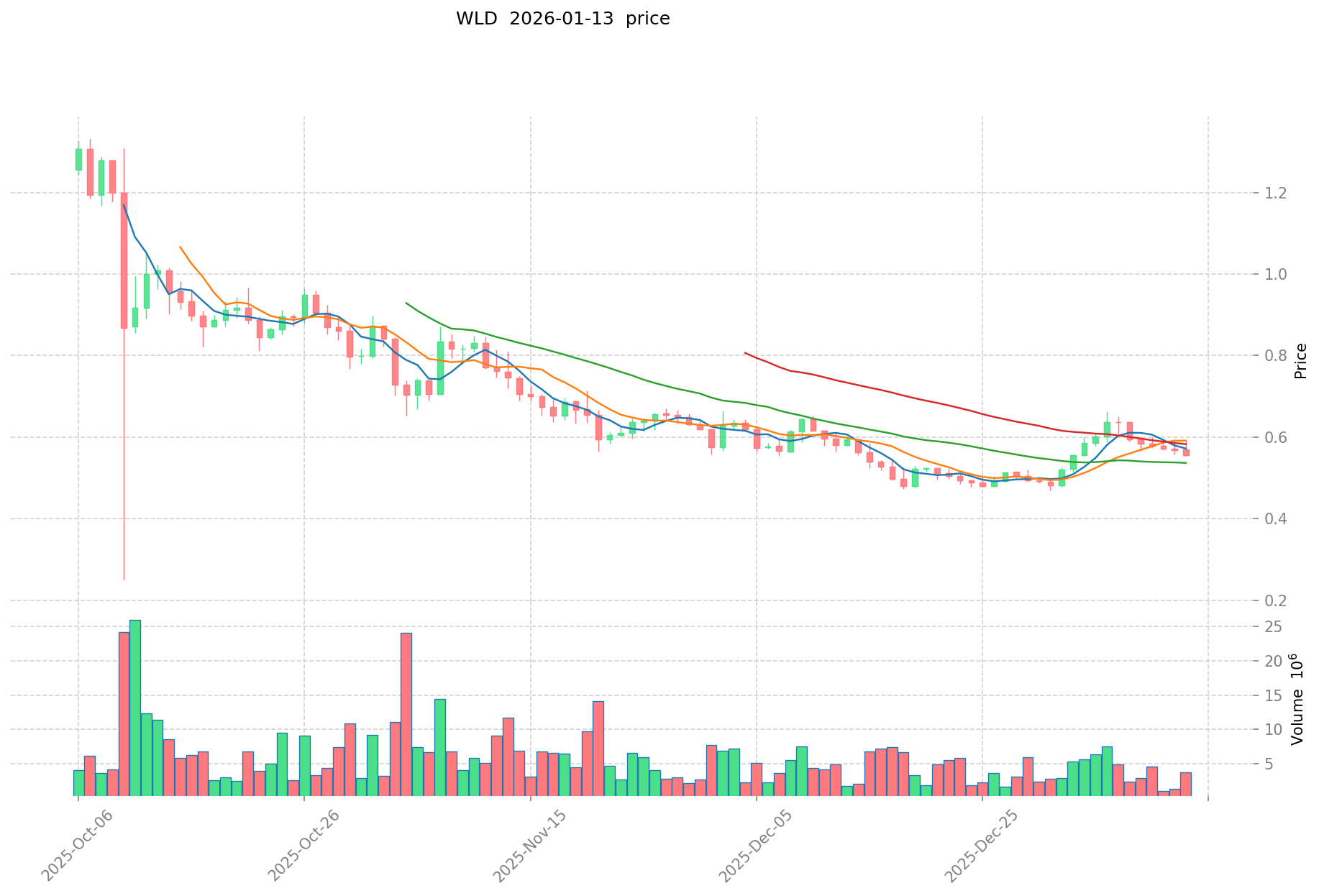
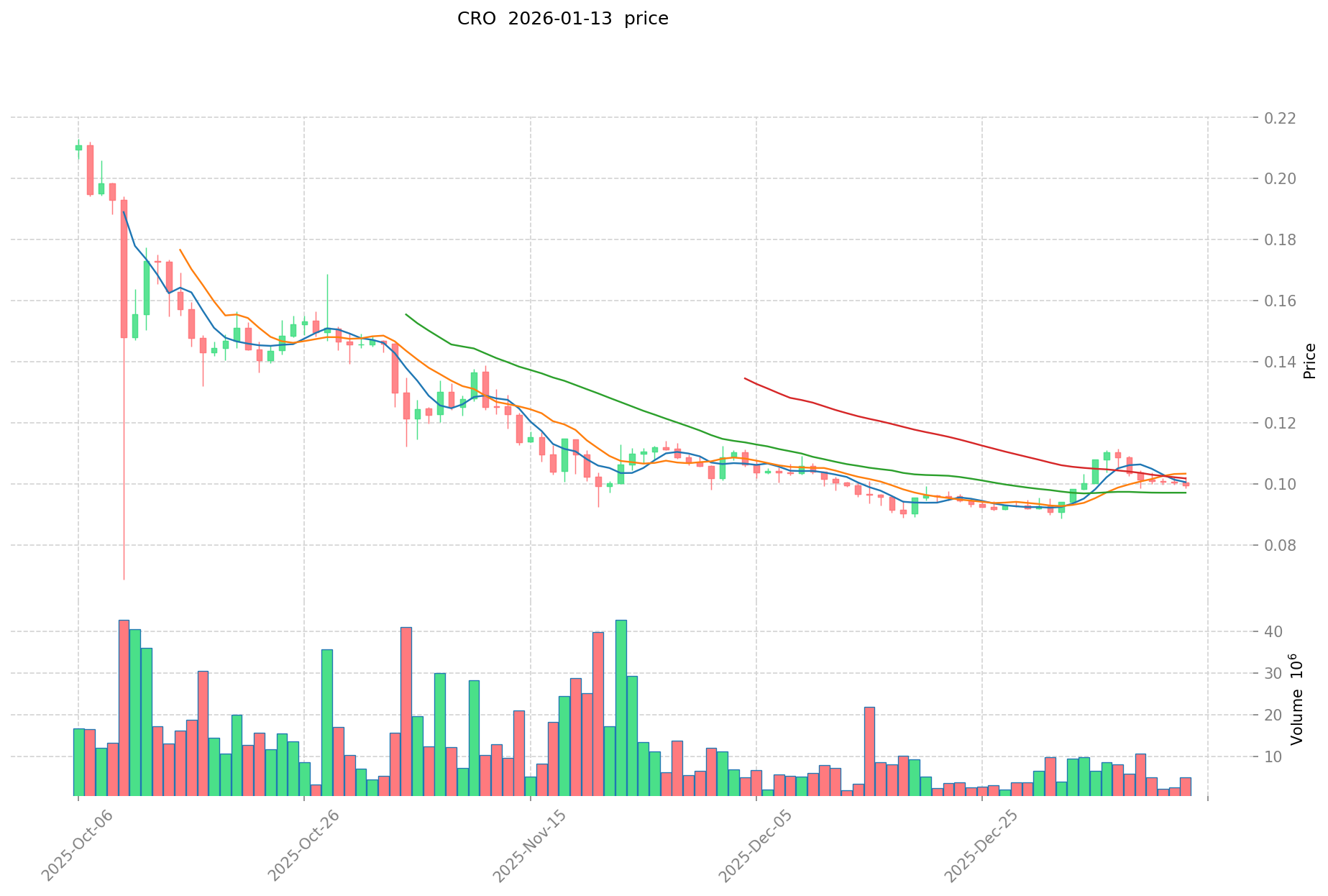
II. Core Factors Influencing Investment Value: WLD vs CRO
Supply Mechanism Comparison (Tokenomics)
- WLD: Information regarding WLD's supply mechanism is not available in the reference materials.
- CRO: The reference materials do not provide specific details about CRO's tokenomics or supply mechanism.
- 📌 Historical patterns: Supply mechanisms can influence price cycles through inflation rates, token release schedules, and scarcity dynamics, though specific historical data for these assets is not covered in the provided materials.
Institutional Adoption and Market Application
- Institutional holdings: The reference materials mention Trump Media Group CRO Strategy, which focuses on strategic investments connecting traditional investment opportunities with digital asset ecosystems, implementing CRO accumulation and active management as core strategies. However, comparative institutional preference data between WLD and CRO is not available.
- Enterprise adoption: Specific information about WLD or CRO applications in cross-border payments, settlements, or investment portfolios is not provided in the reference materials.
- National policies: The materials do not contain specific regulatory attitudes from different countries toward WLD or CRO.
Technological Development and Ecosystem Building
- WLD technological upgrades: The reference materials do not contain information about WLD's technical development or upgrades.
- CRO technological development: According to the materials, CROS (related to CRO) is described as a leading in-game advertising platform combining Ethereum L2 and AI technology. However, specific technical upgrade details and their potential impacts are not elaborated.
- Ecosystem comparison: The materials lack comprehensive information about DeFi, NFT, payment applications, and smart contract implementation for either WLD or CRO.
Macroeconomic Environment and Market Cycles
- Performance in inflationary environments: The reference materials do not provide comparative analysis of anti-inflation properties for WLD or CRO.
- Macroeconomic monetary policy: The materials mention that both sectors are influenced by regulatory changes and global economic shifts, but specific impacts of interest rates or the US dollar index on these assets are not detailed.
- Geopolitical factors: While the materials note that market trends and global economic shifts affect these sectors, specific analysis of cross-border transaction demand or international situations related to WLD and CRO is not provided.
III. 2026-2031 Price Forecast: WLD vs CRO
Short-term Forecast (2026)
- WLD: Conservative $0.58-$0.61 | Optimistic $0.61-$0.74
- CRO: Conservative $0.07-$0.10 | Optimistic $0.10-$0.15
Mid-term Forecast (2028-2029)
- WLD may enter a moderate growth phase, with estimated prices ranging from $0.69 to $1.08
- CRO may enter an expansion phase, with estimated prices ranging from $0.13 to $0.26
- Key drivers: institutional capital inflows, ETF developments, ecosystem expansion
Long-term Forecast (2030-2031)
- WLD: Baseline scenario $0.82-$0.98 | Optimistic scenario $0.98-$1.62
- CRO: Baseline scenario $0.19-$0.24 | Optimistic scenario $0.24-$0.31
View detailed price predictions for WLD and CRO
Disclaimer
WLD:
| Year |
Predicted High Price |
Predicted Average Price |
Predicted Low Price |
Price Change |
| 2026 |
0.743303 |
0.6143 |
0.583585 |
1 |
| 2027 |
0.767045695 |
0.6788015 |
0.5430412 |
12 |
| 2028 |
1.0410099804 |
0.7229235975 |
0.686777417625 |
19 |
| 2029 |
1.0848191504085 |
0.88196678895 |
0.723212766939 |
46 |
| 2030 |
1.307912649673402 |
0.98339296967925 |
0.816216164833777 |
63 |
| 2031 |
1.61537046164362 |
1.145652809676326 |
0.973804888224877 |
90 |
CRO:
| Year |
Predicted High Price |
Predicted Average Price |
Predicted Low Price |
Price Change |
| 2026 |
0.1512483 |
0.10289 |
0.0689363 |
1 |
| 2027 |
0.1893330335 |
0.12706915 |
0.0927604795 |
24 |
| 2028 |
0.2325556048725 |
0.15820109175 |
0.1265608734 |
55 |
| 2029 |
0.263760770220187 |
0.19537834831125 |
0.1875632143788 |
92 |
| 2030 |
0.250230819599633 |
0.229569559265718 |
0.192838429783203 |
125 |
| 2031 |
0.307072242473825 |
0.239900189432676 |
0.211112166700754 |
135 |
IV. Investment Strategy Comparison: WLD vs CRO
Long-term vs Short-term Investment Strategies
- WLD: May be suitable for investors focusing on community-driven governance models and open-source protocol development, with particular attention to the project's global access initiatives launched since July 2023.
- CRO: May appeal to investors interested in established blockchain ecosystems with extensive partnership networks, including over 500 application developers and an addressable user base exceeding 100 million globally, particularly those seeking exposure to DeFi and gaming applications.
Risk Management and Asset Allocation
- Conservative investors: Diversified allocation considering market volatility patterns, with emphasis on position sizing relative to individual risk tolerance and portfolio objectives.
- Aggressive investors: Portfolio construction may incorporate higher allocations to assets demonstrating stronger historical momentum patterns, while maintaining appropriate risk management protocols.
- Hedging instruments: Stablecoin positions for liquidity management, options strategies for downside protection, and cross-asset diversification approaches.
V. Potential Risk Comparison
Market Risks
- WLD: Historical price volatility demonstrated by the decline from $11.968 (March 2024) to $0.25 (October 2025), indicating substantial downward pressure during market corrections. Current 24-hour trading volume of $1,694,617.99 reflects ongoing market participation levels.
- CRO: Price movements between historical high of $0.965407 (November 2021) and historical low of $0.0121196 (February 2019) illustrate market cycle sensitivity. Current 24-hour trading volume of $400,564.29 suggests moderate liquidity conditions.
Technical Risks
- WLD: Scalability considerations and network stability factors require ongoing monitoring as the protocol continues development since its 2023 launch.
- CRO: Technical infrastructure supporting the Crypto.com partnership ecosystem and application developer network necessitates evaluation of network performance and security architecture.
Regulatory Risks
- Both assets operate within evolving regulatory frameworks across multiple jurisdictions. Market trends are influenced by regulatory changes and global economic shifts, requiring investors to monitor policy developments that may impact operational parameters and market access.
VI. Conclusion: Which Is the Better Buy?
📌 Investment Value Summary:
- WLD strengths: Open-source protocol architecture with decentralized governance framework, community-driven decision-making structure, and focus on global economic access since July 2023 launch.
- CRO strengths: Established ecosystem presence since December 2018, extensive partnership network including Crypto.com and 500+ application developers, addressable user base exceeding 100 million globally, with demonstrated applications in DeFi and gaming sectors.
✅ Investment Considerations:
- Beginning investors: Consider starting with smaller position sizes to understand market dynamics and volatility patterns. Current market sentiment index at 26 (Fear) suggests cautious market conditions. Emphasis on education regarding both projects' fundamental characteristics and risk factors.
- Experienced investors: Evaluation may incorporate historical price performance analysis, trading volume patterns, and ecosystem development trajectories. WLD's price forecast suggests potential range of $0.58-$1.62 through 2031, while CRO's forecast indicates potential range of $0.07-$0.31 over the same period.
- Institutional investors: Assessment may focus on partnership networks, addressable market size, technological infrastructure, and alignment with broader portfolio strategies. CRO's established ecosystem and WLD's community governance model represent distinct positioning within the digital asset landscape.
⚠️ Risk Disclosure: Cryptocurrency markets exhibit substantial volatility. Historical price movements demonstrate significant fluctuation potential. This analysis does not constitute investment advice. Investors should conduct independent research, assess individual risk tolerance, and consider consultation with qualified financial advisors before making investment decisions.
VII. FAQ
Q1: Which asset has demonstrated greater price stability between WLD and CRO?
CRO has shown relatively greater price stability compared to WLD. While WLD experienced a dramatic decline from its peak of $11.968 in March 2024 to $0.25 in October 2025 (a 97.9% correction), CRO has maintained a more consistent trading range following its 2021 peak of $0.965407. CRO's current price of $0.10173 reflects a more gradual adjustment pattern over its longer operational history since December 2018, whereas WLD's shorter market presence since July 2023 has been marked by more extreme volatility cycles.
Q2: What are the primary differences in ecosystem positioning between WLD and CRO?
WLD and CRO represent fundamentally different ecosystem approaches. WLD focuses on decentralized governance with community-driven decision-making and global economic access through an open-source protocol framework launched in 2023. In contrast, CRO operates as an established blockchain ecosystem integrated with Crypto.com and over 500 application developers, serving an addressable user base exceeding 100 million people globally. CRO emphasizes practical applications in DeFi and gaming sectors, while WLD prioritizes governance mechanisms and broad accessibility.
Q3: How do the trading volumes compare between WLD and CRO, and what does this indicate?
As of January 14, 2026, WLD recorded a 24-hour trading volume of $1,694,617.99, significantly higher than CRO's $400,564.29. This approximately 4.2x volume differential suggests WLD maintains stronger market liquidity and trading activity despite its shorter market history. Higher trading volume typically indicates greater market participant interest and easier position entry/exit capabilities, though it can also reflect heightened speculative activity during volatile periods.
Q4: What are the projected price trajectories for WLD and CRO through 2031?
Price forecasts indicate divergent trajectories for both assets. WLD's projections range from a conservative scenario of $0.58-$0.98 to an optimistic scenario reaching $1.62 by 2031, representing potential upside of 61-168% from current levels. CRO's forecasts suggest a range from $0.07-$0.24 in the baseline scenario to $0.31 in the optimistic scenario by 2031, indicating potential changes of -31% to +205% from current prices. WLD's forecasts show higher absolute price targets, while CRO's percentage-based upside potential varies depending on the scenario considered.
Q5: Which asset is more suitable for risk-averse investors?
Neither asset is particularly suitable for highly risk-averse investors given the inherent volatility of cryptocurrency markets. However, CRO may present relatively lower volatility risk based on its longer operational history, established ecosystem partnerships, and more moderate price fluctuation patterns compared to WLD's dramatic price swings. Risk-averse investors considering either asset should employ conservative position sizing, diversified allocation strategies, and hedging instruments such as stablecoin reserves. The current market sentiment index of 26 (Fear) further suggests cautious conditions requiring enhanced risk management protocols.
Q6: How do institutional adoption patterns differ between WLD and CRO?
CRO demonstrates clearer institutional adoption pathways through its integration with Crypto.com and partnerships with over 500 application developers, providing tangible infrastructure for institutional engagement. The reference to Trump Media Group CRO Strategy indicates institutional interest in CRO's strategic positioning within digital asset ecosystems. WLD's institutional adoption profile is less defined in available data, with its value proposition centered more on community governance and open-source protocol development rather than direct enterprise partnerships. Institutional investors typically favor assets with established operational frameworks and clear use cases, which currently favors CRO's positioning.
Q7: What regulatory considerations should investors evaluate for WLD versus CRO?
Both assets operate within evolving regulatory frameworks across multiple jurisdictions, requiring ongoing monitoring of policy developments. CRO's longer operational history and integration with Crypto.com means it has navigated more regulatory cycles and established compliance frameworks across various markets. WLD's newer market presence means its regulatory positioning is still developing, with potential for both opportunities and challenges as frameworks evolve. Investors should consider jurisdictional regulations affecting their specific situation, the regulatory status of associated platforms (particularly Crypto.com for CRO), and potential impacts of global regulatory shifts on project operations and market access for both assets.
Q8: How should investors approach portfolio allocation between WLD and CRO?
Portfolio allocation decisions should reflect individual risk tolerance, investment timeframe, and strategic objectives. Conservative investors might consider minimal allocations (1-5% of crypto portfolio) with emphasis on diversification between both assets to capture different ecosystem exposures. Aggressive investors with higher risk tolerance might allocate 10-20% of their crypto holdings, potentially weighted toward the asset aligning with their thesis on community governance (WLD) versus established ecosystems (CRO). Regardless of allocation strategy, investors should implement position sizing relative to their total portfolio, maintain adequate liquidity reserves, and employ rebalancing protocols to manage concentration risk as market conditions evolve.
* The information is not intended to be and does not constitute financial advice or any other recommendation of any sort offered or endorsed by Gate.