This comprehensive comparison analyzes WLFI and SAND, two distinct digital assets addressing different market segments. WLFI, launched in 2025, operates as a DeFi governance token promoting USD-based stablecoins with institutional backing, while SAND, since 2020, powers metaverse and blockchain gaming experiences. The article examines historical price performance—WLFI trading at $0.1704 following a decline from $1.1 peak, SAND at $0.1172 amid sustained pressure—and evaluates critical investment factors including tokenomics, institutional adoption, technical ecosystems, and macroeconomic influences. Current market data from Gate shows WLFI's $2.9M trading volume versus SAND's lower activity, reflecting differing liquidity profiles. Through detailed price range analysis (2026-2031), investment strategy frameworks, and comprehensive risk assessment, this guide helps investors determine optimal positioning based on their risk tolerance and sector exposure preferences within volatile cryptocurrency markets.
Introduction: Investment Comparison Between WLFI and SAND
In the cryptocurrency market, the comparison between WLFI vs SAND has consistently been a topic of interest for investors. The two differ significantly in market capitalization ranking, application scenarios, and price performance, representing distinct positioning within the crypto asset landscape.
WLFI (World Liberty Financial): Launched in 2025, this governance token has gained market recognition through its positioning as a DeFi protocol dedicated to promoting USD-based stablecoins and preserving the U.S. Dollar's global dominance, bridging Web2 and Web3 ecosystems.
SAND (The Sandbox): Since its introduction in 2020, SAND has been recognized as a metaverse and gaming-focused token, powering a virtual game world where players can create, own, and monetize gaming experiences through blockchain technology.
This article will comprehensively analyze the investment value comparison of WLFI vs SAND, focusing on historical price trends, supply mechanisms, institutional adoption, technological ecosystems, and future predictions, attempting to address the question most investors care about:
"Which is the better buy right now?"
I. Historical Price Comparison and Current Market Status
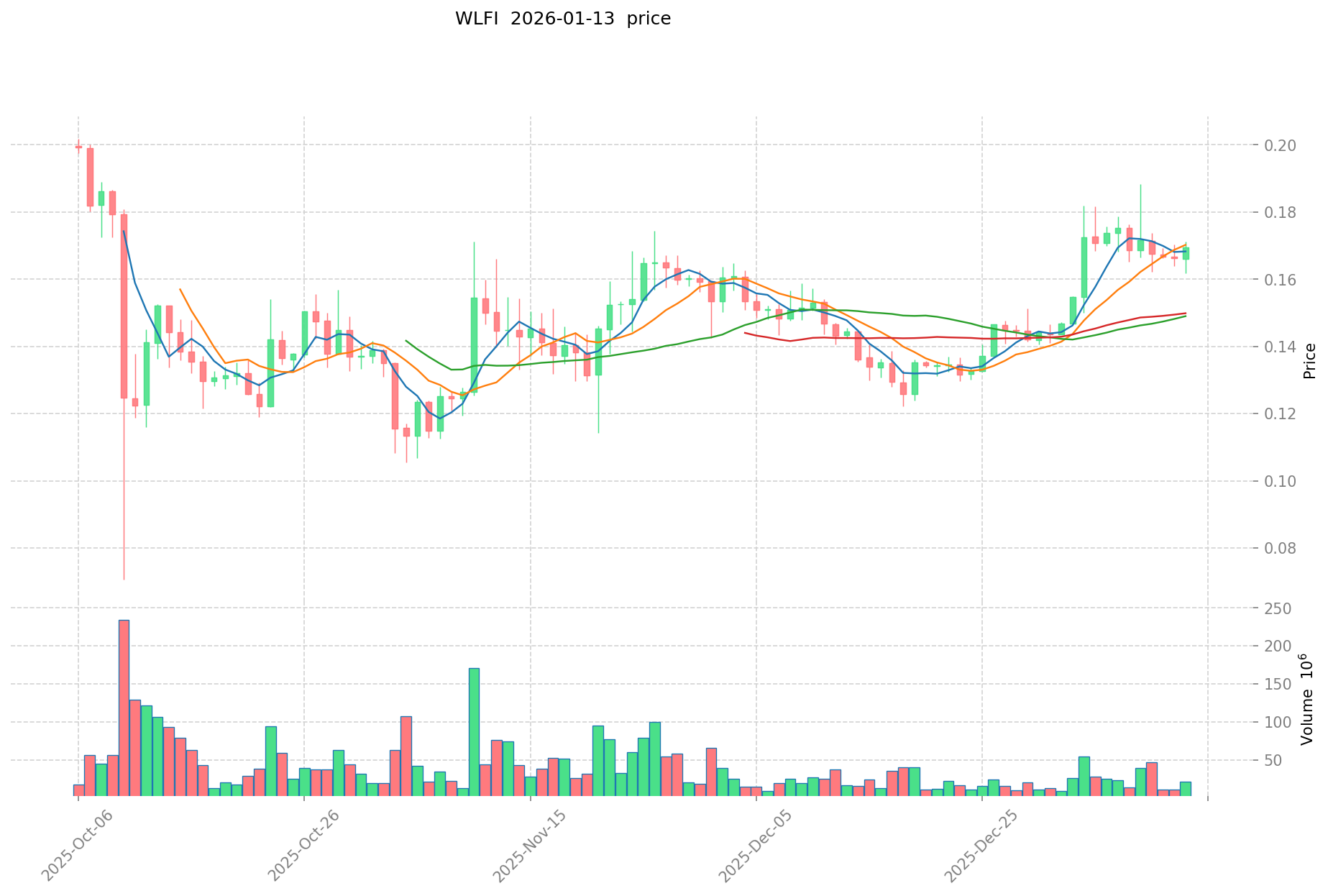
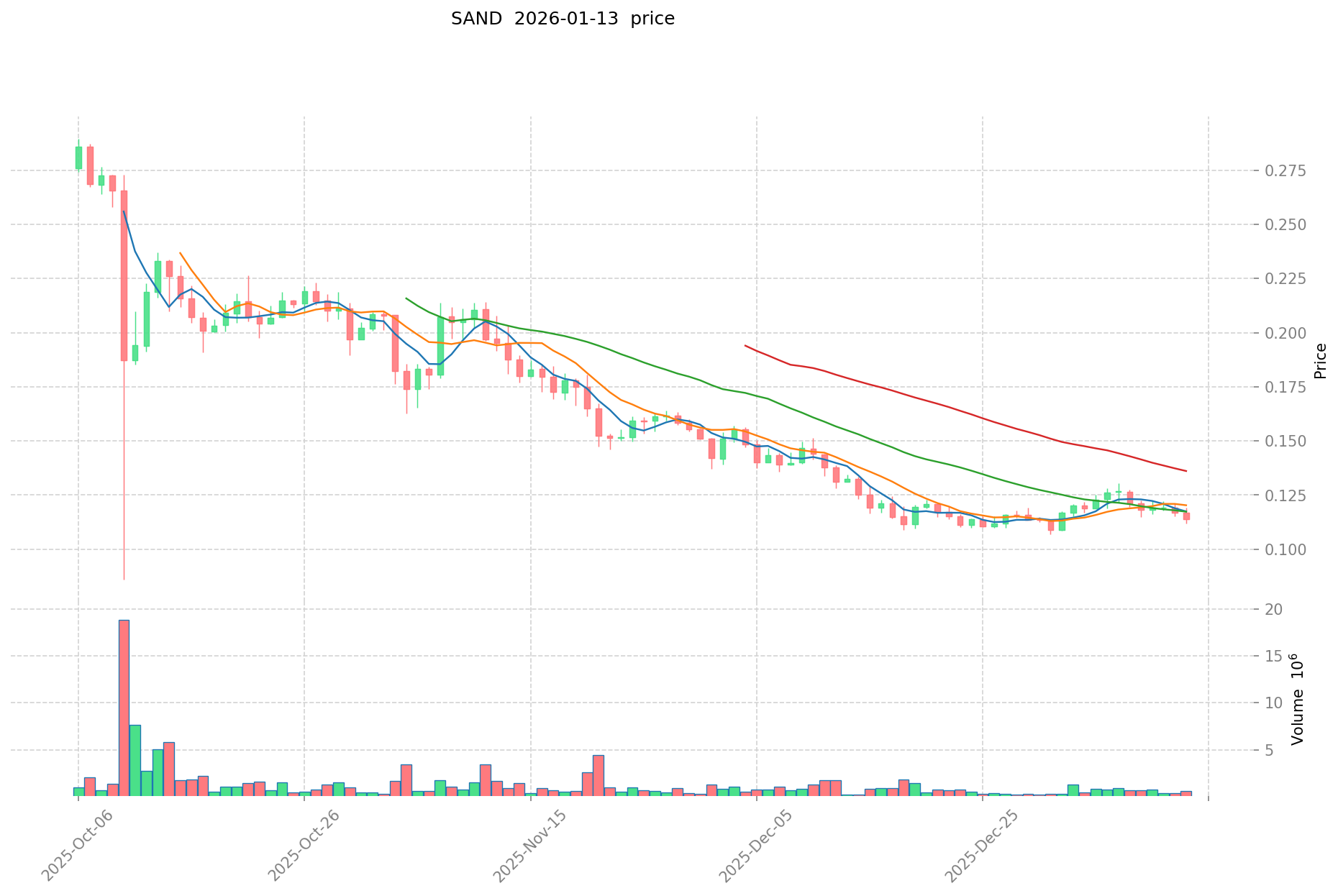
Price Trends of WLFI (Coin A) and SAND (Coin B)
- 2025: WLFI reached its historical high of $1.1 in September 2025, followed by a decline to its historical low of $0.0706 in October 2025.
- 2021: SAND reached its historical high of $8.4 in November 2021, while its historical low of $0.02897764 occurred in November 2020.
- Comparative Analysis: WLFI, as a newer token launched in 2025, experienced significant volatility within its first year, with price movements ranging between $0.0706 and $1.1. SAND, with a longer market presence since 2020, demonstrated a broader historical range from $0.02897764 to $8.4, though recent data suggests sustained downward pressure over the past year.
Current Market Conditions (2026-01-13)
- WLFI Current Price: $0.1704
- SAND Current Price: $0.1172
- 24-hour Trading Volume: WLFI recorded $2,919,748.20, while SAND registered $63,977.55
- Market Sentiment Index (Fear & Greed Index): 26 (Fear)
View real-time prices:
II. Core Factors Influencing WLFI vs SAND Investment Value
Supply Mechanism Comparison (Tokenomics)
-
WLFI: According to reference materials, WLFI has a total supply of 100 billion tokens with approximately 24.67 billion in circulation. The token employs a dual-token architecture consisting of the governance token WLFI and stablecoin USD1. Over 20% of the supply is held by the Trump family, with founder, advisor, and partner tokens remaining locked. The project implements a phased unlocking mechanism, with 20% of tokens becoming claimable on September 1st through a two-step process.
-
SAND: Reference materials do not provide specific information regarding SAND's supply mechanism or tokenomics structure.
-
📌 Historical Pattern: The distribution structure and unlocking schedule of WLFI tokens may influence price volatility, particularly during major unlock events when significant token quantities enter circulation.
Institutional Adoption and Market Application
-
Institutional Holdings: According to materials, WLFI has attracted participation from several institutions including ALT5 Sigma Corporation (announced $1.5 billion registered direct offering for WLFI treasury strategy), B2C2 Group (committed $80 million), and Aqua1 Fund (subscribed $80 million in WLFI tokens). However, materials note that major crypto institutions such as Grayscale and Ark Capital have not entered WLFI positions. One Trump-affiliated company reportedly reduced its WLFI stake from 60% to 40% in June.
-
Enterprise Adoption: WLFI's product architecture aims to connect traditional finance with DeFi through its institutional-grade stablecoin USD1 and community-driven governance token. The project features multi-chain deployment, compliance management including KYC and third-party audits, and community governance mechanisms.
-
National Policies: Materials indicate that WLFI's political connections and regulatory environment significantly impact its value. The project's association with political figures introduces unique regulatory considerations that may affect its market performance differently across jurisdictions.
Technical Development and Ecosystem Building
-
WLFI Technical Development: WLFI operates as a governance token supporting DeFi protocols, focusing on promoting USD-based stablecoin development. The project implements a dual-token architecture with multi-chain deployment capabilities and emphasizes compliance features including KYC processes and third-party auditing mechanisms.
-
SAND Technical Development: Reference materials do not contain specific information regarding SAND's technical upgrades or development roadmap.
-
Ecosystem Comparison: WLFI positions itself within the DeFi sector with governance functionality and stablecoin integration. Materials describe it as attempting to bridge traditional finance and decentralized finance through its USD1 stablecoin and governance structure. The project's ecosystem focuses on compliance-friendly DeFi services.
Macroeconomic Environment and Market Cycles
-
Performance in Inflationary Environments: WLFI's focus on USD-based stablecoins and its positioning to maintain dollar dominance in the global financial system may influence its relationship with inflationary dynamics. However, materials emphasize that cryptocurrency investments involve substantial risk and price fluctuations.
-
Macroeconomic Monetary Policy: Materials note that WLFI's value depends on multiple factors including market trends, regulatory environment, and political influence. The project's political connections may create unique sensitivities to policy changes and regulatory developments.
-
Geopolitical Factors: WLFI's political associations and its stated mission to support USD-based financial infrastructure suggest potential connections to geopolitical considerations. Materials indicate that political background and market sentiment significantly influence WLFI's investment landscape, though specific cross-border transaction data is not provided in the reference materials.
III. 2026-2031 Price Forecast: WLFI vs SAND
Short-term Forecast (2026)
- WLFI: Conservative $0.102-$0.170 | Optimistic $0.170-$0.228
- SAND: Conservative $0.073-$0.117 | Optimistic $0.117-$0.161
Medium-term Forecast (2028-2029)
- WLFI may enter a consolidation phase with estimated price range of $0.129-$0.252 in 2028, potentially expanding to $0.147-$0.319 by 2029
- SAND may experience gradual growth trajectory with projected range of $0.118-$0.228 in 2028, potentially reaching $0.120-$0.282 by 2029
- Key drivers: Institutional capital inflows, ETF developments, ecosystem expansion
Long-term Forecast (2030-2031)
- WLFI: Base scenario $0.222-$0.404 (2030) | Optimistic scenario $0.207-$0.482 (2031)
- SAND: Base scenario $0.168-$0.354 (2030) | Optimistic scenario $0.196-$0.309 (2031)
View detailed price predictions for WLFI and SAND
Disclaimer: Price forecasts are based on historical data analysis and market modeling. Cryptocurrency markets are highly volatile and subject to numerous unpredictable factors. These projections should not be considered as investment advice or guarantees of future performance.
WLFI:
| Year |
Predicted High Price |
Predicted Average Price |
Predicted Low Price |
Price Change |
| 2026 |
0.227934 |
0.1701 |
0.10206 |
0 |
| 2027 |
0.21692853 |
0.199017 |
0.18110547 |
16 |
| 2028 |
0.25164704565 |
0.207972765 |
0.1289431143 |
22 |
| 2029 |
0.31943576840175 |
0.229809905325 |
0.147078339408 |
34 |
| 2030 |
0.403695570189161 |
0.274622836863375 |
0.222444497859333 |
61 |
| 2031 |
0.4816060690073 |
0.339159203526268 |
0.206887114151023 |
99 |
SAND:
| Year |
Predicted High Price |
Predicted Average Price |
Predicted Low Price |
Price Change |
| 2026 |
0.160838 |
0.1174 |
0.072788 |
0 |
| 2027 |
0.18920184 |
0.139119 |
0.10573044 |
18 |
| 2028 |
0.2281829838 |
0.16416042 |
0.1181955024 |
40 |
| 2029 |
0.282487250736 |
0.1961717019 |
0.119664738159 |
67 |
| 2030 |
0.35420762495064 |
0.239329476318 |
0.1675306334226 |
104 |
| 2031 |
0.308639292659692 |
0.29676855063432 |
0.195867243418651 |
153 |
IV. Investment Strategy Comparison: WLFI vs SAND
Long-term vs Short-term Investment Strategies
-
WLFI: May appeal to investors interested in DeFi governance mechanisms, USD-based stablecoin ecosystems, and exposure to politically-connected crypto projects. The token's dual-architecture design and focus on bridging traditional finance with decentralized systems could attract those seeking participation in emerging financial infrastructure. Given its recent launch in 2025 and ongoing token unlock schedule, WLFI may present higher volatility suitable for investors with tolerance for price fluctuations.
-
SAND: Could be suitable for investors focused on metaverse and gaming sector exposure, seeking participation in virtual world economies and blockchain-based gaming experiences. With a longer market presence since 2020, SAND offers historical performance data spanning multiple market cycles, which may appeal to investors preferring assets with established track records.
Risk Management and Asset Allocation
-
Conservative Investors: Consider a diversified approach with lower allocation to higher-volatility assets. A potential framework might include WLFI: 20-30% vs SAND: 20-30%, with the remainder in stablecoins or established cryptocurrencies to manage downside risk.
-
Aggressive Investors: May pursue higher concentration in growth-oriented positions. A potential allocation could include WLFI: 40-50% vs SAND: 30-40%, accepting increased volatility for potential returns. This approach assumes active portfolio monitoring and risk tolerance for significant price movements.
-
Hedging Tools: Implementation of risk mitigation strategies including stablecoin reserves (15-30% of portfolio), options contracts for downside protection, cross-asset diversification across different crypto sectors, and regular rebalancing based on market conditions and individual risk parameters.
V. Potential Risk Comparison
Market Risk
-
WLFI: Faces volatility associated with newer market entrants, having experienced substantial price fluctuations between $0.0706 and $1.1 within its first year. The token's political associations may create sensitivity to policy developments and regulatory announcements. Additionally, the ongoing token unlock schedule could introduce supply-side pressure on prices as locked tokens become available. Current 24-hour trading volume of $2,919,748.20 suggests liquidity considerations for larger position sizes.
-
SAND: Demonstrates historical volatility with prices ranging from $0.02897764 to $8.4 across its market history. Recent data indicates sustained price pressure over the past year. Current trading volume of $63,977.55 suggests lower liquidity conditions compared to peak periods. The token's correlation with metaverse and gaming sector sentiment may create exposure to broader trends in these industries.
Technical Risk
-
WLFI: As a governance token operating within a DeFi protocol, technical considerations include smart contract security, multi-chain deployment complexity, and the operational stability of its dual-token architecture involving both WLFI and USD1. The project's compliance features including KYC processes and third-party audits aim to address some technical and operational risks, though the effectiveness of these measures requires ongoing monitoring.
-
SAND: Reference materials do not provide specific technical risk information for SAND.
Regulatory Risk
- Global Regulatory Impact: Both assets face evolving regulatory frameworks across different jurisdictions. WLFI's political connections and focus on USD-based financial infrastructure may create unique regulatory considerations, with potential varying impacts across different markets. The project's emphasis on compliance mechanisms including KYC suggests awareness of regulatory requirements. SAND's positioning in gaming and metaverse sectors faces regulatory developments specific to virtual assets, digital property rights, and gaming-related cryptocurrency applications. Investors should monitor regulatory announcements in their respective jurisdictions that may affect either asset's trading, custody, or use cases.
VI. Conclusion: Which Is the Better Buy?
📌 Investment Value Summary:
-
WLFI Characteristics: Represents exposure to DeFi governance, USD-based stablecoin ecosystems, and politically-connected crypto projects. Features a dual-token architecture with multi-chain deployment and compliance-focused design. The token's recent launch and significant holder concentration (over 20% held by Trump family) create distinct risk-return dynamics. Current price of $0.1704 represents substantial decrease from its September 2025 high of $1.1.
-
SAND Characteristics: Provides access to metaverse and blockchain gaming sectors with established market presence since 2020. Historical performance demonstrates both significant upside potential (reaching $8.4 in November 2021) and substantial downside risk. Current price of $0.1172 reflects extended period of price pressure. The token's association with virtual world development and gaming experiences positions it within growing sectors of blockchain application.
✅ Investment Considerations:
-
Beginning Investors: Should approach both assets with caution given their volatility and specialized positioning. Consider starting with smaller allocations as part of a diversified portfolio including established cryptocurrencies and stablecoins. Prioritize understanding each project's fundamentals, risk factors, and personal risk tolerance before committing capital. Educational focus on DeFi mechanisms (for WLFI) or metaverse concepts (for SAND) may help inform investment decisions.
-
Experienced Investors: May evaluate both assets based on portfolio strategy and sector exposure preferences. WLFI offers participation in DeFi governance and politically-connected projects, while SAND provides gaming and metaverse sector access. Consider position sizing relative to overall portfolio risk, liquidity requirements, and correlation with existing holdings. Active monitoring of token unlocks (WLFI), regulatory developments, and sector-specific catalysts may inform tactical adjustments.
-
Institutional Investors: Should conduct comprehensive due diligence on both assets including legal, compliance, and operational considerations. WLFI's institutional participation from entities such as B2C2 Group and Aqua1 Fund suggests some institutional interest, though materials note absence of major crypto institutions like Grayscale and Ark Capital. Institutional considerations include custody solutions, regulatory approval in relevant jurisdictions, position sizing within investment mandates, and ongoing monitoring frameworks for political, technical, and market developments affecting both assets.
⚠️ Risk Disclosure: Cryptocurrency markets demonstrate high volatility and involve substantial risk of loss. This analysis does not constitute investment advice, financial guidance, or recommendations to buy, sell, or hold any cryptocurrency. Investors should conduct independent research, consult qualified financial advisors, and carefully consider their financial situation, investment objectives, and risk tolerance before making investment decisions. Past performance does not indicate future results. The information presented reflects conditions as of 2026-01-13 and may change rapidly. Political associations, regulatory developments, technological changes, and market conditions can significantly impact cryptocurrency values in unpredictable ways.
VII. FAQ
Q1: What are the main differences between WLFI and SAND in terms of their use cases?
WLFI functions as a DeFi governance token focused on USD-based stablecoin ecosystems and bridging traditional finance with Web3, while SAND serves as a metaverse and gaming token powering virtual world experiences. WLFI operates within a dual-token architecture (WLFI governance token and USD1 stablecoin) emphasizing compliance features, multi-chain deployment, and institutional-grade DeFi services. SAND, launched in 2020, enables users to create, own, and monetize gaming experiences through blockchain technology within The Sandbox virtual world. The fundamental distinction lies in their sectoral positioning: WLFI targets financial infrastructure and dollar-denominated DeFi protocols, while SAND focuses on gaming, virtual property, and metaverse economy development.
Q2: How does the token supply structure impact the investment risk profile of WLFI compared to SAND?
WLFI presents higher concentration risk with over 20% of its 100 billion total supply held by the Trump family and significant portions held by founders, advisors, and partners under lock-up arrangements. The project implements a phased unlocking mechanism, with 20% of tokens becoming claimable starting September 1st through a two-step process. This concentrated ownership structure and scheduled unlock events may create supply-side pressure and increased volatility. Currently, approximately 24.67 billion WLFI tokens circulate in the market. Reference materials do not provide specific tokenomics information for SAND, limiting direct comparison of its supply dynamics. However, WLFI's transparent but concentrated distribution structure represents a distinct risk factor that investors should consider when evaluating position sizes and potential price volatility during unlock periods.
Q3: What institutional adoption has WLFI achieved, and how does this compare to SAND?
WLFI has attracted participation from several institutional entities including ALT5 Sigma Corporation (announced $1.5 billion registered direct offering for WLFI treasury strategy), B2C2 Group (committed $80 million), and Aqua1 Fund (subscribed $80 million in WLFI tokens). However, materials indicate that major crypto institutions such as Grayscale and Ark Capital have not entered WLFI positions. Additionally, one Trump-affiliated company reportedly reduced its WLFI stake from 60% to 40% in June, suggesting some institutional repositioning. Reference materials do not contain specific information regarding SAND's institutional adoption or enterprise partnerships. The institutional landscape for WLFI demonstrates moderate participation from specialized entities but lacks engagement from established cryptocurrency investment firms, which may influence its legitimacy perception and liquidity profile in institutional markets.
Q4: How volatile have WLFI and SAND been historically, and what does this indicate for future price movements?
WLFI, launched in 2025, experienced extreme volatility within its first year, ranging from a historical high of $1.1 in September 2025 to a low of $0.0706 in October 2025—representing an 84.5% decline within weeks. Current price of $0.1704 remains substantially below its peak. SAND demonstrates broader historical volatility with a range from $0.02897764 (November 2020) to $8.4 (November 2021)—a 28,900% increase—followed by sustained downward pressure to its current $0.1172 price, representing a 98.6% decline from peak. Both assets exhibit extreme volatility characteristics common in cryptocurrency markets. WLFI's compressed volatility timeframe suggests rapid price discovery in a newer market, while SAND's multi-year range reflects broader market cycles. Historical volatility patterns indicate both assets carry substantial risk of significant price fluctuations, requiring investors to maintain appropriate position sizing and risk management strategies.
Q5: What regulatory risks specifically affect WLFI due to its political connections?
WLFI's political associations create unique regulatory considerations that may affect its market performance differently across jurisdictions. The project's positioning to support USD-based financial infrastructure and its connections to political figures introduce sensitivities to policy developments and regulatory announcements. Materials indicate that WLFI's value depends significantly on political influence and regulatory environment factors beyond typical cryptocurrency market dynamics. The project's emphasis on compliance mechanisms including KYC processes and third-party audits suggests awareness of regulatory requirements, though political associations may attract increased regulatory scrutiny. Investors should monitor regulatory developments in their specific jurisdictions, as different markets may impose varying restrictions or requirements on politically-connected crypto assets. The intersection of cryptocurrency regulation and political influence represents an evolving risk landscape that could materially impact WLFI's accessibility, trading venues, and institutional adoption.
Q6: Which asset is more suitable for conservative investors seeking stable returns?
Neither WLFI nor SAND is particularly suitable for conservative investors seeking stable returns due to their high volatility profiles and speculative nature. Both assets have demonstrated extreme price fluctuations, with WLFI declining 84.5% from its peak within weeks and SAND down 98.6% from its historical high. Conservative investors prioritizing capital preservation and predictable returns should consider limiting exposure to both assets within a diversified portfolio framework. A conservative allocation might include WLFI: 20-30% and SAND: 20-30% with the remainder in stablecoins or established cryptocurrencies to manage downside risk. However, even this approach carries substantial risk given both assets' volatility characteristics. Conservative investors should prioritize established cryptocurrencies with longer track records, higher liquidity, and lower concentration risk, while treating WLFI and SAND as higher-risk, smaller portfolio positions if included at all.
Q7: What are the key catalysts that could drive WLFI and SAND prices in 2026?
For WLFI, key catalysts include institutional capital inflows from additional financial entities, regulatory clarity regarding politically-connected crypto assets, successful implementation of its USD1 stablecoin ecosystem, scheduled token unlock events (which could create either selling pressure or demonstration of holder confidence), and developments in DeFi adoption of USD-based protocols. Political developments involving associated figures may create both positive and negative price catalysts. For SAND, potential drivers include metaverse sector growth and mainstream adoption, gaming partnerships and platform expansions, technological upgrades to The Sandbox ecosystem, broader cryptocurrency market trends affecting gaming tokens, and institutional interest in virtual world economies. Both assets remain sensitive to macroeconomic conditions, Bitcoin and Ethereum price movements, regulatory announcements in major markets, and overall cryptocurrency market sentiment. The current Fear & Greed Index of 26 (Fear) suggests market pessimism that could shift with positive catalysts.
Q8: How should investors interpret the current low trading volumes for both WLFI and SAND?
Current 24-hour trading volumes show WLFI at $2,919,748.20 and SAND at $63,977.55, both representing relatively low liquidity conditions compared to major cryptocurrencies. Low trading volume indicates several important considerations: limited market depth making larger trades more difficult to execute without significant price impact, wider bid-ask spreads increasing transaction costs, potential difficulty exiting positions quickly during market stress, and reduced institutional participation which typically requires higher liquidity for position building. For WLFI, higher volume relative to SAND may reflect ongoing interest from its institutional participants and political attention, though absolute volume remains modest. For SAND, significantly lower volume suggests reduced active trading interest despite its longer market history. Investors should account for liquidity constraints by using limit orders rather than market orders, avoiding position sizes that exceed reasonable percentages of daily volume, and maintaining realistic expectations about execution prices during volatile periods. Low liquidity amplifies both upside and downside price movements.
* The information is not intended to be and does not constitute financial advice or any other recommendation of any sort offered or endorsed by Gate.