This comprehensive analysis compares WOO and FLOW, two distinct blockchain platforms with different value propositions in the cryptocurrency market. WOO, launched in 2020 by Kronos Research, addresses fragmented liquidity through innovative single-asset mechanisms across WOO X, WOOFi, and WOOFi Pro, offering zero-fee trading for institutions and retail users on Gate. FLOW, positioned for mainstream adoption, focuses on next-generation gaming and NFT applications with protocol-level usability improvements. The article examines historical price performance, current market status as of January 2026, tokenomics, institutional adoption, and technical ecosystems to guide investment decisions. It presents price projections through 2031, tailored investment strategies for different investor profiles, and comparative risk assessments including market, technical, and regulatory factors. The analysis concludes with actionable recommendations for novice, experienced, and institutional investors seeking exposure to DeFi i
Introduction: WOO vs FLOW Investment Comparison
In the cryptocurrency market, the comparison between WOO and FLOW has remained a focal point for investors. Both projects exhibit distinct differences in market capitalization ranking, application scenarios, and price performance, representing divergent positioning within the crypto asset landscape.
WOO (WOO): Launched in 2020, WOO has gained market recognition by connecting centralized and decentralized markets to provide deep liquidity support. Incubated by leading quantitative firm Kronos Research, the platform aims to solve fragmented liquidity issues while offering zero-fee trading for institutions, exchanges, and retail users. Its ecosystem encompasses WOO X (customizable CeFi exchange), WOOFi (multichain DEX), and WOOFi Pro (on-chain order book exchange).
FLOW (FLOW): Since its launch in 2020, FLOW has been positioned as a platform for next-generation games, applications, and digital assets. Designed specifically for mainstream adoption, FLOW integrates usability improvements into the protocol layer and has attracted top developers and major brands to build innovative experiences on its network.
This article will provide a comprehensive analysis of WOO vs FLOW investment value comparison, examining historical price trends, supply mechanisms, institutional adoption, technical ecosystems, and future projections. The analysis aims to address investors' primary concern:
"Which is the better buy right now?"
I. Historical Price Comparison and Current Market Status
WOO and FLOW Historical Price Trends
- 2021: WOO reached its all-time high of $1.78 in November 2021, reflecting strong market momentum during the broader crypto bull market cycle.
- 2021: FLOW achieved its all-time high of $42.40 in April 2021, driven by significant adoption in the NFT sector, particularly through projects like NBA Top Shot.
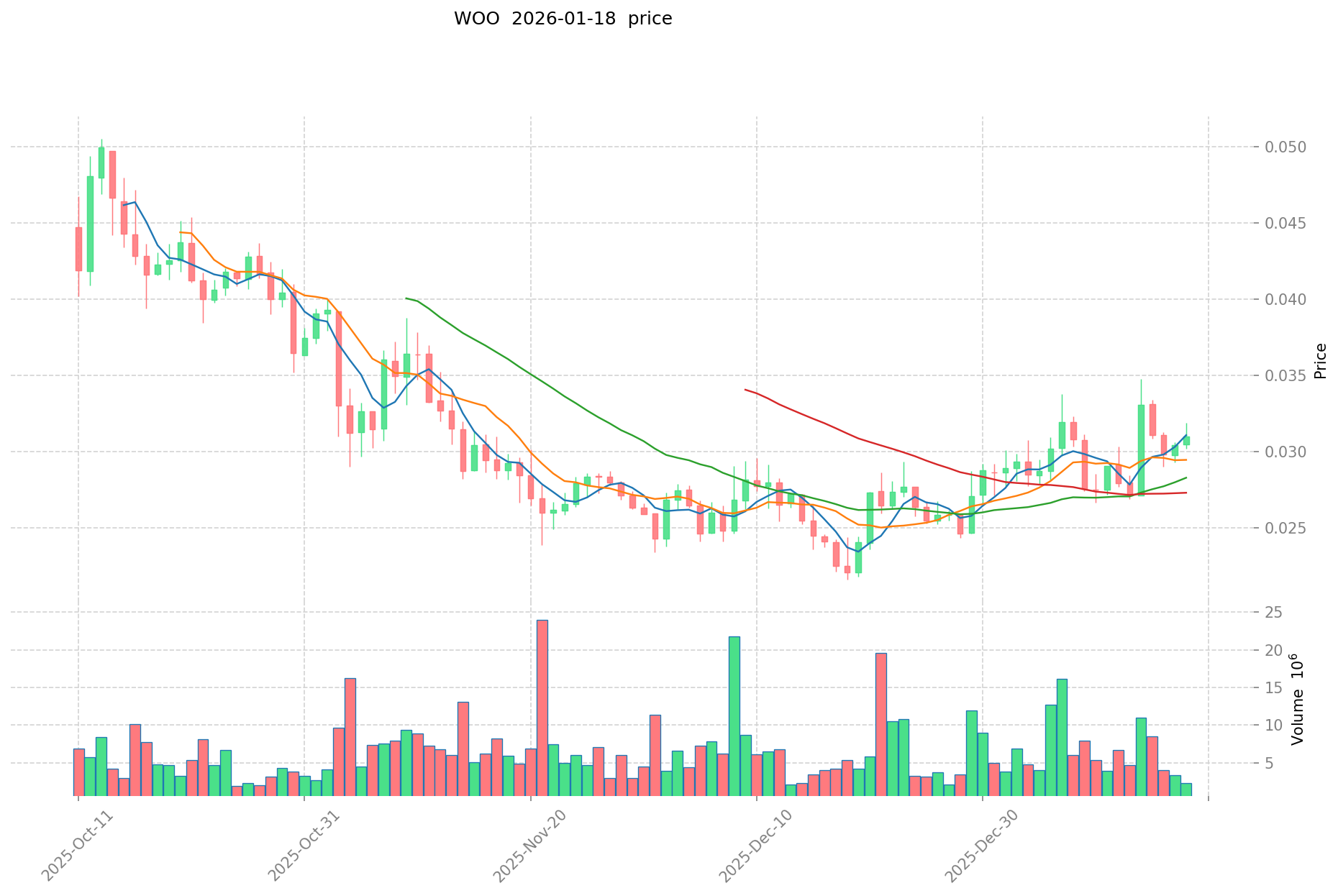
- Comparative Analysis: During the 2021-2026 market cycle, WOO declined from its peak of $1.78 to a low of $0.02175951 (recorded in December 2025), representing a significant correction. FLOW experienced a similar trajectory, falling from $42.40 to its all-time low of $0.07519 (recorded in January 2026), demonstrating substantial price volatility across both assets.
Current Market Status (2026-01-19)
- WOO Current Price: $0.03138
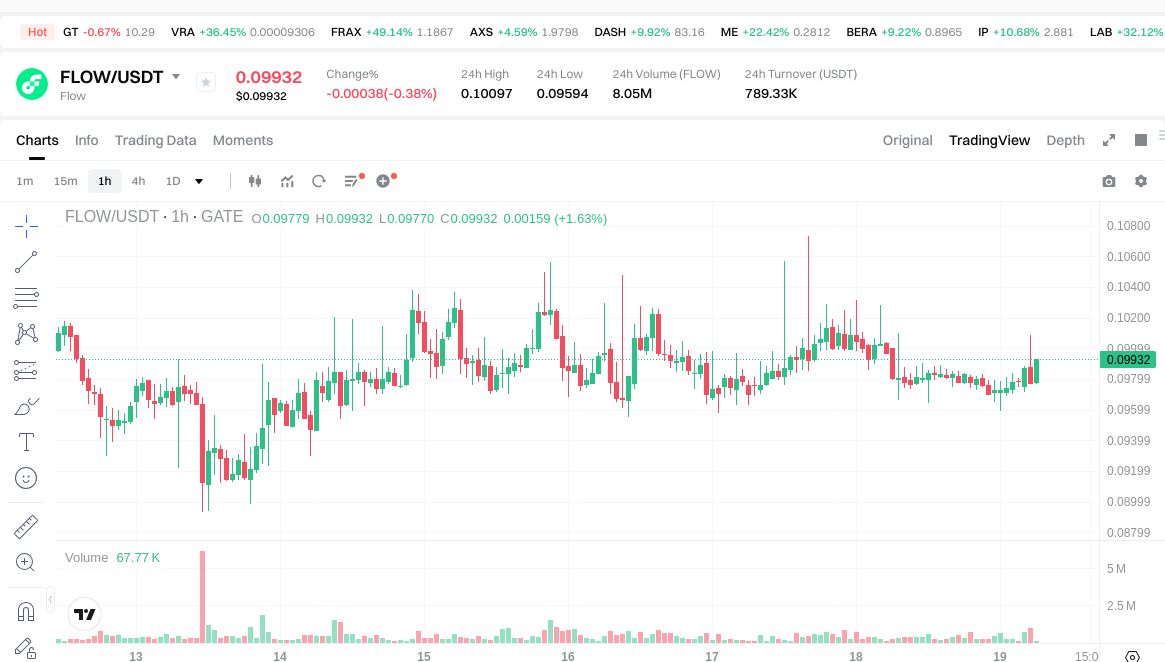
- FLOW Current Price: $0.09786
- 24-Hour Trading Volume: WOO reported $85,468.87 compared to FLOW's $785,311.56
- Market Sentiment Index (Fear & Greed Index): 49 (Neutral)
View real-time prices:
- Check WOO current price Market Price
- Check FLOW current price Market Price
II. Core Factors Influencing Investment Value: WOO vs FLOW
Tokenomics Comparison
- WOO: WOOFi introduced an innovative single-asset liquidity provision mechanism, which differs from traditional dual-asset liquidity pool (LP) systems. This approach effectively manages and rebalances assets through single-asset pools as liquidity sources, with reward-based incentive structures.
- FLOW: Specific supply mechanism details are not available in the provided materials.
- 📌 Historical Pattern: Supply mechanisms and liquidity provision models may influence price cycles through their impact on market liquidity depth and asset circulation efficiency.
Institutional Adoption and Market Application
- Institutional Holdings: Specific institutional preference data between WOO and FLOW is not available in the provided materials.
- Enterprise Adoption: Application scenarios in cross-border payments, settlements, or investment portfolios for both assets are not detailed in the available materials.
- Regulatory Landscape: National policy attitudes toward these specific assets are not covered in the provided materials.
Technology Development and Ecosystem Building
- WOO Technology: WOO X Research has documented the project's creator background, current product ecosystem status, and future potential. The project's unique liquidity mechanism and market appeal may determine its investment potential.
- FLOW Technology: Specific technical upgrades and development roadmaps are not detailed in the provided materials.
- Ecosystem Comparison: Comprehensive deployment status across DeFi, NFT, payments, and smart contract implementations for both projects is not fully covered in the available materials.
Macroeconomic Environment and Market Cycles
- Inflationary Environment Performance: Comparative anti-inflation attributes between these assets are not substantiated in the provided materials.
- Monetary Policy Impact: Specific relationships between interest rates, US Dollar Index movements, and the performance of WOO or FLOW are not documented in the available materials.
- Geopolitical Factors: Direct correlations with cross-border transaction demand and international situations are not established in the provided materials.
III. 2026-2031 Price Forecast: WOO vs FLOW
Short-term Forecast (2026)
- WOO: Conservative $0.0273 - $0.0314 | Optimistic $0.0314 - $0.0355
- FLOW: Conservative $0.0886 - $0.0985 | Optimistic $0.0985 - $0.1142
Mid-term Forecast (2028-2029)
- WOO may enter a gradual growth phase, with estimated price range of $0.0279 - $0.0622
- FLOW may enter a consolidation and expansion phase, with estimated price range of $0.0748 - $0.1423
- Key drivers: institutional capital inflows, ETF developments, ecosystem expansion
Long-term Forecast (2030-2031)
- WOO: Baseline scenario $0.0412 - $0.0528 | Optimistic scenario $0.0503 - $0.0627
- FLOW: Baseline scenario $0.1081 - $0.1299 | Optimistic scenario $0.1461 - $0.2119
View detailed price predictions for WOO and FLOW
Disclaimer
WOO:
| Year |
Predicted High Price |
Predicted Average Price |
Predicted Low Price |
Price Change |
| 2026 |
0.0354594 |
0.03138 |
0.0273006 |
0 |
| 2027 |
0.047455974 |
0.0334197 |
0.020720214 |
6 |
| 2028 |
0.04650351255 |
0.040437837 |
0.02790210753 |
29 |
| 2029 |
0.06216306492825 |
0.043470674775 |
0.03173359258575 |
38 |
| 2030 |
0.060211231630852 |
0.052816869851625 |
0.041197158484267 |
68 |
| 2031 |
0.062730596322775 |
0.056514050741238 |
0.050297505159702 |
80 |
FLOW:
| Year |
Predicted High Price |
Predicted Average Price |
Predicted Low Price |
Price Change |
| 2026 |
0.1142368 |
0.09848 |
0.088632 |
0 |
| 2027 |
0.115930656 |
0.1063584 |
0.054242784 |
8 |
| 2028 |
0.14226499584 |
0.111144528 |
0.09336140352 |
12 |
| 2029 |
0.133040000016 |
0.12670476192 |
0.0747558095328 |
28 |
| 2030 |
0.16234047621 |
0.129872380968 |
0.10909280001312 |
31 |
| 2031 |
0.21185432145405 |
0.146106428589 |
0.10811875715586 |
48 |
IV. Investment Strategy Comparison: WOO vs FLOW
Long-term vs Short-term Investment Strategies
- WOO: May suit investors focused on liquidity infrastructure and DeFi ecosystem development, particularly those interested in innovative liquidity provision mechanisms and zero-fee trading platforms.
- FLOW: May suit investors interested in NFT applications, gaming platforms, and digital asset infrastructure designed for mainstream adoption.
Risk Management and Asset Allocation
- Conservative Investors: WOO 30-40% vs FLOW 60-70%
- Aggressive Investors: WOO 50-60% vs FLOW 40-50%
- Hedging Tools: Stablecoin allocation, options strategies, cross-asset portfolio combinations
V. Potential Risk Comparison
Market Risk
- WOO: Price volatility influenced by liquidity provision dynamics, trading volume fluctuations, and competitive pressure from other DEX platforms. Historical data shows significant price corrections during broader market downturns.
- FLOW: Price sensitivity to NFT market trends and gaming sector adoption rates. Market performance may correlate with the success of major projects built on the platform.
Technical Risk
- WOO: Scalability considerations related to cross-chain operations, network stability across multiple ecosystem components (WOO X, WOOFi, WOOFi Pro), and smart contract security in liquidity pools.
- FLOW: Network scalability for mainstream adoption, potential technical challenges in protocol layer improvements, and security considerations for supporting diverse applications.
Regulatory Risk
- Global regulatory developments may impact both assets differently based on their functional classifications. WOO's exchange-related infrastructure may face regulatory scrutiny in jurisdictions with strict trading platform regulations. FLOW's focus on NFTs and gaming may encounter evolving regulatory frameworks for digital collectibles and blockchain-based entertainment.
VI. Conclusion: Which Is the Better Buy?
📌 Investment Value Summary:
- WOO Advantages: Innovative single-asset liquidity mechanism, zero-fee trading model, backing from established quantitative firm Kronos Research, comprehensive ecosystem spanning CeFi and DeFi.
- FLOW Advantages: Purpose-built for mainstream adoption, established presence in NFT and gaming sectors, protocol-level usability improvements, partnerships with major brands.
✅ Investment Recommendations:
- Novice Investors: Consider starting with smaller positions in both assets to understand their respective ecosystems and market behaviors. Prioritize education about liquidity mechanisms (WOO) and NFT platform dynamics (FLOW) before increasing allocation.
- Experienced Investors: May consider balanced exposure based on market cycle analysis and sector rotation strategies. WOO may offer opportunities during periods of increased DeFi activity, while FLOW may benefit from NFT market revivals.
- Institutional Investors: Evaluate both assets within broader portfolio context, considering liquidity depth, regulatory clarity, and alignment with institutional investment mandates. Due diligence on governance structures and long-term sustainability is essential.
⚠️ Risk Warning: The cryptocurrency market exhibits extreme volatility. This analysis does not constitute investment advice. Investors should conduct independent research and consult financial professionals before making investment decisions.
VII. FAQ
Q1: What are the main differences between WOO and FLOW's core functionalities?
WOO focuses on liquidity infrastructure connecting centralized and decentralized markets with zero-fee trading, while FLOW specializes in mainstream-oriented NFT and gaming applications with protocol-level usability improvements. WOO's ecosystem centers around its single-asset liquidity provision mechanism across WOO X (CeFi exchange), WOOFi (multichain DEX), and WOOFi Pro (on-chain order book exchange), supported by quantitative firm Kronos Research. FLOW, conversely, positions itself as a platform specifically designed for next-generation games, applications, and digital assets, having achieved notable adoption through projects like NBA Top Shot in the NFT sector.
Q2: How have WOO and FLOW performed during historical market cycles?
WOO reached its all-time high of $1.78 in November 2021, declining to a low of $0.02175951 in December 2025, representing a significant correction. FLOW achieved its all-time high of $42.40 in April 2021, falling to an all-time low of $0.07519 in January 2026. Both assets experienced substantial volatility during the 2021-2026 market cycle, with FLOW showing higher absolute price peaks but similar downward trajectories during market corrections. As of January 19, 2026, WOO trades at $0.03138 while FLOW trades at $0.09786, with FLOW maintaining approximately 3x higher price levels.
Q3: What investment allocation strategies suit different investor profiles for WOO vs FLOW?
Conservative investors may consider a 30-40% WOO and 60-70% FLOW allocation, prioritizing FLOW's established market presence and mainstream adoption focus. Aggressive investors might opt for 50-60% WOO and 40-50% FLOW, capitalizing on WOO's innovative liquidity mechanisms and potential growth opportunities. Both strategies should incorporate risk management tools including stablecoin allocations, options strategies, and cross-asset portfolio combinations. Novice investors should start with smaller positions to understand each asset's ecosystem dynamics, while experienced investors may implement sector rotation strategies based on DeFi activity cycles (favoring WOO) or NFT market revivals (favoring FLOW).
Q4: What are the primary risk factors associated with investing in WOO and FLOW?
WOO faces market risks from price volatility tied to liquidity provision dynamics, trading volume fluctuations, and competitive pressure from other DEX platforms. Technical risks include scalability considerations across cross-chain operations and smart contract security in liquidity pools. FLOW's market risks stem from price sensitivity to NFT market trends and gaming sector adoption rates, with technical challenges related to network scalability for mainstream adoption. Both assets face regulatory risks, with WOO's exchange infrastructure potentially subject to trading platform regulations, while FLOW may encounter evolving frameworks for digital collectibles and blockchain-based entertainment in various jurisdictions.
Q5: What are the price forecasts for WOO and FLOW through 2031?
For 2026, WOO's conservative forecast ranges from $0.0273 to $0.0314, with optimistic scenarios reaching $0.0355, while FLOW projects conservative estimates of $0.0886 to $0.0985 and optimistic scenarios up to $0.1142. By 2031, WOO's baseline scenario estimates $0.0412 to $0.0528 (optimistic: $0.0503 to $0.0627), representing an 80% increase from current levels. FLOW's 2031 baseline forecast ranges from $0.1081 to $0.1299 (optimistic: $0.1461 to $0.2119), indicating a 48% increase. These projections depend on factors including institutional capital inflows, ETF developments, ecosystem expansion, and broader market cycle dynamics, with mid-term phases (2028-2029) potentially showing gradual growth for WOO and consolidation-expansion patterns for FLOW.
Q6: Which asset better suits long-term holding strategies?
WOO may suit long-term investors focused on liquidity infrastructure evolution and DeFi ecosystem development, particularly those believing in the future of zero-fee trading platforms and innovative single-asset liquidity mechanisms. FLOW appeals to investors betting on mainstream adoption of blockchain technology through gaming and NFT applications, with protocol-level improvements designed for mass-market usability. Long-term holding decisions should consider WOO's backing from established quantitative firm Kronos Research and its comprehensive CeFi-DeFi ecosystem, versus FLOW's established partnerships with major brands and proven track record in the NFT sector. Both assets require thorough due diligence on governance structures, development roadmaps, and alignment with broader market trends.
Q7: How does current market sentiment affect short-term investment decisions for WOO and FLOW?
As of January 19, 2026, the market sentiment index (Fear & Greed Index) stands at 49 (Neutral), suggesting neither extreme fear nor greed conditions. WOO's 24-hour trading volume of $85,468.87 significantly trails FLOW's $785,311.56, indicating lower short-term liquidity and potentially higher volatility for WOO. In neutral sentiment environments, fundamental analysis becomes more critical than momentum-based strategies. Investors should monitor key indicators including trading volume trends, ecosystem development announcements, and broader crypto market catalysts. The current neutral sentiment may present opportunities for accumulation strategies rather than aggressive short-term trading, though positions should remain sized appropriately given both assets' historical volatility patterns.
Q8: What role should WOO and FLOW play in a diversified cryptocurrency portfolio?
WOO represents exposure to decentralized exchange infrastructure and liquidity provision innovation, serving as a DeFi-focused allocation within crypto portfolios. FLOW provides exposure to NFT platforms and blockchain gaming sectors, representing entertainment and digital asset infrastructure themes. In diversified portfolios, these assets offer non-correlated exposure to different crypto subsectors, potentially reducing overall portfolio volatility through sector diversification. Institutional investors should evaluate both assets within broader mandates, considering liquidity requirements, regulatory positioning, and correlation with traditional portfolio holdings. Hedging strategies may include pairing these growth-oriented assets with stablecoin positions, utilizing options for downside protection, or implementing cross-asset combinations with more established cryptocurrencies to balance risk-return profiles.
* The information is not intended to be and does not constitute financial advice or any other recommendation of any sort offered or endorsed by Gate.