This comprehensive guide compares WRX and CRO, two leading cryptocurrency exchange tokens with distinct positioning in the crypto market. WRX, launched in 2020, functions as WazirX's utility token offering trading fee discounts and transaction mining rewards, while CRO, since 2018, powers the Cronos blockchain ecosystem supporting 500+ DeFi and gaming developers. The article analyzes historical price trends—WRX peaked at $5.88 in April 2021 versus CRO's $0.965407 in November 2021—current market status, and 2026-2031 price forecasts across conservative and optimistic scenarios. It examines investment value through tokenomics, institutional adoption, technical development, and macroeconomic factors, providing allocation strategies for conservative (30% WRX/70% CRO) and aggressive investors (60% WRX/40% CRO). The comparison addresses liquidity differences, technical risks, regulatory considerations, and includes detailed FAQs to help investors determine which token aligns with their portfolio objectives on Gate
Introduction: Investment Comparison Between WRX and CRO
In the cryptocurrency market, the comparison between WRX vs CRO remains a topic of interest among investors. The two tokens exhibit notable differences in market cap ranking, use cases, and price performance, representing distinct positioning within the crypto asset landscape.
WRX (WRX): Launched in 2020, this token serves as the utility token for WazirX, a cryptocurrency exchange offering trading fee discounts, transaction mining rewards, and margin fee payments.
CRO (CRO): Since its 2018 launch, CRO has been positioned as the native token of the Cronos blockchain ecosystem, partnering with Crypto.com and supporting over 500 application developers with a focus on decentralized finance and gaming.
This article provides a comprehensive analysis of WRX vs CRO investment value comparison, examining historical price trends, supply mechanisms, institutional adoption, technical ecosystems, and future outlook. We aim to address the question many investors are asking:
"Which is the better buy right now?"
I. Historical Price Comparison and Current Market Status
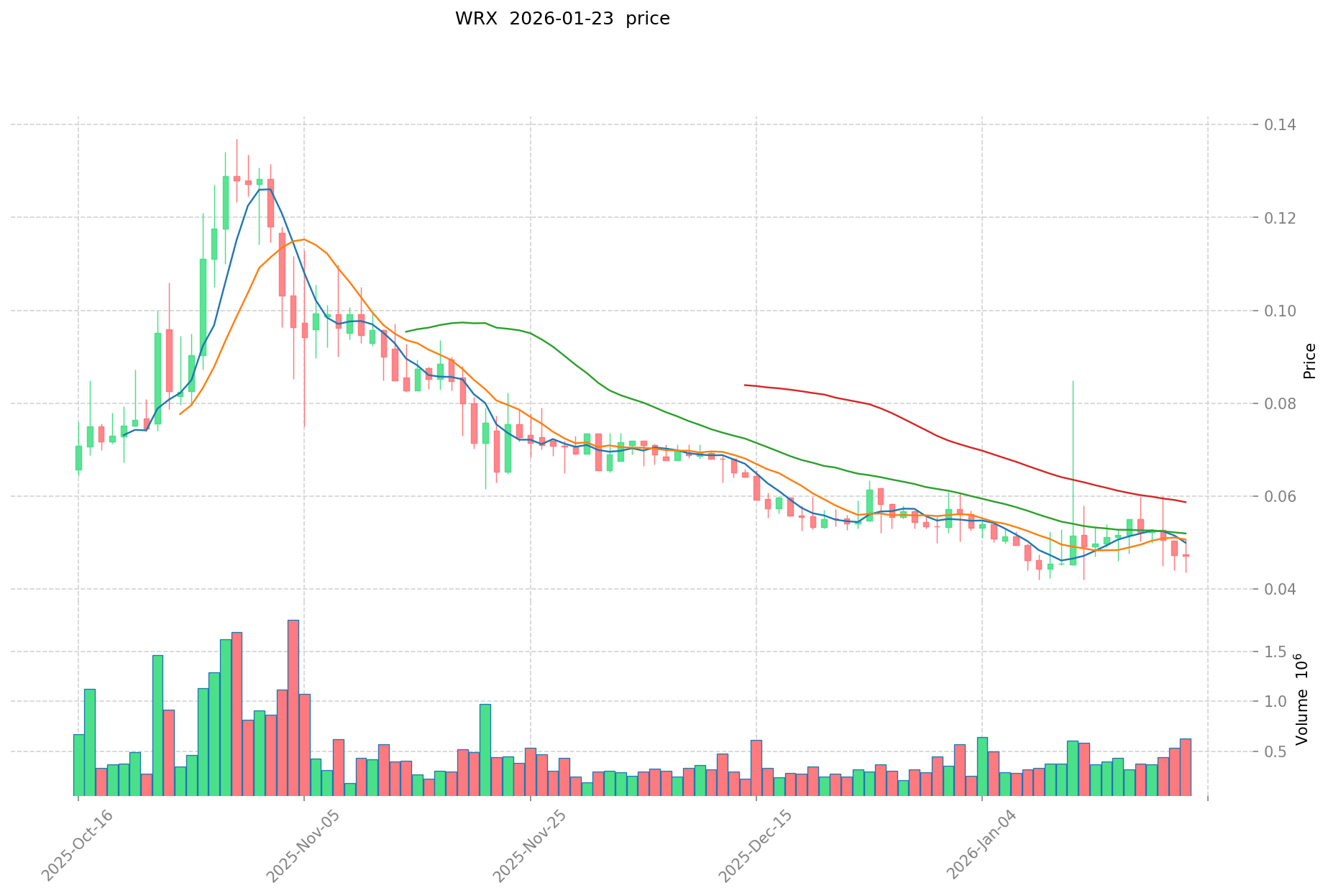
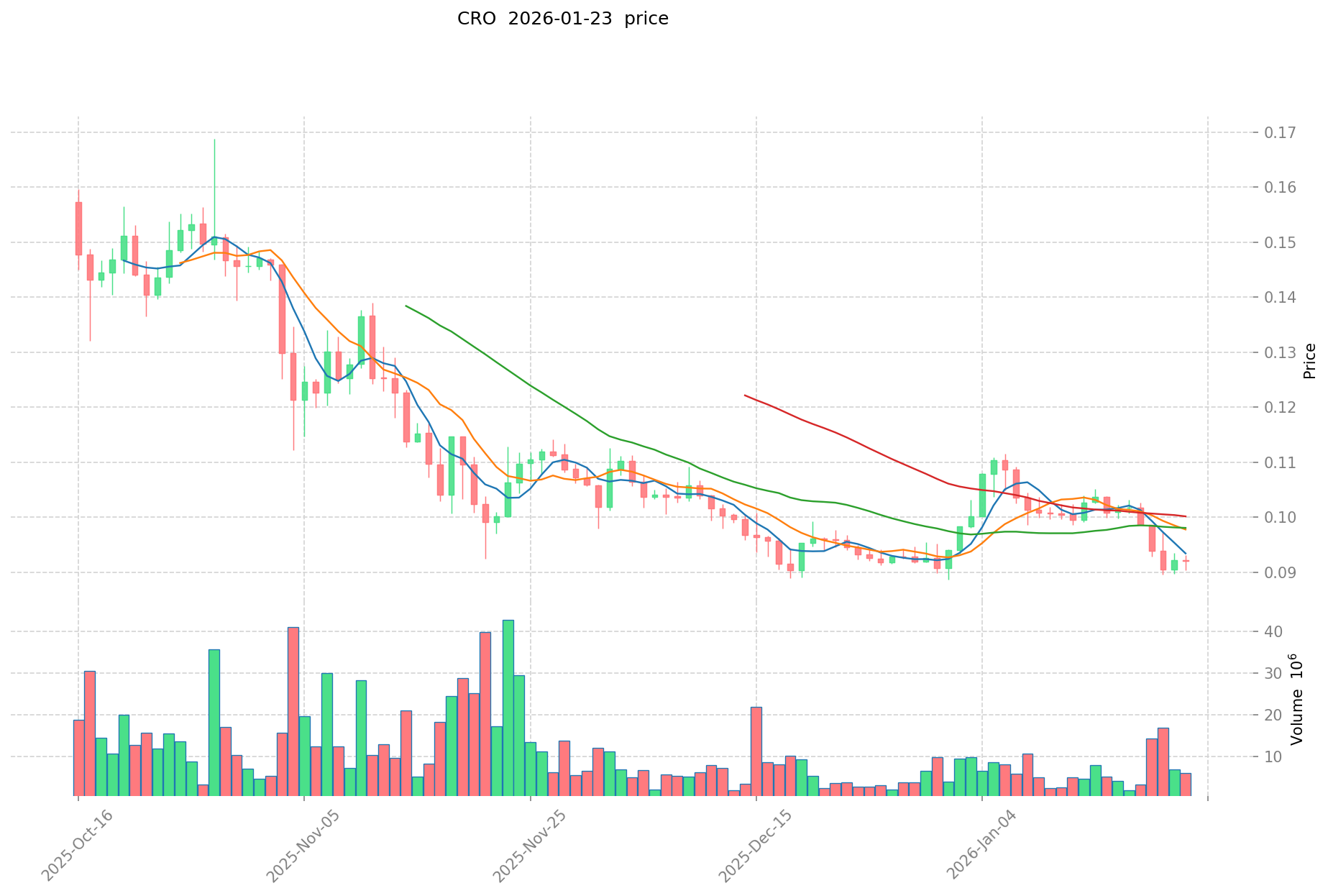
WRX and CRO Historical Price Trends
- 2021: WRX reached a notable price level during April 2021, with its all-time high recorded at $5.88 on April 5, 2021.
- 2021: CRO experienced significant market activity in November 2021, with its all-time high recorded at $0.965407 on November 24, 2021.
- Comparative Analysis: During the market cycle from 2021 to present, WRX declined from its peak of $5.88 to a low of $0.01565274 recorded on December 25, 2024, while CRO decreased from $0.965407 to $0.0121196, with its all-time low occurring on February 8, 2019.
Current Market Status (2026-01-23)
- WRX current price: $0.0443
- CRO current price: $0.0924
- 24-hour trading volume: WRX $28,903.37 vs CRO $568,810.34
- Market Sentiment Index (Fear & Greed Index): 24 (Extreme Fear)
View real-time prices:
II. Core Factors Affecting the Investment Value of WRX vs CRO
Supply Mechanism Comparison (Tokenomics)
Due to limited available data on the specific supply mechanisms of WRX and CRO, a comprehensive comparison cannot be provided at this time. Supply-related details such as total supply caps, circulation patterns, and deflationary or inflationary models require verified technical documentation.
Institutional Adoption and Market Application
Without concrete data on institutional holdings, enterprise-level adoption cases, or specific regulatory stances across different jurisdictions for WRX and CRO, this analysis cannot determine which asset demonstrates stronger institutional preference. Cross-border payment integration, settlement infrastructure usage, and portfolio inclusion metrics are not available in the reference materials.
Technical Development and Ecosystem Building
The reference materials do not contain sufficient information regarding recent technical upgrades, development roadmaps, or ecosystem expansion for either WRX or CRO. Comparative analysis of DeFi integration, NFT marketplace presence, payment system implementations, and smart contract deployment cannot be conducted without substantiated data.
Macroeconomic Conditions and Market Cycles
Analysis of how WRX and CRO perform under different macroeconomic conditions requires historical performance data that is not present in the provided materials. Comparative assessment of inflation-hedging properties, sensitivity to interest rate changes, US dollar index correlations, and geopolitical risk factors cannot be established without empirical evidence.
III. 2026-2031 Price Forecast: WRX vs CRO
Short-term Forecast (2026)
- WRX: Conservative $0.029-$0.045 | Optimistic $0.045-$0.053
- CRO: Conservative $0.063-$0.092 | Optimistic $0.092-$0.101
Mid-term Forecast (2028-2029)
- WRX may enter a consolidation phase, with projected price range of $0.036-$0.077 in 2028, potentially expanding to $0.058-$0.081 by 2029
- CRO may enter a growth phase, with projected price range of $0.076-$0.127 in 2028, potentially reaching $0.058-$0.134 by 2029
- Key drivers: institutional capital inflows, ETF developments, ecosystem expansion
Long-term Forecast (2030-2031)
- WRX: Baseline scenario $0.051-$0.077 | Optimistic scenario $0.077-$0.084
- CRO: Baseline scenario $0.072-$0.126 | Optimistic scenario $0.126-$0.149
View detailed price predictions for WRX and CRO
Disclaimer
WRX:
| Year |
Predicted High Price |
Predicted Average Price |
Predicted Low Price |
Price Change |
| 2026 |
0.0525798 |
0.04494 |
0.029211 |
1 |
| 2027 |
0.054611088 |
0.0487599 |
0.027793143 |
10 |
| 2028 |
0.07701138606 |
0.051685494 |
0.03566299086 |
16 |
| 2029 |
0.0810790344378 |
0.06434844003 |
0.057913596027 |
45 |
| 2030 |
0.082166523074307 |
0.0727137372339 |
0.061806676648815 |
64 |
| 2031 |
0.084409741867972 |
0.077440130154103 |
0.051110485901708 |
74 |
CRO:
| Year |
Predicted High Price |
Predicted Average Price |
Predicted Low Price |
Price Change |
| 2026 |
0.1006288 |
0.09232 |
0.0627776 |
0 |
| 2027 |
0.102262864 |
0.0964744 |
0.088756448 |
4 |
| 2028 |
0.12719184896 |
0.099368632 |
0.07552016032 |
7 |
| 2029 |
0.1336706837664 |
0.11328024048 |
0.0577729226448 |
22 |
| 2030 |
0.128414480608128 |
0.1234754621232 |
0.109893161289648 |
33 |
| 2031 |
0.148615066211483 |
0.125944971365664 |
0.071788633678428 |
36 |
IV. Investment Strategy Comparison: WRX vs CRO
Long-term vs Short-term Investment Strategies
- WRX: May appeal to investors focusing on exchange utility token models and trading ecosystem participation, considering its role within the WazirX platform for fee discounts and transaction rewards
- CRO: May suit investors interested in blockchain ecosystem development and decentralized application infrastructure, given its positioning within the Cronos network supporting DeFi and gaming applications
Risk Management and Asset Allocation
- Conservative Investors: WRX 30% vs CRO 70%
- Aggressive Investors: WRX 60% vs CRO 40%
- Hedging Tools: stablecoin allocation, options strategies, cross-asset portfolio diversification
V. Potential Risk Comparison
Market Risk
- WRX: Trading volume of $28,903.37 indicates relatively lower liquidity levels, which may result in higher price volatility during market movements
- CRO: Trading volume of $568,810.34 suggests comparatively higher market activity, though both assets remain subject to broader cryptocurrency market fluctuations
Technical Risk
- WRX: Network scalability and platform stability considerations related to exchange infrastructure
- CRO: Blockchain network performance, developer ecosystem sustainability, and smart contract security considerations
Regulatory Risk
- Both tokens face varying regulatory approaches across different jurisdictions, with exchange-based tokens and blockchain platform tokens subject to distinct compliance frameworks that may evolve over time
VI. Conclusion: Which Is the Better Buy?
📌 Investment Value Summary:
- WRX Characteristics: Exchange utility token with trading incentive mechanisms, launched in 2020 with specific use cases within the WazirX ecosystem
- CRO Characteristics: Blockchain ecosystem token supporting developer infrastructure since 2018, with applications spanning DeFi and gaming sectors
✅ Investment Considerations:
- Beginning Investors: Consider diversified allocation between both assets with emphasis on understanding exchange utility versus blockchain platform value propositions
- Experienced Investors: Evaluate portfolio positioning based on risk tolerance, with attention to liquidity differences and ecosystem development trajectories
- Institutional Investors: Assess regulatory compliance frameworks and operational infrastructure supporting each token within relevant jurisdictions
⚠️ Risk Disclosure: Cryptocurrency markets exhibit substantial volatility. This content does not constitute investment advice.
VII. FAQ
Q1: What is the primary difference between WRX and CRO tokens?
WRX serves as an exchange utility token for WazirX platform operations, while CRO functions as a blockchain ecosystem token for the Cronos network. WRX launched in 2020 focuses on trading fee discounts, transaction mining rewards, and margin payments within a centralized exchange environment. CRO, launched in 2018, supports over 500 application developers across decentralized finance and gaming sectors, representing a broader blockchain infrastructure approach rather than exchange-specific utility.
Q2: Which token shows higher current market liquidity?
CRO demonstrates significantly higher liquidity with 24-hour trading volume of $568,810.34 compared to WRX's $28,903.37. This approximately 20-fold difference in trading volume indicates that CRO offers substantially better market depth, potentially resulting in lower slippage during transactions and reduced price volatility from individual trades. Higher liquidity generally provides investors with more efficient entry and exit opportunities, though both assets remain subject to broader cryptocurrency market dynamics.
Q3: How do the all-time high prices of WRX and CRO compare?
WRX reached its all-time high of $5.88 on April 5, 2021, while CRO achieved its peak of $0.965407 on November 24, 2021. From these peaks, WRX declined to a low of $0.01565274 by December 25, 2024, representing approximately 99.7% drawdown, whereas CRO's all-time low of $0.0121196 occurred on February 8, 2019, before its 2021 peak. Current prices as of January 23, 2026 stand at $0.0443 for WRX and $0.0924 for CRO, both significantly below their historical highs.
Q4: What are the projected price ranges for 2030?
Conservative 2030 projections estimate WRX between $0.051-$0.077, with optimistic scenarios reaching $0.077-$0.084. For CRO, baseline forecasts suggest $0.072-$0.126, while optimistic scenarios project $0.126-$0.149. These projections reflect potential long-term growth trajectories based on ecosystem development, institutional adoption patterns, and broader market cycles. However, cryptocurrency price predictions carry substantial uncertainty, and actual outcomes may differ significantly from forecasted ranges due to technological developments, regulatory changes, and macroeconomic factors.
Q5: What portfolio allocation strategy should conservative investors consider?
Conservative investors may consider a 30% WRX and 70% CRO allocation strategy. This weighting favors CRO's higher liquidity profile and broader blockchain ecosystem positioning while maintaining WRX exposure for exchange utility token diversification. Conservative approaches should incorporate risk management tools including stablecoin allocation for portfolio stability, options strategies for downside protection, and cross-asset diversification beyond cryptocurrency holdings. Portfolio construction should align with individual risk tolerance, investment timeframes, and overall financial objectives.
Q6: What are the main regulatory considerations for both tokens?
Both WRX and CRO face varying regulatory frameworks across different jurisdictions, with distinct compliance considerations. Exchange-based tokens like WRX may encounter regulations specific to centralized trading platforms, securities classification determinations, and platform operational requirements. Blockchain platform tokens like CRO face considerations related to network infrastructure, smart contract oversight, and decentralized application frameworks. Regulatory environments continue evolving globally, potentially impacting operational models, market access, and compliance costs for both token categories.
Q7: Which investment strategy suits aggressive investors better?
Aggressive investors might consider a 60% WRX and 40% CRO allocation, emphasizing higher concentration in the lower-liquidity asset with potential for greater price volatility. This approach assumes willingness to accept increased risk exposure, including potential liquidity constraints during market stress periods and amplified price fluctuations. Aggressive strategies require active portfolio monitoring, clear exit parameters, and understanding of both tokens' technical ecosystems and market positioning. Such allocation should only constitute a portion of overall investment capital that investors can afford to lose without impacting financial stability.
Q8: What technical risks differentiate WRX from CRO?
WRX faces technical risks primarily related to centralized exchange infrastructure, including platform stability, network scalability during high-volume periods, and operational continuity considerations. CRO's technical risks center on blockchain network performance, smart contract security vulnerabilities, developer ecosystem sustainability, and decentralized application infrastructure reliability. Exchange-based tokens depend heavily on platform operational excellence and user trust maintenance, while blockchain ecosystem tokens require sustained developer engagement, network security, and technological competitiveness within evolving decentralized infrastructure landscapes.
* The information is not intended to be and does not constitute financial advice or any other recommendation of any sort offered or endorsed by Gate.