This comprehensive guide compares XAUT (Tether Gold), a physical gold-backed digital asset, with LTC (Litecoin), an established proof-of-work cryptocurrency, across multiple investment dimensions. XAUT offers regulated gold exposure without physical storage complexities and demonstrates resilience during economic uncertainty, while LTC provides payment infrastructure utility and potential cyclical growth opportunities. The article analyzes historical price trends, tokenomics differences, institutional adoption patterns, technological ecosystems, and 2026-2031 market forecasts to help investors determine optimal asset allocation. Conservative investors should favor XAUT (60-70%) for portfolio stability and inflation hedging, while aggressive investors may prioritize LTC (60-70%) for growth potential. Key considerations include liquidity differences ($9.07M LTC vs $7.43M XAUT trading volume), regulatory classifications, and macroeconomic sensitivity factors. The analysis provides risk management strategies, inv
Introduction: Investment Comparison Between XAUT and LTC
In the cryptocurrency market, the comparison between XAUT vs LTC has consistently been a topic investors cannot avoid. The two not only exhibit significant differences in market cap ranking, application scenarios, and price performance, but also represent distinct positioning within the crypto asset landscape.
XAUT (Tether Gold): Launched in 2020, it has gained market recognition through its positioning as a digital representation of physical gold, with each token backed by one troy ounce of London Good Delivery gold.
LTC (Litecoin): Since its launch in 2011, it has been recognized for its faster transaction confirmation speed and enhanced network efficiency, establishing itself as one of the pioneering cryptocurrencies with substantial trading volume and market presence.
This article will comprehensively analyze the investment value comparison between XAUT vs LTC, focusing on historical price trends, supply mechanisms, institutional adoption, technical ecosystems, and future predictions, attempting to address investors' most pressing question:
"Which is the better buy right now?"
I. Historical Price Comparison and Current Market Status
Tether Gold (XAUT) and Litecoin (LTC) Historical Price Trends
- 2020: XAUT recorded its lowest price point at $1,447.84 on March 19, 2020, during the early stages of the COVID-19 pandemic, reflecting the impact of global market uncertainty on gold-backed assets.
- 2021: LTC reached its historical peak at $410.26 on May 10, 2021, driven by increased institutional interest and broader cryptocurrency market momentum during that period.
- 2026: XAUT approached a notable price level at $4,622.95 on January 13, 2026, while LTC has experienced price adjustments from its previous highs.
- Comparative Analysis: During recent market cycles, XAUT has shown growth from its historical low of $1,447.84 to current levels around $4,585.70, representing a substantial increase. In contrast, LTC has declined from its peak of $410.26 to approximately $76.60, reflecting different market dynamics between gold-backed tokens and proof-of-work cryptocurrencies.
Current Market Situation (January 14, 2026)
- XAUT Current Price: $4,585.70
- LTC Current Price: $76.60
- 24-Hour Trading Volume: XAUT recorded $7.43 million, while LTC showed $9.07 million in trading activity
- Market Sentiment Index (Fear & Greed Index): 26 (Fear)
- Price Performance (24H): XAUT decreased by 0.2%, while LTC increased by 0.58%
- Market Capitalization: XAUT stands at approximately $2.38 billion with a market share of 0.071%, while LTC maintains a market cap of $5.88 billion with a 0.17% market share
- Circulating Supply: XAUT has 520,089.3 tokens in circulation (100% of total supply), compared to LTC's 76,730,214.48 tokens (91.35% of maximum supply of 84 million)
View real-time prices:
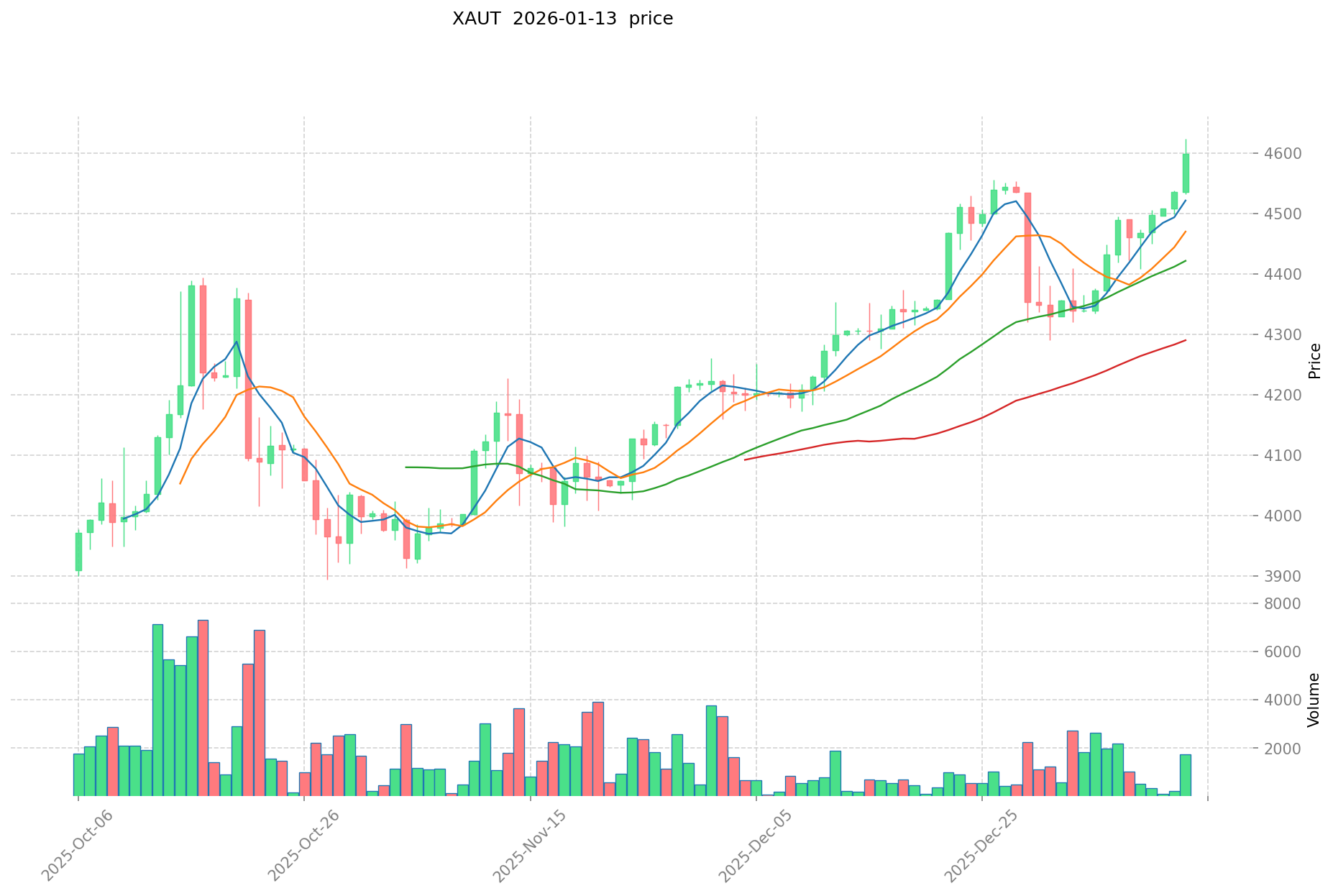
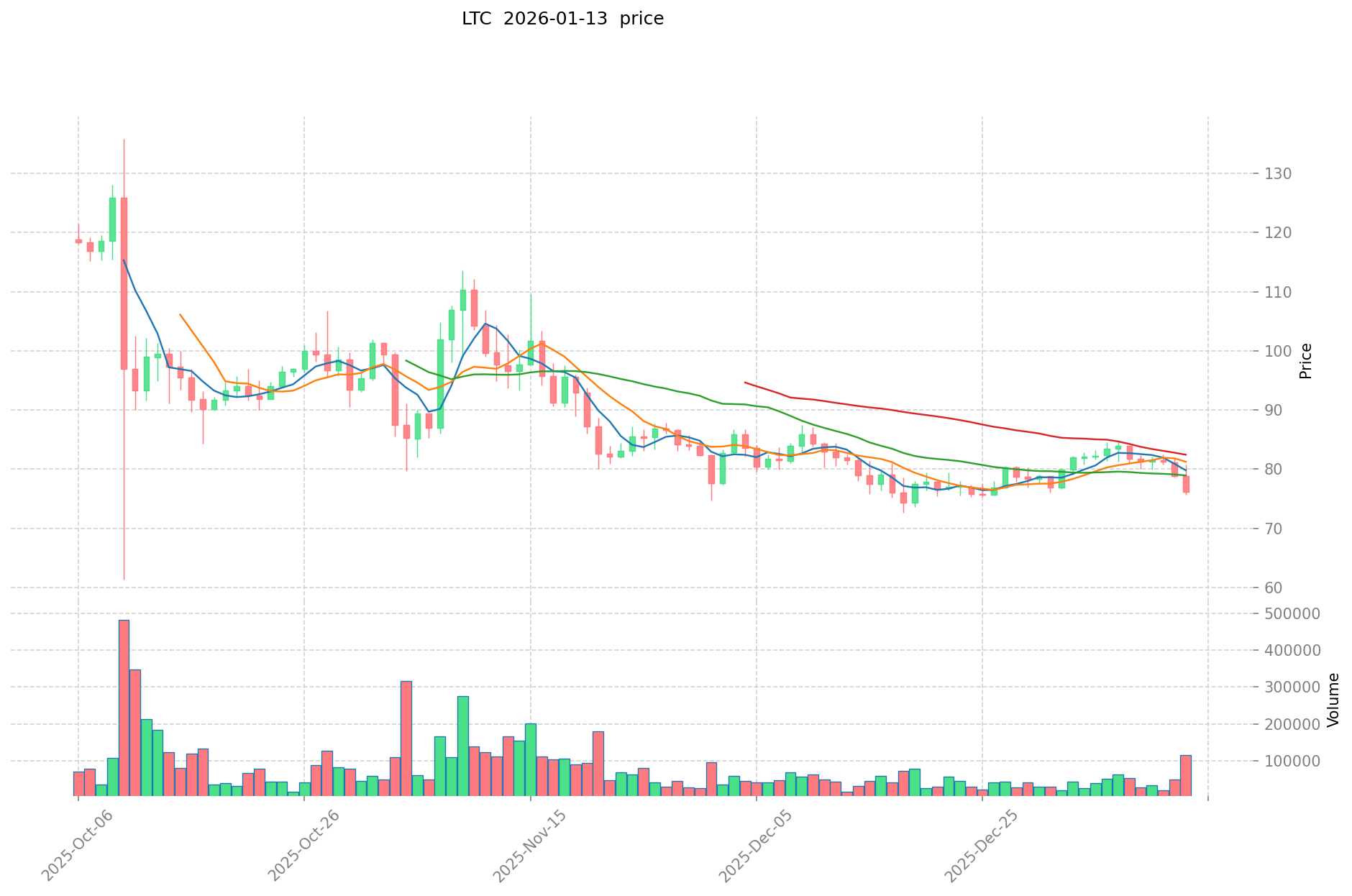
II. Core Factors Influencing XAUT vs LTC Investment Value
Supply Mechanism Comparison (Tokenomics)
-
XAUT: Each token is backed by one troy ounce of physical gold stored in Swiss vaults, with a supply directly tied to physical gold reserves. The token is divisible to six decimal places (0.000001 troy ounces), allowing fractional ownership. Supply expands or contracts based on tokenization demand for physical gold backing.
-
LTC: Operates on a fixed supply model with a maximum cap, following a halving mechanism that reduces block rewards periodically. This deflationary design aims to create scarcity over time, similar to precious metal mining dynamics.
-
📌 Historical Pattern: Supply mechanisms drive distinct price cycles - XAUT's value tracks physical gold market dynamics and macroeconomic uncertainty, while LTC's halving events have historically correlated with cyclical price movements driven by scarcity expectations.
Institutional Adoption and Market Applications
-
Institutional Holdings: XAUT appeals to institutions seeking regulated exposure to gold without physical storage complexities. Reference materials indicate growing institutional interest in gold-backed digital assets as traditional finance entities explore blockchain-based commodity exposure.
-
Enterprise Adoption: XAUT serves primarily as a digital gold reserve and portfolio diversification tool, bridging traditional finance with blockchain technology. LTC functions in cross-border payments and settlement use cases, though specific enterprise adoption metrics were not detailed in available materials.
-
National Policies: Regulatory attitudes vary across jurisdictions. The incoming U.S. administration has shown crypto-friendly signals that may benefit digital asset adoption broadly, though specific policy frameworks for gold-backed tokens versus payment cryptocurrencies differ in regulatory classification.
Technology Development and Ecosystem Building
-
XAUT Technology: Currently operates on the Ethereum blockchain. Tether is developing transparency tools allowing token holders to identify the specific gold bars backing their tokens, enhancing auditability and trust.
-
LTC Technology Development: Continues network development focused on payment efficiency and security, though specific recent upgrades were not detailed in provided materials.
-
Ecosystem Comparison: XAUT primarily serves as a store-of-value instrument with limited DeFi integration compared to broader crypto assets. LTC maintains presence in payment infrastructure and exchange ecosystems. Neither shows extensive NFT or complex smart contract applications in available data.
Macroeconomic Factors and Market Cycles
-
Performance in Inflationary Environments: XAUT's value proposition strengthens during inflationary periods as it inherits gold's traditional inflation hedge characteristics. Physical gold prices have shown resilience during economic uncertainty, with reference materials noting gold reaching elevated price levels.
-
Macroeconomic Monetary Policy: Interest rate decisions and U.S. dollar index movements inversely affect gold valuations, thereby impacting XAUT. Materials reference Federal Reserve policy considerations and dollar movements creating market dynamics. LTC pricing shows correlation with broader cryptocurrency market sentiment influenced by monetary policy expectations.
-
Geopolitical Factors: Cross-border transaction demand and international tensions typically increase safe-haven asset appeal. Materials note geopolitical developments and their market impact, with gold-backed assets potentially benefiting from uncertainty-driven demand for stability.
III. 2026-2031 Price Forecast: XAUT vs LTC
Short-term Forecast (2026)
- XAUT: Conservative $3,764.95 - $4,591.40 | Optimistic $4,591.40 - $6,703.44
- LTC: Conservative $45.16 - $76.54 | Optimistic $76.54 - $100.27
Mid-term Forecast (2028-2029)
- XAUT may enter a consolidation phase with projected prices ranging from $3,998.37 to $7,672.81, showing gradual upward momentum
- LTC may enter an expansion phase with projected prices ranging from $101.54 to $174.64, demonstrating stronger growth trajectory
- Key drivers: institutional capital flows, ETF developments, and ecosystem expansion
Long-term Forecast (2030-2031)
- XAUT: Baseline scenario $4,302.65 - $7,985.43 | Optimistic scenario $7,985.43 - $10,620.62
- LTC: Baseline scenario $83.71 - $169.74 | Optimistic scenario $169.74 - $247.82
View detailed price predictions for XAUT and LTC
Disclaimer
XAUT:
| Year |
Predicted High Price |
Predicted Average Price |
Predicted Low Price |
Price Change |
| 2026 |
6703.444 |
4591.4 |
3764.948 |
0 |
| 2027 |
7906.3908 |
5647.422 |
5195.62824 |
23 |
| 2028 |
7047.982656 |
6776.9064 |
3998.374776 |
47 |
| 2029 |
7672.81342608 |
6912.444528 |
5599.08006768 |
50 |
| 2030 |
8678.2284826776 |
7292.62897704 |
4302.6510964536 |
59 |
| 2031 |
10620.620210712204 |
7985.4287298588 |
7107.031569574332 |
74 |
LTC:
| Year |
Predicted High Price |
Predicted Average Price |
Predicted Low Price |
Price Change |
| 2026 |
100.2674 |
76.54 |
45.1586 |
0 |
| 2027 |
129.953439 |
88.4037 |
79.56333 |
15 |
| 2028 |
161.58428286 |
109.1785695 |
101.536069635 |
42 |
| 2029 |
174.6420397722 |
135.38142618 |
120.4894693002 |
76 |
| 2030 |
184.463962241559 |
155.0117329761 |
83.706335807094 |
102 |
| 2031 |
247.81725750889107 |
169.7378476088295 |
164.645712180564615 |
121 |
IV. Investment Strategy Comparison: XAUT vs LTC
Long-term vs Short-term Investment Strategies
-
XAUT: Suitable for investors seeking portfolio stability and inflation hedging characteristics, particularly those looking to diversify traditional cryptocurrency holdings with gold-backed digital assets. The asset's correlation with physical gold markets makes it appropriate for longer investment horizons during periods of economic uncertainty.
-
LTC: Suitable for investors focused on payment infrastructure development and cryptocurrency adoption cycles, particularly those comfortable with market volatility associated with proof-of-work cryptocurrencies. The asset's historical price patterns around halving events suggest potential for cyclical trading strategies.
Risk Management and Asset Allocation
-
Conservative Investors: XAUT 60-70% vs LTC 30-40% - emphasizing stability through gold-backed asset exposure while maintaining limited cryptocurrency market participation
-
Aggressive Investors: XAUT 30-40% vs LTC 60-70% - prioritizing growth potential through higher cryptocurrency exposure while using gold-backed tokens as portfolio stabilizers
-
Hedging Tools: Stablecoin allocation for liquidity management, options strategies for downside protection, cross-asset combinations balancing commodity-backed tokens with payment cryptocurrencies
V. Potential Risk Comparison
Market Risks
-
XAUT: Price movements tied to physical gold market dynamics, macroeconomic policy shifts affecting precious metal valuations, and dollar index fluctuations. Trading volume of $7.43 million indicates relatively limited liquidity compared to major cryptocurrencies, potentially impacting execution during market stress.
-
LTC: Exposure to broader cryptocurrency market sentiment cycles, correlation with major digital assets during market downturns, and historical volatility patterns. Price decline from $410.26 peak to current $76.60 level demonstrates significant drawdown risk during market corrections.
Technical Risks
-
XAUT: Dependency on blockchain infrastructure reliability, smart contract security considerations on Ethereum network, and custodial arrangements for physical gold backing requiring trust in storage mechanisms.
-
LTC: Network scalability considerations for payment use cases, mining concentration dynamics affecting decentralization, and potential security vulnerabilities requiring ongoing protocol maintenance.
Regulatory Risks
- Global regulatory frameworks treat commodity-backed tokens and payment cryptocurrencies differently across jurisdictions. XAUT faces scrutiny under securities regulations and commodity trading rules, while LTC encounters varying treatment under payment system regulations. Evolving policy environments in major markets create ongoing compliance considerations for both assets.
VI. Conclusion: Which Is the Better Buy?
📌 Investment Value Summary
-
XAUT Advantages: Provides regulated exposure to gold without physical storage requirements, offers portfolio diversification beyond traditional cryptocurrencies, demonstrates resilience during market uncertainty periods, and maintains backing by tangible physical assets
-
LTC Advantages: Established network with operational history since 2011, functions in payment infrastructure ecosystems, shows potential for cyclical price appreciation patterns, and benefits from broader cryptocurrency adoption trends
✅ Investment Recommendations
-
Novice Investors: Consider XAUT for initial cryptocurrency exposure due to its gold backing and relative stability characteristics, allowing familiarization with digital asset markets while maintaining connection to traditional commodity values
-
Experienced Investors: Evaluate portfolio allocation between both assets based on risk tolerance and market outlook - XAUT for stability during uncertain periods, LTC for participation in cryptocurrency market cycles and payment infrastructure development
-
Institutional Investors: Assess XAUT for treasury diversification and regulated commodity exposure through blockchain technology, while evaluating LTC based on specific use case requirements in payment processing or settlement infrastructure
⚠️ Risk Warning: Cryptocurrency markets exhibit substantial volatility. This content does not constitute investment advice.
VII. FAQ
Q1: What is the fundamental difference between XAUT and LTC as investment assets?
XAUT is a gold-backed digital token where each token represents one troy ounce of physical gold stored in Swiss vaults, functioning primarily as a store-of-value and inflation hedge. LTC is a proof-of-work cryptocurrency with a fixed supply cap designed for payment processing and cross-border transactions. XAUT's value tracks physical gold market dynamics and macroeconomic factors affecting precious metals, while LTC's price movements correlate with broader cryptocurrency market sentiment and adoption cycles. The core distinction lies in their backing: XAUT derives value from tangible commodity reserves, whereas LTC's value emerges from network utility and scarcity through its capped supply mechanism.
Q2: How do the supply mechanisms of XAUT and LTC impact their long-term price potential?
XAUT operates on a flexible supply model that expands or contracts based on tokenization demand for physical gold backing, with 520,089.3 tokens currently in circulation (100% of total supply). LTC follows a deflationary fixed supply model with a maximum cap, utilizing halving mechanisms that reduce block rewards periodically—currently 76,730,214.48 tokens circulate (91.35% of 84 million maximum). XAUT's supply mechanism ties its scarcity to physical gold market dynamics rather than protocol-enforced limitations, while LTC's programmatic scarcity creates predictable supply constraints that have historically correlated with cyclical price movements around halving events.
Q3: Which asset performs better during economic uncertainty and inflationary periods?
XAUT demonstrates stronger resilience during inflationary environments and economic uncertainty periods due to its inheritance of gold's traditional safe-haven characteristics. Historical data shows XAUT growing from $1,447.84 in March 2020 during early pandemic uncertainty to $4,585.70 currently, reflecting gold's appeal during turbulent economic conditions. Interest rate decisions and U.S. dollar index movements inversely affect gold valuations, thereby impacting XAUT performance. LTC's performance depends more on cryptocurrency market sentiment and adoption trends rather than macroeconomic hedging demand, making XAUT the preferred option for investors specifically seeking inflation protection and stability during geopolitical tensions or monetary policy uncertainties.
Q4: What are the liquidity differences between XAUT and LTC for practical trading purposes?
LTC demonstrates superior liquidity with 24-hour trading volume of $9.07 million compared to XAUT's $7.43 million, despite XAUT's higher per-token price. LTC's market capitalization of $5.88 billion (0.17% market share) substantially exceeds XAUT's $2.38 billion (0.071% market share), providing deeper order books and potentially better execution during market stress. The liquidity disparity becomes particularly relevant for larger institutional positions or rapid rebalancing requirements. XAUT's relatively limited liquidity may impact execution quality during volatile periods, while LTC's established presence across major exchanges and trading pairs facilitates more efficient position management for active traders.
Q5: How should portfolio allocation between XAUT and LTC differ based on investor risk profiles?
Conservative investors should consider allocating 60-70% to XAUT and 30-40% to LTC, emphasizing stability through gold-backed asset exposure while maintaining limited cryptocurrency market participation. Aggressive investors seeking growth potential may reverse this allocation to 30-40% XAUT and 60-70% LTC, prioritizing cryptocurrency exposure while using gold-backed tokens as portfolio stabilizers. Risk management should incorporate stablecoin reserves for liquidity, options strategies for downside protection, and recognition that XAUT serves defensive portfolio roles during market corrections while LTC provides participation in cryptocurrency appreciation cycles. The optimal allocation depends on individual time horizons, volatility tolerance, and specific portfolio objectives regarding commodity exposure versus cryptocurrency market participation.
Q6: What regulatory considerations differentiate XAUT from LTC for institutional adoption?
XAUT faces regulatory scrutiny under both securities regulations and commodity trading rules across different jurisdictions, as commodity-backed tokens occupy a distinct classification requiring compliance with precious metal trading frameworks. LTC encounters varying treatment under payment system regulations and cryptocurrency-specific frameworks, with its classification as a payment cryptocurrency subjecting it to different regulatory requirements than asset-backed tokens. The incoming U.S. administration's crypto-friendly signals may benefit both assets, though regulatory paths diverge based on their fundamental characteristics. Institutional investors must evaluate jurisdiction-specific frameworks, with XAUT potentially requiring additional commodity trading licenses while LTC falls under cryptocurrency exchange and payment processing regulations.
Q7: What are the key technological risks associated with each asset?
XAUT's technological risks center on Ethereum blockchain infrastructure dependency, smart contract security on the underlying network, and custodial arrangements for physical gold backing that require trust in storage mechanisms and transparency systems. The current development of tools allowing token holders to identify specific gold bars backing their tokens aims to address auditability concerns. LTC faces network scalability considerations for payment use cases, mining concentration dynamics affecting decentralization, and potential security vulnerabilities requiring ongoing protocol maintenance. Both assets carry blockchain infrastructure dependencies, though XAUT additionally requires trust in physical custody arrangements while LTC's risks relate more to network security and mining economics.
Q8: Based on 2026-2031 forecasts, which asset shows stronger growth potential?
Price forecasts suggest different trajectory patterns: XAUT conservative projections range from $3,764.95-$4,591.40 in 2026 to $4,302.65-$7,985.43 by 2030-2031, representing gradual appreciation tied to gold market dynamics. LTC conservative forecasts range from $45.16-$76.54 in 2026 to $83.71-$169.74 by 2030-2031, showing stronger percentage growth potential from current levels. Optimistic scenarios project XAUT reaching $10,620.62 by 2031 while LTC could reach $247.82, indicating LTC demonstrates higher growth potential but with correspondingly greater volatility risk. The forecasts reflect fundamental differences: XAUT growth ties to macroeconomic precious metal trends, while LTC's potential depends on cryptocurrency adoption expansion and network utility development over the forecast period.
* The information is not intended to be and does not constitute financial advice or any other recommendation of any sort offered or endorsed by Gate.