This comprehensive guide compares XPLA and ETH, two distinct blockchain platforms serving different crypto ecosystem roles. XPLA emerges as a next-generation Layer 1 Cultural Fintech Mainnet integrating RWA, Security Tokens, AIGC, and IP within compliance frameworks, while ETH remains an established smart contract platform with extensive DApp ecosystem. Current market data reveals significant differences: ETH dominates with $417M daily trading volume versus XPLA's $25K, trading at $2,958 versus XPLA's $0.018 respectively. The article analyzes historical price trends, institutional adoption patterns, and technology ecosystems to evaluate long-term investment potential through 2031. ETH suits established investors seeking proven institutional interest, while XPLA appeals to those targeting emerging cultural fintech opportunities. Trade both assets on Gate with detailed risk assessments, price predictions, and tailored investment strategies for conservative and aggressive investors.
Introduction: XPLA vs ETH Investment Comparison
In the cryptocurrency market, the comparison between XPLA vs ETH remains a topic of significant interest among investors. Both assets exhibit notable differences in market capitalization ranking, application scenarios, and price performance, representing distinct positioning within the crypto asset landscape.
XPLA: Positioning itself as a next-generation Layer 1 Cultural Fintech Mainnet, XPLA bridges Web2 and Web3 by integrating culture, finance, and technology. Designed for the AI and tokenized-asset era, it combines Real World Assets (RWA), Security Tokens (STO), AI-generated content (AIGC), and intellectual property (IP) within a compliance-ready framework, enabling institutions, creators, and investors to participate in the digital economy through platforms like CONX Pulse, Vault, Origin, Nest, and Arena.
ETH: Launched in 2014, Ethereum has established itself as a decentralized, open-source blockchain platform supporting smart contracts and decentralized applications (DApps). Operating through Ether (ETH), it facilitates various cryptocurrencies and executes decentralized smart contracts, holding the position as one of the most traded and capitalized cryptocurrencies globally.
This article provides a comprehensive analysis of XPLA vs ETH investment value comparison, examining historical price trends, supply mechanisms, institutional adoption, technological ecosystems, and future projections, addressing the question investors frequently consider:
"Which is the better buy right now?"
I. Historical Price Comparison and Current Market Status
XPLA and ETH Historical Price Trends
- March 2023: XPLA reached a price peak of $1.4 during a period of market expansion.
- December 2025: XPLA experienced a decline to a low of approximately $0.0115 amid broader market corrections.
- October 2015: ETH was initially traded at a low of approximately $0.433 during its early development phase.
- August 2025: ETH reached a notable high of $4,946.05, reflecting strong institutional interest and network growth.
- Comparative Analysis: During the recent market cycle, XPLA declined from $1.4 to $0.0115, while ETH experienced fluctuations but maintained a broader price range between $0.433 and $4,946.05.
Current Market Status (January 24, 2026)
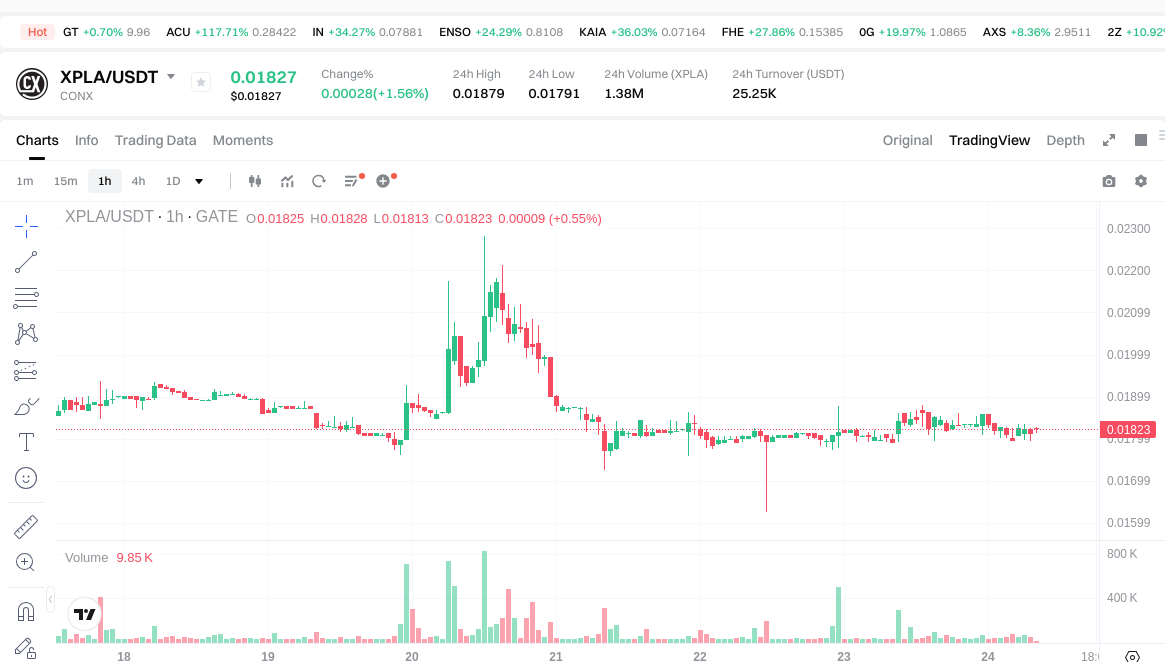
- XPLA Current Price: $0.01813
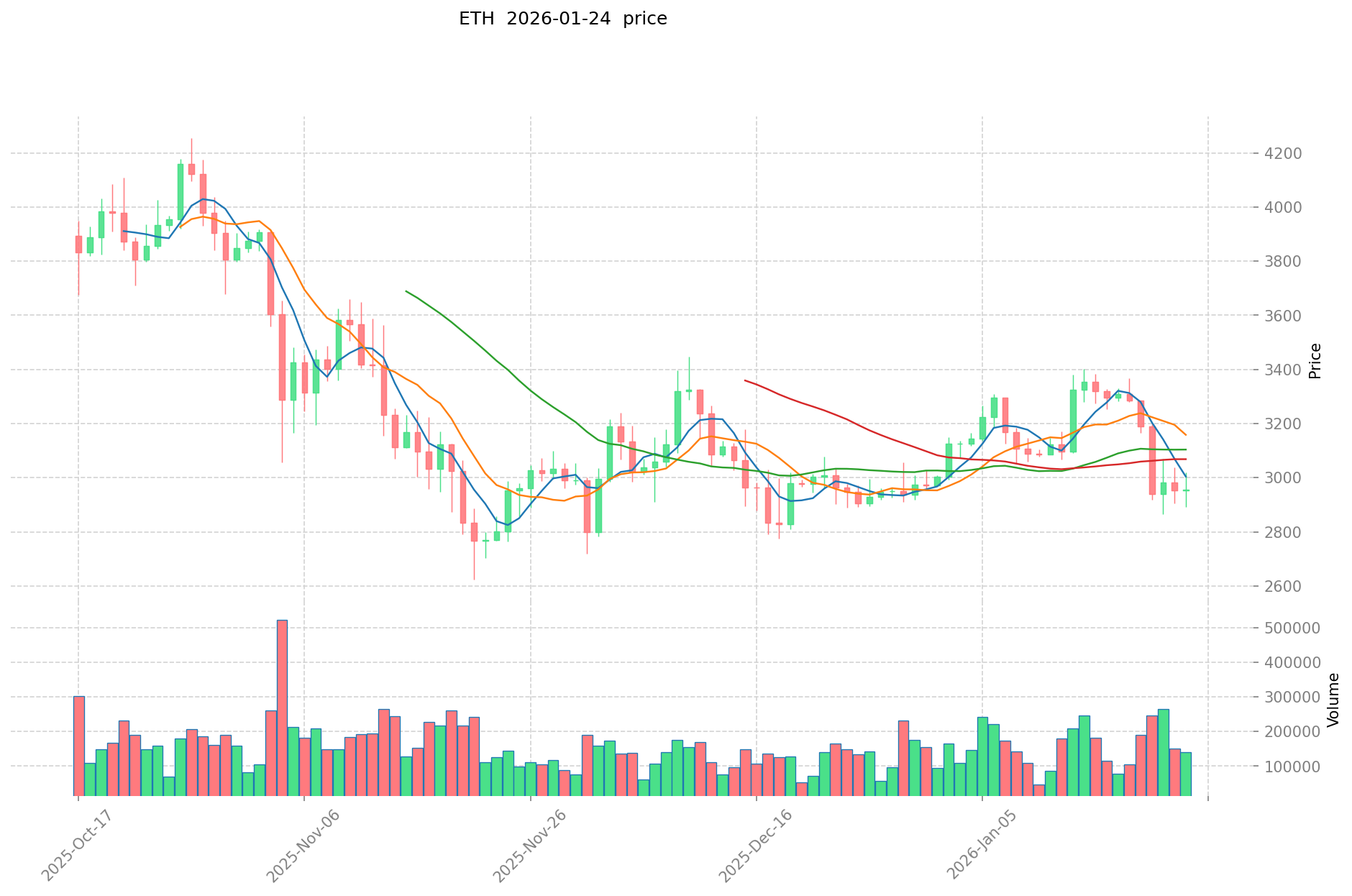
- ETH Current Price: $2,958.08
- 24-Hour Trading Volume: XPLA $25,176.16 vs ETH $417,054,643.56
- Market Sentiment Index (Fear & Greed Index): 24 (Extreme Fear)
View Real-Time Prices:
II. Core Factors Affecting XPLA vs ETH Investment Value
Supply Mechanism Comparison (Tokenomics)
Due to insufficient reference materials regarding the specific supply mechanisms of XPLA and ETH, this section cannot provide detailed comparative analysis at this time.
Institutional Adoption and Market Application
Without adequate data on institutional holdings, enterprise adoption patterns, or regulatory stances across different jurisdictions for XPLA and ETH, a comprehensive comparison of their market application cannot be conducted based on available materials.
Technology Development and Ecosystem Construction
The reference materials do not contain sufficient information regarding specific technology upgrades, development roadmaps, or ecosystem activities (including DeFi, NFT, payment systems, and smart contract implementations) for either XPLA or ETH to support a meaningful comparative analysis.
Macroeconomic Factors and Market Cycles
Given the absence of relevant data in the provided materials concerning the performance characteristics of XPLA and ETH under various macroeconomic conditions—including inflationary environments, monetary policy impacts, interest rate fluctuations, US dollar index correlations, or geopolitical factors—this comparative assessment cannot be completed with the current information set.
III. 2026-2031 Price Prediction: XPLA vs ETH
Short-term Forecast (2026)
- XPLA: Conservative $0.0139-$0.0183 | Optimistic $0.0183-$0.0225
- ETH: Conservative $1,626-$2,956 | Optimistic $2,956-$3,489
Mid-term Forecast (2028-2029)
- XPLA may enter a consolidation phase with predicted prices ranging from $0.0216-$0.0360, showing gradual growth momentum
- ETH may enter an expansion phase with predicted prices ranging from $2,322-$5,238, reflecting broader market adoption
- Key drivers: institutional capital inflows, ETF development, and ecosystem expansion
Long-term Forecast (2030-2031)
- XPLA: Baseline scenario $0.0228-$0.0318 | Optimistic scenario $0.0318-$0.0432
- ETH: Baseline scenario $2,789-$4,893 | Optimistic scenario $4,893-$6,753
View detailed price predictions for XPLA and ETH
Disclaimer
XPLA:
| Year |
Predicted High Price |
Predicted Average Price |
Predicted Low Price |
Price Change |
| 2026 |
0.0224598 |
0.01826 |
0.0138776 |
0 |
| 2027 |
0.028096662 |
0.0203599 |
0.013233935 |
12 |
| 2028 |
0.02713567472 |
0.024228281 |
0.02229001852 |
33 |
| 2029 |
0.035954769004 |
0.02568197786 |
0.0215728614024 |
41 |
| 2030 |
0.03174292463496 |
0.030818373432 |
0.02557924994856 |
69 |
| 2031 |
0.043167295666202 |
0.03128064903348 |
0.02283487379444 |
72 |
ETH:
| Year |
Predicted High Price |
Predicted Average Price |
Predicted Low Price |
Price Change |
| 2026 |
3488.5874 |
2956.43 |
1626.0365 |
0 |
| 2027 |
3319.183961 |
3222.5087 |
2416.881525 |
8 |
| 2028 |
4546.476399395 |
3270.8463305 |
2322.300894655 |
10 |
| 2029 |
5237.60622902965 |
3908.6613649475 |
2892.40941006115 |
32 |
| 2030 |
5213.3725285669755 |
4573.133796988575 |
4070.08907931983175 |
54 |
| 2031 |
6752.689364633329845 |
4893.25316277777525 |
2789.154302783331892 |
65 |
IV. Investment Strategy Comparison: XPLA vs ETH
Long-term vs Short-term Investment Strategies
- XPLA: May be suitable for investors interested in emerging Layer 1 platforms with focus on cultural fintech integration, tokenized assets, and AI-generated content applications within compliance-ready frameworks
- ETH: May be suitable for investors seeking exposure to established smart contract platforms with broader ecosystem adoption, diverse DApp development, and sustained institutional interest
Risk Management and Asset Allocation
- Conservative investors: Consider balanced allocation approaches with careful assessment of market volatility and risk tolerance
- Aggressive investors: May evaluate higher-risk allocations based on individual investment objectives and market conditions
- Hedging instruments: Stablecoin positioning, derivatives strategies, and cross-asset diversification remain available options for portfolio risk management
V. Potential Risk Comparison
Market Risk
- XPLA: Exhibits price volatility with historical fluctuations from $1.4 to $0.0115, suggesting sensitivity to market cycles and investor sentiment shifts
- ETH: Demonstrates significant price range movement between $0.433 and $4,946.05, reflecting both growth potential and correction exposure during varying market conditions
Technical Risk
- XPLA: As an emerging Layer 1 platform, considerations include network maturity, scalability implementation, and ongoing ecosystem development
- ETH: Considerations include network congestion management, transaction fee optimization, and continuous protocol upgrades
Regulatory Risk
- Both assets may face varying regulatory approaches across different jurisdictions, with potential impacts on trading availability, institutional adoption patterns, and compliance requirements
VI. Conclusion: Which Is the Better Buy?
📌 Investment Value Summary:
- XPLA advantages: Positions itself within the cultural fintech sector with integration of RWA, STO, AIGC, and IP elements; targets the AI and tokenized-asset era with compliance-focused approach
- ETH advantages: Established market position with extensive smart contract functionality; sustained institutional interest; broader ecosystem development; significant trading volume of $417,054,643.56 compared to XPLA's $25,176.16
✅ Investment Considerations:
- Novice investors: May consider starting with more established assets while conducting thorough research on market fundamentals, price volatility patterns, and risk factors
- Experienced investors: May evaluate both assets based on portfolio diversification objectives, risk tolerance levels, and individual investment timeframes
- Institutional investors: May assess opportunities aligned with regulatory frameworks, liquidity requirements, and long-term strategic positioning
⚠️ Risk Disclosure: Cryptocurrency markets exhibit extreme volatility. This content does not constitute investment advice. Investors should conduct independent research and consult qualified financial advisors before making investment decisions.
VII. FAQ
Q1: What are the main differences between XPLA and ETH in terms of market positioning?
XPLA positions itself as a next-generation Layer 1 Cultural Fintech Mainnet designed for the AI and tokenized-asset era, while ETH serves as an established decentralized smart contract platform. XPLA bridges Web2 and Web3 by integrating Real World Assets (RWA), Security Tokens (STO), AI-generated content (AIGC), and intellectual property (IP) within a compliance-ready framework. In contrast, ETH has established itself since 2014 as a platform supporting smart contracts and decentralized applications (DApps), holding a position as one of the most traded and capitalized cryptocurrencies globally with broader ecosystem adoption.
Q2: How do the current trading volumes of XPLA and ETH compare?
As of January 24, 2026, ETH demonstrates significantly higher trading volume at $417,054,643.56 compared to XPLA's $25,176.16 over a 24-hour period. This substantial difference reflects ETH's established market presence, broader institutional adoption, and extensive ecosystem development. The higher trading volume typically indicates greater market liquidity, which can facilitate easier entry and exit positions for investors across various transaction sizes.
Q3: What are the price predictions for XPLA and ETH through 2031?
For XPLA, conservative estimates suggest a price range of $0.0139-$0.0183 in 2026, potentially reaching $0.0228-$0.0432 by 2031 under optimistic scenarios. For ETH, conservative forecasts indicate a range of $1,626-$2,956 in 2026, potentially expanding to $2,789-$6,753 by 2031. Mid-term forecasts (2028-2029) suggest XPLA may enter a consolidation phase with prices ranging from $0.0216-$0.0360, while ETH may enter an expansion phase with predicted prices ranging from $2,322-$5,238, driven by institutional capital inflows, ETF development, and ecosystem expansion.
Q4: What type of investor profile suits each asset?
XPLA may be suitable for investors interested in emerging Layer 1 platforms with focus on cultural fintech integration, tokenized assets, and AI-generated content applications within compliance-ready frameworks. ETH may be suitable for investors seeking exposure to established smart contract platforms with broader ecosystem adoption, diverse DApp development, and sustained institutional interest. Conservative investors should consider balanced allocation approaches with careful assessment of market volatility and risk tolerance, while aggressive investors may evaluate higher-risk allocations based on individual investment objectives and market conditions.
Q5: What are the primary risk factors associated with investing in XPLA versus ETH?
Both assets face distinct risk profiles. XPLA exhibits significant price volatility with historical fluctuations from $1.4 to $0.0115, suggesting sensitivity to market cycles and investor sentiment shifts. As an emerging Layer 1 platform, considerations include network maturity, scalability implementation, and ongoing ecosystem development. ETH demonstrates a significant price range movement between $0.433 and $4,946.05, reflecting both growth potential and correction exposure during varying market conditions. Technical considerations for ETH include network congestion management, transaction fee optimization, and continuous protocol upgrades. Both assets may face varying regulatory approaches across different jurisdictions, with potential impacts on trading availability, institutional adoption patterns, and compliance requirements.
Q6: How has the historical price performance differed between XPLA and ETH?
XPLA reached a price peak of $1.4 in March 2023 during a period of market expansion, but experienced a significant decline to approximately $0.0115 in December 2025 amid broader market corrections. Currently, XPLA trades at $0.01813. ETH was initially traded at approximately $0.433 in October 2015 during its early development phase and reached a notable high of $4,946.05 in August 2025, reflecting strong institutional interest and network growth. Currently, ETH trades at $2,958.08. The comparative analysis shows that while both assets experienced volatility, ETH has maintained a broader price range and demonstrated more sustained growth trajectory over its longer operational history.
Q7: What should investors consider when choosing between XPLA and ETH?
Novice investors may consider starting with more established assets like ETH while conducting thorough research on market fundamentals, price volatility patterns, and risk factors. Experienced investors may evaluate both assets based on portfolio diversification objectives, risk tolerance levels, and individual investment timeframes. Institutional investors may assess opportunities aligned with regulatory frameworks, liquidity requirements, and long-term strategic positioning. The current market sentiment index stands at 24 (Extreme Fear), indicating a cautious market environment. Investors should note that cryptocurrency markets exhibit extreme volatility and conduct independent research while consulting qualified financial advisors before making investment decisions, as this content does not constitute investment advice.
* The information is not intended to be and does not constitute financial advice or any other recommendation of any sort offered or endorsed by Gate.