This comprehensive comparison examines YGG and GMX, two leading protocols in GameFi and DeFi sectors, analyzing their distinct value propositions and investment characteristics. YGG operates as a blockchain gaming infrastructure DAO focused on NFT investments and play-to-earn ecosystems, while GMX functions as a decentralized perpetual exchange with a revenue-sharing model benefiting token holders. The article evaluates historical price trends, tokenomics mechanisms, institutional adoption, and technical development trajectories to help investors distinguish between gaming sector exposure and DeFi derivatives infrastructure. Through detailed market analysis and 2026-2031 price forecasts, this guide addresses risk management strategies and allocation frameworks tailored for different investor profiles. Whether you're a novice seeking sector fundamentals or an institutional investor conducting due diligence, this analysis provides actionable insights for informed decision-making on Gate's trading platform.
Introduction: Investment Comparison Between YGG and GMX
In the cryptocurrency market, the comparison between YGG vs GMX has consistently been a topic investors cannot overlook. Both exhibit notable differences in market cap ranking, application scenarios, and price performance, while representing distinct positioning within the crypto asset landscape.
Yield Guild Games (YGG): Launched in 2021, this decentralized autonomous organization (DAO) has gained market recognition through its positioning in NFT investments focused on virtual worlds and blockchain gaming, combining characteristics of NFT and DeFi.
GMX (GMX): Operating as a decentralized perpetual exchange, GMX serves as both a utility and governance token, with token holders accruing 30% of platform-generated fees.
This article will comprehensively analyze the investment value comparison of YGG vs GMX through historical price trends, supply mechanisms, institutional adoption, technical ecosystems, and future predictions, attempting to address investors' most pressing question:
"Which is the better buy right now?"
I. Historical Price Comparison and Current Market Status
YGG and GMX Historical Price Trends
- 2021: YGG experienced significant price movement, reaching a peak of $11.17 on November 20, 2021, driven by early adoption in the Web3 gaming guild sector.
- 2023: GMX showed notable volatility, achieving its highest price of $91.07 on April 18, 2023, supported by its position as a leading decentralized perpetual exchange on Arbitrum.
- Comparative Analysis: During the recent market cycle, YGG declined from its historical high of $11.17 to a low of $0.056812 recorded on December 19, 2025, representing a substantial retracement. Meanwhile, GMX dropped from its peak of $91.07 to a low of $6.92 on October 11, 2025, reflecting similar downward pressure across the DeFi sector.
Current Market Status (January 19, 2026)
- YGG Current Price: $0.06436
- GMX Current Price: $7.292
- 24-Hour Trading Volume: YGG recorded $406,747.85 compared to GMX's $43,640.72
- Market Sentiment Index (Fear & Greed Index): 44 (Fear)
View Real-Time Prices:
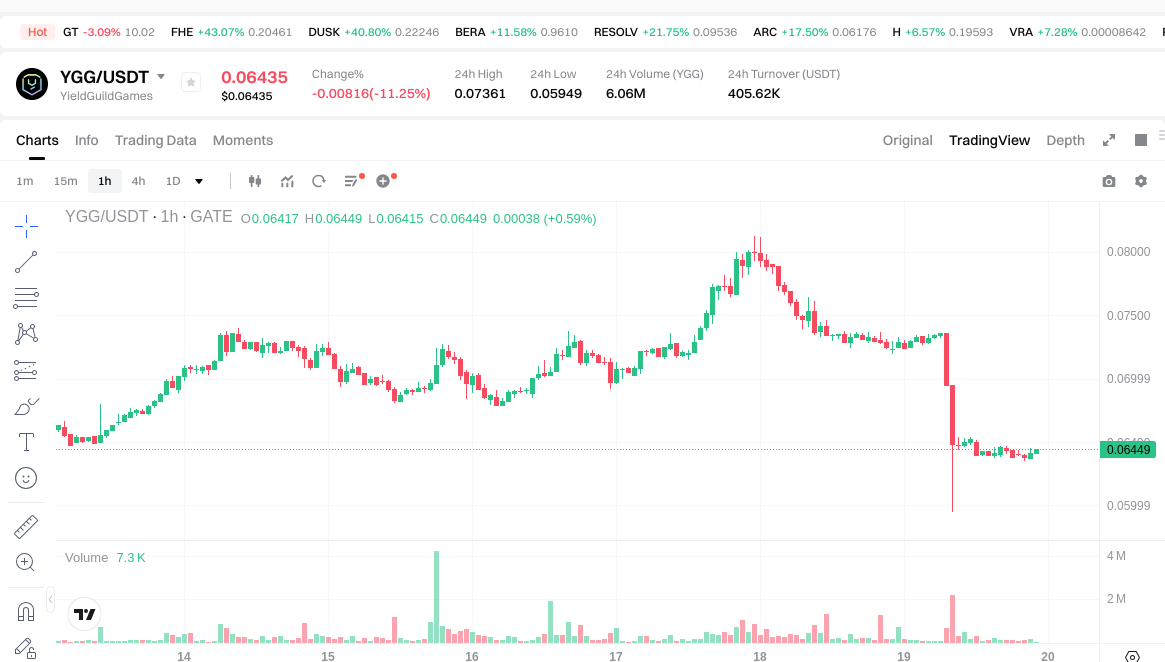
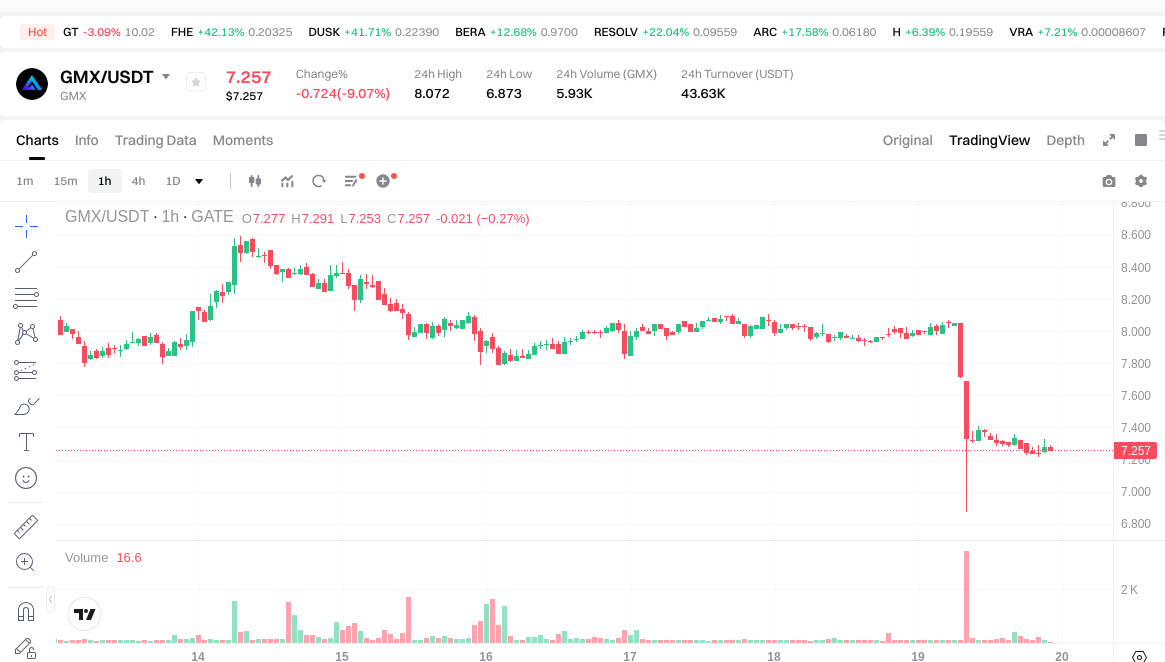
II. Core Factors Affecting YGG vs GMX Investment Value
Supply Mechanism Comparison (Tokenomics)
-
YGG: The reference materials indicate YGG operates within a gaming ecosystem with token economic models designed to incentivize community participation. Analysis suggests that tokenomics represents a core factor influencing investment returns in Web3 projects, though specific supply mechanism details require further examination.
-
GMX: Materials position GMX within the decentralized derivatives trading platform category. The DeFi sector typically emphasizes incentivizing liquidity providers (LPs) and coordinating relationships between governance token holders and LPs, though precise supply parameters were not detailed in available sources.
-
📌 Historical Pattern: Reference materials emphasize that tokenomics design significantly impacts project lifecycle sustainability. Well-structured token supply mechanisms can help maintain network stability and reduce selling pressure from validators, while poorly designed models may trigger death spirals during early stages.
Institutional Adoption and Market Application
-
Institutional Positioning: Materials suggest institutional backing and team credentials serve as important credibility indicators. Projects with reputable founding teams and recognized institutional investors tend to demonstrate stronger market confidence.
-
Enterprise Application: YGG focuses on gaming ecosystem development with applications in GameFi infrastructure, while GMX concentrates on decentralized derivatives trading services. Both projects address distinct market segments within the crypto economy.
-
Regulatory Environment: Materials note that different jurisdictions maintain varying regulatory approaches toward crypto assets. Investors should monitor policy developments across major markets when evaluating project compliance and operational sustainability.
Technical Development and Ecosystem Building
-
YGG Technical Evolution: Positioned within the blockchain gaming sector, YGG's value proposition centers on gaming ecosystem infrastructure. Materials reference potential catalysts and development milestones that could influence token performance.
-
GMX Technical Progress: Operating in the on-chain derivatives space, materials note that GMX participates in a competitive landscape alongside other protocols. The derivatives sector emphasizes product features like risk management and capital efficiency.
-
Ecosystem Comparison: YGG operates primarily in GameFi with connections to NFT markets and play-to-earn models, while GMX functions within DeFi infrastructure focused on perpetual contracts and liquidity provision. Materials categorize both projects under distinct sector classifications (Gaming vs DeFi derivatives).
Macroeconomic Factors and Market Cycles
-
Market Cycle Dynamics: Reference materials emphasize the importance of market timing and cycle positioning. Projects launching during late bull markets or early bear markets may experience different trajectory patterns compared to those debuting during other phases.
-
Monetary Policy Context: Materials note that broader macroeconomic factors including liquidity conditions and risk appetite influence crypto asset performance. Both projects operate within this larger market framework.
-
Sector-Specific Considerations: YGG's gaming-focused model may respond to different catalysts than GMX's derivatives platform. Materials suggest evaluating projects based on sector-specific fundamentals, user adoption metrics, and competitive positioning within their respective market segments.
III. 2026-2031 Price Forecast: YGG vs GMX
Short-term Forecast (2026)
- YGG: Conservative $0.0393-$0.0644 | Optimistic $0.0644-$0.0915
- GMX: Conservative $6.46-$7.26 | Optimistic $7.26-$9.22
Mid-term Forecast (2028-2029)
- YGG may enter a consolidation phase, with projected prices ranging from $0.0626 to $0.1103
- GMX may enter an expansion phase, with projected prices ranging from $6.36 to $15.03
- Key drivers: institutional capital inflows, ETF developments, ecosystem growth
Long-term Forecast (2030-2031)
- YGG: Baseline scenario $0.0636-$0.0979 | Optimistic scenario $0.1023-$0.1514
- GMX: Baseline scenario $8.16-$12.75 | Optimistic scenario $13.22-$19.60
View detailed price predictions for YGG and GMX
Disclaimer
YGG:
| Year |
Predicted High Price |
Predicted Average Price |
Predicted Low Price |
Price Change |
| 2026 |
0.0914622 |
0.06441 |
0.0392901 |
0 |
| 2027 |
0.082612266 |
0.0779361 |
0.07014249 |
21 |
| 2028 |
0.09070982679 |
0.080274183 |
0.06261386274 |
24 |
| 2029 |
0.11028468631455 |
0.085492004895 |
0.06411900367125 |
32 |
| 2030 |
0.106698296709204 |
0.097888345604775 |
0.063627424643103 |
52 |
| 2031 |
0.151394115312345 |
0.102293321156989 |
0.083880523348731 |
58 |
GMX:
| Year |
Predicted High Price |
Predicted Average Price |
Predicted Low Price |
Price Change |
| 2026 |
9.21639 |
7.257 |
6.45873 |
0 |
| 2027 |
11.94320775 |
8.236695 |
6.589356 |
12 |
| 2028 |
15.03402754875 |
10.089951375 |
6.35666936625 |
38 |
| 2029 |
12.93884914573125 |
12.561989461875 |
10.67769104259375 |
72 |
| 2030 |
18.3606037974765 |
12.750419303803125 |
8.160268354434 |
74 |
| 2031 |
19.599944553806163 |
15.555511550639812 |
13.22218481804384 |
113 |
IV. Investment Strategy Comparison: YGG vs GMX
Long-term vs Short-term Investment Strategies
-
YGG: May appeal to investors focused on blockchain gaming ecosystem development and Web3 infrastructure buildout. The project's positioning within the GameFi sector suggests potential alignment with longer-term thematic exposure to gaming adoption trends, though current price levels reflect substantial retracement from historical peaks.
-
GMX: May suit investors seeking exposure to decentralized derivatives infrastructure and DeFi protocol revenue models. The platform's fee-sharing mechanism with token holders provides a structural element that connects token value to trading volume metrics, though performance remains subject to broader DeFi sector dynamics.
Risk Management and Asset Allocation
-
Conservative Investors: A balanced approach might consider reduced exposure to both assets given current market uncertainty (Fear & Greed Index: 44), with potential weighting favoring GMX's established trading platform over YGG's gaming-focused model (example allocation framework: YGG 30% vs GMX 70% within crypto gaming/DeFi segment allocation).
-
Aggressive Investors: Higher risk tolerance portfolios might increase allocation proportions while maintaining diversification across sectors (example allocation framework: YGG 45% vs GMX 55% within targeted crypto exposure), recognizing that both tokens have experienced significant drawdowns from historical peaks.
-
Hedging Tools: Portfolio construction may incorporate stablecoin reserves for rebalancing opportunities, options strategies where available for downside protection, and cross-asset diversification across gaming, DeFi, and other crypto sectors to manage correlation risks.
V. Potential Risk Comparison
Market Risk
-
YGG: Token performance exhibits sensitivity to GameFi sector adoption cycles and broader NFT market sentiment. Historical data shows substantial volatility, with price declining from $11.17 peak to $0.056812 low, reflecting sector-specific headwinds during market downturns.
-
GMX: Price action demonstrates correlation with DeFi sector trends and derivatives trading volume patterns. The token experienced drawdown from $91.07 peak to $6.92 low, indicating exposure to liquidity shifts and competitive pressures within decentralized exchange landscape.
Technical Risk
-
YGG: Ecosystem development depends on sustained gaming adoption and NFT infrastructure maturation. Project success requires ongoing technical evolution to support gaming partnerships and user acquisition within competitive Web3 gaming market.
-
GMX: Platform operates within competitive derivatives trading environment requiring continuous product development and liquidity maintenance. Technical considerations include smart contract security, trading infrastructure reliability, and risk management system effectiveness.
Regulatory Risk
- Different jurisdictions maintain evolving policy frameworks toward crypto assets, with potential divergent treatment of gaming tokens versus DeFi protocols. YGG's gaming focus may face considerations around virtual asset classification, while GMX's derivatives functionality could encounter scrutiny related to trading platform regulations. Both projects operate within dynamic regulatory environments requiring ongoing compliance monitoring.
VI. Conclusion: Which Is the Better Buy?
📌 Investment Value Summary:
-
YGG Characteristics: Positioned within blockchain gaming infrastructure with focus on GameFi ecosystem development. Current trading levels ($0.06436) represent significant discount from historical peak, though sector recovery timing remains uncertain. Project targets Web3 gaming adoption trend with DAO governance structure.
-
GMX Characteristics: Operates as decentralized perpetual exchange with established fee-sharing model connecting token value to platform trading activity. Current price ($7.292) reflects retracement from peak levels while maintaining position within DeFi derivatives sector. Revenue-generating mechanism provides structural element for long-term token holders.
✅ Investment Considerations:
-
Novice Investors: May consider establishing understanding of sector fundamentals (gaming infrastructure vs derivatives trading) before position sizing. Dollar-cost averaging approach could help manage entry timing risk given current market uncertainty (Fear & Greed Index: 44). Risk tolerance assessment and portfolio diversification remain essential considerations.
-
Experienced Investors: May evaluate projects based on sector-specific metrics including gaming adoption indicators for YGG and trading volume trends for GMX. Technical analysis of support levels, ecosystem development milestones, and competitive positioning could inform allocation decisions. Consider correlation with broader crypto market cycles when establishing positions.
-
Institutional Investors: May assess projects through due diligence frameworks examining tokenomics sustainability, team execution track record, regulatory compliance posture, and liquidity profiles. Sector allocation strategies might incorporate both gaming infrastructure and DeFi derivatives exposure as complementary thematic positions within diversified crypto portfolios.
⚠️ Risk Disclosure: Cryptocurrency markets exhibit high volatility. This analysis does not constitute investment advice. Investors should conduct independent research, assess personal risk tolerance, and consult qualified financial advisors before making investment decisions.
VII. FAQ
Q1: What are the primary differences between YGG and GMX in terms of their core business models?
YGG operates as a decentralized autonomous organization (DAO) focused on blockchain gaming and NFT investments, while GMX functions as a decentralized perpetual exchange for derivatives trading. YGG's value proposition centers on GameFi ecosystem development and Web3 gaming infrastructure, targeting play-to-earn models and virtual world investments. GMX, conversely, provides derivatives trading services with a revenue-sharing mechanism where token holders receive 30% of platform-generated fees. The fundamental distinction lies in their sectors: YGG represents gaming infrastructure investment, whereas GMX operates within DeFi derivatives infrastructure.
Q2: Which token has demonstrated better price stability during recent market downturns?
GMX has shown relatively better price stability compared to YGG during recent market corrections. YGG experienced a decline from its peak of $11.17 to a low of $0.056812 (approximately 99.5% drawdown), while GMX dropped from $91.07 to $6.92 (approximately 92.4% drawdown). Although both tokens faced substantial retracements, GMX's smaller percentage decline and higher absolute price level suggest comparatively more resilient price action. This performance differential may reflect GMX's established revenue-generating platform versus YGG's exposure to the more volatile GameFi sector.
Q3: What are the key factors investors should consider when choosing between YGG and GMX?
Investors should evaluate sector preference (gaming infrastructure vs derivatives trading), risk tolerance, and investment timeline. YGG suits those bullish on blockchain gaming adoption and Web3 ecosystem expansion, while GMX appeals to investors seeking exposure to decentralized derivatives trading and fee-sharing revenue models. Additional considerations include tokenomics sustainability, ecosystem development progress, competitive positioning within respective sectors, regulatory environment, and correlation with broader crypto market cycles. Portfolio diversification strategy should also factor into allocation decisions between these distinct sector exposures.
Q4: How do the 2026-2031 price forecasts compare for YGG versus GMX?
Price forecasts suggest divergent trajectories. For 2026, YGG's conservative range ($0.0393-$0.0644) and optimistic range ($0.0644-$0.0915) indicate modest near-term expectations, while GMX projects conservative ($6.46-$7.26) and optimistic ($7.26-$9.22) ranges. By 2031, YGG's baseline scenario ($0.0636-$0.0979) and optimistic scenario ($0.1023-$0.1514) show potential appreciation of approximately 58% from current levels. GMX's 2031 baseline ($8.16-$12.75) and optimistic ($13.22-$19.60) scenarios suggest potential growth of approximately 113%. These forecasts indicate GMX may offer higher absolute growth potential, though both remain subject to significant market uncertainties.
Q5: What are the main risks specific to investing in YGG compared to GMX?
YGG faces gaming sector-specific risks including GameFi adoption cycle uncertainty, NFT market sentiment volatility, and competitive pressures within Web3 gaming infrastructure. The project requires sustained gaming partnerships and user acquisition in a nascent market segment. GMX encounters DeFi-specific risks including derivatives trading volume fluctuations, liquidity provision challenges, competitive pressure from other decentralized exchanges, and smart contract security considerations. Both face regulatory uncertainty, though YGG may encounter virtual asset classification issues while GMX could face scrutiny related to derivatives trading platform regulations. YGG's higher historical volatility (99.5% peak drawdown) suggests elevated risk profile compared to GMX.
Q6: How do the tokenomics and supply mechanisms differ between YGG and GMX?
YGG operates with token economic models designed to incentivize community participation within its gaming ecosystem, though specific supply parameters require detailed examination. The gaming-focused tokenomics emphasizes community engagement and DAO governance structures. GMX implements a fee-sharing mechanism where token holders receive 30% of platform-generated trading fees, creating direct alignment between token value and trading volume. This revenue-sharing model provides structural support connecting token performance to platform usage metrics. The key distinction lies in YGG's community-driven incentive model versus GMX's utility-based fee distribution mechanism, representing different approaches to value accrual.
Q7: What allocation strategy might conservative investors consider between YGG and GMX?
Conservative investors might consider reduced overall exposure given current market uncertainty (Fear & Greed Index: 44), with potential weighting favoring GMX's established trading platform over YGG's gaming-focused model. An example allocation framework could allocate 30% to YGG and 70% to GMX within the designated crypto gaming and DeFi segment allocation. This approach reflects GMX's revenue-generating mechanism and relatively lower historical volatility compared to YGG's exposure to nascent GameFi sector dynamics. Conservative strategies should incorporate stablecoin reserves for rebalancing opportunities, maintain diversification across multiple crypto sectors, and establish clear risk management parameters including stop-loss levels and position sizing limits based on individual risk tolerance.
Q8: What institutional factors should be evaluated when comparing YGG and GMX investments?
Institutional investors should assess multiple dimensions including tokenomics sustainability models, team execution track records and founder credentials, regulatory compliance posture across major jurisdictions, liquidity profiles and market depth, competitive positioning within respective sectors, ecosystem development milestones and partnership quality, and correlation characteristics with broader crypto market cycles. Additional considerations include due diligence on smart contract audits, governance structures and DAO effectiveness, revenue generation mechanisms and sustainability, user adoption metrics and growth trajectories, and risk management frameworks. Sector allocation strategies might incorporate both gaming infrastructure (YGG) and DeFi derivatives (GMX) exposure as complementary thematic positions within diversified crypto portfolios, recognizing distinct risk-return profiles and correlation characteristics.
* The information is not intended to be and does not constitute financial advice or any other recommendation of any sort offered or endorsed by Gate.