This article provides a comprehensive comparison between ZEUS and DYDX, two prominent decentralized derivatives trading platforms. ZEUS, launched in 2024, functions as a cross-chain communication layer on Solana designed to introduce Bitcoin liquidity through its APOLLO DApp. DYDX, since 2021, operates as an established decentralized perpetual contract exchange combining off-chain order matching with on-chain settlement. The analysis examines historical price trends, tokenomics, institutional adoption, technical ecosystems, and price forecasts through 2031 on Gate exchange. It addresses investment strategies for different investor profiles, compares market risks, technical risks, and regulatory considerations, while providing FAQ insights to help investors determine which asset better suits their portfolio objectives and risk tolerance.
Introduction: Investment Comparison Between ZEUS and DYDX
In the cryptocurrency market, the comparison between ZEUS vs DYDX has consistently been a topic investors cannot ignore. The two assets demonstrate notable differences in market cap ranking, application scenarios, and price performance, representing distinct crypto asset positioning.
ZEUS Network (ZEUS): Launched in 2024, it has gained market recognition through its positioning as a cross-chain communication layer on SVM, with its primary mission of introducing Bitcoin liquidity to Solana through its first DApp, APOLLO.
dYdX (DYDX): Since its inception in 2021, it has been recognized as a decentralized derivatives trading protocol, operating as one of the prominent decentralized perpetual contract exchanges with hybrid infrastructure combining off-chain order matching and on-chain settlement.
This article will comprehensively analyze the investment value comparison of ZEUS vs DYDX through historical price trends, supply mechanisms, institutional adoption, technical ecosystem, and future predictions, attempting to address investors' most pressing question:
"Which is the better buy right now?"
I. Historical Price Comparison and Current Market Status
Historical Price Trends of ZEUS (Coin A) and DYDX (Coin B)
- 2024: ZEUS experienced significant price volatility, reaching an all-time high of $1.1485 on April 8, 2024, driven by market enthusiasm surrounding cross-chain communication technology and Bitcoin liquidity integration on Solana.
- 2024: DYDX recorded its all-time high of $4.52 on March 8, 2024, influenced by growing adoption of its decentralized perpetual contract trading platform.
- Comparative Analysis: During the market cycle from 2024 to early 2026, ZEUS declined from its peak of $1.1485 to a low of $0.01163 on January 25, 2026, while DYDX fell from $4.52 to $0.126201 on October 11, 2025, before showing some recovery.
Current Market Status (January 26, 2026)
- ZEUS current price: $0.01236
- DYDX current price: $0.1632
- 24-hour trading volume: ZEUS $58,678.12 vs DYDX $615,747.78
- Market Sentiment Index (Fear & Greed Index): 20 (Extreme Fear)
View real-time prices:
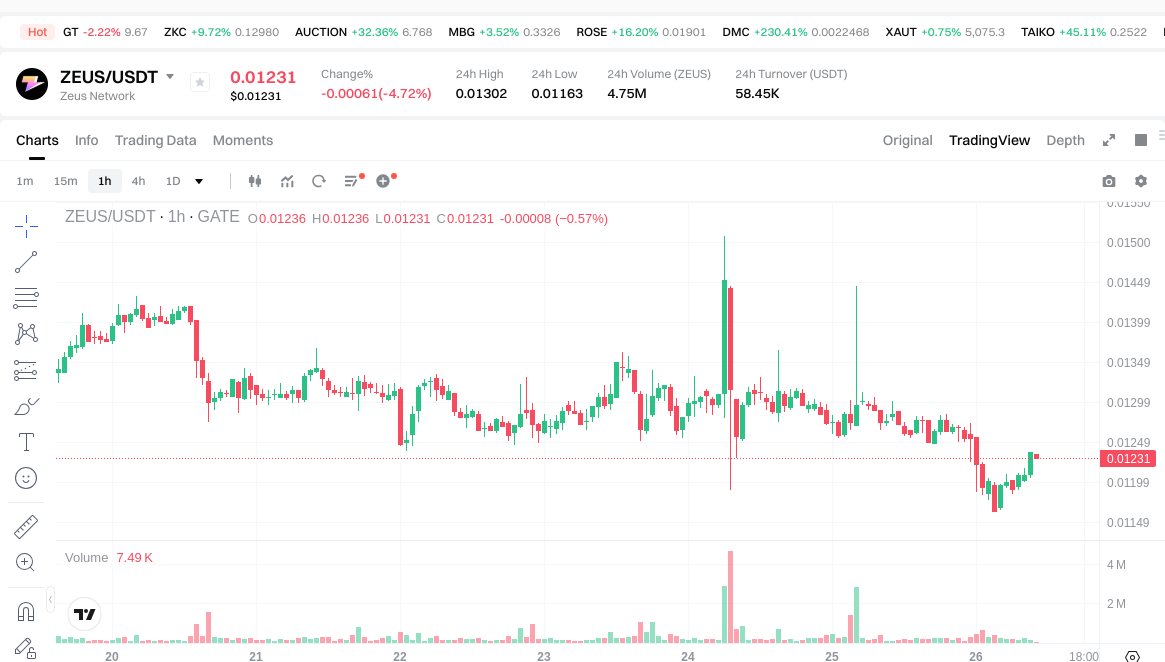
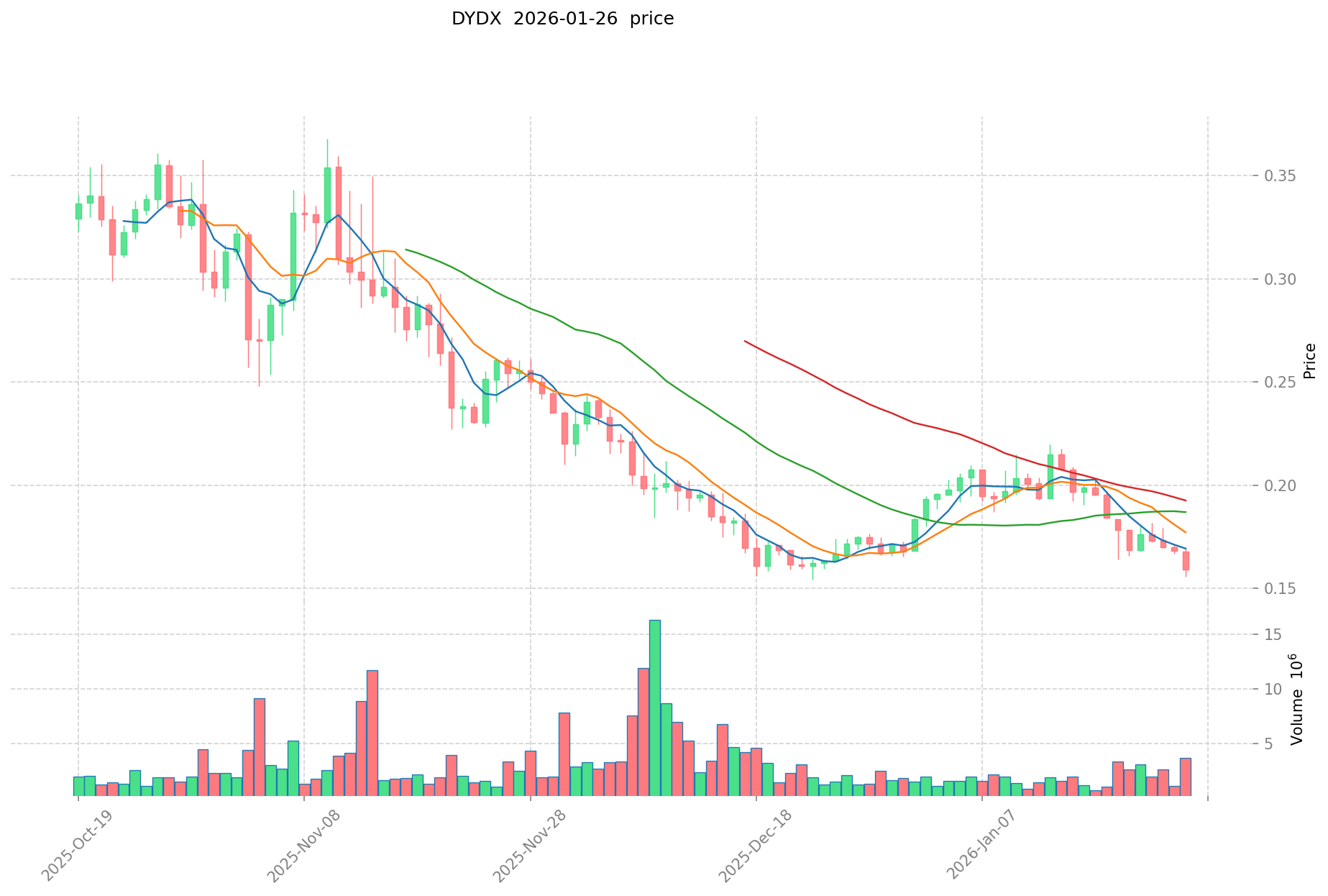
II. Core Factors Affecting ZEUS vs DYDX Investment Value
Supply Mechanism Comparison (Tokenomics)
Due to insufficient reference materials, detailed supply mechanism information for ZEUS and DYDX cannot be provided at this time.
Institutional Adoption and Market Application
Without available data on institutional holdings and enterprise adoption patterns, a comparative analysis of ZEUS and DYDX in cross-border payments, settlement systems, and investment portfolios cannot be conducted. Regulatory attitudes from different jurisdictions toward these assets also require further documentation.
Technology Development and Ecosystem Building
The reference materials do not contain sufficient information regarding specific technical upgrades for ZEUS or DYDX. Comparative data on their respective ecosystems in DeFi, NFT, payment systems, and smart contract implementation is not available for analysis.
Macroeconomic Factors and Market Cycles
Comprehensive analysis of how ZEUS and DYDX perform under inflationary environments, their responses to macroeconomic monetary policies including interest rates and dollar index movements, as well as their roles in geopolitical contexts and cross-border transaction demands, cannot be provided based on current reference materials.
III. 2026-2031 Price Forecast: ZEUS vs DYDX
Short-term Forecast (2026)
- ZEUS: Conservative $0.0069 - $0.0123 | Optimistic $0.0123 - $0.0165
- DYDX: Conservative $0.1006 - $0.1622 | Optimistic $0.1622 - $0.2011
Mid-term Forecast (2028-2029)
- ZEUS may enter a gradual growth phase, with estimated price range of $0.0117 - $0.0200
- DYDX may enter a consolidation phase, with estimated price range of $0.1417 - $0.2755
- Key drivers: institutional capital inflows, ETF developments, ecosystem expansion
Long-term Forecast (2030-2031)
- ZEUS: Baseline scenario $0.0127 - $0.0190 | Optimistic scenario $0.0190 - $0.0234
- DYDX: Baseline scenario $0.1857 - $0.2516 | Optimistic scenario $0.2516 - $0.2934
View detailed price predictions for ZEUS and DYDX
Disclaimer
ZEUS:
| Year |
Predicted High Price |
Predicted Average Price |
Predicted Low Price |
Price Change |
| 2026 |
0.0164954 |
0.01231 |
0.0068936 |
0 |
| 2027 |
0.01728324 |
0.0144027 |
0.013106457 |
16 |
| 2028 |
0.0199621422 |
0.01584297 |
0.0117237978 |
28 |
| 2029 |
0.020050862832 |
0.0179025561 |
0.013963993758 |
44 |
| 2030 |
0.02144368169658 |
0.018976709466 |
0.01271439534222 |
53 |
| 2031 |
0.023443826874296 |
0.02021019558129 |
0.014955544730154 |
63 |
DYDX:
| Year |
Predicted High Price |
Predicted Average Price |
Predicted Low Price |
Price Change |
| 2026 |
0.201128 |
0.1622 |
0.100564 |
0 |
| 2027 |
0.19619712 |
0.181664 |
0.17076416 |
11 |
| 2028 |
0.2663920896 |
0.18893056 |
0.14169792 |
15 |
| 2029 |
0.275470203008 |
0.2276613248 |
0.200341965824 |
39 |
| 2030 |
0.28678497085056 |
0.251565763904 |
0.2389874757088 |
54 |
| 2031 |
0.293401150441235 |
0.26917536737728 |
0.185731003490323 |
64 |
IV. Investment Strategy Comparison: ZEUS vs DYDX
Long-term vs Short-term Investment Strategies
- ZEUS: May suit investors interested in cross-chain communication technology and Bitcoin liquidity integration within the Solana ecosystem, with a focus on emerging infrastructure developments.
- DYDX: May appeal to investors seeking exposure to decentralized derivatives trading platforms and perpetual contract exchange ecosystems.
Risk Management and Asset Allocation
- Conservative Investors: ZEUS 20-30% vs DYDX 70-80%
- Aggressive Investors: ZEUS 40-50% vs DYDX 50-60%
- Hedging Tools: Stablecoin allocation, options strategies, cross-asset portfolio diversification
V. Potential Risk Comparison
Market Risk
- ZEUS: High volatility demonstrated through historical price movements from $1.1485 to $0.01163, reflecting sensitivity to market sentiment shifts and cross-chain technology adoption cycles.
- DYDX: Significant price fluctuations observed from $4.52 to $0.126201, indicating exposure to decentralized exchange market dynamics and trading volume variations.
Technical Risk
- ZEUS: Scalability considerations related to cross-chain communication infrastructure and network stability during high-transaction periods.
- DYDX: Platform reliability concerns regarding order matching systems and settlement mechanisms in decentralized perpetual contract trading.
Regulatory Risk
- Global regulatory policies may affect ZEUS and DYDX differently based on their respective operational models, with cross-chain protocols and decentralized derivatives platforms facing varying compliance requirements across jurisdictions.
VI. Conclusion: Which Is the Better Buy?
📌 Investment Value Summary:
- ZEUS Advantages: Positioning in cross-chain communication technology, potential for Bitcoin liquidity integration with Solana ecosystem, early-stage infrastructure development opportunities.
- DYDX Advantages: Established presence in decentralized derivatives trading, operational perpetual contract exchange platform, demonstrated market adoption in DeFi sector.
✅ Investment Recommendations:
- Novice Investors: Consider DYDX for its established platform status and relatively clearer use case in decentralized trading, with limited exposure (10-20%) to higher-risk assets like ZEUS.
- Experienced Investors: May evaluate balanced allocation between ZEUS (30-40%) and DYDX (60-70%) based on risk tolerance and ecosystem development timelines.
- Institutional Investors: Conduct comprehensive due diligence on both assets, considering portfolio diversification strategies that account for cross-chain infrastructure (ZEUS) and decentralized exchange protocols (DYDX).
⚠️ Risk Disclosure: Cryptocurrency markets exhibit extreme volatility. This content does not constitute investment advice. Market conditions as of January 26, 2026 show a Fear & Greed Index of 20 (Extreme Fear), indicating heightened market uncertainty. Investors should conduct independent research and assess their risk tolerance before making investment decisions.
VII. FAQ
Q1: What is the main difference between ZEUS and DYDX in terms of their core functionality?
ZEUS focuses on cross-chain communication infrastructure, while DYDX operates as a decentralized derivatives trading platform. ZEUS positions itself as a cross-chain communication layer on SVM (Solana Virtual Machine), primarily designed to bridge Bitcoin liquidity to the Solana ecosystem through its first DApp, APOLLO. In contrast, DYDX functions as a decentralized perpetual contract exchange, utilizing hybrid infrastructure that combines off-chain order matching with on-chain settlement mechanisms for derivatives trading.
Q2: Which asset has demonstrated greater price stability since their respective launches?
DYDX has shown relatively greater price stability compared to ZEUS. While both assets experienced significant volatility, DYDX's price range from its all-time high of $4.52 (March 8, 2024) to its low of $0.126201 (October 11, 2025) represents approximately a 97% decline. ZEUS, however, declined approximately 99% from its peak of $1.1485 (April 8, 2024) to $0.01163 (January 25, 2026), indicating higher volatility and greater downside movement during the same market cycle.
Q3: What allocation strategy should conservative investors consider for ZEUS vs DYDX?
Conservative investors should allocate 20-30% to ZEUS and 70-80% to DYDX. This allocation strategy reflects DYDX's established presence in the decentralized trading sector with demonstrated operational history since 2021, compared to ZEUS's earlier-stage positioning as emerging cross-chain infrastructure launched in 2024. Conservative portfolios should prioritize more established protocols with clearer use cases while maintaining limited exposure to higher-risk, emerging infrastructure projects.
Q4: How do the current 24-hour trading volumes compare between ZEUS and DYDX?
DYDX significantly outperforms ZEUS in trading volume, with approximately 10.5 times higher daily liquidity. As of January 26, 2026, DYDX recorded a 24-hour trading volume of $615,747.78, compared to ZEUS's $58,678.12. This substantial difference indicates greater market participation, liquidity depth, and active trading interest in DYDX, which may translate to easier entry and exit positions for investors and potentially lower slippage during transactions.
Q5: What are the projected price ranges for ZEUS and DYDX by 2031?
By 2031, ZEUS is projected to reach $0.0234 in optimistic scenarios and maintain a baseline range of $0.0127-$0.0190, while DYDX may achieve $0.2934 in optimistic scenarios with a baseline range of $0.1857-$0.2516. These long-term forecasts suggest DYDX maintains a significantly higher absolute price point, though both assets show potential for gradual appreciation from current levels. The projections indicate ZEUS may experience approximately 63% growth and DYDX approximately 64% growth from their respective 2026 baseline prices over the five-year period.
Q6: Which asset is more suitable for investors interested in DeFi ecosystem exposure?
DYDX offers more direct DeFi ecosystem exposure through its operational decentralized derivatives platform. As an established decentralized perpetual contract exchange, DYDX provides investors with exposure to the growing decentralized trading infrastructure and derivatives market within DeFi. While ZEUS contributes to DeFi infrastructure through cross-chain communication capabilities, its primary focus on bridging Bitcoin liquidity to Solana represents a more specialized infrastructure layer rather than direct DeFi application exposure.
Q7: What market sentiment conditions currently affect both ZEUS and DYDX investments?
Both assets are trading under extreme fear conditions with a Fear & Greed Index of 20 as of January 26, 2026. This extreme fear sentiment indicates heightened market uncertainty, risk aversion among investors, and potentially oversold conditions. Historical market patterns suggest extreme fear levels may present accumulation opportunities for long-term investors, though such conditions also reflect genuine market concerns and increased volatility risks. Investors should exercise caution and implement appropriate risk management strategies when entering positions during extreme fear periods.
Q8: What are the key risk factors that differentiate ZEUS from DYDX?
ZEUS faces higher technical risks related to cross-chain infrastructure scalability and network stability during high-transaction periods, while DYDX confronts platform reliability concerns regarding order matching and settlement mechanisms. ZEUS's risk profile centers on emerging cross-chain communication technology adoption and integration challenges between Bitcoin and Solana ecosystems. DYDX's risks primarily involve maintaining operational reliability for its trading platform, managing trading volume fluctuations, and ensuring consistent order execution in decentralized perpetual contract markets. Both assets face regulatory uncertainties, though potentially under different compliance frameworks based on their operational models.
* The information is not intended to be and does not constitute financial advice or any other recommendation of any sort offered or endorsed by Gate.