This comprehensive guide compares ZEX and RUNE, two leading DeFi protocol tokens, helping investors determine which asset aligns with their portfolio strategy. ZEX, launched in 2024 on Solana as a high-speed perpetual DEX, demonstrates extreme volatility with significant recent declines. RUNE, an established cross-chain liquidity protocol since 2019, offers greater market stability with substantially higher trading volume and market capitalization. The analysis examines historical price trends, tokenomics, institutional adoption, technical ecosystems, and long-term price projections through 2031. Investors gain clear risk-reward assessments and allocation recommendations tailored to conservative, aggressive, and institutional profiles. Whether seeking emerging protocol exposure or established DeFi infrastructure, readers will understand each asset's distinctive positioning, market dynamics, and investment implications for informed decision-making in the volatile cryptocurrency landscape.
Introduction: Investment Comparison Between ZEX and RUNE
In the cryptocurrency market, the comparison between ZEX vs RUNE remains a topic that investors cannot overlook. Both exhibit notable differences in market capitalization ranking, application scenarios, and price performance, representing distinct positioning within the crypto asset landscape.
ZEX (Zeta Markets): Launched in 2024, it has gained market recognition by positioning itself as a high-speed, secure perpetual decentralized exchange (perps DEX) leveraging Solana's scalability.
RUNE (THORChain): Since its inception in 2019, it has been recognized as a cross-chain liquidity protocol, facilitating decentralized asset swaps across multiple blockchains.
This article will provide a comprehensive analysis of the investment value comparison between ZEX vs RUNE, focusing on historical price trends, supply mechanisms, institutional adoption, technological ecosystems, and future projections, attempting to address investors' most pressing question:
"Which is the better buy right now?"
I. Historical Price Comparison and Current Market Status
Historical Price Trends of ZEX (Coin A) and RUNE (Coin B)
- 2024: ZEX launched at $0.1769 on June 27, 2024, reaching an all-time high of $0.3184 on the same day, followed by a decline to an all-time low of $0.0218 on August 5, 2024.
- 2021: RUNE experienced notable price movement, reaching an all-time high of $20.87 on May 19, 2021, representing a substantial increase from its early trading levels.
- 2019: RUNE recorded its all-time low of $0.00851264 on September 28, 2019, during its early market phase.
- Comparative Analysis: During the 2024 market cycle, ZEX demonstrated significant volatility, declining approximately 93% from its all-time high of $0.3184 to its all-time low of $0.0218 within approximately one month. In contrast, RUNE has shown a longer trading history with a more extended price discovery period, experiencing a decline from its 2021 peak of $20.87 to current levels.
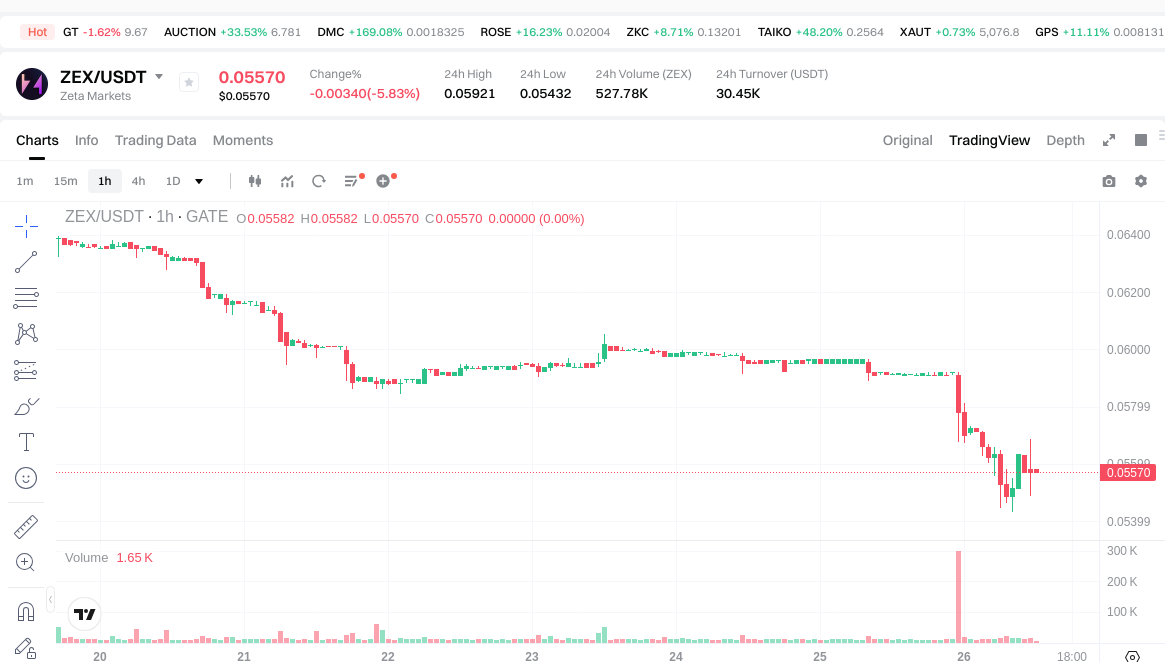
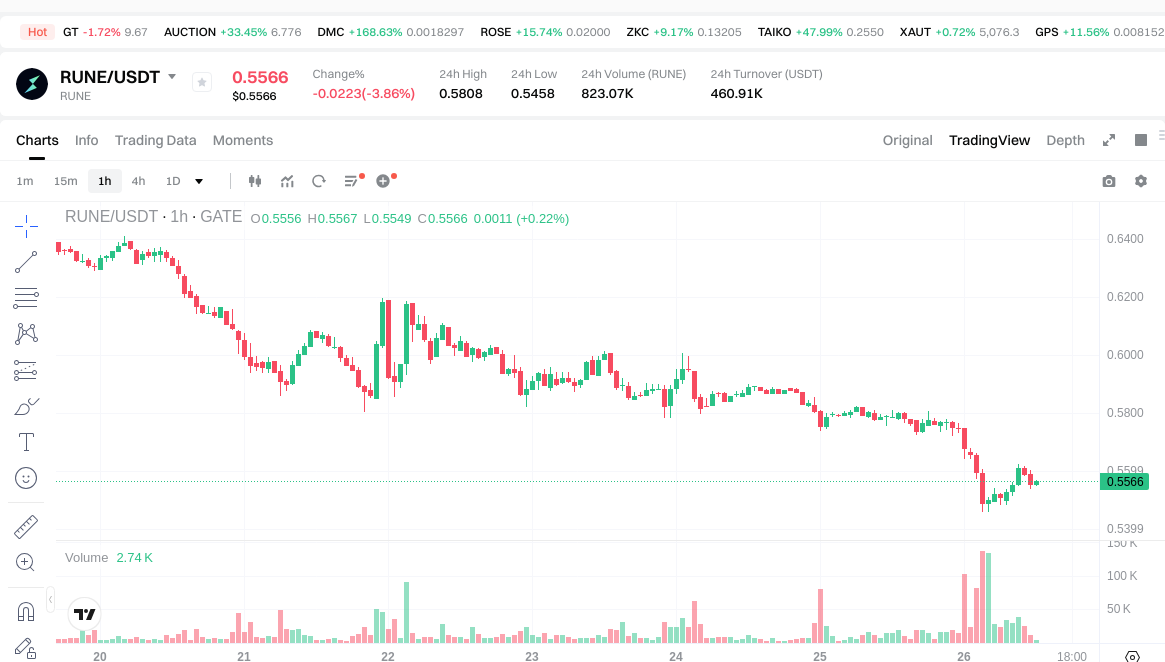
Current Market Status (2026-01-26)
- ZEX current price: $0.05582
- RUNE current price: $0.5554
- 24-hour trading volume: ZEX $30,431.25 vs RUNE $461,193.21
- Market capitalization: ZEX $10,127,870.95 vs RUNE $194,940,404.18
- Market sentiment index (Fear & Greed Index): 20 (Extreme Fear)
- 24-hour price change: ZEX -5.83% vs RUNE -4.19%
Check real-time prices:
II. Core Factors Affecting ZEX vs RUNE Investment Value
Supply Mechanism Comparison (Tokenomics)
Due to the absence of specific supply mechanism data in the provided materials, a detailed comparison of the tokenomics structures for ZEX and RUNE cannot be established at this time. Supply-related characteristics such as maximum supply caps, emission schedules, or deflationary features would typically influence long-term price dynamics through scarcity mechanisms and inflation rates.
Institutional Adoption and Market Application
Without available information regarding institutional holdings, enterprise-level adoption cases, or regulatory positioning across different jurisdictions, it remains unclear which asset demonstrates stronger institutional preference or broader practical implementation in cross-border payments, settlement systems, or portfolio allocation strategies.
Technical Development and Ecosystem Building
The provided materials do not contain specific details about ongoing technical upgrades, protocol enhancements, or ecosystem expansion initiatives for either ZEX or RUNE. A comprehensive evaluation would typically examine development roadmaps, decentralized finance integrations, non-fungible token ecosystem participation, payment infrastructure deployment, and smart contract functionality.
Macroeconomic Environment and Market Cycles
The relationship between macroeconomic conditions and the performance characteristics of ZEX versus RUNE cannot be assessed based on the current materials. Factors such as inflation hedging properties, sensitivity to monetary policy adjustments, interest rate fluctuations, US dollar index movements, and geopolitical developments affecting cross-border transaction demand would normally be considered in this analysis.
III. 2026-2031 Price Prediction: ZEX vs RUNE
Short-term Prediction (2026)
- ZEX: Conservative $0.04456 - $0.0557 | Optimistic $0.0557 - $0.059599
- RUNE: Conservative $0.356096 - $0.5564 | Optimistic $0.5564 - $0.829036
Medium-term Prediction (2028-2029)
- ZEX may enter a gradual growth phase, with projected prices ranging from $0.041585466825 to $0.085679263395
- RUNE may enter an expansion phase, with projected prices ranging from $0.417813900777 to $0.917552095824
- Key drivers: institutional capital inflows, ETF developments, ecosystem expansion
Long-term Prediction (2030-2031)
- ZEX: Base scenario $0.064087181400144 - $0.0791444043225 | Optimistic scenario $0.083101624538625 - $0.094102696739452
- RUNE: Base scenario $0.702099394323327 - $0.868397519262 | Optimistic scenario $1.06378696109595 - $1.340371570980897
View detailed price predictions for ZEX and RUNE
Disclaimer: Price predictions are based on historical data analysis and market trend modeling. Cryptocurrency markets are highly volatile and subject to numerous unpredictable factors. These projections should not be considered as investment advice. Past performance does not guarantee future results.
ZEX:
| Year |
Predicted High Price |
Predicted Average Price |
Predicted Low Price |
Price Change |
| 2026 |
0.059599 |
0.0557 |
0.04456 |
0 |
| 2027 |
0.074367855 |
0.0576495 |
0.04496661 |
3 |
| 2028 |
0.079210413 |
0.0660086775 |
0.041585466825 |
18 |
| 2029 |
0.085679263395 |
0.07260954525 |
0.0617181134625 |
30 |
| 2030 |
0.083101624538625 |
0.0791444043225 |
0.0696470758038 |
41 |
| 2031 |
0.094102696739452 |
0.081123014430562 |
0.064087181400144 |
45 |
RUNE:
| Year |
Predicted High Price |
Predicted Average Price |
Predicted Low Price |
Price Change |
| 2026 |
0.829036 |
0.5564 |
0.356096 |
0 |
| 2027 |
0.81740724 |
0.692718 |
0.54032004 |
24 |
| 2028 |
0.8834232654 |
0.75506262 |
0.604050096 |
35 |
| 2029 |
0.917552095824 |
0.8192429427 |
0.417813900777 |
47 |
| 2030 |
1.2591764029299 |
0.868397519262 |
0.8249776432989 |
56 |
| 2031 |
1.340371570980897 |
1.06378696109595 |
0.702099394323327 |
91 |
IV. Investment Strategy Comparison: ZEX vs RUNE
Long-term vs Short-term Investment Strategies
- ZEX: May appeal to investors interested in decentralized exchange infrastructure and Solana ecosystem development, particularly those with higher risk tolerance seeking exposure to emerging perpetual trading protocols
- RUNE: May appeal to investors focused on cross-chain liquidity solutions and established DeFi protocols with longer operational histories
Risk Management and Asset Allocation
- Conservative investors: ZEX 20-30% vs RUNE 70-80%
- Aggressive investors: ZEX 40-50% vs RUNE 50-60%
- Hedging instruments: Stablecoin allocation, options strategies, cross-asset portfolio diversification
V. Potential Risk Comparison
Market Risk
- ZEX: Demonstrated considerable price volatility since launch in 2024, with significant fluctuations observed within short timeframes. Lower trading volume ($30,431.25 in 24 hours) may contribute to liquidity constraints and increased price sensitivity to market movements
- RUNE: Exhibits price volatility characteristics common to cryptocurrency assets, with historical data showing substantial value changes across market cycles. Current 24-hour trading volume of $461,193.21 suggests relatively higher market liquidity compared to ZEX
Technical Risk
- ZEX: Considerations may include protocol scalability, network stability dependencies related to underlying blockchain infrastructure, and smart contract security
- RUNE: Cross-chain protocol complexity introduces unique technical considerations, including validator network decentralization, bridge security mechanisms, and multi-blockchain interoperability challenges
Regulatory Risk
Global regulatory developments regarding decentralized exchanges, cross-chain protocols, and cryptocurrency trading platforms may impact both assets differently based on their respective operational models and jurisdictional exposure. Regulatory frameworks continue to evolve across major markets.
VI. Conclusion: Which Is the Better Buy?
📌 Investment Value Summary:
- ZEX advantages: Positioned within the Solana ecosystem with focus on perpetual trading functionality; potentially benefits from decentralized exchange sector growth
- RUNE advantages: Established cross-chain liquidity protocol with longer operational history; larger market capitalization ($194,940,404.18) and higher trading volume suggest greater market presence
✅ Investment Recommendations:
- Beginner investors: Consider starting with assets demonstrating established market presence, higher liquidity, and longer operational track records to mitigate exposure to extreme volatility
- Experienced investors: May evaluate portfolio allocation based on risk tolerance, ecosystem preferences (Solana-based protocols vs cross-chain infrastructure), and market cycle positioning
- Institutional investors: Assess liquidity requirements, regulatory compliance considerations, custody solutions, and alignment with portfolio mandates before making allocation decisions
⚠️ Risk Warning: Cryptocurrency markets exhibit high volatility. This content does not constitute investment advice.
VII. FAQ
Q1: What is the main difference between ZEX and RUNE in terms of their core functionality?
ZEX operates as a Solana-based perpetual decentralized exchange (perps DEX), while RUNE functions as a cross-chain liquidity protocol. ZEX focuses specifically on providing high-speed derivative trading infrastructure leveraging Solana's scalability, whereas RUNE facilitates decentralized asset swaps across multiple blockchain networks without relying on wrapped tokens or centralized intermediaries.
Q2: Which asset shows higher price volatility based on historical performance?
ZEX demonstrates significantly higher volatility, declining approximately 93% from its all-time high of $0.3184 to its all-time low of $0.0218 within roughly one month after launch in 2024. RUNE, having a longer market history since 2019, has experienced price fluctuations across extended market cycles, though with a more gradual price discovery process compared to ZEX's compressed volatility timeframe.
Q3: How do the current trading volumes compare between ZEX and RUNE?
RUNE exhibits substantially higher 24-hour trading volume at $461,193.21 compared to ZEX's $30,431.25 as of January 26, 2026. This difference of approximately 15x suggests RUNE has greater market liquidity, potentially resulting in lower slippage during trades and reduced price impact for larger transactions. Higher trading volume typically indicates stronger market interest and easier entry/exit positions for investors.
Q4: What is the projected long-term price outlook for both assets by 2031?
According to the analysis, ZEX's base scenario projects a price range of $0.064087181400144 to $0.0791444043225 by 2031, representing a potential increase of approximately 45% from 2026 levels. RUNE's base scenario forecasts a range of $0.702099394323327 to $0.868397519262, potentially marking a 91% increase. However, these projections are based on historical data modeling and should not be interpreted as guaranteed outcomes given cryptocurrency market unpredictability.
Q5: Which asset is more suitable for conservative investors?
For conservative investors, RUNE may present a relatively more suitable option based on several factors: longer operational history since 2019, higher market capitalization ($194,940,404.18 vs $10,127,870.95), substantially greater trading volume, and established market presence. The analysis suggests a portfolio allocation of 70-80% RUNE versus 20-30% ZEX for conservative strategies, though investors should conduct independent research and assess personal risk tolerance before making decisions.
Q6: What are the primary risks associated with investing in ZEX versus RUNE?
ZEX's primary risks include extreme price volatility demonstrated since launch, lower liquidity constraints due to limited trading volume, dependencies on Solana network stability, and relatively unproven market positioning as a newer protocol. RUNE's risks center on cross-chain protocol complexity, validator network security considerations, bridge mechanism vulnerabilities inherent to multi-blockchain operations, and exposure to evolving regulatory frameworks affecting decentralized cross-chain services. Both assets face general cryptocurrency market risks including regulatory uncertainty and macroeconomic volatility.
Q7: How does the current market sentiment affect investment decisions for both assets?
With the Fear & Greed Index at 20 (Extreme Fear) as of January 26, 2026, market-wide sentiment suggests heightened caution among investors. Both ZEX (-5.83%) and RUNE (-4.19%) experienced negative 24-hour price movements reflecting this sentiment. Periods of extreme fear historically present potential accumulation opportunities for long-term investors with appropriate risk management, though timing market bottoms remains challenging. Investors should evaluate whether current sentiment aligns with their investment horizon and risk capacity before making allocation decisions.
Q8: Can beginners start investing in either ZEX or RUNE with limited cryptocurrency experience?
For beginners with limited cryptocurrency experience, the analysis recommends prioritizing assets with established market presence, higher liquidity, and longer operational track records. Based on these criteria, RUNE may be more appropriate for newcomers due to its four-year operational history, larger market capitalization, and higher trading volume. However, beginners should first educate themselves on fundamental cryptocurrency concepts, understand wallet security, implement proper risk management (never invest more than affordable to lose), and consider starting with smaller positions before making substantial commitments to either asset.
* The information is not intended to be and does not constitute financial advice or any other recommendation of any sort offered or endorsed by Gate.