This comprehensive analysis compares ZND and LRC, two distinct blockchain protocol tokens positioned in cryptocurrency markets. ZND, launched December 2023, operates as a regulated financial ecosystem integrating trading, payments, earning, and borrowing on Gate. LRC, established August 2017, functions as a decentralized exchange protocol enabling non-custodial asset trading. Current market conditions reflect extreme fear (Fear & Greed Index: 14) with both assets experiencing 98%+ declines from peaks. The article examines historical price trends, market positioning, tokenomics, technical ecosystems, institutional adoption, and risk factors. Long-term predictions (2031) suggest LRC baseline $0.071-$0.082 and ZND baseline $0.013-$0.016. Investment considerations vary by investor profile, with emphasis on comprehensive risk assessment, regulatory monitoring, and liquidity management across these volatile digital assets.
Introduction: Investment Comparison Between ZND and LRC
In the cryptocurrency market, the comparison between ZND vs LRC has consistently been a topic that investors cannot overlook. The two not only demonstrate significant differences in market cap ranking, application scenarios, and price performance, but also represent distinct crypto asset positioning.
ZND (ZND): Launched in December 2023, it has gained market recognition through its positioning as a fully regulated financial ecosystem integrating multiple platforms including trading, payments, earning, and borrowing functionalities.
LRC (LRC): Since its launch in August 2017, it has been recognized for its role as a decentralized exchange protocol based on ERC20 and smart contracts, enabling asset exchange without custody requirements.
This article will comprehensively analyze the investment value comparison of ZND vs LRC around historical price trends, supply mechanisms, technical ecosystems, and future forecasts, attempting to answer the question that investors care about most:
"Which is the better buy right now?"
I. Historical Price Comparison and Current Market Status
ZND and LRC Historical Price Trends
- 2025: ZND reached an all-time high of $0.55 on March 3, 2025, following its platform launch in December 2023 and subsequent market momentum.
- 2021: LRC experienced significant price appreciation, reaching an all-time high of $3.75 on November 10, 2021, driven by increased interest in Layer 2 scaling solutions and decentralized exchanges.
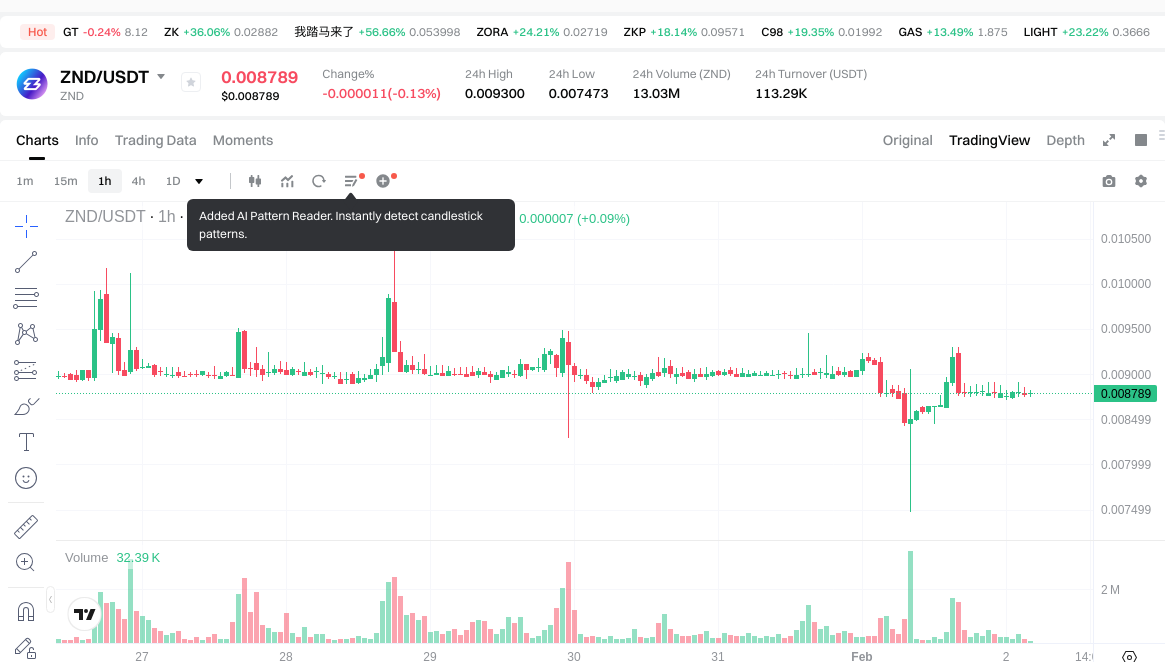
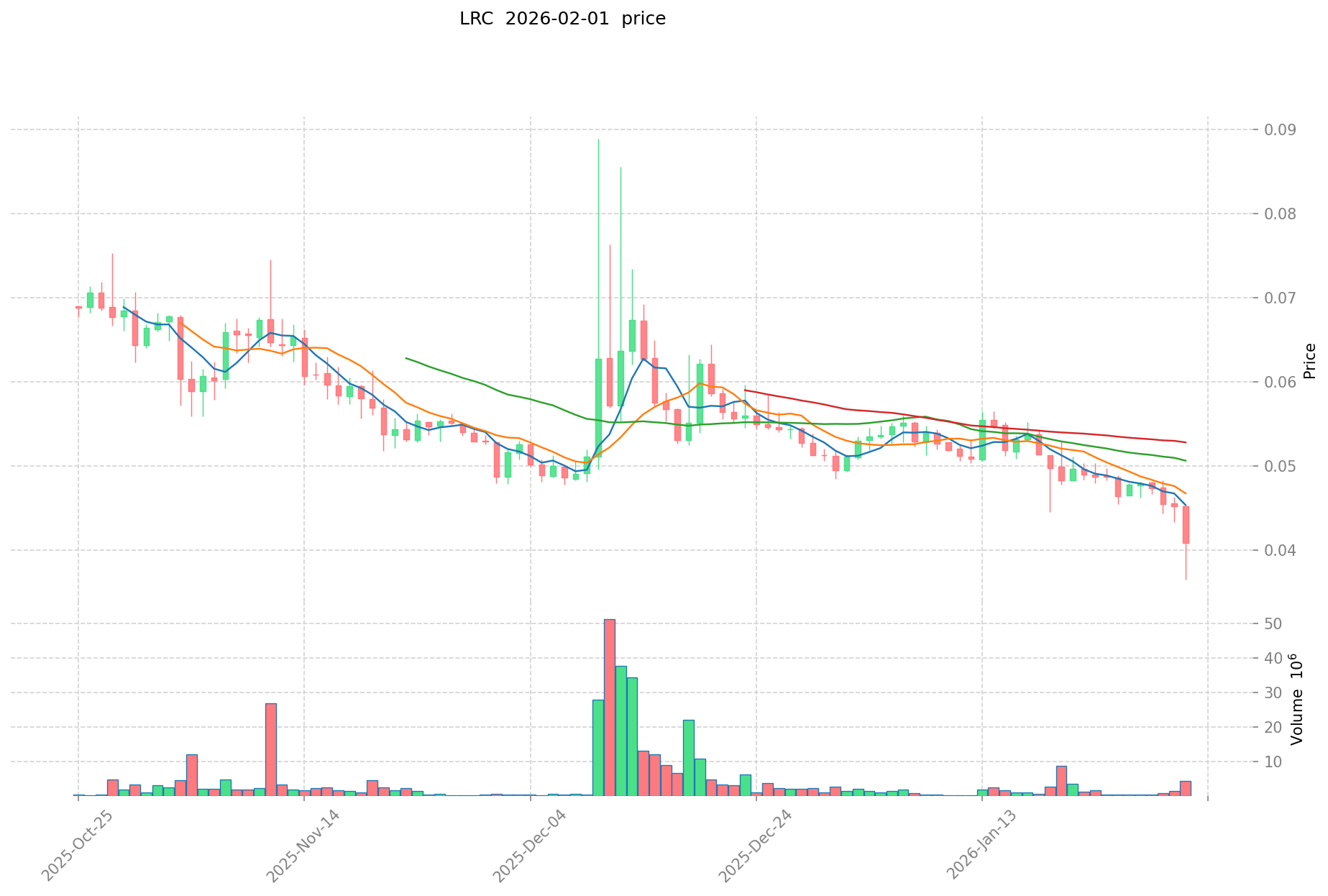
- Comparative Analysis: During the recent market cycle, ZND declined from its peak of $0.55 to a low of $0.007473 recorded on February 1, 2026, representing a decline of approximately 98.6%. Meanwhile, LRC experienced a similar downward trajectory, falling from its historical high of $3.75 to recent levels around $0.04056, marking a decline of approximately 98.9% from its peak.
Current Market Status (February 2, 2026)
- ZND Current Price: $0.008784
- LRC Current Price: $0.04056
- 24-Hour Trading Volume: ZND recorded $114,645.86 compared to LRC's $127,891.23
- Market Sentiment Index (Fear & Greed Index): 14 (Extreme Fear)
View real-time prices:
- Check ZND current price Market Price
- Check LRC current price Market Price
II. Core Factors Influencing ZND vs LRC Investment Value
Supply Mechanism Comparison (Tokenomics)
The provided reference materials do not contain specific information regarding the supply mechanisms, tokenomics models, or circulation parameters for ZND and LRC. Without documented evidence of fixed supply configurations, deflationary models, halving mechanisms, or other monetary policy frameworks for these assets, a comparative analysis of their tokenomics cannot be substantiated.
Institutional Adoption and Market Application
Institutional Holdings: The reference materials do not provide data on institutional positioning or preferences between ZND and LRC.
Enterprise Adoption: Documentation regarding the deployment of ZND or LRC in cross-border payments, settlement systems, or institutional investment portfolios is not available in the provided sources.
National Policy: The materials reference general investment policy frameworks and regulatory considerations in various jurisdictions, but do not contain specific regulatory attitudes or policy positions toward ZND or LRC from any national authorities.
Technical Development and Ecosystem Construction
The reference materials do not include technical upgrade roadmaps, development milestones, or ecosystem expansion plans for either ZND or LRC. Consequently, comparative assessments of DeFi integration, NFT functionality, payment system deployment, or smart contract implementation cannot be conducted based on the available documentation.
Macroeconomic Environment and Market Cycles
Performance in Inflationary Environments: The materials reference general investment considerations and macroeconomic factors affecting asset valuation, but do not provide comparative data on how ZND or LRC perform under inflationary conditions or their respective inflation-hedging characteristics.
Macroeconomic Monetary Policy: While the documents discuss investment decision-making factors and market considerations, they do not contain analysis of how interest rate fluctuations, dollar index movements, or other monetary policy variables specifically impact ZND or LRC.
Geopolitical Factors: The reference materials mention investment environment considerations and cross-border business contexts, but do not provide specific analysis of how geopolitical developments, international situations, or cross-border transaction demand patterns affect the investment value proposition of ZND or LRC.
III. 2026-2031 Price Prediction: ZND vs LRC
Short-term Prediction (2026)
- ZND: Conservative $0.00843264 - $0.008784 | Optimistic $0.008784 - $0.01133136
- LRC: Conservative $0.0259584 - $0.04056 | Optimistic $0.04056 - $0.0507
Medium-term Prediction (2028-2029)
- ZND may enter a consolidation phase, with estimated price range of $0.008545004928 - $0.01305486864 in 2028, potentially expanding to $0.0102184017264 - $0.014330685348 by 2029
- LRC may experience gradual growth phase, with projected price range of $0.045776016 - $0.068664024 in 2028, potentially reaching $0.03897637029 - $0.0756257931 by 2029
- Key drivers: institutional capital flows, ETF developments, ecosystem expansion
Long-term Prediction (2031)
- ZND: Baseline scenario $0.013071890408497 - $0.01594132976646 | Optimistic scenario $0.01594132976646 - $0.021999035077714
- LRC: Baseline scenario $0.07100738408907 - $0.081617682861 | Optimistic scenario $0.081617682861 - $0.10365445723347
View detailed price predictions for ZND and LRC
Disclaimer
ZND:
| Year |
Predicted High Price |
Predicted Average Price |
Predicted Low Price |
Price Change |
| 2026 |
0.01133136 |
0.008784 |
0.00843264 |
0 |
| 2027 |
0.0136784448 |
0.01005768 |
0.008046144 |
14 |
| 2028 |
0.01305486864 |
0.0118680624 |
0.008545004928 |
34 |
| 2029 |
0.014330685348 |
0.01246146552 |
0.0102184017264 |
41 |
| 2030 |
0.01848658409892 |
0.013396075434 |
0.0113866641189 |
52 |
| 2031 |
0.021999035077714 |
0.01594132976646 |
0.013071890408497 |
81 |
LRC:
| Year |
Predicted High Price |
Predicted Average Price |
Predicted Low Price |
Price Change |
| 2026 |
0.0507 |
0.04056 |
0.0259584 |
0 |
| 2027 |
0.0497367 |
0.04563 |
0.0355914 |
12 |
| 2028 |
0.068664024 |
0.04768335 |
0.045776016 |
17 |
| 2029 |
0.0756257931 |
0.058173687 |
0.03897637029 |
43 |
| 2030 |
0.096335625672 |
0.06689974005 |
0.0381328518285 |
64 |
| 2031 |
0.10365445723347 |
0.081617682861 |
0.07100738408907 |
101 |
IV. Investment Strategy Comparison: ZND vs LRC
Long-term vs Short-term Investment Strategies
-
ZND: May appeal to investors interested in regulated financial ecosystems with integrated trading, payment, earning, and borrowing functionalities. The asset's positioning within a comprehensive platform structure could attract those seeking exposure to emerging fintech infrastructure developments.
-
LRC: May suit investors focused on decentralized exchange protocols and Layer 2 scaling solutions. The asset's foundation in non-custodial trading infrastructure and smart contract-based exchange mechanisms could resonate with participants interested in DeFi protocol development.
Risk Management and Asset Allocation
-
Conservative Investors: A prudent approach might consider balanced exposure with careful position sizing, potentially exploring allocation frameworks that prioritize capital preservation and volatility management across both assets.
-
Aggressive Investors: More risk-tolerant participants might evaluate differentiated allocation strategies based on individual risk profiles, market conditions, and specific investment objectives related to each asset's unique characteristics.
-
Hedging Tools: Portfolio risk management may incorporate stablecoin positions, derivatives instruments where available, and diversified cryptocurrency holdings to mitigate concentration risk and market volatility exposure.
V. Potential Risk Comparison
Market Risk
-
ZND: As a relatively recent market entrant (launched December 2023), the asset has experienced significant price volatility, declining approximately 98.6% from its peak. Limited historical performance data and lower trading volumes ($114,645.86 on February 2, 2026) may contribute to liquidity concerns and price sensitivity.
-
LRC: Despite longer market presence since August 2017, the asset has undergone substantial value contraction of approximately 98.9% from historical highs. Current trading volumes ($127,891.23) and market sentiment conditions (Fear & Greed Index at 14 - Extreme Fear) reflect challenging market dynamics.
Technical Risk
-
ZND: The reference materials do not provide detailed information regarding network architecture, scalability parameters, security audit results, or technical infrastructure specifications that would enable comprehensive technical risk assessment.
-
LRC: Documentation does not include specific technical vulnerability assessments, network stability metrics, smart contract audit findings, or infrastructure resilience evaluations necessary for detailed technical risk analysis.
Regulatory Risk
The evolving global regulatory landscape for digital assets presents considerations for both ZND and LRC. While ZND positions itself as a regulated financial ecosystem, specific jurisdictional frameworks, compliance requirements, and regulatory developments affecting either asset are not detailed in the available materials. Investors should monitor regulatory developments across relevant jurisdictions that may impact asset classification, trading restrictions, or operational parameters.
VI. Conclusion: Which Is the Better Buy?
📌 Investment Value Summary:
-
ZND Characteristics: Integrated financial ecosystem positioning with multiple platform functionalities including trading, payments, earning, and borrowing services. Relatively new market presence with current price of $0.008784.
-
LRC Characteristics: Established decentralized exchange protocol with foundation in Layer 2 scaling solutions and non-custodial trading infrastructure. Longer operational history since 2017 with current price of $0.04056.
✅ Investment Considerations:
-
Novice Investors: May benefit from comprehensive research, education on cryptocurrency fundamentals, risk assessment frameworks, and consultation with qualified financial professionals before engaging with either asset. Understanding market volatility, liquidity characteristics, and individual risk tolerance remains essential.
-
Experienced Investors: Might evaluate each asset's positioning within their existing portfolio strategy, considering factors such as correlation with other holdings, technical development trajectories, ecosystem expansion potential, and alignment with specific investment theses.
-
Institutional Investors: Could assess both assets within broader digital asset allocation frameworks, considering liquidity requirements, regulatory compliance considerations, custody solutions, and strategic alignment with institutional investment mandates.
⚠️ Risk Disclaimer: Cryptocurrency markets demonstrate extreme volatility and substantial risk characteristics. Both ZND and LRC have experienced significant value declines from historical peaks. This content does not constitute investment advice, financial guidance, or recommendations to buy, sell, or hold any digital assets. Investors should conduct independent research, assess personal risk tolerance, and consult qualified financial advisors before making investment decisions. Past performance does not indicate future results.
VII. FAQ
Q1: What are the main differences between ZND and LRC in terms of their core functionality?
ZND operates as a regulated financial ecosystem integrating multiple platforms including trading, payments, earning, and borrowing functionalities, launched in December 2023. LRC functions as a decentralized exchange protocol based on ERC20 and smart contracts, enabling non-custodial asset exchange since August 2017. The fundamental distinction lies in ZND's comprehensive platform approach versus LRC's specialized focus on decentralized trading infrastructure and Layer 2 scaling solutions.
Q2: Which asset has shown better price resilience during recent market downturns?
Both assets have demonstrated similar vulnerability to market corrections, with ZND declining approximately 98.6% from its peak of $0.55 to $0.007473, while LRC experienced a comparable 98.9% decline from $3.75 to current levels around $0.04056. Neither asset has shown significant price resilience, reflecting the extreme volatility characteristic of the broader cryptocurrency market during the recent downturn, as evidenced by the Fear & Greed Index reading of 14 (Extreme Fear) as of February 2, 2026.
Q3: What factors should investors consider when choosing between ZND and LRC?
Investors should evaluate several key considerations: investment time horizon (short-term vs long-term), risk tolerance levels, interest in specific technological approaches (integrated financial platforms vs decentralized exchange protocols), liquidity requirements, regulatory considerations, and alignment with existing portfolio strategies. Additionally, factors such as trading volume differences ($114,645.86 for ZND vs $127,891.23 for LRC), market maturity (ZND's recent 2023 launch vs LRC's 2017 establishment), and individual investment objectives should inform decision-making processes.
Q4: How do the long-term price predictions compare between ZND and LRC?
According to the 2031 projections, ZND's baseline scenario ranges from $0.013071890408497 to $0.01594132976646, with an optimistic scenario extending to $0.021999035077714, representing an 81% projected change from current levels. LRC's 2031 baseline scenario projects $0.07100738408907 to $0.081617682861, with optimistic scenarios reaching $0.10365445723347, indicating a 101% projected change. While LRC shows higher absolute price projections, both assets present speculative long-term growth scenarios subject to numerous market variables and uncertainties.
Q5: What are the primary risks associated with investing in either ZND or LRC?
Both assets face significant market risk, evidenced by extreme volatility and substantial value contractions exceeding 98% from historical peaks. Liquidity concerns exist due to relatively modest trading volumes. Technical risks remain present, though specific vulnerability assessments and security audit results are not detailed in available documentation. Regulatory uncertainty affects both assets as the global digital asset regulatory framework continues evolving. Additionally, the extreme market sentiment (Fear & Greed Index at 14) indicates prevailing risk-averse conditions that may impact price stability and investor confidence.
Q6: Are ZND and LRC suitable for beginner cryptocurrency investors?
Neither ZND nor LRC may be optimal entry points for novice investors due to extreme volatility, significant historical value declines, and complex risk profiles. Beginners should prioritize comprehensive cryptocurrency education, fundamental risk assessment, understanding of market dynamics, and consultation with qualified financial professionals before considering either asset. The substantial price corrections both assets have experienced (approximately 98-99% declines from peaks) underscore the importance of risk management, position sizing, and emotional discipline required for cryptocurrency investment participation.
Q7: How do institutional adoption levels compare between ZND and LRC?
The available reference materials do not provide specific data regarding institutional holdings, enterprise adoption rates, or documented institutional preferences between ZND and LRC. Information concerning deployment in cross-border payment systems, settlement infrastructure, or institutional investment portfolios is not documented in the provided sources. Consequently, comparative analysis of institutional adoption levels cannot be substantiated based on available documentation, and investors seeking this information should conduct additional independent research through official project channels and institutional disclosure sources.
Q8: What role does each asset play in the broader cryptocurrency ecosystem?
ZND positions itself within the regulated financial services segment, offering integrated platform functionality spanning trading, payment processing, earning mechanisms, and lending services, potentially appealing to users seeking comprehensive financial ecosystem solutions. LRC occupies a distinct position in the decentralized finance infrastructure layer, providing protocol-level solutions for non-custodial exchange operations and Layer 2 scaling, serving developers and users prioritizing decentralization and trustless trading mechanisms. These differentiated ecosystem roles represent distinct value propositions within the broader digital asset landscape.
* The information is not intended to be and does not constitute financial advice or any other recommendation of any sort offered or endorsed by Gate.