This comprehensive analysis compares ZRX and AAVE, two major DeFi protocol tokens, examining their investment potential and market dynamics. ZRX, launched in 2017, serves as infrastructure for decentralized exchange operations on Ethereum, currently trading at $0.1505 with a $127.68M market cap. AAVE, a leading DeFi lending protocol, trades at $171.34 with a $2.60B market cap. The article addresses key investor questions regarding price performance drivers, associated risks, and utility within respective ecosystems. It covers historical price trends from 2018-2026, tokenomics comparison, institutional adoption patterns, and technical ecosystem development. The analysis provides short, mid, and long-term price forecasts through 2031, evaluates investment strategies for different investor profiles, and identifies market, technical, and regulatory risks. Real-time prices available on Gate platform. Suitable for investors seeking DeFi exposure assessment and protocol comparison frameworks.
Introduction: Investment Value, Price Prediction, and Risk Analysis of ZRX
In the decentralized finance ecosystem, ZRX has established itself as a foundational protocol token since its launch in August 2017. As the native token of 0x Protocol, ZRX facilitates peer-to-peer trading of ERC20 tokens on the Ethereum blockchain, playing a role in the development of decentralized exchange infrastructure.
ZRX (0xProject): Launched in 2017, it serves as an open-source protocol designed to promote interoperability among decentralized applications with exchange functionalities. The protocol enables DApps to access public liquidity pools or create their own, charging transaction fees on trading volume.
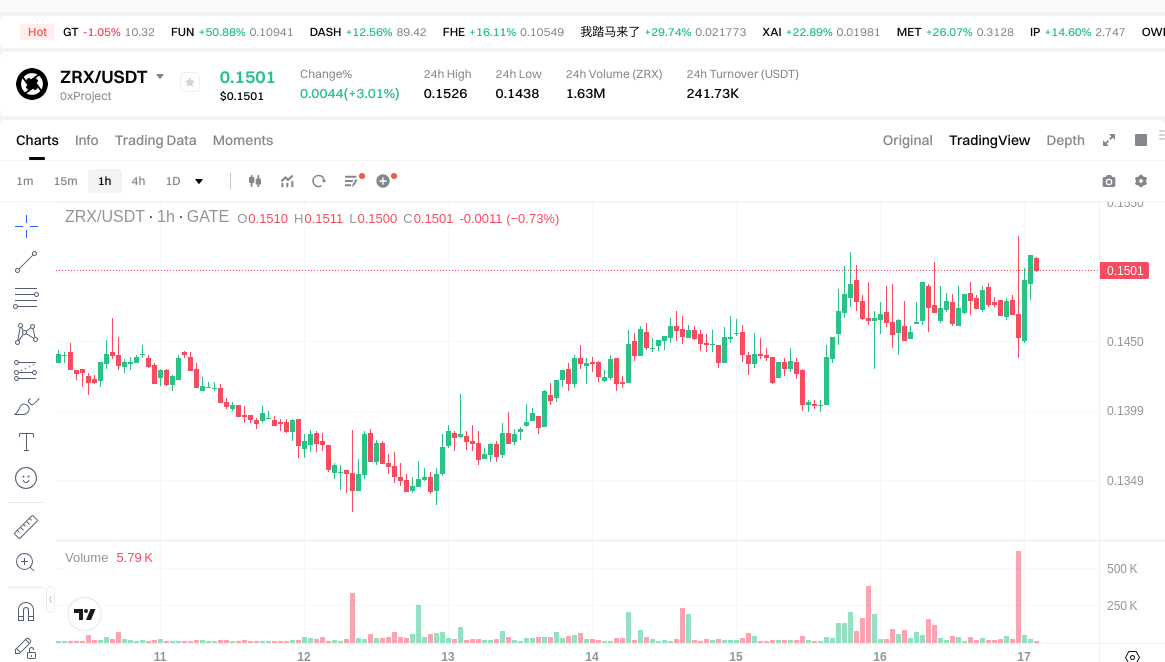
As of January 17, 2026, ZRX is trading at $0.1505 with a market capitalization of approximately $127.68 million, ranking 315th in the cryptocurrency market. The token has exhibited notable volatility, with a 24-hour price change of 3.27%, a 7-day increase of 5.22%, and a 30-day gain of 20.86%. However, the 1-year performance shows a decline of 70.92%, reflecting broader market dynamics and sector-specific challenges.
This article will provide a comprehensive analysis covering historical price trends, supply mechanisms, technical ecosystem development, and market dynamics. We aim to address key questions that investors frequently consider:
"What factors influence ZRX's price performance?"
"What are the primary risks associated with investing in ZRX?"
"How does the token's utility within the 0x Protocol ecosystem affect its value proposition?"
I. Historical Price Comparison and Current Market Status
ZRX and AAVE Historical Price Trends
- 2018: ZRX reached an all-time high of $2.50 in January 2018 during the broader cryptocurrency bull market, reflecting strong early adoption of decentralized exchange infrastructure.
- 2021: AAVE recorded its all-time high of $661.69 in May 2021, driven by the DeFi summer phenomenon and institutional interest in decentralized lending protocols.
- 2020-2025: ZRX experienced significant volatility, declining from its 2018 peak to a historical low of $0.11448 in December 2025, representing a decrease of over 95% from its all-time high.
- 2020-2025: AAVE declined from its 2021 peak of $661.69 to a low of $26.02 in November 2020, though it subsequently recovered and maintained stronger price levels relative to its historical range compared to ZRX.
- Comparative Analysis: During the 2021-2026 market cycle, ZRX declined from approximately $2.50 to $0.1505, while AAVE experienced a decline from $661.69 to $171.34, showing both assets faced significant downward pressure but AAVE maintained relatively stronger market positioning.
Current Market Status (January 17, 2026)
- ZRX Current Price: $0.1505
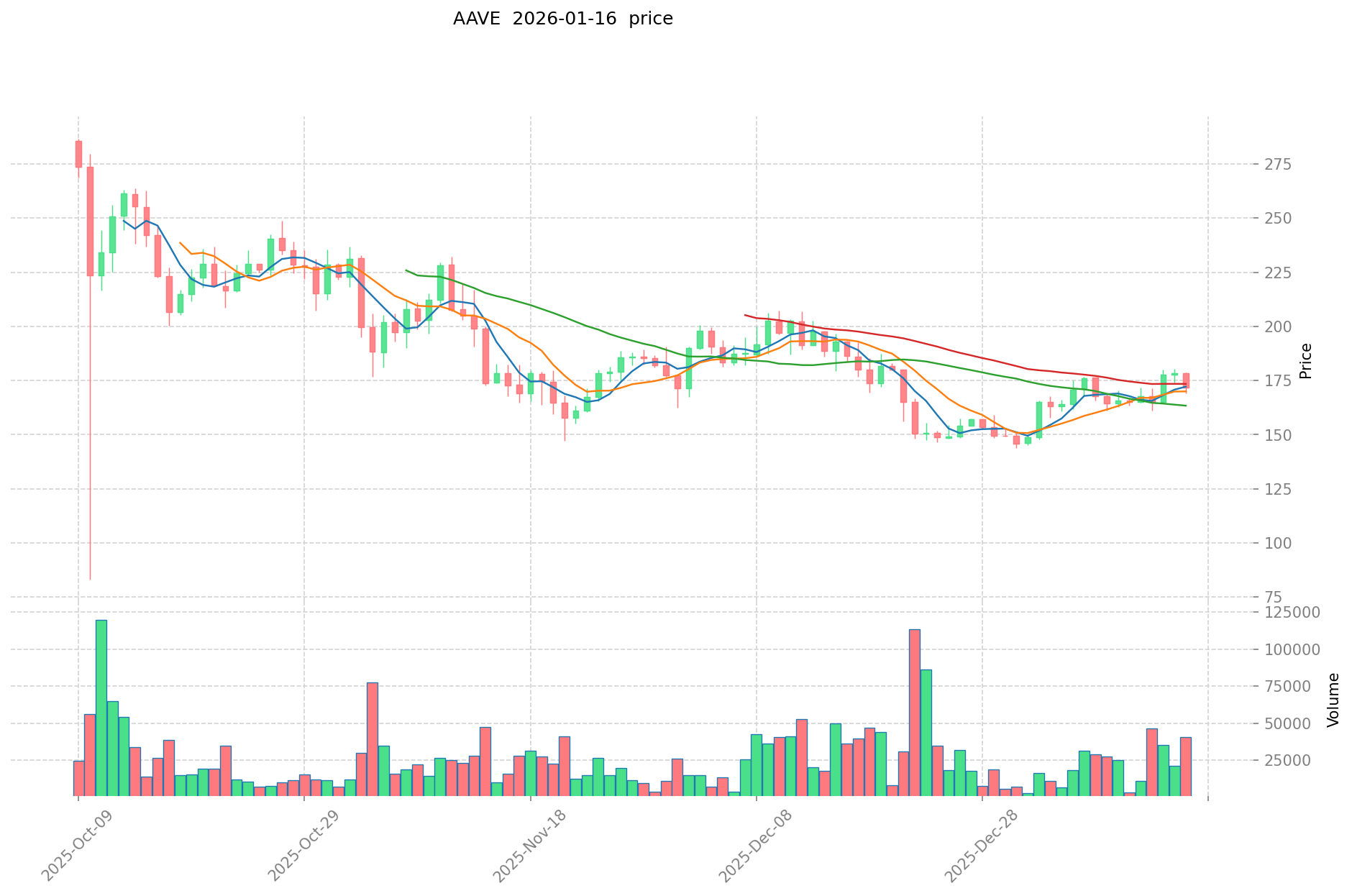
- AAVE Current Price: $171.34
- 24-Hour Trading Volume: ZRX $241,344.72 vs AAVE $4,185,528.49
- Market Sentiment Index (Fear & Greed Index): 49 (Neutral)
- Price Performance (24H): ZRX +3.27%, AAVE -0.37%
- Market Capitalization: ZRX $127.68M vs AAVE $2.60B
- Circulating Supply Ratio: ZRX 84.84% vs AAVE 94.90%
View real-time prices:
II. Core Factors Influencing ZRX vs AAVE Investment Value
Supply Mechanism Comparison (Tokenomics)
-
ZRX: The 0x protocol token features a fixed supply model designed to facilitate peer-to-peer asset exchanges on the Ethereum network. As a governance and utility token within the 0x ecosystem, its value proposition is tied to protocol adoption and transaction volume.
-
AAVE: AAVE operates with a token model that incorporates both utility and governance functions within its lending protocol. The token's economic design includes mechanisms for protocol fee distribution and a safety module where users can stake AAVE to earn rewards while providing security to the protocol.
-
📌 Historical Pattern: Supply mechanisms in DeFi protocols have shown correlation with ecosystem growth patterns. Projects with innovative tokenomics tied to protocol usage have demonstrated resilience during market cycles, though regulatory developments and technological innovation remain primary value drivers.
Institutional Adoption and Market Application
-
Institutional Holdings: Both protocols operate within the decentralized finance ecosystem, serving different functional niches. AAVE has gained traction in the lending and borrowing space, while ZRX focuses on decentralized exchange infrastructure.
-
Enterprise Adoption: AAVE's lending protocol has seen integration across multiple DeFi platforms, with its liquidity pools supporting various crypto assets. The protocol expanded through AMM markets and Layer 2 solutions like Polygon. ZRX serves as infrastructure for peer-to-peer trading, with its role dependent on adoption of the 0x protocol by developers and applications requiring exchange functionality.
-
Policy Landscape: Regulatory approaches vary across jurisdictions. Some regions have introduced frameworks for digital asset taxation and trading oversight, while others are developing blockchain application standards in financial services.
Technology Development and Ecosystem Building
-
ZRX Technology: The 0x protocol provides open standards for developers building decentralized exchange functionality. Its value is linked to the growth of applications utilizing its peer-to-peer trading infrastructure.
-
AAVE Technology: AAVE has demonstrated continuous innovation in DeFi lending mechanisms. The protocol evolved from order book models to liquidity pool-based lending, introducing features such as flash loans, credit delegation, and multi-collateral support. Recent developments include V2 protocol optimization, AMM market integration with Uniswap and Balancer LP tokens, and Layer 2 deployment on Polygon for reduced transaction costs.
-
Ecosystem Comparison: AAVE has expanded its presence across multiple markets including V1, V2, AMM markets, and Polygon deployment. The protocol's total value locked grew substantially, reflecting user adoption. ZRX's ecosystem development depends on integration by applications requiring decentralized exchange functionality. Both protocols operate within the broader Ethereum DeFi ecosystem, where MakerDAO supported multiple tokens including ZRX as collateral for stablecoin generation.
Macroeconomic Environment and Market Cycles
-
Performance Considerations: DeFi protocol tokens have shown different characteristics compared to traditional crypto assets. Their value drivers include protocol adoption, total value locked, transaction volumes, and ecosystem development rather than purely speculative factors.
-
Monetary Policy Context: Broader cryptocurrency market conditions, including liquidity factors and risk appetite in digital asset markets, influence DeFi protocol valuations. Interest rate environments and capital flows affect overall crypto sector sentiment.
-
Market Dynamics: The DeFi sector experienced significant growth phases, with lending protocols and decentralized exchange infrastructure seeing varying adoption rates. Cross-border transaction capabilities and blockchain technology applications in financial services represent ongoing development areas, though specific geopolitical impacts on individual protocols require careful assessment based on actual usage patterns and regulatory developments.
III. 2026-2031 Price Forecast: ZRX vs AAVE
Short-term Forecast (2026)
- ZRX: Conservative $0.126-$0.15 | Optimistic $0.15-$0.207
- AAVE: Conservative $151.09-$171.69 | Optimistic $171.69-$242.08
Mid-term Forecast (2028-2029)
- ZRX may enter a gradual growth phase, with estimated prices ranging from $0.143 to $0.291
- AAVE may enter an expansion phase, with estimated prices ranging from $219.33 to $393.59
- Key drivers: institutional capital inflows, ETF developments, ecosystem growth
Long-term Forecast (2030-2031)
- ZRX: Baseline scenario $0.142-$0.250 | Optimistic scenario $0.178-$0.396
- AAVE: Baseline scenario $191.17-$335.38 | Optimistic scenario $269.23-$513.61
View detailed price predictions for ZRX and AAVE
Disclaimer
ZRX:
| Year |
Predicted High Price |
Predicted Average Price |
Predicted Low Price |
Price Change |
| 2026 |
0.207 |
0.15 |
0.126 |
0 |
| 2027 |
0.20349 |
0.1785 |
0.13209 |
18 |
| 2028 |
0.22728405 |
0.190995 |
0.14324625 |
26 |
| 2029 |
0.29070393975 |
0.209139525 |
0.15267185325 |
38 |
| 2030 |
0.3448919906775 |
0.249921732375 |
0.14245538745375 |
66 |
| 2031 |
0.395551125829912 |
0.29740686152625 |
0.17844411691575 |
97 |
AAVE:
| Year |
Predicted High Price |
Predicted Average Price |
Predicted Low Price |
Price Change |
| 2026 |
242.0829 |
171.69 |
151.0872 |
0 |
| 2027 |
275.1589785 |
206.88645 |
151.0271085 |
20 |
| 2028 |
313.329528525 |
241.02271425 |
219.3306699675 |
40 |
| 2029 |
393.59009237025 |
277.1761213875 |
235.599703179375 |
61 |
| 2030 |
493.01316711194625 |
335.383106878875 |
191.16837092095875 |
95 |
| 2031 |
513.605689874309175 |
414.198136995410625 |
269.228789047016906 |
141 |
IV. Investment Strategy Comparison: ZRX vs AAVE
Long-term vs Short-term Investment Strategies
-
ZRX: May appeal to investors focused on decentralized exchange infrastructure development and protocol adoption trends. The token's value proposition is tied to the growth of applications utilizing 0x Protocol for peer-to-peer trading functionality. Given its current market position and lower market capitalization, it presents different risk-return characteristics compared to larger DeFi protocols.
-
AAVE: May suit investors seeking exposure to established DeFi lending infrastructure with demonstrated protocol adoption. AAVE's broader ecosystem presence across multiple markets (V1, V2, AMM markets, Polygon deployment) and higher total value locked reflects more mature protocol development. The token's governance and utility functions within a widely-adopted lending protocol represent a different value proposition.
Risk Management and Asset Allocation
-
Conservative Investors: Consider portfolio weighting that reflects market capitalization differences and protocol maturity levels. A sample allocation might include ZRX 20-30% vs AAVE 70-80% within a DeFi-focused portfolio segment, though individual circumstances vary significantly.
-
Aggressive Investors: May explore higher allocation to smaller market cap protocols like ZRX 40-50% vs AAVE 50-60% to capture potential growth opportunities, acknowledging elevated volatility and development-stage considerations.
-
Hedging Tools: Stablecoin positions can provide liquidity buffers during volatility periods. Options strategies, where available, may offer downside protection. Cross-protocol diversification across different DeFi functional categories (lending, exchange infrastructure, derivatives) can reduce concentration exposure.
V. Potential Risk Comparison
Market Risks
-
ZRX: The token has experienced substantial price decline from historical levels, with 1-year performance showing decrease of 70.92%. Lower trading volumes ($241,344.72 in 24-hour period) may present liquidity considerations during market stress periods. Market capitalization of $127.68 million reflects smaller protocol scale compared to leading DeFi projects.
-
AAVE: While demonstrating stronger market positioning with $2.60 billion market capitalization and higher trading volumes ($4,185,528.49 in 24-hour period), the protocol experienced significant drawdown from 2021 levels. DeFi lending protocols face sector-specific dynamics including competition, protocol innovation cycles, and changing user preferences across different market conditions.
Technical Risks
-
ZRX: Protocol adoption depends on developer integration of 0x infrastructure for exchange functionality. Network effects and competitive positioning within decentralized exchange infrastructure represent ongoing considerations. The protocol operates on Ethereum, inheriting base layer scalability characteristics.
-
AAVE: Protocol complexity includes smart contract interactions for lending, borrowing, flash loans, and collateral management. While the protocol has undergone audits and operates across multiple deployments, DeFi protocols generally face ongoing technical evolution requirements. Layer 2 integrations and cross-chain expansions introduce additional technical considerations.
Regulatory Risks
- Global regulatory approaches to DeFi protocols continue to evolve across jurisdictions. Different regions are developing varied frameworks for digital asset oversight, with some implementing registration requirements, taxation policies, and consumer protection measures. Decentralized exchange infrastructure and lending protocols may face different regulatory considerations based on their functional characteristics and operational structures. Investors should monitor regulatory developments in relevant jurisdictions affecting protocol operations and token utility.
VI. Conclusion: Which Is the Better Buy?
📌 Investment Value Summary:
-
ZRX Considerations: Functions as infrastructure token for decentralized exchange protocol with open-source architecture. Current lower market capitalization may present different growth potential scenarios compared to established protocols. Price performance shows recent short-term gains (30-day increase of 20.86%) though longer-term trend reflects significant decline. Protocol value tied to developer adoption and integration of 0x infrastructure.
-
AAVE Considerations: Established position within DeFi lending sector with demonstrated protocol adoption and ecosystem expansion. Higher market capitalization and trading volumes reflect more mature protocol development stage. Continuous innovation in lending mechanisms including flash loans, credit delegation, and multi-chain deployment. Total value locked growth indicates sustained user engagement.
✅ Investment Considerations:
-
Novice Investors: Consider starting with smaller position sizes in established protocols with demonstrated adoption patterns. Focus on understanding protocol fundamentals, tokenomics, and ecosystem development before allocation decisions. Diversification across different protocol types and functions may reduce concentration exposure.
-
Experienced Investors: Evaluate risk-return profiles based on protocol maturity stages, adoption metrics, technical development roadmaps, and competitive positioning. Consider allocation strategies that reflect individual risk tolerance and investment timeframes. Monitor protocol governance developments and ecosystem growth indicators.
-
Institutional Investors: Assess protocols based on total value locked trends, security audit history, technical infrastructure maturity, and regulatory compliance considerations. Evaluate liquidity profiles, custody solutions, and operational risk management frameworks. Consider broader DeFi sector allocation strategies incorporating different functional categories.
⚠️ Risk Disclosure: Cryptocurrency markets exhibit substantial volatility. DeFi protocols face technical, market, regulatory, and operational considerations. Historical performance does not indicate future results. This content provides informational analysis and does not constitute investment advice. Individuals should conduct independent research and consult qualified professionals before making investment decisions.
VII. FAQ
Q1: What is the primary difference between ZRX and AAVE in terms of protocol functionality?
ZRX serves as infrastructure for decentralized exchange operations, while AAVE functions as a decentralized lending and borrowing protocol. ZRX (0x Protocol) provides open-source standards enabling peer-to-peer trading of ERC20 tokens on Ethereum, allowing developers to build exchange functionality into their applications. AAVE operates liquidity pools where users can lend assets to earn interest or borrow against collateral, introducing innovations like flash loans and credit delegation. The fundamental distinction lies in their core use cases: ZRX facilitates token exchange infrastructure, whereas AAVE enables capital markets through decentralized lending mechanisms.
Q2: Why has ZRX experienced a 70.92% decline over the past year while AAVE maintained relatively stronger positioning?
The performance divergence reflects differences in protocol adoption, ecosystem maturity, and market positioning. AAVE has demonstrated broader integration across DeFi platforms with substantial total value locked, multiple market deployments (V1, V2, AMM markets, Polygon), and continuous protocol innovation. Its $2.60 billion market capitalization and higher trading volumes ($4.19 million vs ZRX's $241,344 in 24-hour period) indicate stronger market confidence. ZRX's protocol value depends heavily on developer adoption of 0x infrastructure, which faces competitive dynamics in the decentralized exchange landscape. The smaller market capitalization ($127.68 million) reflects more limited ecosystem integration compared to AAVE's established position in DeFi lending.
Q3: What are the key risk factors investors should consider when evaluating ZRX versus AAVE?
Both protocols face distinct risk profiles based on their functional characteristics. ZRX carries protocol adoption risk, as its value proposition depends on developers integrating 0x infrastructure for exchange functionality, alongside lower liquidity levels that may impact trading during volatility periods. AAVE faces smart contract complexity risks associated with lending mechanisms, collateral management, and cross-chain deployments, though its higher liquidity and established ecosystem provide certain buffers. Both protocols inherit Ethereum base layer considerations and face evolving regulatory frameworks for DeFi applications. Additionally, competitive dynamics differ significantly—ZRX competes in decentralized exchange infrastructure while AAVE operates within the lending protocol landscape, each facing sector-specific innovation pressures and user adoption challenges.
Q4: How do the tokenomics of ZRX and AAVE influence their respective investment value propositions?
ZRX operates with a fixed supply model where the token functions primarily for governance and utility within the 0x ecosystem, with value tied directly to protocol transaction volumes and developer adoption rates. AAVE's token model incorporates both governance rights and economic incentives through protocol fee distribution and a safety module where staking generates rewards while securing the protocol. The circulating supply ratios differ significantly (ZRX 84.84% vs AAVE 94.90%), affecting potential dilution considerations. AAVE's tokenomics create direct economic linkages between protocol usage and token utility through fees and staking mechanisms, whereas ZRX's value proposition relies more heavily on ecosystem network effects and exchange infrastructure adoption. These structural differences influence how protocol growth translates into token demand dynamics.
Q5: What allocation strategy might suit different investor profiles when considering ZRX and AAVE exposure?
Conservative investors seeking DeFi exposure might consider portfolio weighting that reflects protocol maturity differences, such as 20-30% ZRX versus 70-80% AAVE within a DeFi-focused segment, prioritizing established protocols with demonstrated adoption. Aggressive investors pursuing higher growth potential may explore elevated ZRX allocation (40-50%) versus AAVE (50-60%) to capture potential upside from smaller market capitalization protocols, while accepting increased volatility. Institutional investors typically emphasize protocols with substantial total value locked, extensive security audits, and mature technical infrastructure, suggesting AAVE-weighted strategies. However, optimal allocation depends on individual risk tolerance, investment timeframes, and broader portfolio diversification strategies. Cross-protocol diversification across different DeFi functional categories (lending, exchange infrastructure, derivatives) can reduce concentration exposure regardless of investor profile.
Q6: How do regulatory considerations differ between decentralized exchange infrastructure (ZRX) and lending protocols (AAVE)?
Regulatory frameworks for DeFi protocols vary by functional characteristics and jurisdictional approaches. Decentralized exchange infrastructure like ZRX may face regulatory scrutiny related to securities trading rules, exchange operation requirements, and transaction reporting obligations, depending on how authorities classify peer-to-peer token trading facilitation. Lending protocols such as AAVE potentially encounter regulatory considerations around banking services, credit provision, interest-bearing products, and consumer protection measures for financial services. Different regions are developing varied frameworks—some implementing registration requirements, taxation policies, and operational standards specific to protocol functions. Both protocols operate in evolving regulatory landscapes where classification as infrastructure versus financial services may influence compliance obligations. Investors should monitor developments in jurisdictions relevant to protocol operations and token utility, recognizing that regulatory approaches continue to develop across global markets.
Q7: What technical factors should investors monitor when tracking ZRX and AAVE protocol development?
For ZRX, key technical indicators include developer adoption rates of 0x Protocol, integration announcements from applications building exchange functionality, network effect metrics showing peer-to-peer trading volume growth, and competitive positioning versus alternative decentralized exchange infrastructure solutions. AAVE technical monitoring should focus on total value locked trends across different market deployments, smart contract upgrade implementations, new feature launches (such as additional collateral types or lending mechanisms), Layer 2 scaling adoption rates, cross-chain expansion progress, and flash loan utilization patterns. Both protocols require attention to Ethereum base layer developments affecting transaction costs and throughput. Security audit results, governance proposal outcomes, protocol parameter adjustments, and ecosystem partnership announcements provide additional signals of technical health and development trajectory. Trading volume trends, liquidity depth changes, and token holder distribution patterns offer supplementary insights into protocol adoption dynamics.
Q8: Based on the 2026-2031 price forecasts, what growth trajectories do ZRX and AAVE present?
The forecast models suggest divergent growth patterns reflecting protocol maturity stages. ZRX conservative projections indicate gradual appreciation from $0.126-$0.15 (2026) to $0.142-$0.250 (2030-2031), with optimistic scenarios reaching $0.178-$0.396, representing potential gains of 18-97% over the forecast period. AAVE conservative estimates project growth from $151.09-$171.69 (2026) to $191.17-$335.38 (2030-2031), with optimistic scenarios reaching $269.23-$513.61, indicating potential appreciation of 20-141%. These projections reflect AAVE's larger market capitalization base requiring greater capital inflows for equivalent percentage gains, while ZRX's smaller scale presents higher relative growth potential alongside elevated risk. However, cryptocurrency price forecasts carry substantial uncertainty due to market volatility, technological developments, regulatory changes, and adoption dynamics. Historical performance shows both protocols experienced significant drawdowns from previous peaks, emphasizing that projections represent scenario analysis rather than guaranteed outcomes. Investors should treat forecasts as analytical frameworks requiring continuous reassessment based on evolving market conditions.
* The information is not intended to be and does not constitute financial advice or any other recommendation of any sort offered or endorsed by Gate.