This comprehensive analysis compares ZTX and BAT cryptocurrencies across multiple dimensions to determine superior investment potential in 2024. ZTX, a Web3 metaverse platform backed by Jump Crypto since 2023, contrasts with BAT, an established digital advertising token created by JavaScript founder Brendan Eich in 2017. The article examines historical price performance, tokenomics, institutional adoption, and technical ecosystems. ZTX currently trades at $0.0003777 with limited volume, while BAT stands at $0.1445 with substantially higher trading activity. Through 2031 price forecasts, investment strategy comparisons, and risk assessments, this guide helps investors determine which asset aligns with their risk tolerance, investment timeline, and portfolio diversification objectives. Check real-time prices on Gate.
Introduction: ZTX vs BAT Investment Comparison
In the cryptocurrency market, the comparison between ZTX vs BAT has always been a topic that investors cannot avoid. The two not only have obvious differences in market cap ranking, application scenarios, and price performance, but also represent different crypto asset positioning.
ZTX: Since its launch in 2023, it has gained market recognition by positioning itself as a Web3 metaverse platform backed by Jump Crypto and ZEPETO, aiming to offer virtual social networking venues for avatars and diverse add-on offerings such as portal games.
BAT (Basic Attention Token): Since its inception in 2017, it has been regarded as a digital asset for decentralized digital advertising, created by Brendan Eich, founder of JavaScript and co-founder of Mozilla and Firefox browsers, designed to revolutionize ad display and user incentives in browsers.
This article will provide a comprehensive analysis of the investment value comparison between ZTX vs BAT around historical price trends, supply mechanisms, institutional adoption, technical ecosystems, and future predictions, and attempt to answer the question that investors are most concerned about:
"Which is the better buy right now?"
I. Historical Price Comparison and Current Market Overview
- 2023: ZTX experienced a peak in December, reaching its all-time high of $0.0396, following its launch in October with an initial offering price of $0.01.
- 2021: BAT reached its all-time high of $1.90 in November, driven by increased adoption of the Brave browser ecosystem and broader market momentum during that period.
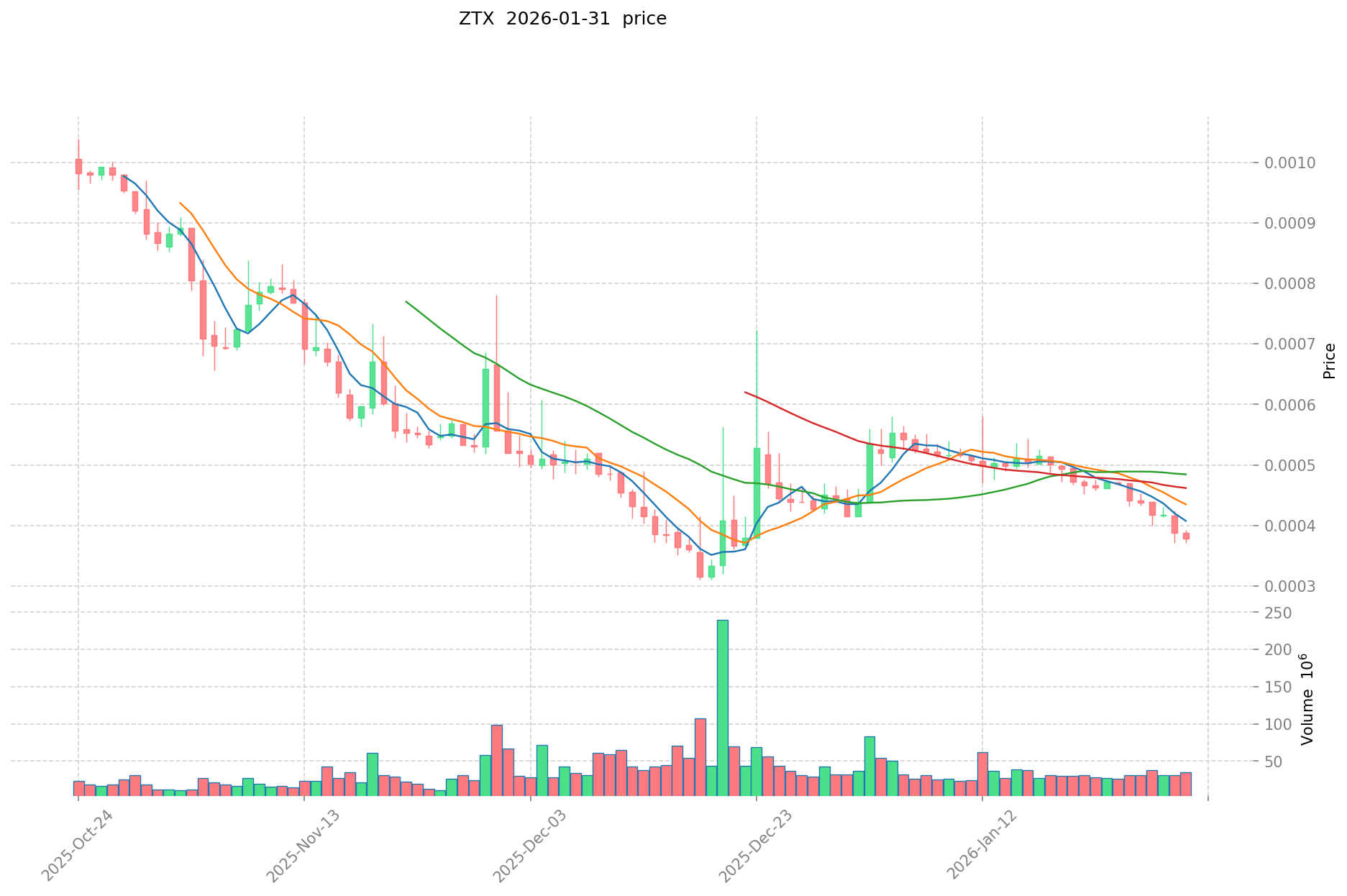
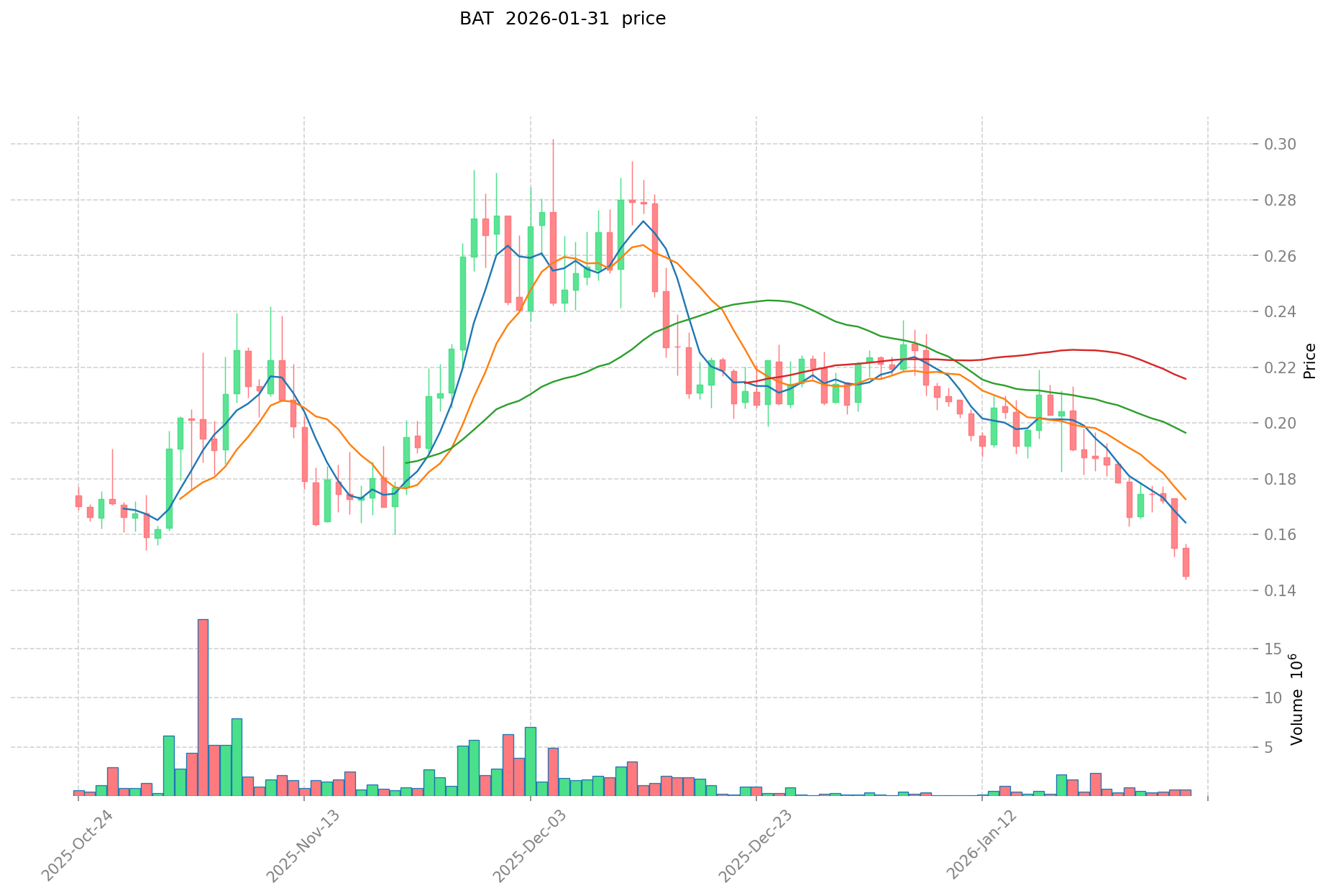
- Comparative Analysis: Throughout the market cycle, ZTX declined from its peak of $0.0396 to a low of $0.00031 recorded in December 2025, representing a substantial correction. In contrast, BAT has experienced a decline from its $1.90 peak to current levels, though maintaining a relatively higher price stability compared to newer entrants in the market.
Current Market Status (2026-01-31)
- ZTX current price: $0.0003777
- BAT current price: $0.1445
- 24-hour trading volume: ZTX $13,240.17 vs BAT $70,420.68
- Market Sentiment Index (Fear & Greed Index): 20 (Extreme Fear)
View real-time prices:
II. Core Factors Affecting ZTX vs BAT Investment Value
Supply Mechanism Comparison (Tokenomics)
- ZTX: Fixed total supply of 10 billion tokens. Historical data indicates that supply variations have previously driven price fluctuations, with scarcity serving as a potential value driver.
- BAT: Supply mechanism details were not available in the provided materials.
- 📌 Historical Pattern: Supply constraints and token distribution mechanisms can influence periodic price cycles, though specific historical patterns require further data.
Institutional Adoption and Market Application
- Institutional Holdings: The materials indicate that institutional investment plays a role in determining BAT's investment value, though specific institutional preference data between ZTX and BAT was not provided.
- Enterprise Adoption: Application scenarios in cross-border payments, settlement systems, and investment portfolios were not detailed in the available materials.
- National Policy: Regulatory attitudes toward these assets vary by jurisdiction, though specific policy comparisons were not included in the reference materials.
Technology Development and Ecosystem Building
- ZTX Technology: Technology development and ecosystem expansion represent important factors for ZTX investment consideration, though specific technical upgrades were not detailed in the materials.
- BAT Technology: Technology development serves as a core factor affecting BAT's investment value, with the overall technical evolution influencing market positioning.
- Ecosystem Comparison: Applications in DeFi, NFT, payment systems, and smart contract implementation were not comprehensively covered in the available materials.
Macroeconomic Environment and Market Cycles
- Performance Under Inflation: The materials suggest that overall economic environment impacts both assets' investment value, though specific inflation-hedging characteristics were not compared.
- Macroeconomic Monetary Policy: Interest rates, dollar index movements, and broader financial conditions influence investment considerations for both assets.
- Geopolitical Factors: Cross-border transaction demand and international circumstances may affect adoption patterns, though specific comparative analysis was not provided in the reference materials.
III. 2026-2031 Price Forecast: ZTX vs BAT
Short-term Forecast (2026)
- ZTX: Conservative $0.00030288 - $0.0003786 | Optimistic $0.000552756
- BAT: Conservative $0.13661 - $0.1438 | Optimistic $0.168246
Medium-term Forecast (2028-2029)
- ZTX may enter a consolidation phase, with estimated prices ranging from $0.000429587955 to $0.0007904418372
- BAT may enter a growth phase, with estimated prices ranging from $0.1173917052 to $0.27000092196
- Key drivers: institutional capital inflows, ETF developments, ecosystem expansion
Long-term Forecast (2030-2031)
- ZTX: Baseline scenario $0.000439503990569 - $0.000708877404144 | Optimistic scenario $0.001128887266099
- BAT: Baseline scenario $0.135598376065152 - $0.23282688198 | Optimistic scenario $0.360788536316208
View detailed price predictions for ZTX and BAT
Disclaimer
ZTX:
| Year |
Predicted High Price |
Predicted Average Price |
Predicted Low Price |
Price Change |
| 2026 |
0.000552756 |
0.0003786 |
0.00030288 |
0 |
| 2027 |
0.00067988988 |
0.000465678 |
0.00042376698 |
23 |
| 2028 |
0.0007904418372 |
0.00057278394 |
0.000429587955 |
51 |
| 2029 |
0.000736141919688 |
0.0006816128886 |
0.000422599990932 |
80 |
| 2030 |
0.001027872236008 |
0.000708877404144 |
0.000439503990569 |
87 |
| 2031 |
0.001128887266099 |
0.000868374820076 |
0.000442871158238 |
129 |
BAT:
| Year |
Predicted High Price |
Predicted Average Price |
Predicted Low Price |
Price Change |
| 2026 |
0.168246 |
0.1438 |
0.13661 |
0 |
| 2027 |
0.1872276 |
0.156023 |
0.10297518 |
7 |
| 2028 |
0.219680384 |
0.1716253 |
0.144165252 |
18 |
| 2029 |
0.27000092196 |
0.195652842 |
0.1173917052 |
35 |
| 2030 |
0.2514530325384 |
0.23282688198 |
0.2165290002414 |
61 |
| 2031 |
0.360788536316208 |
0.2421399572592 |
0.135598376065152 |
67 |
IV. Investment Strategy Comparison: ZTX vs BAT
Long-term vs Short-term Investment Strategies
- ZTX: May appeal to investors focused on emerging Web3 metaverse applications and virtual social networking ecosystems, particularly those willing to accept higher volatility in pursuit of potential growth from early-stage platform development.
- BAT: May suit investors interested in established digital advertising models and browser ecosystem integration, particularly those seeking exposure to decentralized content monetization with relatively longer market history.
Risk Management and Asset Allocation
- Conservative Investors: ZTX allocation considerations should account for higher volatility profiles, while BAT allocation may reflect more established market positioning. Specific percentage recommendations require individual risk assessment.
- Aggressive Investors: Portfolio weighting decisions should consider respective growth trajectories, with ZTX representing higher-risk exposure to metaverse developments and BAT offering participation in browser-based advertising evolution.
- Hedging Tools: Stablecoin allocation for liquidity management, options strategies for downside protection, cross-asset portfolio construction for diversification.
V. Potential Risk Comparison
Market Risk
- ZTX: Exposure to metaverse sector sentiment shifts, relatively limited trading volume (current 24-hour volume $13,240.17), and correlation with broader Web3 adoption trends.
- BAT: Subject to browser ecosystem adoption dynamics, digital advertising market cycles, and correlation with established cryptocurrency market movements (current 24-hour volume $70,420.68).
Technical Risk
- ZTX: Considerations include platform scalability requirements for metaverse applications and network stability as the ecosystem develops.
- BAT: Technical considerations encompass browser integration dependencies and ecosystem security maintenance.
Regulatory Risk
- Global regulatory frameworks may impact both assets differently, with metaverse-focused platforms potentially facing evolving virtual asset regulations, while browser-based advertising tokens may encounter digital advertising and user privacy policy developments across jurisdictions.
VI. Conclusion: Which Is the Better Buy?
📌 Investment Value Summary:
- ZTX Characteristics: Represents exposure to Web3 metaverse development with backing from notable entities including Jump Crypto, though accompanied by substantial volatility (decline from $0.0396 to current $0.0003777) and limited trading volume.
- BAT Characteristics: Offers participation in decentralized digital advertising with longer market history (launched 2017), created by experienced technology leadership, and relatively higher price levels ($0.1445 current price) with broader trading activity.
✅ Investment Considerations:
- New Investors: Should carefully evaluate risk tolerance, consider starting with smaller position sizes, and prioritize understanding underlying technology and use cases before allocation decisions.
- Experienced Investors: May assess portfolio diversification benefits, evaluate technical and fundamental factors independently, and consider respective correlations with broader market cycles and sector-specific developments.
- Institutional Investors: Investment decisions should incorporate comprehensive due diligence regarding liquidity profiles, regulatory compliance frameworks, and alignment with institutional investment mandates and risk parameters.
⚠️ Risk Disclosure: Cryptocurrency markets exhibit extreme volatility. This content does not constitute investment advice. Market conditions, regulatory environments, and project fundamentals can change rapidly. Investors should conduct independent research and consult qualified financial advisors before making investment decisions.
VII. FAQ
Q1: What are the main differences between ZTX and BAT in terms of project positioning and use cases?
ZTX and BAT serve fundamentally different purposes within the cryptocurrency ecosystem. ZTX positions itself as a Web3 metaverse platform launched in 2023, backed by Jump Crypto and ZEPETO, focusing on virtual social networking venues for avatars and portal games. In contrast, BAT (Basic Attention Token), launched in 2017 by JavaScript creator Brendan Eich, operates as a decentralized digital advertising token designed to revolutionize ad display and user incentives within the Brave browser ecosystem. ZTX represents emerging metaverse infrastructure, while BAT addresses established digital advertising models with browser integration.
Q2: How do the current price levels and historical performance compare between ZTX and BAT?
As of January 31, 2026, ZTX trades at $0.0003777 with 24-hour volume of $13,240.17, having declined significantly from its December 2023 all-time high of $0.0396. BAT currently trades at $0.1445 with substantially higher 24-hour volume of $70,420.68, down from its November 2021 peak of $1.90. BAT demonstrates relatively higher price stability and significantly greater trading liquidity compared to ZTX, reflecting its longer market history and more established adoption within the Brave browser ecosystem.
Q3: What are the price forecasts for ZTX and BAT through 2031?
For 2026, ZTX conservative estimates range from $0.00030288 to $0.0003786, with optimistic scenarios reaching $0.000552756. BAT's 2026 conservative forecast spans $0.13661 to $0.1438, with optimistic projections at $0.168246. Long-term forecasts for 2031 suggest ZTX baseline scenarios between $0.000439503990569 and $0.000708877404144 (optimistic: $0.001128887266099), while BAT baseline projections range from $0.135598376065152 to $0.23282688198 (optimistic: $0.360788536316208). These forecasts reflect different growth trajectories influenced by respective ecosystem development, institutional adoption, and market cycle dynamics.
Q4: Which asset better suits conservative versus aggressive investment strategies?
Conservative investors may find BAT more suitable due to its longer market history, higher trading volume, relatively established browser ecosystem integration, and reduced volatility compared to newer market entrants. BAT's positioning in decentralized advertising with experienced leadership may appeal to risk-averse profiles. Aggressive investors seeking higher-risk exposure to emerging sectors might consider ZTX for potential growth from early-stage metaverse platform development, though this comes with substantially higher volatility (evident in its 99% decline from peak) and limited liquidity. Portfolio allocation decisions should align with individual risk tolerance, investment timeframes, and thorough due diligence.
Q5: What are the primary risk factors investors should consider for each asset?
ZTX faces market risks including exposure to metaverse sector sentiment volatility, significantly limited trading volume ($13,240.17 daily), and dependency on Web3 adoption trends that remain nascent. Technical risks encompass platform scalability requirements and network stability as the ecosystem develops. BAT's risks include browser ecosystem adoption dynamics, digital advertising market cycle fluctuations, and integration dependencies within the Brave browser infrastructure. Both assets face regulatory uncertainties, with ZTX potentially encountering evolving virtual asset regulations and BAT subject to digital advertising and user privacy policy developments across jurisdictions.
Q6: How do supply mechanisms differ between ZTX and BAT, and why does this matter?
ZTX features a fixed total supply of 10 billion tokens, with historical data indicating that supply variations have previously driven price fluctuations, positioning scarcity as a potential value driver within its tokenomics model. The fixed supply mechanism theoretically creates deflationary pressure as adoption increases, though actual market dynamics depend on distribution patterns and ecosystem growth. Detailed supply mechanism information for BAT was not available in the reference materials, limiting direct tokenomics comparison. Supply mechanisms fundamentally influence long-term value accrual potential, inflation characteristics, and holder incentive structures that investors should evaluate when assessing investment positioning.
Q7: What role does institutional adoption play in determining investment value for these assets?
Institutional adoption serves as a critical factor influencing both assets' investment value, though manifestation differs significantly. ZTX benefits from backing by notable entities including Jump Crypto, potentially providing credibility and development resources for its metaverse platform ambitions. BAT's institutional considerations relate to enterprise adoption within digital advertising frameworks and browser ecosystem integration partnerships. Institutional investment patterns typically correlate with enhanced liquidity, price stability, regulatory compliance infrastructure, and long-term ecosystem sustainability. However, specific comparative institutional holding data and enterprise adoption metrics between ZTX and BAT require further detailed analysis beyond available reference materials.
Q8: Under current market conditions (Extreme Fear Index: 20), what considerations should guide investment decisions?
The current Fear & Greed Index reading of 20 (Extreme Fear) as of January 31, 2026, suggests widespread market pessimism that historically has coincided with potential accumulation opportunities for long-term investors, though timing market bottoms remains inherently uncertain. Under extreme fear conditions, both ZTX and BAT may experience compressed valuations that could present value for investors with appropriate risk tolerance and extended investment horizons. However, extreme fear environments also indicate elevated downside volatility risks, potential for further price deterioration, and reduced liquidity conditions. Investment decisions during such periods require enhanced risk management, position sizing discipline, and realistic assessment of capital preservation versus growth objectives aligned with individual financial circumstances.
* The information is not intended to be and does not constitute financial advice or any other recommendation of any sort offered or endorsed by Gate.