In the privacy coin space, different projects balance privacy strength, data structure, and scalability, so users must understand the underlying technical logic when evaluating solutions. This distinction is crucial in areas like transaction analysis, node synchronization, and auditing, where BEAM and Monero show clear differences.
These differences typically span three layers: privacy technology path, transaction structure design, and anonymity model. Together, these factors define the system behaviors and usage scenarios for BEAM and Monero.
What Is BEAM?
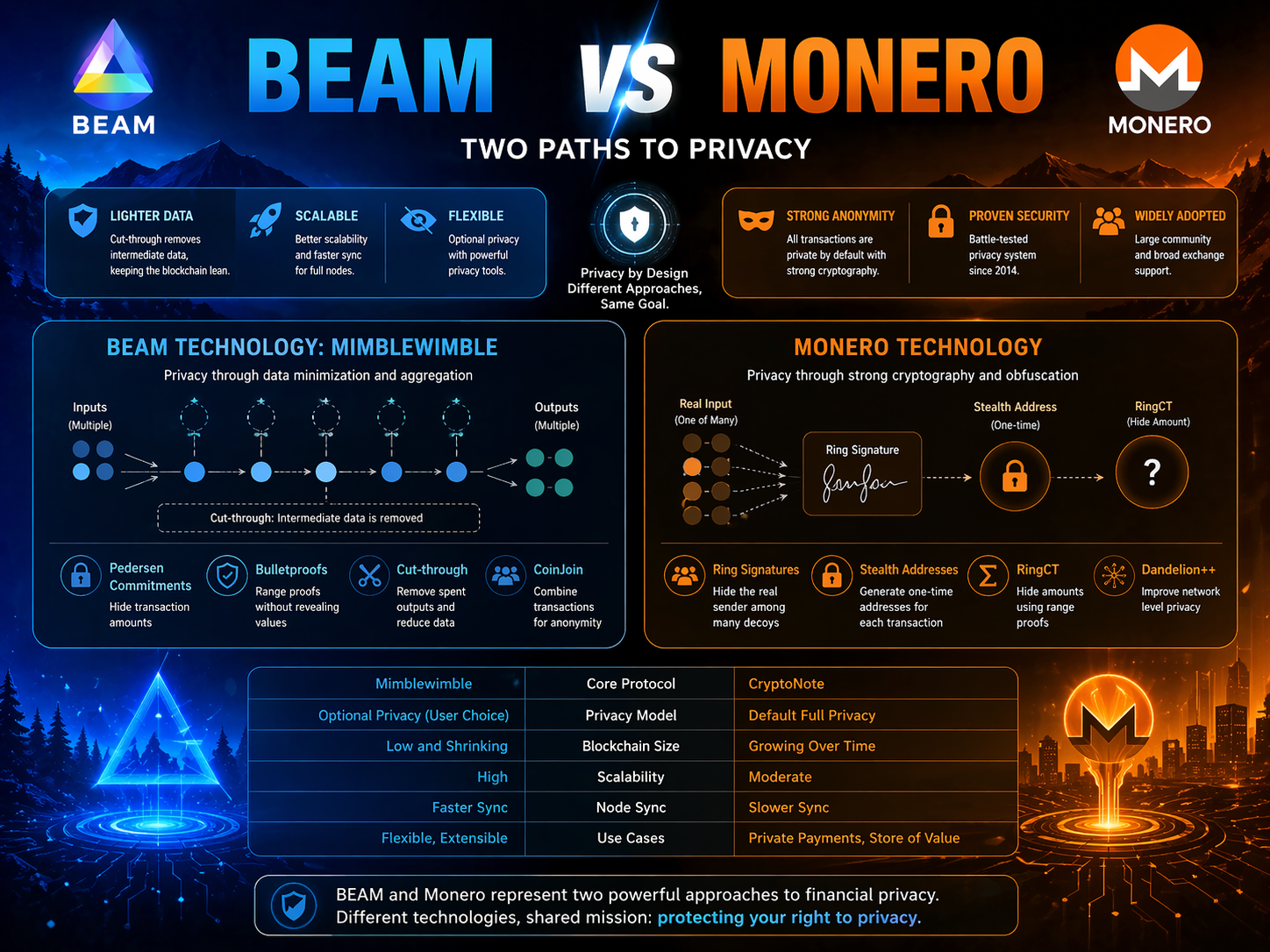
BEAM is a privacy blockchain built on the Mimblewimble protocol, designed to combine privacy and scalability by compressing transaction data.
BEAM aggregates transaction inputs and outputs, eliminating full transaction paths from the blockchain and retaining only state change results. This approach prevents the buildup of historical data seen in traditional UTXO models.
BEAM relies on several key components:
-
Pedersen commitments to conceal transaction amounts
-
CoinJoin-style transaction mixing
-
Cut-through technology for removing intermediate data
This design reduces on-chain data volume while maintaining privacy, significantly boosting node synchronization efficiency.
What Is Monero?
Monero is a privacy-focused cryptocurrency designed for strong anonymity, emphasizing both untraceability and unlinkability.
Monero hides the transaction sender via ring signatures, the recipient via stealth addresses, and the amount via RingCT. Together, these create a comprehensive privacy framework.
Each Monero transaction includes multiple decoy inputs to obscure the real input, and all transactions default to privacy features.
This means that any single transaction is highly resistant to external analysis, delivering robust anonymity.
How Do BEAM and Monero Differ in Privacy Technology?
BEAM and Monero follow fundamentally different approaches to privacy.
BEAM achieves privacy through structural data compression—privacy comes from data irreversibility. In contrast, Monero relies on cryptographic obfuscation, with transaction details existing on-chain but remaining unintelligible.
Key structural differences are summarized below:
| Dimension |
BEAM |
Monero |
| Technical Path |
Mimblewimble |
Ring Signature + RingCT |
| Amount Concealment |
Pedersen Commitment |
RingCT |
| Sender Privacy |
Transaction Aggregation |
Ring Signature |
| Receiver Privacy |
One-Time Address |
Stealth Address |
| Data Retention |
Partial Deletion |
Full Retention |
In short, BEAM depends on structural optimization, while Monero relies on cryptographic mixing.
How Do Their Transaction Structures and Data Models Differ?
Transaction structure dictates the nature of on-chain data.
BEAM uses Cut-through to eliminate intermediate transactions, retaining only final states. Monero, by contrast, keeps the full transaction history but shields details with encryption.
As a result, BEAM’s blockchain grows more slowly, whereas Monero’s data volume continually increases.
This impacts network efficiency:
BEAM nodes synchronize much faster, while Monero nodes must handle greater data loads.
Anonymity and Traceability: Design Differences
The anonymity model directly shapes privacy strength.
Monero achieves strong anonymity through indistinguishable inputs—every input is mixed with decoys, making tracking extremely difficult. BEAM eliminates the transaction path entirely, so no tracking information remains.
Monero offers “strong anonymity with data retention,” while BEAM delivers “data minimization with privacy through structure.”
As a result, Monero excels at resisting analysis, while BEAM provides superior data efficiency.
Performance differences stem from their data models.
BEAM enhances scalability by reducing on-chain data, while Monero adapts using dynamic block sizes and fee mechanisms.
Comparative structural features:
| Dimension |
BEAM |
Monero |
| Data Growth |
Slow |
Continuous |
| Synchronization Efficiency |
High |
Low |
| Scaling Approach |
Data Compression |
Dynamic Block Sizing |
| Computational Complexity |
Low |
High |
In essence, BEAM prioritizes structural efficiency; Monero relies on expanding computational resources.
Application Scenarios and Ecosystem Development
Technical approaches ultimately shape application scenarios.
Monero’s strong anonymity is best suited for privacy-focused payments. BEAM’s structural flexibility lends itself to asset issuance and privacy DeFi applications.
Monero’s ecosystem centers on payments and value storage, while BEAM aims to build a broader application layer.
In summary, Monero is a “privacy payment tool,” whereas BEAM serves as “privacy infrastructure.”
Conclusion
BEAM and Monero represent two distinct privacy paradigms: BEAM balances efficiency and privacy through data compression, while Monero achieves robust anonymity via cryptographic mixing. Their structural and application differences are clear and significant.
FAQ
Which offers stronger privacy, BEAM or Monero?
Monero’s design puts a premium on untraceability and is generally considered stronger in privacy.
Why is BEAM’s data volume smaller?
Cut-through technology removes intermediate transactions, keeping only essential state data on-chain.
Why is Monero’s synchronization slower?
Because Monero retains its full transaction history and employs complex encryption, nodes must process much more information.
Can BEAM and Monero replace each other?
They serve different needs; the choice depends on your privacy and performance requirements.
What are the main challenges for privacy coins?
Key challenges include regulatory compliance, performance scaling, and ecosystem development.







