In multi-VM networks, computation, data interactions, and state updates across different execution environments all consume resources. To manage pricing and incentive distribution, a unified value medium is required. BLEND is designed precisely to solve this challenge, allowing complex execution logic to be efficiently coordinated through an economic model.
This challenge involves three main areas: fee mechanisms, incentive distribution, and governance structures. Together, these components define BLEND’s role within the Fluent ecosystem.
What Is the BLEND Token?
BLEND serves as the native utility token of the Fluent network, acting as the bridge between the execution and economic layers.
Functionally, BLEND is used to pay transaction fees, participate in governance, and allocate network incentives. All computation on Fluent—whether within a single VM or across multiple VMs—settles value using this token.
BLEND is more than just gas; it also facilitates value transfer and system coordination, enabling all execution modules to operate within a unified economic framework.
This approach enables Fluent’s Blended Execution architecture to price resources through a single token, driving greater system efficiency.
How Is BLEND Used for Transaction Fees?
Transaction fees are the most fundamental use of BLEND.
On Fluent, users pay BLEND to initiate transactions or execute smart contracts. These fees cover the computing, storage, and cross-VM communication costs generated by those actions.
Since Fluent supports collaborative multi-VM execution, operational complexity can vary significantly, so the fee model must account for the resource usage and computation paths involved. For example, cross-VM calls are typically more complex and therefore more costly than single-VM operations.
This dynamic fee model helps regulate resource usage, ensuring network stability in complex execution environments and preventing abuse.
How Does the Incentive Mechanism Power the Fluent Network?
A robust incentive mechanism is critical for network continuity.
BLEND is used to reward execution nodes, validators, and ecosystem contributors. Rewards are sourced from transaction fees and a dedicated incentive pool, compensating participants for providing computation and validation services.
Fluent’s multi-VM architecture means different nodes have distinct roles, so incentives are tailored to each. For example, execution nodes perform computations, while validator nodes verify results.
| Participant Role |
Incentive Source |
| Execution Nodes |
Transaction Fees |
| Validator Nodes |
Network Rewards |
| Developers |
Ecosystem Incentives |
| User Participants |
Airdrops & Rewards |
This structure attracts participants through economic rewards, maintaining network security and execution efficiency.
What Role Does BLEND Play in Governance?
BLEND grants holders voting rights within the protocol.
Token holders can participate in Fluent’s governance, making decisions on network parameters, resource allocation, and ecosystem direction—typically via on-chain voting.
Governance power is proportional to BLEND holdings, enabling participants to influence the network’s evolution through their stake. This mechanism supports decentralized, adaptive system management.
This design allows Fluent to remain open while supporting ongoing self-improvement.
How Is BLEND’s Total Supply and Allocation Structured?
BLEND’s supply model is public: the total supply is 1 billion tokens, distributed via a multi-tier allocation framework to fuel network growth and ecosystem expansion.
Tokens are allocated across ecosystem growth, core contributors, and market circulation, with the largest share designated for ecosystem incentives—demonstrating a focus on developer and application-driven growth.
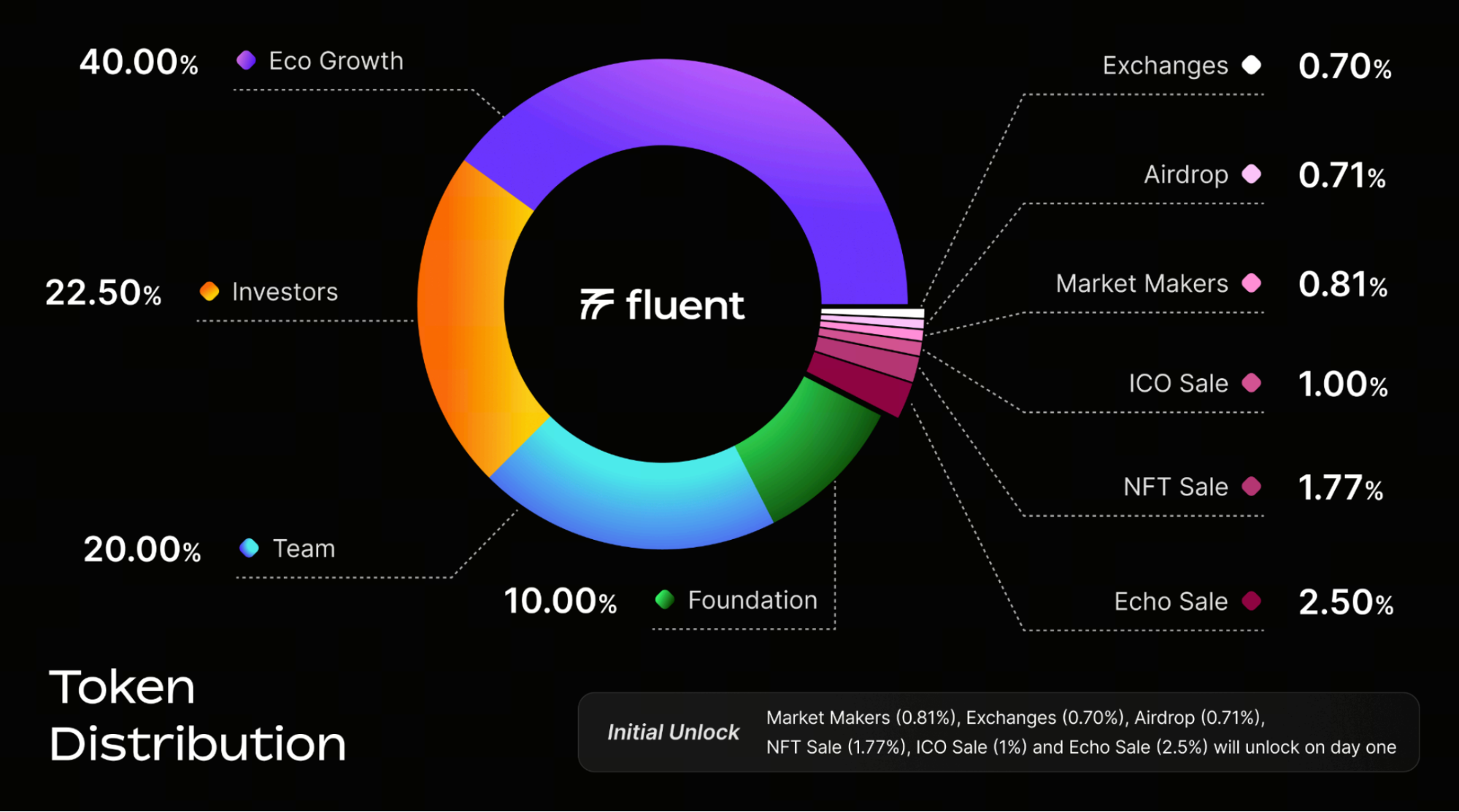
BLEND’s allocation tiers:
| BLEND Allocation Category |
Proportion |
| Eco Growth |
40.00% |
| Investors |
22.50% |
| Team |
20.00% |
| Foundation |
10.00% |
| Echo Sale |
2.50% |
| NFT Sale |
1.77% |
| ICO Sale |
1.00% |
| Market Makers |
0.81% |
| Airdrop |
0.71% |
| Exchanges |
0.70% |
Ecosystem growth receives the largest allocation, supporting developer and application expansion. Team and investor allocations provide long-term development incentives, while smaller portions for circulation support early market liquidity.
This structure is designed to control early circulation and prioritize ecosystem incentives, allowing Fluent to build network effects across its multi-VM infrastructure.
What Are BLEND’s Use Cases Within the Ecosystem?
Token utility determines actual value.
BLEND can be used to pay execution fees, participate in governance, earn ecosystem incentives, and interact within the network. In a multi-VM environment, these use cases often involve complex cross-execution workflows.
Within the ecosystem, BLEND connects users, smart contracts, and infrastructure, creating synergy between modules. In cross-VM applications, the token may be used and distributed at multiple execution stages.
This versatility gives BLEND multiple functions within the network, boosting both its utility and value.
Summary
BLEND establishes Fluent’s economic foundation through fee payments, incentive distribution, and governance participation, enabling a unified value system for multi-VM execution.
FAQ
What Are BLEND’s Core Uses?
Transaction fee payments, node incentives, and protocol governance.
Is BLEND Required for All Execution Operations?
Yes. All computational and interactive actions are priced in BLEND.
What Is BLEND’s Total Supply?
1 billion tokens, distributed through a multi-tiered structure.
Which BLEND Allocation Category Is Largest?
Ecosystem growth, at 40%, focused on network expansion.
What Is BLEND’s Core Value in Fluent?
As a unified value medium, BLEND links execution and incentive mechanisms, creating a sustainable economic system for the network.







