Blockchain.com Brings Perpetual Futures Trading to Self-Custody Wallets

Last Updated 2026-04-24 09:50:13
Reading Time: 1m
Blockchain.com has introduced Perpetual Futures Trading to its Non-Custodial Wallet, enabling users to use Bitcoin directly as collateral for leveraged trading. This article explores the mechanism behind this feature and examines its implications for trading models.

Wallets Are More Than Just Supply: Now Support Derivative Trading

Wallets Are More Than Just Supply: Now Support Derivative Trading

(Source: blockchain)

Blockchain.com, a leading crypto service platform, has recently introduced a new feature enabling users to trade Perpetual Futures directly within their self-custodial wallets. This allows users to participate in leveraged trading without transferring Assets to centralized exchanges, while maintaining full control over their Private Keys.

What Are Perpetual Futures?

Perpetual Futures are a widely used Derivative in the crypto market, offering:

  • No Expiration Date, so positions can be held indefinitely

  • Leverage options to amplify both Return and risk

  • Two-Way trading capabilities (long and short positions)

Compared to traditional futures, Perpetual Futures offer greater flexibility, making them popular in the crypto space.

How It Works: Keeping Assets in Your Wallet

A key advantage of this new feature is that Assets remain in the user's wallet throughout the trading process:

  • Bitcoin is used as collateral

  • Open position and Close position directly within the wallet

  • No need for third-party custody

This setup reduces risks related to Asset transfer and custody, while preserving the benefits of decentralization.

Technical Partnership: Connecting to Decentralized Exchanges

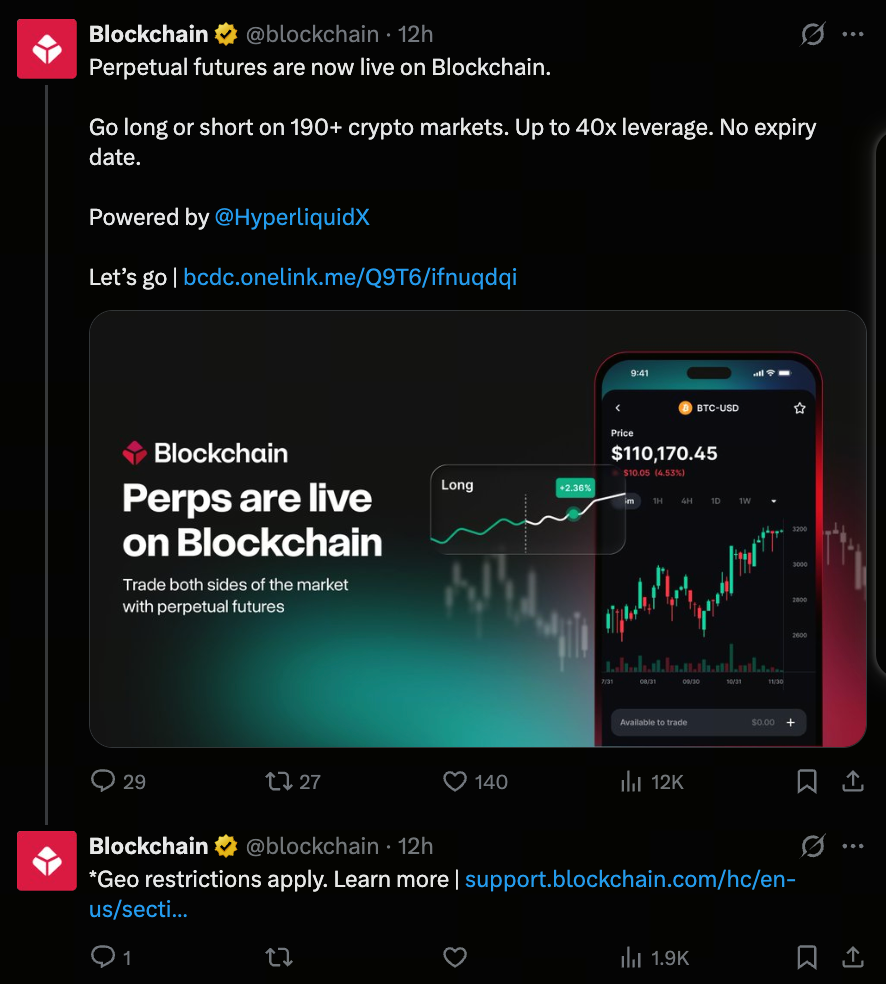
The feature utilizes Hyperliquid to provide liquidity and facilitate trade execution, giving users access to a broader marketplace. Currently, it supports more than 190 crypto trading markets and offers leverage up to 40x.
Technical Partnership: Connecting to Decentralized Exchanges

(Source: blockchain)

Streamlined Operation: Deposit BTC Directly

Blockchain.com’s design simplifies the process compared to traditional methods:

  • Trade directly using BTC from your wallet

  • No need for additional Asset conversion

  • No transferring funds between multiple platforms

This reduces operational complexity and lowers trading costs.

Expanding to More Assets Soon

Blockchain.com has announced plans to support additional Asset types, including Forex, Equities, and Commodities. This signals that Perpetual Futures are gradually moving beyond the crypto market into broader financial sectors.

Regulatory Landscape Becoming Clearer

Regulation of Perpetual Futures in the US is still evolving. However, the Commodity Futures Trading Commission (CFTC) has indicated that such products may be allowed in the US market in the future, prompting platforms to prepare ahead.

Summary

By integrating Perpetual Futures Trading into self-custodial wallets, Blockchain.com is driving a major shift in crypto trading: from reliance on centralized platforms to environments where users control their own Assets. As technology and regulation advance, products combining security and flexibility are likely to shape the future of trading.

Author:  Allen
Disclaimer
* The information is not intended to be and does not constitute financial advice or any other recommendation of any sort offered or endorsed by Gate.
* This article may not be reproduced, transmitted or copied without referencing Gate. Contravention is an infringement of Copyright Act and may be subject to legal action.

Related Articles

Exploring 8 Major DEX Aggregators: Engines Driving Efficiency and Liquidity in the Crypto Market
Beginner

Exploring 8 Major DEX Aggregators: Engines Driving Efficiency and Liquidity in the Crypto Market

DEX aggregators integrate order data, price information, and liquidity pools from multiple decentralized exchanges, helping users find the optimal trading path in the shortest time. This article delves into 8 commonly used DEX aggregators, highlighting their unique features and routing algorithms.
2026-04-05 18:15:50
The Future of Cross-Chain Bridges: Full-Chain Interoperability Becomes Inevitable, Liquidity Bridges Will Decline
Beginner

The Future of Cross-Chain Bridges: Full-Chain Interoperability Becomes Inevitable, Liquidity Bridges Will Decline

This article explores the development trends, applications, and prospects of cross-chain bridges.
2026-04-08 17:11:27
Solana Need L2s And Appchains?
Advanced

Solana Need L2s And Appchains?

Solana faces both opportunities and challenges in its development. Recently, severe network congestion has led to a high transaction failure rate and increased fees. Consequently, some have suggested using Layer 2 and appchain technologies to address this issue. This article explores the feasibility of this strategy.
2026-04-06 23:31:03
Sui: How are users leveraging its speed, security, & scalability?
Intermediate

Sui: How are users leveraging its speed, security, & scalability?

Sui is a PoS L1 blockchain with a novel architecture whose object-centric model enables parallelization of transactions through verifier level scaling. In this research paper the unique features of the Sui blockchain will be introduced, the economic prospects of SUI tokens will be presented, and it will be explained how investors can learn about which dApps are driving the use of the chain through the Sui application campaign.
2026-04-07 01:11:45
What Is Copy Trading And How To Use It?
Beginner

What Is Copy Trading And How To Use It?

Copy Trading, as the most profitable trading model, not only saves time but also effectively reduces losses and avoids man-made oversights.
2026-04-09 06:04:24
What Is Technical Analysis?
Beginner

What Is Technical Analysis?

Learn from the past - To explore the law of price movements and the wealth code in the ever-changing market.
2026-04-09 10:30:57





