Event Overview: MSBT Approaches Listing Launch
In March 2026, Morgan Stanley’s Bitcoin ETF (ticker symbol MSBT) received a listing announcement from the New York Stock Exchange—widely regarded as the final step before trading begins. Historically, reaching this stage means only technical preparations and time remain before the product goes live.
The importance of this event isn’t simply about “another ETF,” but rather a shift in participant roles. Morgan Stanley has previously engaged with crypto assets, mainly as an allocation channel and product distributor. Now, by entering as an issuer, the firm signals a fundamental strategic shift in its approach to crypto assets.
From a market perspective, this development highlights three key signals: traditional financial institutions are accelerating their entry into crypto asset issuance; ETF compliance pathways are now highly mature; and institutional capital inflows are becoming increasingly standardized.
Regulatory Path Review: Key Steps from Application to Listing
MSBT’s progress closely follows the standard US spot Bitcoin ETF process, with clear milestones forming a straightforward timeline.
-
Early 2026: S-1 Filing Submitted: Formal application to the US SEC to establish a spot Bitcoin ETF
-
Mid-March: S-1/A Filing Updated: Clarifies product structure, participating institutions, and operational mechanisms
-
Seed Funding Established (Approx. $1 Million): Supports initial ETF liquidity
-
NYSE Listing Announcement Received: Marks completion of approval and exchange technical readiness
This standardized process is a significant signal in itself. Unlike early crypto products that faced lengthy and uncertain approval cycles, ETF launches now match traditional finance timelines, lowering institutional barriers and increasing market certainty.
Product Mechanism Breakdown: How Spot ETFs Operate
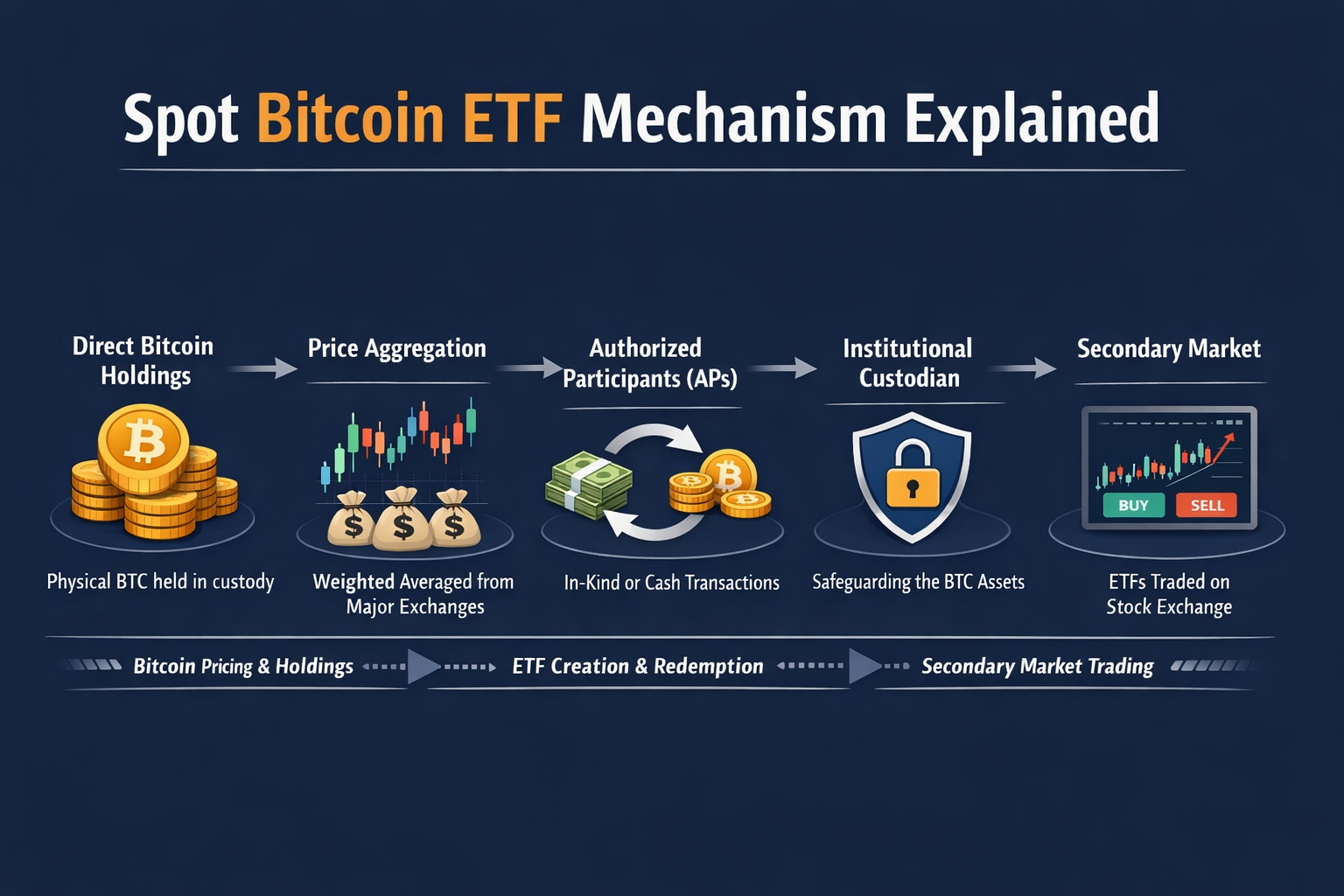
MSBT represents a classic spot Bitcoin ETF, fundamentally designed to “map on-chain assets into securitized shares.” Its operational mechanism can be understood across several key dimensions:
-
Underlying assets are directly held in Bitcoin, rather than exposed via futures or other derivatives
-
Pricing is typically based on a weighted average of spot prices from multiple major exchanges, minimizing single-market bias
-
Subscription and redemption are handled by authorized participants (APs), supporting both cash and in-kind modes
-
Professional custodians manage asset storage, ensuring safety and compliance
-
Market makers provide liquidity, maintaining ETF trading efficiency in the secondary market
This structure’s core value lies in transforming complex on-chain operations—wallet management, private key security, and trade execution—into simple buy/sell actions within traditional securities accounts, dramatically lowering institutional entry barriers.
Additionally, the ETF’s arbitrage mechanism is critical. When ETF prices deviate from net asset value (NAV), authorized participants can arbitrage via subscription and redemption, restoring prices to a reasonable range. This infrastructure is fundamental to the ETF’s long-term stability.
Macro Drivers: Why Accelerate Entry Now
Morgan Stanley’s decision to advance its Bitcoin ETF at this time is shaped by multiple macro factors.
-
Spot Bitcoin ETFs have already proven themselves in the market. Since 2024, these products have consistently attracted capital inflows and become mainstream tools for institutional crypto asset allocation. The regulatory environment has also improved, with approval processes becoming more transparent and standardized, allowing new entrants to plan product launches with greater clarity.
-
Institutional client demand is rising. Investor groups—including pension funds, family offices, and high-net-worth clients—prefer gaining Bitcoin exposure through compliant financial instruments rather than direct crypto asset holdings. ETFs fill this gap precisely.
-
Competitive pressure is significant. With multiple institutions launching similar products, Morgan Stanley risks losing ground in future asset management competition if it remains a distributor. Strategically, this entry is both defensive and offensive.
Wall Street Landscape Shift: From Channel to Issuer
Morgan Stanley’s transition reflects Wall Street’s broader evolution in the crypto asset sector. Initially, traditional financial institutions participated by recommending or distributing third-party products, earning revenue through channel fees and client services. As the market expanded, the limits of this model became apparent.
Now, more institutions are shifting to “product issuer” roles, enabling direct management fee collection and long-term returns via AUM growth. Issuing products also strengthens client loyalty, positioning institutions more centrally within asset allocation frameworks.
This shift means crypto assets are no longer mere adjuncts, but are becoming independent business zones within traditional finance. Future ETF competition will extend beyond fee levels to include brand strength, channel capabilities, and product innovation.
Market Impact: Capital Structure and Pricing Power Shifts
If MSBT launches successfully, its market impact will be felt across several areas.
-
Capital structure changes. ETFs offer low-barrier, highly compliant investment channels, attracting more traditional capital—typically with longer-term allocation tendencies.
-
Liquidity structure adjustments. As ETFs become key trading entry points, the crypto market will feature both on-chain and off-chain liquidity. Trading will no longer be confined to crypto exchanges; traditional securities markets will also become important venues for price formation.
-
Pricing power migration. As ETF scale grows, trading activity will influence Bitcoin prices more directly, especially during US stock trading hours, with traditional financial market capital flows possibly leading short-term price movements.
Over the long term, these changes may yield two outcomes: reduced market volatility, as institutional capital favors longer holding periods; and a more macro-driven price logic, with stronger ties to interest rates and liquidity factors.
Risk Factors: Fee Competition and Regulatory Uncertainty
Despite its promising outlook, MSBT faces several uncertainties.
-
Fee competition: Bitcoin ETF fees are already compressed in the current market; if new products lack cost advantages, attracting large-scale capital may be difficult.
-
Market cycles: ETFs cannot alter Bitcoin’s inherent high volatility; in downturns, capital outflows may amplify price swings.
-
Regulatory factors: While the environment is currently favorable, future policy tightening—such as stricter requirements for custody, trading, or capital sources—could impact ETF operations.
-
Liquidity concentration: If large amounts of capital enter through a few ETF products, concentrated redemptions could trigger short-term market shocks.
Future Trends: The Next Phase of the ETF Ecosystem
Looking further ahead, Morgan Stanley’s Bitcoin ETF launch may be only the beginning. Future ETF market development can be summarized in several trends:
-
More assets will be included in ETF frameworks, such as Ethereum and other major crypto assets;
-
Product structure innovation, including staking returns or enhanced yield strategies;
-
Improved derivatives and arbitrage systems, creating tighter links between ETFs and futures/options markets.
Meanwhile, the boundary between traditional and decentralized finance may gradually blur. ETFs, as bridges, connect on-chain assets with off-chain capital, providing infrastructure for new financial structures.
Overall, MSBT’s advancement is not just a single product listing, but a pivotal moment for crypto assets entering mainstream finance. As ETFs become standard allocation tools, Bitcoin’s asset characteristics will shift—from “alternative investment” to “core asset class.” This process is ongoing, and Morgan Stanley’s entry is undoubtedly a new driving force for this trend.