This Is Not a Black Swan Event—It’s a Structural Exposure
Markets often label these incidents as "black swans," but when you zoom out, this round of DeFi losses is better understood as a systemic stress test triggered by a series of shocks, not a one-off accident.
This risk cycle began on April 1, when Drift Protocol suffered a major attack. Multiple on-chain analyses and post-incident reviews show the attacker gained control and introduced fake collateral, extracting roughly $285 million from the protocol. This wiped out more than half its TVL, making it one of the largest DeFi attacks since 2026.
But more importantly, this wasn't an isolated case.
After Drift, the risk didn’t subside—it kept building:
- From early to mid-April, a series of security incidents hit small and mid-sized protocols and infrastructure (including cross-chain, front-end, and liquidity components)
- On April 18, Kelp DAO’s restaking system was exploited, with about $293 million stolen—the largest single loss in this cycle
- Multiple protocols (lending, cross-chain, derivatives) faced systemic pressure as asset nesting spread risk across the ecosystem
In just 18 days, DeFi’s total losses topped $606 million, with the Drift and Kelp DAO incidents accounting for about 95% of the total.
In other words, this wasn’t about "one protocol failing." Instead, Drift shattered security expectations → Kelp DAO triggered a liquidity collapse → multiple protocols were forced to deleverage → TVL dropped systemically.
If this were just a single-point vulnerability, such a cascade wouldn’t have happened. The real takeaway: these attacks were triggers that exposed deeper systemic weaknesses in DeFi—fragilities that had existed under high leverage, asset reuse, and protocol nesting, but had never been collectively stress-tested.
What Went Wrong at Kelp DAO—Is It the Only Problem?
On the surface, Kelp DAO’s issue seems straightforward: a vulnerability in the cross-chain asset rsETH was exploited, resulting in nearly $300 million lost.
But if you shift perspective from "protocol error" to "structural position," the story changes entirely.
Kelp DAO isn’t an isolated protocol; it sits at the heart of a deeply nested structure:
- At the top: the restaking narrative
- In the middle: the LST/LSDfi asset system
- At the base: lending protocols and leverage strategies
- On the periphery: bridges and liquidity channels
In short, rsETH isn’t just a simple asset—it’s a "credit vehicle" that’s repeatedly used and amplified across multiple layers.
When this vehicle fails, the impact doesn’t stay within Kelp DAO—it radiates outward through the entire structure.
So, the more accurate statement is:
Kelp DAO isn’t the only problem—it’s just the first breaking point.
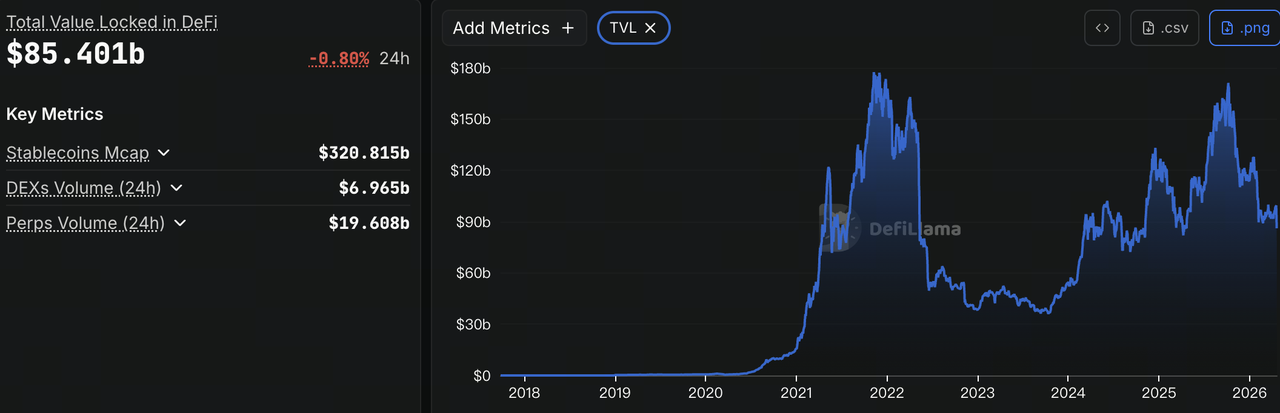
Why Is TVL "Falling Faster"?
Source: DefiLlama
Many see TVL hitting a one-year low and assume "capital is flowing out."
But the reality is more nuanced.
TVL drops are usually driven by three overlapping factors:
- Capital outflows—the most obvious part
- Asset price fluctuations, especially for ETH and derivatives
- Leverage contraction—DeFi’s TVL has never been just "net capital," but "capital × leverage." When assets like rsETH are used for collateral, lending, and restaking, the same underlying asset can be counted multiple times. Once risk is triggered, all these layers can unwind at once.
That’s why TVL often falls much faster than capital outflows alone would suggest.
In other words, this isn’t just "users withdrawing funds"—it’s the system actively deleveraging.
How DeFi Risk Gets Amplified—Layer by Layer
The most critical takeaway from this episode is the risk transmission path itself.
A typical chain looks like this:
rsETH is used as collateral → enters a lending protocol → is lent out again → used for recursive staking → expands liquidity further via bridges
In normal markets, this boosts capital efficiency.
But under stress, it acts as an amplifier:
- Uncertainty in underlying assets
- Collateral gets discounted
- Liquidations are triggered
- Leverage is forcibly unwound
- Liquidity evaporates rapidly
Crucially, these steps don’t happen in sequence—they happen all at once. That’s why, under stress, DeFi can resemble a traditional financial "bank run."
This Shock Is a "Shadow Banking Stress Test"
From a traditional finance perspective, these events are all too familiar.
- Restaked assets mirror "repackaged assets"
- Lending protocols act as "credit intermediaries"
- Bridges serve as "liquidity channels"
- Recursive leverage echoes "shadow banking expansion"
Stack these together, and DeFi starts to look a lot like a "shadow banking system."
The core risks of shadow banking are well known:
- Opaque risk exposures
- Heavy reliance on market confidence
- Rapid, simultaneous contraction under stress
The Kelp DAO incident was a localized failure that quickly escalated into system-wide volatility.
What the Market Fears Most Isn’t the Loss—It’s Losing Its Anchor
A $600 million loss isn’t unprecedented in crypto. But the sentiment this time is far more severe.
Why? Because it shakes a key assumption—not just a single protocol:
Is DeFi’s complex structure really under control?
When users start doubting:
- The safety of restaked assets
- The authenticity and liquidatability of collateral
- The reliability of cross-chain liquidity
The issue isn’t just "lower returns"—it’s "declining trust." And in DeFi, trust is the foundation of liquidity.
DeFi Is Entering a New Phase of Risk Pricing
Viewed over a longer cycle, this event may mark a turning point: DeFi is shifting from "yield-driven" to "risk-pricing-driven."
Over the past two years, the focus was on:
- How high APY could go
- Maximum leverage
- How many times assets could be reused
Now, the market is reassessing:
- Structure transparency
- Controllability of risk
- Liquidation feasibility under extreme conditions
Several changes are coming:
- Tiered pricing for restaked assets
- Higher capital costs for high-leverage strategies
- Liquidity concentrating in top protocols
- Smaller protocols finding it harder to earn a trust premium
In effect, this isn’t DeFi’s decline—it’s a "deleveraging" moment.
Conclusion: The Real Test Is Still Ahead
The Kelp DAO incident is over, but its impact lingers. The TVL drop is just the surface; the deeper shift is the market’s re-evaluation of DeFi’s risk structure.
What matters next isn’t:
- Whether TVL rebounds
- Which protocol recovers fastest
But rather:
- Will the restaking system be restructured?
- Will lending protocols adjust collateral standards?
- Will cross-chain liquidity contract?
- Will the market establish new "security anchors"?
For DeFi, this shockwave may not end soon. But it’s forcing the industry to confront a fundamental question: In a system without a central bank, lender of last resort, or unified regulation, who ultimately bears the risk? That’s the real issue behind the $600 million loss.







