With the 21Shares Dogecoin ETF (TDOG) officially listing on NASDAQ in early 2026 and the administrative narrative of the “Department of Government Efficiency (D.O.G.E.)” reshaping its brand value, DOGE is accelerating its establishment as “digital cash” in global payment settlements. In contrast, Shiba Inu is attempting to build a closed-loop decentralized economy on the Shibarium chain by fully integrating AI Agents and Real-World Asset (RWA) tokenization engines.
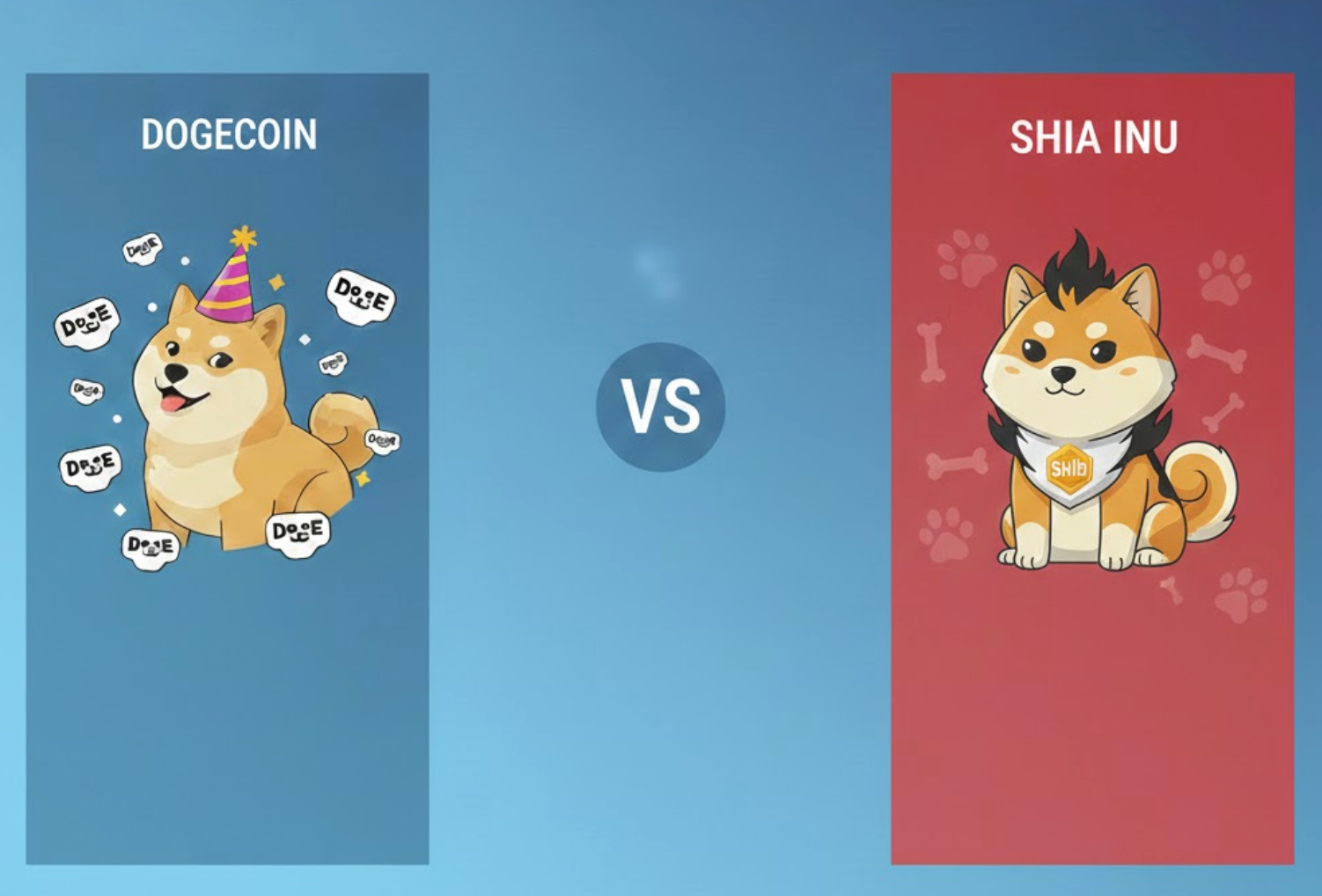
The comparison between Dogecoin and Shiba Inu reveals different pathways for crypto assets transitioning from “cultural symbols” to “financial infrastructure.” Dogecoin proves that an extremely simple payment function, driven by social consensus, can be transformed into trillion-dollar settlement efficiency. Meanwhile, Shiba Inu demonstrates how a meme community can complete self-iteration through modular upgrades within the highly competitive smart contract sector.
What Is Dogecoin?
Dogecoin is a cryptocurrency that runs on an independent blockchain and was originally launched in 2013. It was created against the backdrop of lighthearted internet culture, but its technical structure resembles that of early cryptocurrencies, featuring a complete blockchain network, node system, and mining mechanism.
From a technical perspective, Dogecoin uses a Proof of Work consensus mechanism and relies on the Scrypt algorithm for block validation. This means network security and transaction confirmation depend on miner hash power. The Dogecoin network independently processes transactions, generates blocks, and maintains ledger state without relying on any other blockchain.
In terms of functionality, Dogecoin has a relatively simple design goal. It is primarily used for value transfer, on-chain payments, and small scale tipping. Unlike platforms that support complex smart contracts, Dogecoin does not offer native smart contract functionality, and its structure is closer to early digital currency models.
What Is Shiba Inu?
Shiba Inu is an ERC 20 token built on the Ethereum network. Unlike Dogecoin, it does not have its own independent blockchain and instead operates entirely on Ethereum infrastructure.
As an ERC 20 standard token, Shiba Inu relies on Ethereum for transaction validation, network security, and consensus. Ethereum currently uses a Proof of Stake mechanism, meaning Shiba Inu operates within Ethereum’s validator and node system.
Shiba Inu places greater emphasis on ecosystem expansion in its design. Because it is built on a smart contract standard, it can interact directly with decentralized finance protocols, NFT platforms, and decentralized exchanges. This structure allows Shiba Inu to support multi token systems and on-chain application modules.
From a technical standpoint, Shiba Inu is classified as a token based asset rather than a native blockchain asset.
Underlying Architecture Differences: Independent Blockchain vs Ethereum Token
The first major difference between Dogecoin and Shiba Inu lies in their underlying architecture.
Dogecoin operates its own mainnet, block production mechanism, and node network. All transaction data is written directly to the Dogecoin blockchain, and network security is ensured through miner hash power.
Shiba Inu, by contrast, runs on the Ethereum blockchain. It does not independently maintain blocks or nodes. Instead, token balance changes are recorded through smart contracts, and security is derived from the Ethereum network as a whole.
| Comparison Dimension |
Dogecoin (DOGE) |
Shiba Inu (SHIB) |
| Network Type |
Independent Layer 1 Blockchain |
Ethereum-based Ecosystem (utilizing Shibarium L2) |
| Has Its Own Mainnet |
Yes (Legacy PoW chain) |
No (Settles on Ethereum; processes on Shibarium) |
| Consensus Mechanism |
Proof of Work (PoW) - Scrypt algorithm |
Proof of Stake (PoS) - via Ethereum & Shibarium |
| Block Production |
Performed by Dogecoin miners (AuxPoW) |
Performed by Ethereum validators & L2 Sequencers |
| Native Smart Contracts |
Limited (via Doginals/Libdogecoin) |
Full Support (EVM-compatible; privacy-enabled) |
| Security Source |
Its own decentralized hash power |
Shared security from the Ethereum network |
| 2026 Tech Milestone |
Gaining “Digital Cash” status via X integration |
Q2 2026 Privacy Upgrade (FHE Implementation) |
The difference between Dogecoin and Shiba Inu can be compared to building a private highway versus driving on an existing one.
It is important to note that this distinction reflects different technical approaches rather than superiority or inferiority. An independent blockchain offers greater autonomy, while reliance on a mature network provides stronger composability.
Supply Mechanisms and Token Model Differences
Supply structure represents another major difference between Dogecoin and Shiba Inu.
Dogecoin uses a continuous issuance model with no fixed maximum supply. New DOGE tokens are generated as block rewards, forming an inflationary structure. The original intent of this design was to encourage network activity and long term circulation.
Shiba Inu, on the other hand, launched with an extremely large initial supply and incorporated a token burn mechanism. Burning reduces circulating supply by sending tokens to inaccessible addresses. Its supply logic follows a fixed issuance combined with dynamic burning.
Structurally speaking, Dogecoin’s supply model more closely resembles a traditional inflationary currency, while Shiba Inu’s model aligns with a smart contract controlled adjustable token system. Supply differences do not directly determine value or utility, but they influence long term circulation dynamics and market behavior.
Functional Positioning and Ecosystem Expansion
Dogecoin’s functional design is relatively straightforward, with its primary use focused on on-chain transfers and payments. Due to the absence of complex smart contract capabilities, ecosystem expansion largely depends on third party platform integrations.
Shiba Inu can directly interact with decentralized applications. Leveraging Ethereum’s composability, its ecosystem can expand into areas such as:
- Decentralized exchanges
- Liquidity pools
- NFT marketplaces
- Multi token governance systems
This structure positions Shiba Inu as an ecosystem oriented token, while Dogecoin more closely resembles a payment oriented crypto asset.
Community Culture and Brand Positioning Differences
Both projects originated from internet culture, but their development paths diverged.
Dogecoin’s cultural foundation comes from early internet humor and casual expression. Its community emphasizes inclusiveness and social interaction, and its brand image has long been associated with tipping and charitable activities.
Shiba Inu places greater emphasis on community driven ecosystem construction. Over time, it has developed more complex governance structures and token coordination mechanisms.
Structurally, Dogecoin can be described as a culture driven blockchain asset, while Shiba Inu functions more as a community driven ecosystem token. Their shared characteristic is strong reliance on community consensus and network driven visibility.
In practice, Dogecoin and Shiba Inu are often conflated. Several common misconceptions should be clarified:
First, Shiba Inu is not an upgraded version of Dogecoin. The two differ entirely in technical architecture.
Second, they do not run on the same blockchain. Dogecoin has its own mainnet, while Shiba Inu operates on Ethereum.
Third, a large token supply does not directly imply low value. Token quantity and overall valuation are not linearly related.
Fourth, Meme Coin does not mean lack of technical foundation. Each project still operates on specific blockchain protocols or smart contracts.
Conclusion: Two Distinct Meme Coin Design Paths
Although Dogecoin and Shiba Inu both belong to the Meme Coin category, they differ fundamentally in technical foundations and structural logic.
Dogecoin is a cryptocurrency with its own independent blockchain, using a Proof of Work mechanism and a relatively simple structure focused on value transfer.
Shiba Inu is an ERC 20 token built on Ethereum, operating through smart contracts and a Proof of Stake network, with stronger ecosystem expansion capabilities.
Together, they represent two distinct paths for Meme Coins within the blockchain ecosystem. One is built on a native blockchain foundation, while the other relies on a smart contract platform.







