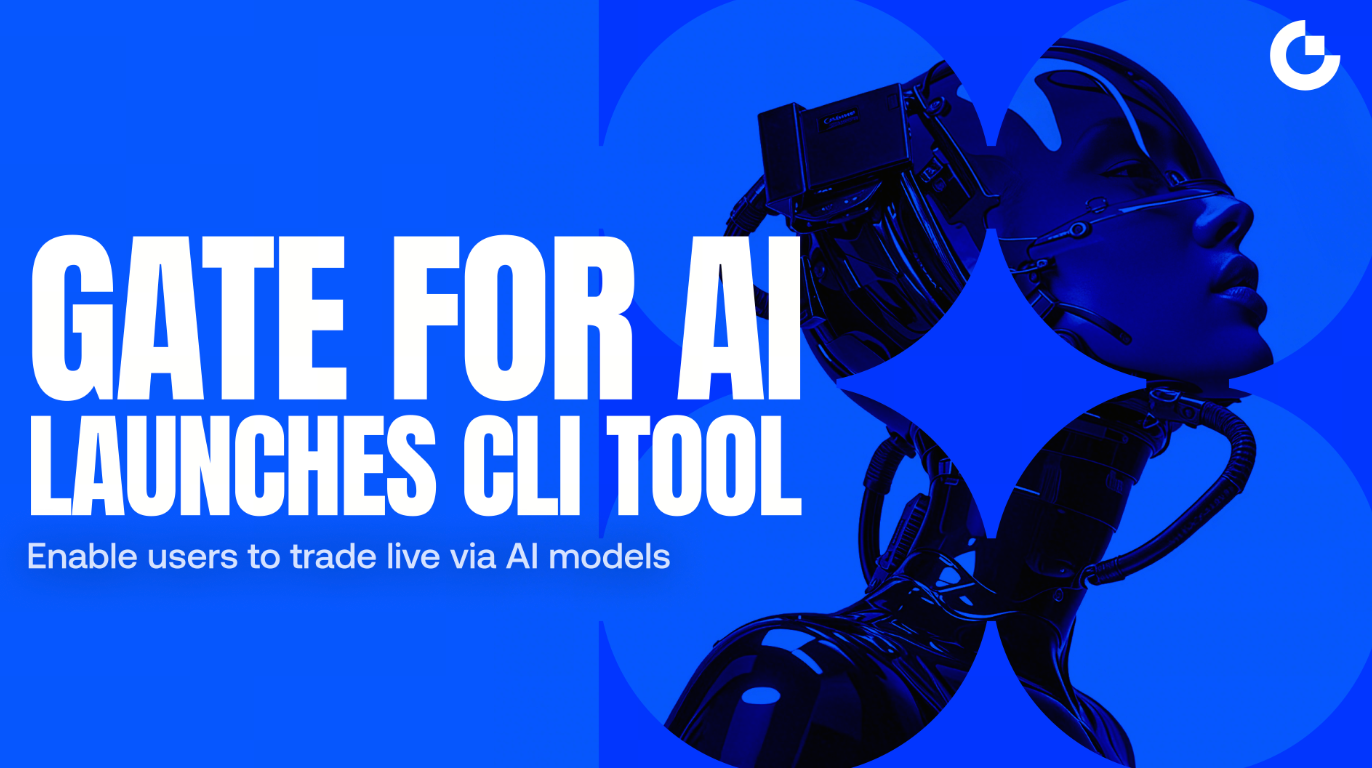
Gate has officially released Gate CLI, a command-line trading tool tailored for developers, quantitative traders, and AI agents. With straightforward commands, users can leverage the exchange's core features, such as market data queries, order placement, order management, and account information review.
This tool allows automated strategies and AI systems to connect to the exchange environment in a streamlined way, making the transition from strategy development to live trading more direct.
Making AI-Driven Decisions Easier to Execute
Traditionally, automated strategies and AI systems interact with trading systems through API integrations. Developers typically need to write significant amounts of code to handle account data, order logic, and data exchange, leading to higher development and maintenance costs.
Gate CLI simplifies these processes by turning them into standard command-line operations, making strategy execution more efficient. For example, when an AI system detects a trading opportunity for a particular asset through market analysis, it can directly use the command-line tool to query market data or place orders—quickly turning strategy insights into trading actions. This direct connection between AI analysis and market execution lowers the technical barrier for building automated trading systems.
Purpose-Built for AI Agents and Automation
Gate CLI is engineered in Go as a single binary executable, so no extra runtime environment is required. Developers only need to perform basic configuration to launch and run strategies on servers, scripts, or CI automation systems.
The tool also supports multi-account profile management and allows users to set credential priorities, enabling flexible setup and management across different strategies or environments.
Comprehensive Trading Operations Supported
Gate CLI delivers robust trading capabilities, covering both spot and derivatives trading scenarios. Via the command line, users can:
-
Query market data
-
Check account assets and balances
-
Place and manage orders
-
Close positions, cancel orders, and modify orders
The system automatically detects both one-way and hedged position modes, minimizing the need for additional logic during strategy execution.
Structured Data Output
Gate CLI supports JSON-formatted output, making it easy for AI agents or automation scripts to directly parse and utilize returned data.
For example, when the system queries market data, account status, or order details, the returned data can be automatically consumed by strategy code for further decision-making. This makes Gate CLI not only developer-friendly but also a key tool for AI agents executing trades.
Bridging AI Strategies and Live Markets
As AI adoption grows across digital asset markets, AI agents are evolving from mere data analysis tools to true market participants capable of making decisions and executing trades. In this context, effectively connecting AI analysis with real trading environments is becoming a critical component of trading infrastructure.
Gate CLI empowers AI agents to bridge the gap between strategy logic and trading execution within a unified framework, shrinking the distance between analysis and action.
A Core Element of the Gate for AI Ecosystem
Gate emphasizes that Gate CLI is a foundational part of its Gate for AI capabilities suite. Through integration with the platform’s MCP and Skills modules, Gate is building a comprehensive AI trading infrastructure that encompasses strategy analysis, data access, and trade execution.
Looking ahead, Gate will continue to enhance the Gate for AI ecosystem, deepening the integration of AI agents, automated trading systems, and digital asset markets, and advancing robust technical support for AI-native trading models.
Summary
As AI continues to advance in the digital asset market, the creation, analysis, and execution of trading strategies are becoming increasingly automated and intelligent. Gate CLI provides developers, quantitative traders, and AI agents with a more direct and efficient means of accessing trading, allowing strategy decisions to be quickly translated into live trading actions. As Gate further improves its Gate for AI ecosystem, the connection between AI and trading infrastructure will strengthen, driving the growth and adoption of AI-native trading models in the marketplace.