The Traditional Framework of Leveraged Trading
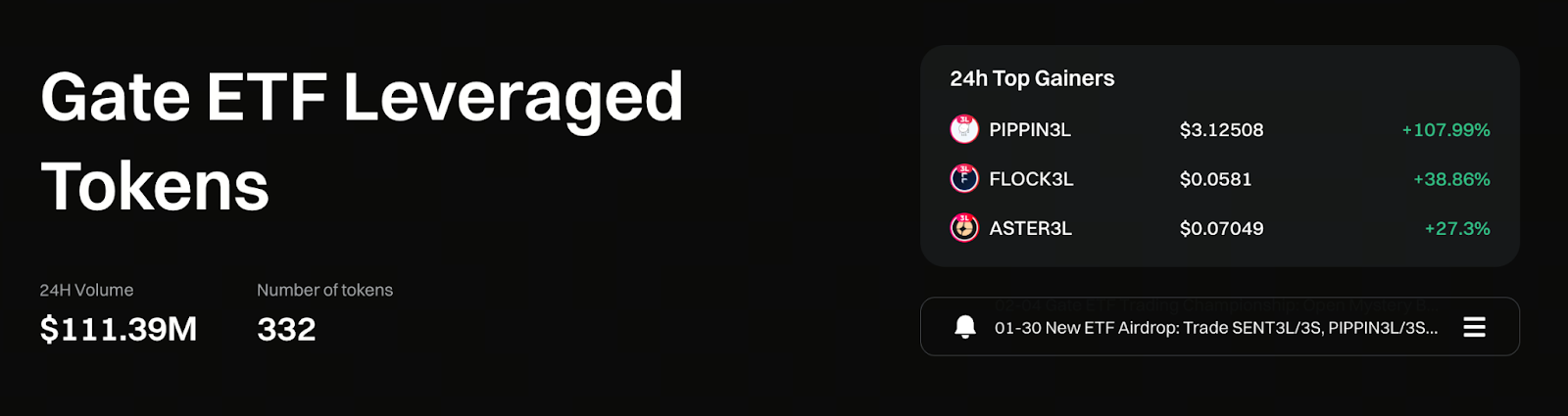
In typical market conditions, leverage is closely linked to contract accounts. Investors must calculate maintenance margin ratios, monitor liquidation risks, and respond quickly during periods of high volatility. While this approach offers flexibility, it also increases operational complexity and psychological pressure. For some, the technical aspects of leverage become a barrier to entry.
Start trading Gate Leveraged ETFs now: https://www.gate.com/leveraged-etf
Turning Leverage into a Product Feature
Gate Leveraged ETFs introduce a different approach, enabling users to participate in the market through spot trading. Investors do not need to open separate contract positions or manually adjust leverage.
Each product is set with a fixed target multiple, such as 3x or 5x. Users simply buy and sell these tokens as they would any other, gaining amplified exposure to price movements. This design standardizes leverage, transforming what was once a trading technique into a product attribute.
How Fixed Multiples and the Rebalancing Mechanism Work
To maintain the target leverage ratio, the system adjusts positions through a daily rebalancing mechanism. When market movements cause the actual leverage to deviate from the target range, the system reallocates positions to keep risk within preset limits.
This means investors do not need to monitor margin ratios or add funds during sharp market swings. The leverage effect remains within a predictable range, rather than expanding without limit.
Why There Is No Forced Liquidation Mechanism
Unlike traditional contracts, leveraged ETFs do not create individual margin positions, so there is no forced liquidation system.
This is because:
-
Investors do not directly borrow assets
-
Risk is reflected in the product’s net asset value, not individual accounts
-
The rebalancing mechanism adjusts positions early in extreme scenarios
As a result, losses appear as a reduction in net asset value, not as account liquidation. While price movements are still amplified, the risk structure differs significantly from traditional leveraged positions.
In trending markets, the rebalancing mechanism can create a compounding effect. If prices continue in one direction, the base for amplification expands, resulting in dynamic growth.
In sideways or range-bound markets, repeated adjustments may erode net asset value, making actual performance differ from simple multiple calculations. These products are best suited for clear trending markets rather than prolonged sideways phases.
Flexibility in Capital Allocation and Liquidity
Compared to contract models that require margin to be locked, leveraged ETFs use spot trading. The invested amount directly corresponds to the target leverage, with no need for additional collateral or borrowing.
The product charges a fixed daily management fee to cover hedging and rebalancing costs, ensuring stable operation. For investors who want to participate in amplified market moves while maintaining capital flexibility, this structure offers an alternative.
Leverage Still Means Amplified Risk
Even with a more intuitive operation, the core of leveraged ETFs is still to magnify price movements. When market direction is judged correctly, gains may accumulate quickly; if the direction is wrong, losses are amplified as well. Understanding the product’s logic and appropriate use cases, along with prudent capital allocation, remains essential for using these tools.
Summary
Leveraged ETFs have standardized and simplified how investors participate in leveraged markets. Through fixed multiples and rebalancing mechanisms, Gate Leveraged ETFs turn actively managed leveraged positions into directly tradable products. This does not eliminate risk, but changes how it is presented. When investors understand their mechanics and allocate capital wisely, leveraged products can serve as a strategic tool rather than a source of stress.