Abstract
- Vibe Coding is a programming practice in which natural language intent serves as the primary input, artificial intelligence systems automatically generate system-level code structures, and rapid trial-and-error with outcome-oriented usability is used as the main validation standard.
- Existing research broadly indicates that AI programming tools can deliver significant improvements in code generation speed, task completion time, and developers’ subjective satisfaction.
- By weakening code comprehension depth and verification rigor, Vibe Coding amplifies security risk exposure in blockchain systems, where code is immutable and directly bound to valuable assets.
- In high-risk blockchain environments, Vibe Coding is better suited for prototyping, non-core logic implementation, and experimental development, rather than for core smart contract logic that directly controls high-value assets.
- Efficiency gains achieved through Vibe Coding must be complemented by stricter security audits, formal verification, and testing mechanisms to compensate for the reduced depth of code understanding during development.
- In the highly sensitive technological context of blockchain, the real issue is not whether Vibe Coding is used, but whether sufficient restraint and governance are maintained over risk while pursuing efficiency.
Introduction
1.1 Research Background
In recent years, Large Language Models (LLMs) have been increasingly applied in the field of software engineering, driving the emergence of a new programming paradigm in which code is generated from natural language. Developers no longer rely solely on writing code line by line; instead, they describe target functionalities, system behaviors, or design intentions, and artificial intelligence systems automatically generate executable code. This programming practice, which emphasizes rapid feedback and iterative refinement and is guided by the principle that “it feels right,” has gradually been summarized in industry as Vibe Coding.
Compared with traditional software engineering, Vibe Coding significantly lowers the barrier to entry for programming, improves the speed of prototyping and feature implementation, and has been widely adopted by startups, individual developers, and in rapid experimentation scenarios. However, this paradigm also weakens developers’ comprehensive understanding of low-level implementation details, boundary conditions, and exceptional execution paths, thereby giving rise to ongoing debates regarding code quality, security, and the attribution of responsibility.
Blockchain systems—especially decentralized applications (DApps) based on smart contracts—provide a particularly tension-filled context for the application of Vibe Coding. On the one hand, blockchain development has long faced challenges such as high technical barriers, lengthy development cycles, and expensive auditing costs. In theory, Vibe Coding could significantly improve development efficiency and accelerate innovation. On the other hand, once blockchain code is deployed, it is difficult to modify, and it often directly controls high-value digital assets; any security vulnerabilities may therefore lead to irreversible economic losses. In this context, any technological paradigm that reduces developers’ “depth of code understanding” may amplify systemic risks.
Consequently, Vibe Coding exhibits a fundamentally paradoxical nature in the blockchain domain: it may serve as a “remedy” for development efficiency bottlenecks, yet it may also evolve into a “poison” that undermines system security.
1.2 Research Questions
Although research on AI-assisted programming has grown rapidly, existing literature mainly focuses on productivity gains, developer experience, and general software engineering scenarios, paying insufficient attention to its impact on high-risk, irreversible systems. In particular, in the blockchain environment—where “Code is Law”—it remains unclear whether Vibe Coding has altered the structure and distribution of risks, and systematic empirical evidence is still lacking.
Accordingly, this paper focuses on the following core research questions:
- Efficiency dimension: Does Vibe Coding significantly shorten development cycles, reduce labor costs, and accelerate time-to-market in blockchain application development?
- Security dimension: In smart contracts and blockchain infrastructure, does rapidly generated and deployed code exhibit higher vulnerability rates, earlier attack windows, or larger economic losses?
- Structural relationship: Is the improvement in development efficiency statistically correlated with an increase in security risks? Do the two constitute a form of “efficiency–security trade-off”?
- Engineering and governance implications: Given that Vibe Coding is difficult to avoid in practice, how should blockchain systems design technical, procedural, and institutional mechanisms to mitigate its potential risks?
1.3 Research Methodology and Data Overview
To address the above questions, this paper adopts a data-driven empirical research approach, combining descriptive statistics, comparative analysis, and correlation analysis to systematically examine the impact of Vibe Coding in the blockchain domain.
Specifically, this study integrates the following data sources:
- Blockchain security incident data: including time-series data on the number of smart contract vulnerabilities, frequency of attacks, and scale of financial losses;
- Open-source repository data: used to analyze smart contract code structure, commit patterns, and development cycles, and to construct proxy indicators for Vibe Coding practices;
- Smart contract audit report data: used to compare vulnerability density and audit pass rates under different development paradigms;
- Blockchain project development data: used to measure development efficiency, team size, and time-to-launch.
Since it is currently not possible to directly observe whether developers use AI programming tools, this paper employs indirect indicators such as code similarity, commit behavior, and development rhythm to approximate the prevalence of Vibe Coding-related practices. It should be emphasized that this study focuses on statistical correlations and structural trends, rather than making causal judgments about individual projects or developer behaviors.
Definition of Vibe Coding
2.1 Conceptual Definition of Vibe Coding
With the widespread adoption of large-scale language models in software engineering, a new development practice driven by natural language code generation has gradually taken shape. Although “Vibe Coding” was not originally a strictly defined academic term, the characteristics it exhibits in engineering practice already constitute a representative paradigm shift in programming.
In this paper, Vibe Coding is defined as:
A programming practice in which natural language intent serves as the primary input, artificial intelligence systems automatically generate system-level code structures, and rapid trial-and-error together with functional usability serves as the main validation criterion.
Under this paradigm, developers no longer regard step-by-step construction, formal reasoning, and complete understanding of code logic as necessary prerequisites. Instead, they iteratively approach the target functionality through a cycle of “generate–run–revise.” The correctness of the code is judged more by whether the runtime behavior matches expectations than by systematic verification of implementation details, boundary conditions, and exceptional execution paths.
2.2 Distinguishing Vibe Coding from Related Programming Paradigms
To avoid conceptual confusion, it is necessary to distinguish Vibe Coding from existing software development paradigms.
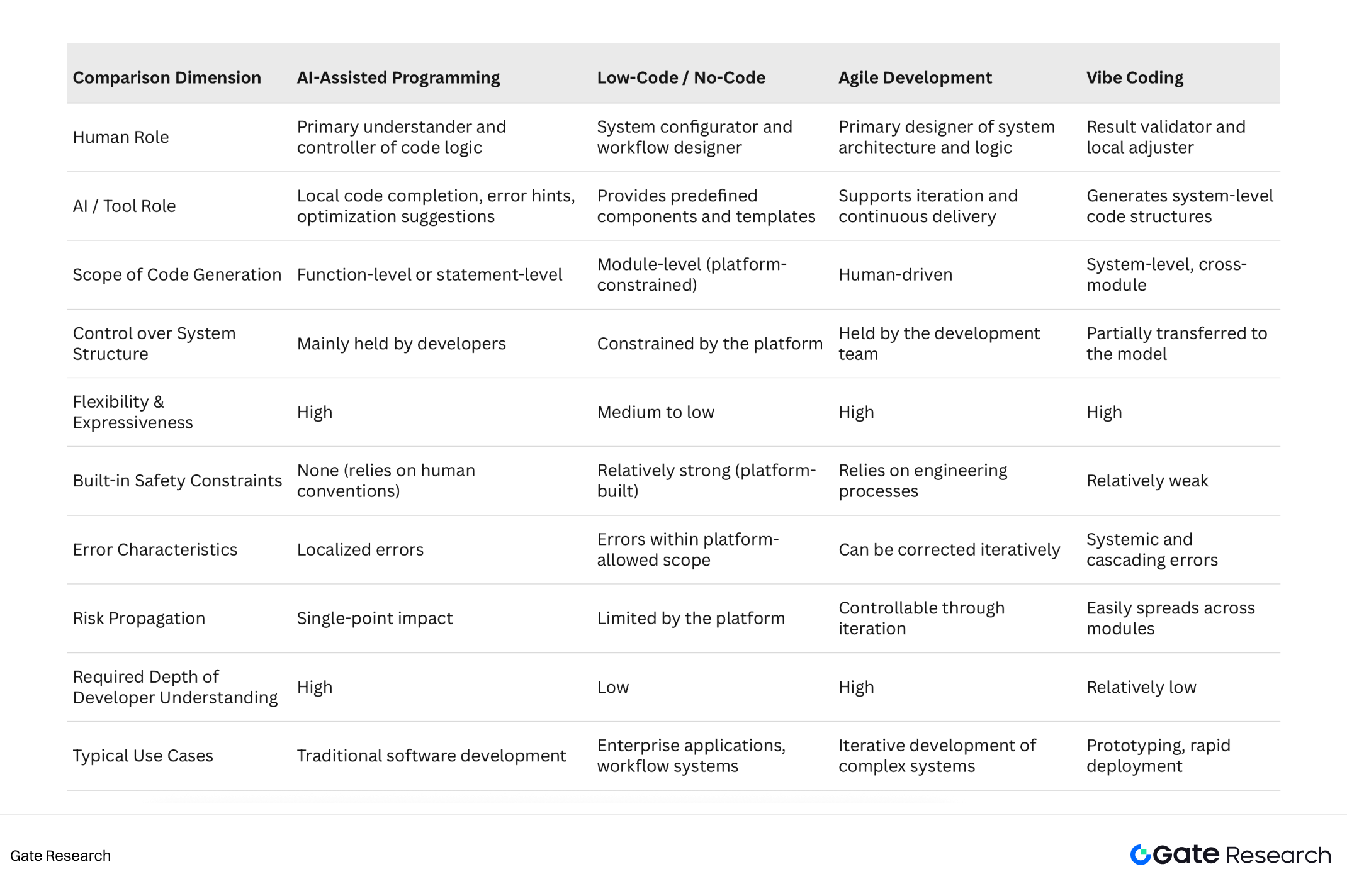
2.2.1 Distinction from AI-Assisted Programming
Existing studies on AI-assisted programming typically assume that developers remain the primary understanders and controllers of code logic, while AI systems mainly serve auxiliary roles such as code completion, error detection, or local implementation optimization. Under this paradigm, the overall system architecture and core logic are still designed and governed by human developers.
In contrast, under Vibe Coding, AI systems often directly participate in the generation of system-level code structures, while developers increasingly assume the role of validators and revisers. This difference leads to a fundamentally different risk distribution: errors in AI-assisted programming are usually local in nature, whereas errors in Vibe Coding are more likely to be systemic and cascading.
2.2.2 Distinction from Low-Code / No-Code Development
Low-code and no-code platforms reduce the barrier to programming through graphical components, predefined templates, and highly constrained development environments. Their security and compliance are, to some extent, guaranteed by built-in platform mechanisms. However, this approach typically comes at the cost of flexibility and extensibility.
Vibe Coding does not rely on fixed templates or closed platforms. Instead, it leverages the generalization capabilities of large language models to generate highly flexible code structures. This feature gives it significantly greater expressive power than low-code platforms, but at the same time, it lacks the built-in security constraints and engineering discipline provided by such platforms.
2.2.3 Distinction from Agile Development
Agile development emphasizes iteration, feedback, and continuous delivery, but it presupposes that the development team has a clear understanding of the system architecture and core logic. Vibe Coding goes one step further by shifting part of the cognitive engineering burden to automated code generation systems, making iteration speed no longer linearly correlated with humans’ ability to understand system complexity.
Therefore, Vibe Coding should not be regarded as a simple extension of agile methodologies, but rather as a development practice that entails a substantial shift in the cognitive structure of software engineering.
2.3 Engineering Characteristics and Risk Structure of Blockchain Development
Blockchain systems, especially smart contract–based decentralized applications, differ fundamentally from traditional software systems in their engineering properties.
First, once smart contract code is deployed to a blockchain network, it is usually difficult or even impossible to modify or roll back. This irreversibility means that any defects may persist for a long time and remain continuously exposed to an adversarial environment.
Second, blockchain code often directly controls digital assets with real economic value. Security vulnerabilities are therefore not merely functional errors, but can be actively exploited for financial gain. Prior studies show that logic flaws, permission misconfigurations, and state management errors in smart contracts are the primary causes of major security incidents. Moreover, blockchain systems generally operate in highly adversarial environments: attackers can continuously monitor on-chain states, rapidly replicate attack strategies, and automate their execution, making the early stage after deployment a period of highly concentrated risk.
Together, these characteristics constitute an engineering environment that is extremely sensitive to code quality and security, in which any development paradigm that reduces the depth of code understanding or the rigor of verification may amplify systemic risk.
2.4 Review of Related Work
Existing studies generally indicate that AI programming tools can significantly improve code generation speed, task completion time, and developers’ subjective satisfaction. These findings provide theoretical support for the potential efficiency advantages of Vibe Coding. However, most of this literature focuses on short-term development tasks or controlled experimental settings, and relatively little attention has been paid to long-term maintainability and security impacts in complex systems.
Research on blockchain security has mainly focused on vulnerability classification, attack pattern analysis, and defense mechanism design, forming a relatively mature theoretical framework for smart contract security. However, existing literature rarely examines how development paradigms themselves affect the distribution of vulnerabilities and the structure of risks, and in particular lacks systematic empirical studies on AI-driven development practices.
In summary, current research still exhibits several notable gaps:
- The lack of a systematic conceptualization of Vibe Coding as an emerging programming paradigm;
- The lack of empirical analysis targeting high-risk blockchain scenarios;
- The lack of a unified quantitative framework that jointly considers development efficiency and security risk.
This paper aims to fill these gaps by conducting a multi-source data analysis to investigate the structural relationship between efficiency gains and security risks of Vibe Coding in blockchain development, and to provide empirical evidence for related engineering practices and governance mechanisms.
Research Methodology
3.1 Research Design
This paper adopts a quantitative empirical research approach to systematically analyze the efficiency impact of Vibe Coding in blockchain development and its potential security risks. Since Vibe Coding, as a development practice, cannot be directly observed, this study constructs a set of quantifiable proxy variables to approximate its characteristics and examines the statistical relationships between these variables and security risk indicators.
The overall research design follows these steps:
- Construct quantitative indicators reflecting blockchain development efficiency and code generation characteristics;
- Build a project–contract–level sample based on multi-source datasets;
- Use descriptive statistics and comparative analysis to examine overall trends;
- Apply correlation analysis to test the structural relationship between development efficiency and security risks.
This paper focuses on statistical correlations and systemic trends rather than making strong causal claims about specific tools or mechanisms.
3.2 Data Sources
3.2.1 Blockchain Security Incident Data
Security incident data are used to measure the observable security risks of blockchain systems, mainly including the occurrence time of smart contract attacks, attack types, and the scale of economic losses.
This dataset contains the following core fields:
- Date of the attack event
- Project or contract identifier
- Vulnerability category
- Amount of financial loss
3.2.2 Open-Source Repository Data
This study selects blockchain projects with public code repositories and collects their smart contract code and commit histories. These data are used to characterize development rhythm, code structure features, and potential traces of automated code generation.
The collected dimensions include:
- Lines of Code (LOC)
- Cyclomatic Complexity
- Inter-contract code similarity
- Commit timestamps and commit size
Data Description and Sample Statistics
4.1 Dataset Overview
The dataset used in this paper is integrated from multiple publicly verifiable sources, including blockchain security incidents, open-source code repositories, smart contract audit reports, and project-level development information. Contracts serve as the unit of analysis, and the time span covers the period of rapid growth in blockchain applications in recent years.
In constructing the sample, this study follows these principles:
- Only retain records that can be traced to specific projects or contracts;
- Exclude samples with missing key information or that cannot be matched across multiple data sources;
- Identify and treat outliers to reduce the influence of extreme events on statistical results.
The initial sample is drawn from public blockchain projects and their corresponding code repositories, covering multiple application types, including decentralized finance (DeFi), non-fungible tokens (NFTs), and decentralized autonomous organizations (DAOs). The initial dataset consists of two parts: project-level records and contract-level code and commit histories.
4.3 Descriptive Statistics Results
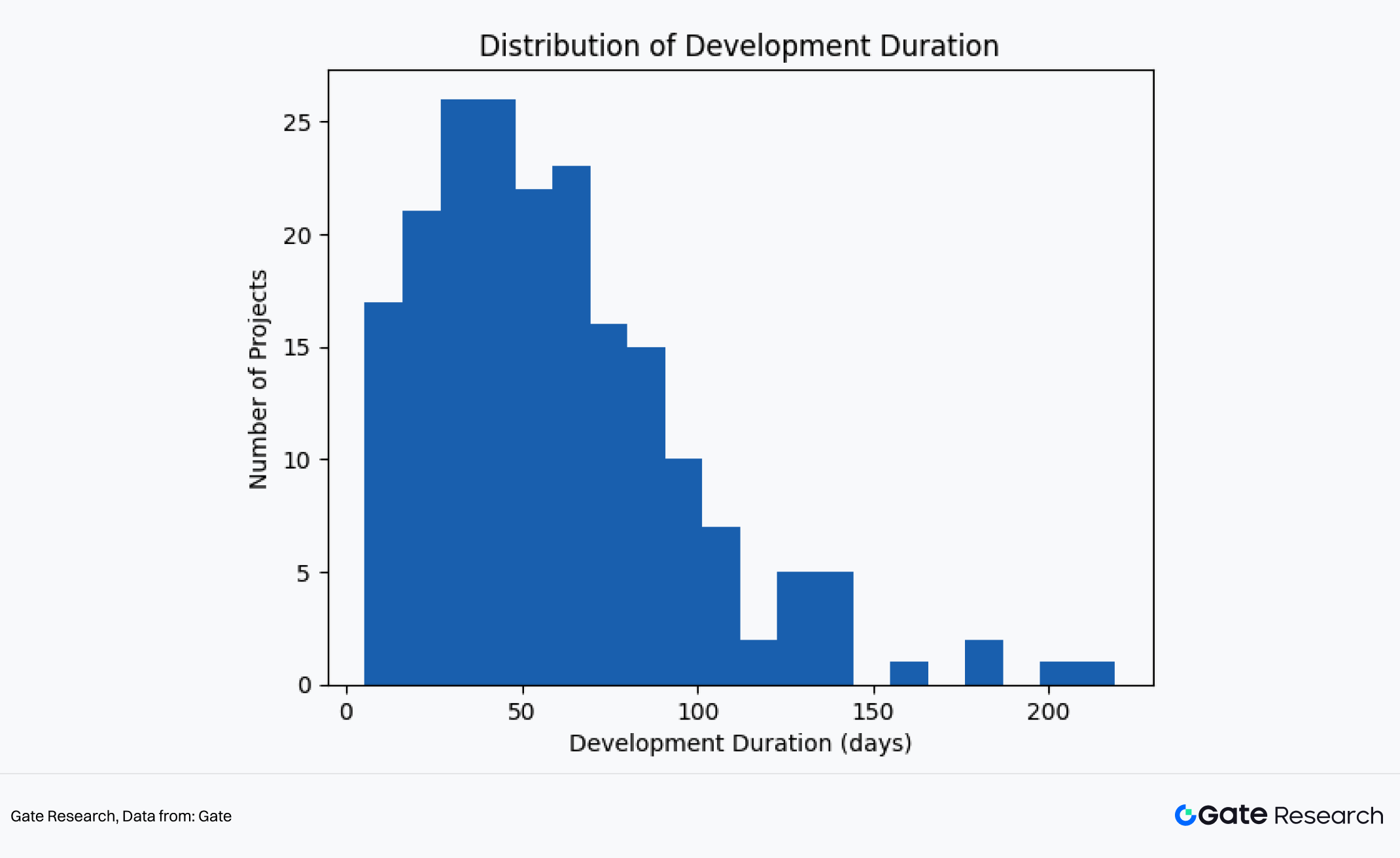
4.3.1 Descriptive Statistics of Development Efficiency Indicators
The table below summarizes the descriptive statistics of variables related to project development efficiency, including development cycle length, commit frequency, and the proportion of large commits. Overall, the sampled projects exhibit significant heterogeneity in development pace. Some projects move from the first code commit to mainnet deployment in a very short time, reflecting highly compressed development processes, while others display much longer development cycles and more dispersed commit rhythms.
4.3.2 Descriptive Statistics of Code Structure Indicators
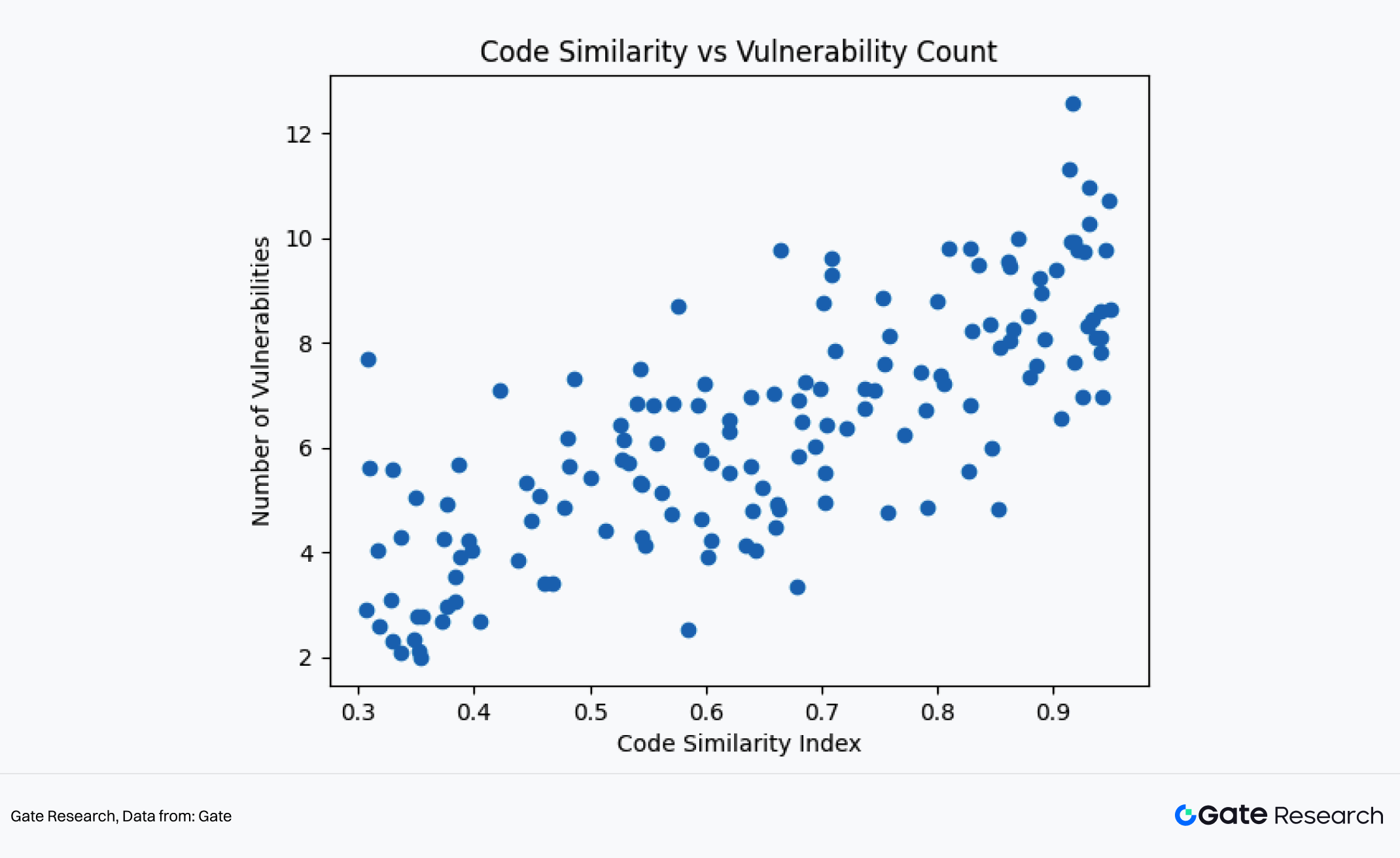
The table below reports the statistical characteristics of smart contract code structure indicators, including lines of code, cyclomatic complexity, code similarity, and the proportion of duplicated code. The results show substantial differences in code complexity and structural similarity across projects. Some samples exhibit highly similar contract structures and relatively high proportions of duplicated code, a phenomenon that is particularly pronounced in multi-contract projects.
4.3.3 Descriptive Statistics of Security Risk Indicators
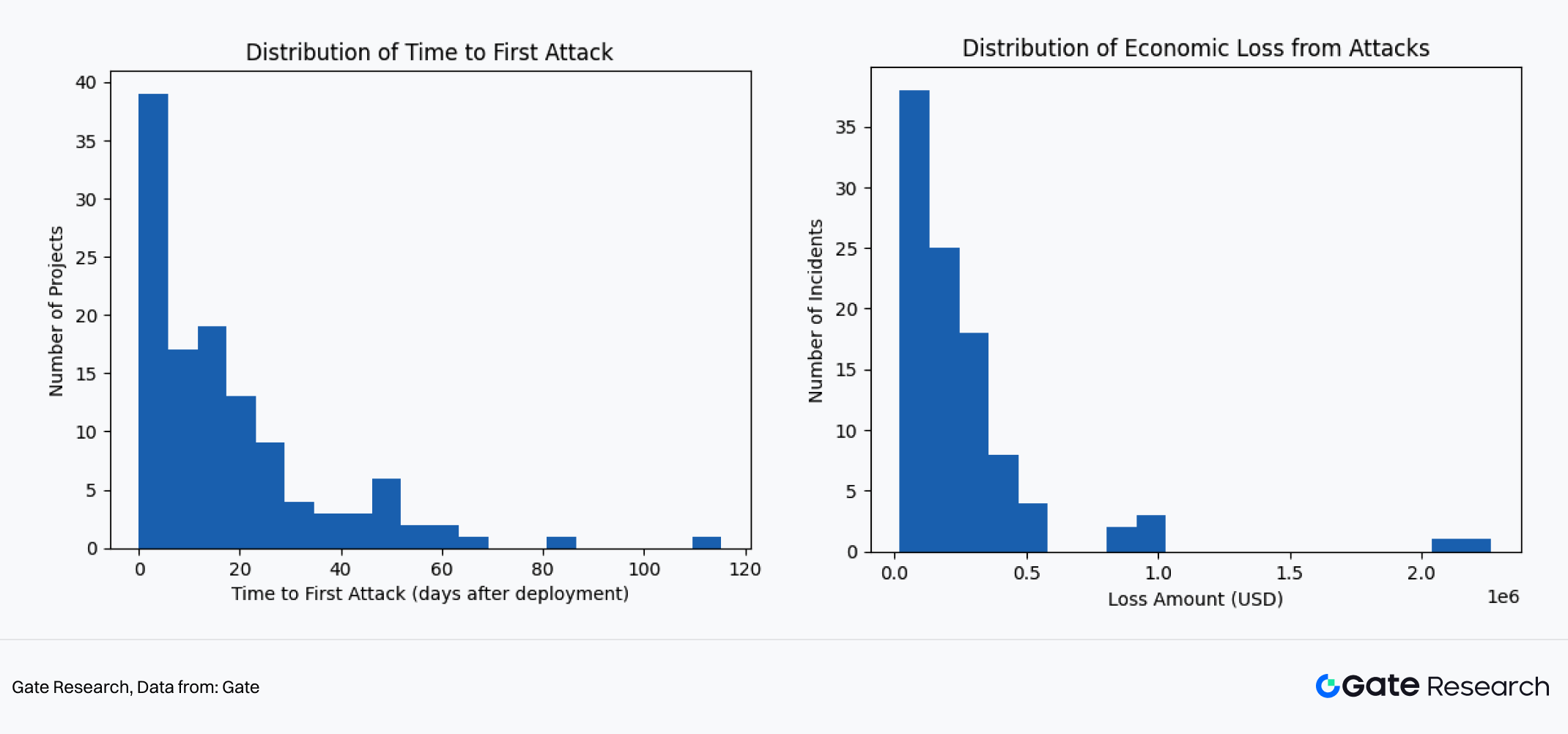
The table below summarizes the descriptive statistics of variables related to security risk, including the incidence rate of security events, the scale of economic losses, and the time to first attack.
The descriptive results indicate that:
- Security incidents are not uniformly distributed across the sample;
- A small number of attacks account for a disproportionately large share of the total economic losses;
- Most security attacks occur within a relatively short time window after project deployment.
In summary, the sample data exhibit substantial heterogeneity in terms of development efficiency, code structure, and security risk. This heterogeneity provides the necessary empirical foundation for analyzing the relationship between Vibe Coding–related characteristics and security risks.
The descriptive statistics in this chapter indicate that:
- Blockchain projects differ significantly in their development pace;
- Code structure characteristics are highly uneven across projects;
- Security risks exhibit strong concentration patterns in both temporal and economic dimensions.
Based on these observations, the next chapter analyzes the efficiency gains of Vibe Coding in blockchain development, while Chapter 6 focuses on examining its potential security risks.
Empirical Analysis of Development Efficiency
Based on the development pace and code generation feature indicators constructed in Chapter 3, this section conducts an empirical analysis of development efficiency in blockchain projects. The descriptive statistics show substantial variation in development cycles across the sample. A subset of projects moves from the first code commit to mainnet deployment significantly faster than the sample average. These projects typically exhibit highly compressed development processes, reflecting the widespread adoption of development practices characterized by automated code generation and rapid iteration in the blockchain context.
Further analysis of commit behavior reveals that high-efficiency projects tend to exhibit both higher commit density and larger single-commit sizes. This commit pattern suggests that the code generation process is more inclined toward centralized output and holistic modification rather than incremental, step-by-step construction. When combined with project-level team size data, it can be observed that the significant shortening of development cycles is not accompanied by a proportional increase in manpower input, indicating that efficiency gains are not primarily driven by team expansion but are more likely related to tool usage and increased automation.
From the perspective of project type distribution, efficiency improvements are not evenly observed across different categories of blockchain applications. Projects with relatively standardized functional structures and clearer business logic are more likely to adopt highly compressed development processes, whereas projects that rely more heavily on long-term security and system robustness tend to exhibit more cautious development rhythms. This pattern suggests that high-efficiency development practices in the blockchain domain are context-dependent and subject to scenario selection.
Overall, the results of this chapter indicate that development practices associated with Vibe Coding can indeed significantly improve development efficiency in blockchain projects, as reflected in shorter development cycles and higher output per unit of labor. However, improvements in development efficiency do not necessarily imply comprehensive improvements in system quality. Their implications for security and risk structure remain to be further examined, which is the focus of the next chapter.
Empirical Analysis of Security Risks
Building on the empirical results on development efficiency, this section further examines whether development practices associated with Vibe Coding introduce higher security risks in blockchain projects. To this end, this paper uses the occurrence of security incidents, the number of vulnerabilities, and the scale of economic losses as security risk indicators, and systematically analyzes their relationships with development pace and code structure proxy variables.
First, from the perspective of the probability of security incidents, the empirical results show that projects with significantly shorter development cycles are more likely to experience security events. Compared with projects with longer development cycles, the high-efficiency group exhibits a higher attack incidence rate in the early stage after deployment. This phenomenon suggests that in the highly adversarial blockchain environment, rapid deployment does not significantly delay attacks; instead, it may shorten the time window for attackers to discover and exploit vulnerabilities.
Second, at the code quality level, code structure characteristics are significantly associated with the number of vulnerabilities. The results show that contracts with higher code similarity and a larger proportion of duplicated code tend to be accompanied by a higher number of vulnerabilities. This indicates that templated and homogenized code structures, while improving development efficiency, may also amplify the propagation range of systemic defects, allowing a single logical flaw to exist simultaneously across multiple contracts.
Furthermore, at the level of economic consequences, development efficiency indicators also exhibit a positive correlation with the scale of economic losses caused by security incidents. Although not all high-efficiency projects suffer attacks, once a security incident occurs, the resulting losses tend to be more concentrated and larger in magnitude. This “low-frequency, high-loss” risk distribution makes the potential security costs of efficiency-driven development particularly salient in the blockchain context.
Taken together, these findings suggest that improvements in development efficiency and security risks are not independent, but instead exhibit a clear structural trade-off. On the one hand, Vibe Coding–related practices can significantly reduce development time and labor costs; on the other hand, their tendency to weaken the depth of code understanding and the rigor of verification amplifies security risk exposure in irreversible, asset-bound blockchain systems. These results provide empirical support for the paper’s central thesis: what serves as a remedy for efficiency may also act as a poison for security.
Conclusion
This paper focuses on Vibe Coding as an emerging development paradigm and systematically analyzes its efficiency gains and security risks in blockchain application development using multi-source empirical data. The results show that Vibe Coding exhibits a pronounced dual effect in the blockchain context. On the one hand, it can significantly compress development cycles and reduce labor input per unit of output, thus playing a positive role in terms of efficiency. On the other hand, this efficiency improvement is not cost-free, but is significantly associated with higher security risks.
Empirically, projects with significantly shortened development cycles are more likely to experience security incidents in the early stage after deployment, and contracts with highly similar and templated code structures tend to exhibit more vulnerabilities. These findings indicate that the automated code generation and rapid iteration mechanisms introduced by Vibe Coding, while weakening developers’ comprehensive understanding of system logic and boundary conditions, also amplify the propagation range of systemic defects. In the blockchain environment—where systems are irreversible and directly bound to assets—such risks are further magnified.
Further analysis shows that although high-efficiency projects do not necessarily suffer more frequent attacks, once an attack occurs, the resulting economic losses tend to be larger, exhibiting a clear long-tail distribution. This suggests that the risk of Vibe Coding in blockchain systems is not primarily reflected in the frequency of incidents, but rather in the accelerated speed of risk exposure and the amplified scale of potential losses. This reveals a typical “low-frequency, high-loss” risk structure, making efficiency gains particularly risk-sensitive in blockchain systems.
Taken together, this paper argues that Vibe Coding should not be viewed simply as either technological progress or engineering regression, but rather as a development paradigm that reshapes the structure of risk distribution. In the blockchain context, development efficiency and system security exhibit a clear structural trade-off. For this reason, Vibe Coding can be seen both as an “efficiency remedy” for alleviating the high barriers of blockchain development and, if left unconstrained, as a “latent poison” that undermines system security.
Based on these findings, this paper offers several practical and governance implications. First, in high-risk blockchain systems, Vibe Coding is more suitable for prototyping, non-core logic implementation, and experimental development, rather than for core contract logic that directly controls high-value assets. Second, improvements in development efficiency must be coupled with stricter security audits, formal verification, and testing mechanisms to compensate for the reduced depth of code understanding during development. Third, at the organizational and institutional level, the boundaries of responsibility for AI-generated code should be clearly defined, shifting developers from mere “code writers” to “system risk bearers,” in order to avoid the blurring of accountability.
Finally, this study has several limitations. Since Vibe Coding cannot be directly observed, the proxy variables used in this study may introduce measurement bias. Moreover, the empirical results mainly reflect statistical correlations rather than strict causal relationships. Future research could further combine developer survey data, experimental designs, and blockchain-oriented automated security analysis tools to provide a more fine-grained characterization of the risk mechanisms of AI-driven development paradigms.
This study suggests that in a highly sensitive technical environment such as blockchain, the real question is not whether to use Vibe Coding, but whether sufficient restraint and governance capacity can be maintained while pursuing efficiency.
Reference
Gate Research is a comprehensive blockchain and cryptocurrency research platform that provides deep content for readers, including technical analysis, market insights, industry research, trend forecasting, and macroeconomic policy analysis.
Disclaimer
Investing in cryptocurrency markets involves high risk. Users are advised to conduct their own research and fully understand the nature of the assets and products before making any investment decisions. Gate is not responsible for any losses or damages arising from such decisions.