In traditional finance, gold investments typically take the form of gold bars, coins, or gold ETFs like SPDR Gold Shares (GLD). However, these products have limitations in trading hours, divisibility, and cross-border transfers. As blockchain technology evolves, asset tokenization has emerged as a new financial innovation, allowing real-world assets to be mapped onto the blockchain, thereby improving liquidity and trading efficiency.
PAXG is not just a gold investment vehicle—it’s a milestone in real-world asset (RWA) tokenization. By leveraging blockchain programmability, gold—a classic store of value—can now participate in on-chain trading, asset allocation, and the DeFi ecosystem, bridging the gap between traditional and crypto finance.
Core Features and Attributes of PAXG
PAXG is a crypto asset backed by physical gold, with each token representing a specific quantity of gold reserves. Paxos issues the token, which is regulated and approved by the New York State Department of Financial Services (NYDFS).
Unlike traditional gold assets, PAXG operates on the Ethereum blockchain, giving it blockchain-native features such as divisibility, programmability, and rapid global transfers. Investors can buy and sell PAXG just as they would any cryptocurrency.
Key attributes of PAXG include:
| Attribute |
Description |
| Asset Type |
Token backed by physical gold |
| Blockchain |
Ethereum |
| Token Standard |
ERC-20 |
| Issuer |
Paxos |
| Asset Backing |
Physical gold reserves |
This structure establishes PAXG as a bridge between the traditional precious metals market and blockchain-based finance.
How Does PAXG’s Asset Pegging Mechanism Work?
PAXG’s value is rooted in its physical gold reserve backing, which operates under strict asset segregation and a 1:1 reserve system.
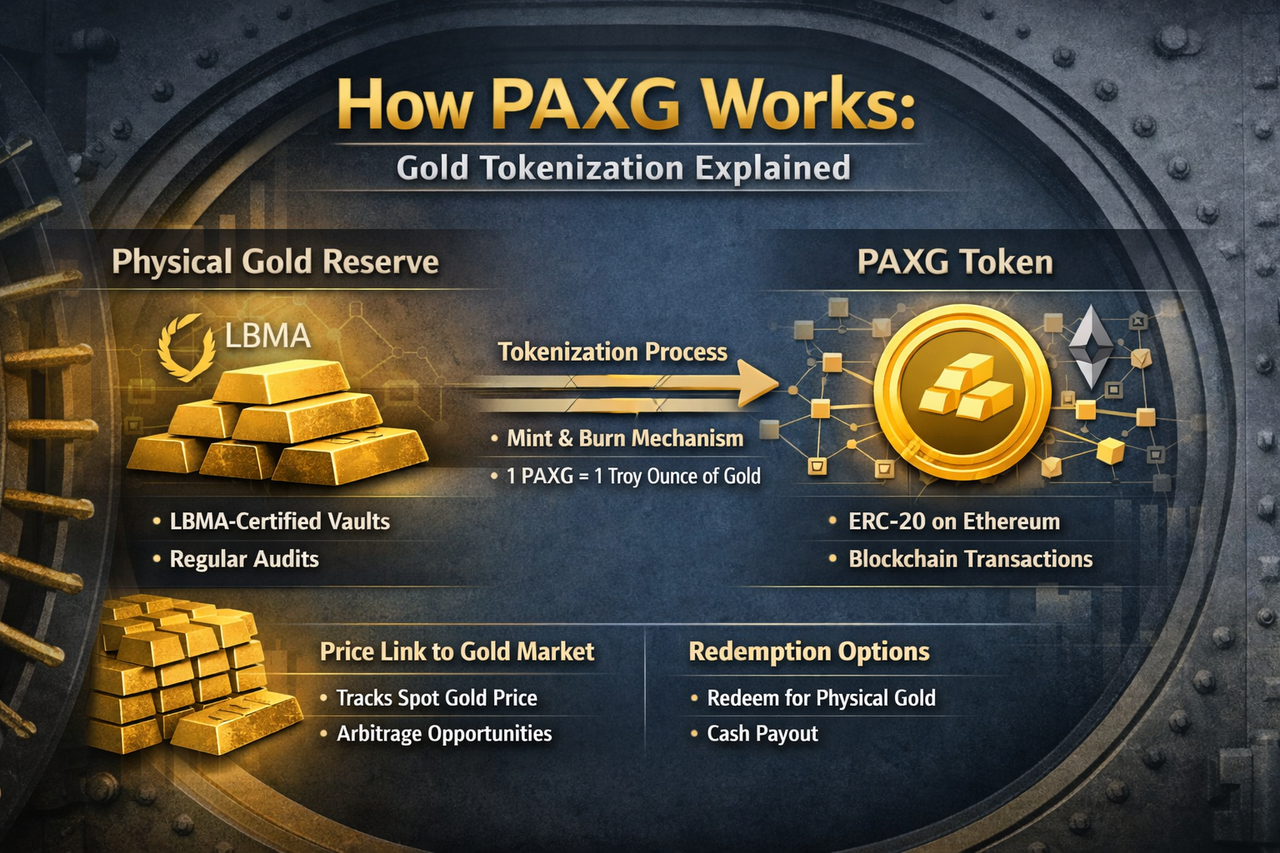
When an investor purchases PAXG, the issuer adds the equivalent amount of gold to its reserves and mints the same number of tokens. This creates a direct mapping: Physical gold → Minting PAXG → On-chain circulation.
When a user redeems PAXG, the corresponding tokens are burned, and the user receives the equivalent value in gold or cash.
This minting and burning mechanism ensures that the total supply of PAXG always matches the gold reserves, providing a solid foundation for its price peg.
How Much Physical Gold Does Each PAXG Represent?
Each PAXG token represents ownership of one troy ounce of a London Good Delivery gold bar. This standard, set by the London Bullion Market Association (LBMA), is a cornerstone of the global gold market.
LBMA-certified bars typically weigh about 400 ounces and are held in major global vaults. PAXG splits these bars into digital units, allowing investors to buy gold in much smaller amounts. This divisibility is a significant advantage over traditional gold bar investments.
How Are Gold Reserves Custodied and Secured?
PAXG’s gold reserves are held by professional custodians and secured by specialized security firms such as Brink’s.
- Not Company Assets: The gold is held in the client’s name and is strictly separated from Paxos’s corporate assets.
- Physical Form: Gold is stored as large 400-ounce bars, not smaller pieces, in compliance with LBMA standards.
Is There an Audit Mechanism to Ensure Reserve Transparency?
To ensure that gold reserves match the token supply, PAXG undergoes regular third-party audits.
Paxos, the issuer, publishes reserve reports that are typically verified by independent auditing firms. These reports review:
- The total supply of PAXG
- The corresponding amount of gold in reserve
- The custody locations for the reserves
Audit results are generally published monthly to promote transparency and market trust. Additionally, investors can use the official Paxos tool to check the serial number and weight of the gold bars backing their PAXG, providing extra transparency.
How Does PAXG Track International Gold Prices?
PAXG’s price is primarily determined by the international spot gold market, which generally follows the London Bullion Market Association’s pricing system.
In trading markets, PAXG’s price is influenced by these factors:
| Factor |
Description |
| International Gold Price |
Fundamental pricing basis |
| Exchange Liquidity |
Impacts short-term price movements |
| Market Demand |
Crypto market hedging needs |
| Minting and Redemption Costs |
Affect arbitrage mechanisms |
If PAXG trades at a significant premium or discount, arbitrageurs can mint or redeem tokens to capitalize on the spread, helping the price revert to spot gold levels.
How Do On-Chain Tokens Correspond to Physical Gold?
PAXG uses an asset reserve plus token issuance mechanism to map on-chain tokens to physical gold.
Process:
- User purchases PAXG
- Issuer mints corresponding tokens
- Gold is added to reserves
- Tokens circulate on the blockchain
When redemption occurs:
- User submits a redemption request
- Corresponding tokens are burned
- User receives gold or cash value
This ensures that the on-chain token supply always matches the gold reserves.
Can PAXG’s Peg Fail During Extreme Market Conditions?
In extreme market environments, PAXG’s price may temporarily diverge from the gold price—for example, if crypto market liquidity collapses, exchanges halt trading, or panic triggers premiums or discounts.
However, thanks to the physical redemption and arbitrage mechanisms, prices typically return to spot levels over time.
In short, PAXG’s peg is not maintained by algorithms alone—it relies on real assets and market arbitrage.
Advantages and Potential Risks of the Digital Gold Model
Asset tokenization, as exemplified by PAXG’s “digital gold” model, brings new opportunities to traditional precious metals investment. Blockchain technology transforms gold into a token that can circulate on-chain, greatly improving liquidity, divisibility, and global transaction efficiency.
Digital gold significantly enhances gold asset liquidity. Traditionally, gold is traded through banks, dealers, or securities markets, but PAXG can be traded 24/7 on crypto exchanges and transferred instantly via blockchain. This enables gold assets to be moved globally like any other crypto asset. Because PAXG is issued on Ethereum, tokens can be split into tiny units, lowering the investment threshold and making gold accessible to more investors.
Digital gold also offers strong financial composability. In blockchain finance, assets can be traded, lent, used as collateral, or provided for liquidity. For example, in some DeFi protocols, PAXG can be used as collateral for on-chain lending, so gold is no longer just a passive hedge—it can have multiple use cases in the digital financial ecosystem.
However, there are risks. The first is custodian and issuer risk: PAXG depends on Paxos to maintain gold reserves and the token issuance system, so investors must trust the company’s ability to safeguard gold and maintain transparency. The second is regulatory risk: since real-world asset tokenization is still developing, changing regulations in different countries could impact digital gold products.
Technical risk is also a concern. PAXG operates on a blockchain, and while smart contracts are usually audited for security, vulnerabilities or systemic risks may still exist. In periods of low liquidity or extreme market conditions, PAXG prices on crypto exchanges may temporarily diverge from spot gold prices. Investors should weigh these risks alongside the advantages of digital gold.
Summary
PAXG tokenizes physical gold, enabling this traditional asset to circulate on blockchain networks. With reserve custody, audit, and redemption mechanisms, PAXG creates a value bridge between on-chain tokens and physical gold.
Its 1:1 physical backing and strict monthly audits strike a balance between the flexibility of digital assets and the stability of physical gold.
FAQs
Is PAXG Really Backed by Physical Gold?
Yes. Each PAXG token is backed by physical gold reserves, with regular third-party audits.
How Much Gold Does One PAXG Represent?
1 PAXG equals 1 troy ounce of LBMA-standard gold.
Can PAXG Be Redeemed for Physical Gold?
Yes. If you meet the minimum redemption requirements, you can redeem PAXG for gold through Paxos.
How Is PAXG Different from Gold ETFs?
Gold ETFs (like SPDR Gold Shares (GLD)) trade on stock markets, while PAXG circulates on blockchains and crypto exchanges and can be used in DeFi.







