On January 15, Elon Musk’s X (formerly Twitter) reignited discussion in the Web3 and AI social communities. Nikita Bier, X’s Head of Product and Solana ecosystem advisor, announced a major revision to the developer API policy: applications that incentivize users to post on X—commonly referred to as “InfoFi”—will no longer be permitted. The platform stated, “We have revoked API access for these applications, so users will soon notice improvements in their X experience (once bots realize posting is no longer profitable).”
This move amounts to an “InfoFi ban,” immediately pushing several leading Web3 projects into a transformation crisis.
What Is InfoFi and Why Is It a Problem for X?
Before analyzing the new policy, it’s essential to understand the core concept of InfoFi (Information Finance). InfoFi is a model that merges “social information” with “financial incentives.” It transforms factors such as project market attention, Twitter account reputation, proposal approval probability, and even narrative activity into tradable, priced financial assets. Classic formats include “Post-to-Earn,” content mining, and reward-based posting.
Users create specific posts on X, tag projects, or interact to earn points or token rewards. For followers of influential posters, curated information may serve as valuable alpha or early signals worth tracking.
However, according to X’s official stance, this model not only “rents” platform traffic but also fuels a flood of AI-generated spam (“AI Slop”) and reply bots, severely degrading the user experience for regular users.
X’s New API Policy Explained
Nikita Bier stated that the InfoFi mechanism has triggered a surge in low-quality AI content and reply spam, undermining the user experience on X.
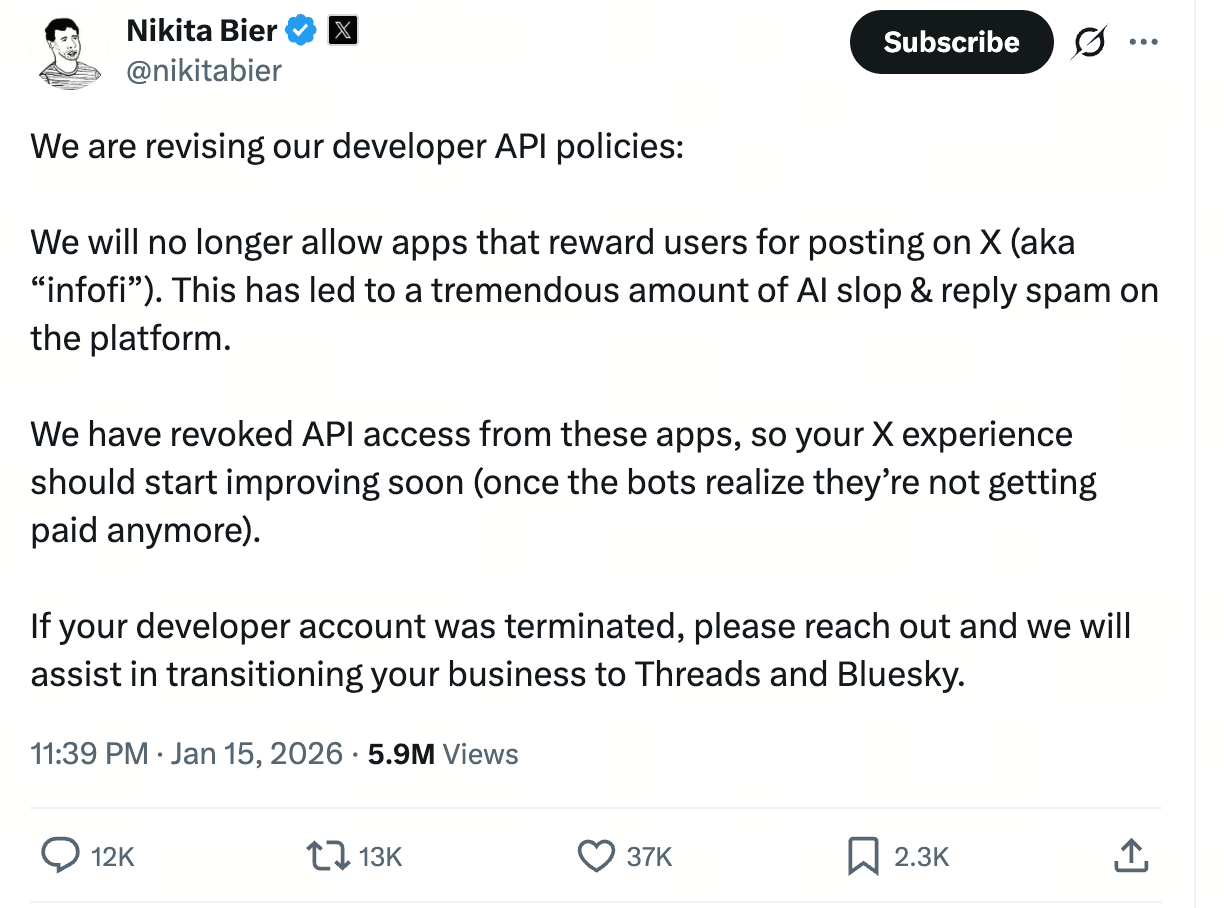
Source: X
Recent actions and new rules on X will affect the following behaviors:
Access Revocation: Any app identified as incentivizing interactions will lose API access.
Content Filtering: Tweets with specific project tags posted in bulk will have their algorithmic exposure weight reduced.
Most Impacted: Kaito and Cookie
Two leading projects are at the forefront of this sudden regulatory shift:
1. Kaito ($KAITO)
Kaito pioneered the InfoFi concept and leads the sector, relying heavily on X’s social signals to build its AI search and sentiment analysis models.
Previously, user social contributions (such as post mining) formed the core of the Kaito ecosystem. The API ban means Kaito can no longer legally collect users’ “contribution data” at scale through official channels, putting its token reward mechanism at risk of suspension.
After the new policy was announced, the team quickly issued a statement: “Kaito will gradually discontinue YAPS and incentive-based leaderboards, and introduce Kaito Studio. Kaito Studio will function more like a traditional tiered marketing platform, where brands selectively collaborate with creators based on established standards and clear project scopes. The platform will cover X, YouTube, TikTok, and other social channels, expanding its business from crypto to finance and AI. The KAITO token will continue to play a role in Kaito Studio, with more details to be released in later phases.”
Following the news, KAITO fell 21% over 24 hours and is now trading at $0.53.
2. Cookie DAO ($COOKIE)
Cookie.fun, launched by the AI-driven Cookie DAO, is an instant data dashboard initially designed to track AI-related token news. It later adopted InfoFi and released Cookie Snaps, focusing on analyzing crypto projects and key opinion leaders (KOLs), and rewarding high-quality Twitter content.
X’s new policy bans “incentivized replies,” directly disrupting Cookie’s AI agent growth strategy and stripping its AI marketing matrix of its core battleground. On January 16, the team announced, “We have decided to immediately shut down Snaps and all ongoing activities.” “We will wait for further confirmation and guidance from X to determine whether creator activities like Snaps may continue in some form in the future.”
The announcement also stated, “Over the past six months, we have been building Cookie Pro—a real-time market intelligence product for the crypto industry, scheduled to launch in Q1.”
Following the news, $COOKIE dropped 13% over 24 hours and is now trading at $0.04.
3. What Other InfoFi Projects Are Impacted?
Beyond those mentioned above, additional InfoFi sector players include:
Galxe: A crypto task distribution project with the community growth platform Starboard.
bam.fun: A decentralized creator monetization platform. Users select brand campaigns and post content according to rules; the platform tracks performance and pays out based on the Final Impact scoring system (factoring in views, follower quality, and genuine engagement).
Wallchain: A Web3 AttentionFi ecosystem that uses X Score to assess user influence. Quacks rewards high-quality content and effective engagement, evaluating users’ content dissemination and interaction quality across social platforms.
MirraAI: Participants earn NLP points or tokens for contributing high-quality content.
XHunt: An AI-driven InfoFi platform where users earn points and tokens for publishing reviews of projects and KOLs.
Conclusion
Many InfoFi projects rapidly rose by leveraging X’s vast traffic pool, even pioneering the content mining sector. Yet in the AI era, InfoFi has brought a flood of ineffective information. Today, platforms that deliver valuable information are increasingly rare. When spam saturates a platform, user experience suffers dramatically—a situation platforms cannot allow.
For InfoFi teams, building decentralized dreams on the territory of centralized giants is fundamentally fragile. Whether they can pivot to more open, decentralized protocols will determine the true future of InfoFi.