Within the Internet Computer network, users not only pay for computation but can also participate in governance decisions through the token. This means ICP is not limited to trading or storing value. Understanding how it functions provides insight into how the entire network operates.
This topic generally involves three dimensions: the fee mechanism, the governance structure, and token supply and demand. Together, these elements define ICP’s role within the Dfinity ecosystem.
What Is ICP and What Role Does It Play in the Dfinity Network
ICP is the native token of the Internet Computer network, acting as the bridge between computational resources and governance mechanisms.
At the protocol level, ICP can be converted into Cycles to pay for computation, or locked to participate in governance. This gives the token a dual role, spanning both resource consumption and decision-making.
Structurally, ICP sits at the core of the network. On one side, it connects developers and application users; on the other, it links governance systems with node incentives.
This positioning ensures that both computation and decision-making are unified under a single token system.
How ICP Is Used for Computing Fees and Resource Consumption
One of ICP’s primary uses is paying for computational resources.
Mechanically, ICP is converted into Cycles, which are used to cover computation and storage costs for Canisters. Cycles function like fuel, keeping applications running.
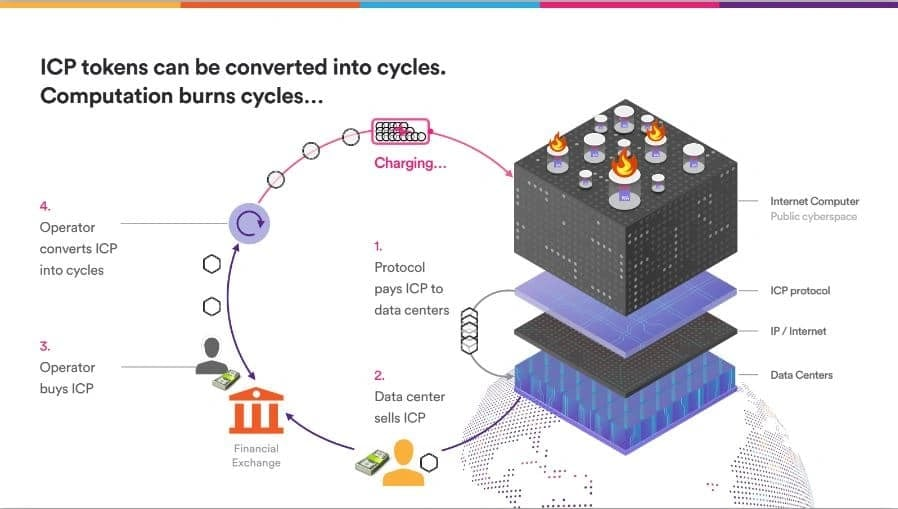
From a structural perspective, ICP and Cycles form a dual-layer model: ICP serves as the value carrier, while Cycles act as the unit of consumption. This design separates price volatility from actual resource usage.
The significance of this mechanism is that developers can operate applications with predictable costs, while ICP retains its market-based characteristics.
How ICP Is Used in Governance
ICP enables holders to participate in network governance.
Mechanically, users can lock ICP into entities called Neurons and vote on proposals. These proposals can include protocol upgrades and parameter adjustments.
Structurally, the governance system consists of proposals, voting, and execution modules, with ICP holders participating through Neurons.
This setup allows the network to evolve without relying on centralized control.
How Neurons Affect Voting Power
Neurons are the core structure within ICP’s governance system, determining voting weight.
Mechanically, when users lock ICP to create a Neuron, their voting power depends on both the amount locked and the duration of the lock. Longer lock periods result in greater voting power.
Structurally, the Neuron system ties token ownership to governance rights and encourages long-term participation through incentives.
This design improves the stability and consistency of governance participation.
How ICP Supply and Tokenomics Work
The initial total supply of ICP was 469,213,710 tokens, and its supply changes dynamically through governance rewards and resource consumption.
Mechanically, ICP does not have a fixed maximum supply. Instead, it is regulated through two processes: minting and burning. On one hand, participating in governance generates newly issued ICP as rewards. On the other, ICP is burned when converted into Cycles for computation.
Structurally, ICP’s supply system consists of three components: initial distribution, governance-based issuance, and usage-based burning. The initial allocation defines the starting structure, while ongoing supply is shaped by network usage and governance activity.
Initial ICP Distribution
| Category |
Allocation |
Description |
| Community and Governance |
50% |
Used for NNS governance, airdrops, and community incentives |
| Team and Early Contributors |
20% |
Supports core development and protocol building |
| Early Investors |
25% |
Participants in multiple funding rounds |
| Foundation and Ecosystem Support |
5% |
Used for ecosystem expansion and long-term growth |
This distribution reflects a governance-first design, with the majority allocated to community participation and incentives.
ICP Supply Dynamics
| Mechanism |
Trigger |
Impact on Supply |
| Governance Rewards (Minting) |
Locking ICP and voting |
Increases circulating supply |
| Cycles Conversion (Burning) |
Converting ICP into computation |
Decreases circulating supply |
This structure links ICP supply directly to network activity.
In practical terms, this design avoids the limitations of purely inflationary or deflationary models. When application usage increases, ICP is consumed and burned; when governance participation increases, new ICP is issued. This creates a dynamic balance between supply and demand.
Use Cases of ICP in the Ecosystem
ICP supports a variety of use cases across the ecosystem.
Mechanically, it is used to pay for computation, participate in governance, and support application operations. Both developers and users rely on ICP to access network resources.
Structurally, ICP spans the application layer, protocol layer, and governance layer, enabling collaboration among different participants within a unified system.
This creates a closed-loop ecosystem where all components are interconnected.
What ICP Means for Network Security
ICP’s design has direct implications for network security.
Mechanically, staking and locking requirements impose costs on governance participants, discouraging malicious behavior. At the same time, the resource payment model ensures that computational resources are used efficiently.
Structurally, ICP integrates economic incentives with network security, increasing the cost of attacks.
This approach enhances overall system stability through economic constraints.
Summary
By linking computation fees, governance participation, and supply dynamics, ICP establishes a token-centric operational framework that allows the Internet Computer to function sustainably in a decentralized environment.
FAQ
What are the main uses of ICP?
It is used to pay for computation, participate in governance, and support network operations.
What is the difference between ICP and Cycles?
ICP is the token, while Cycles are the unit of computational resource consumption.
How can I participate in ICP governance?
By locking ICP to create Neurons and voting on proposals.
Is ICP burned?
Yes, it is burned when converted into Cycles.
Does ICP affect network security?
Yes, it enhances security through economic incentives and constraints.







