For decades, software has stood at the heart of the digital economy. Yet, with the advent of generative AI, this paradigm is shifting.
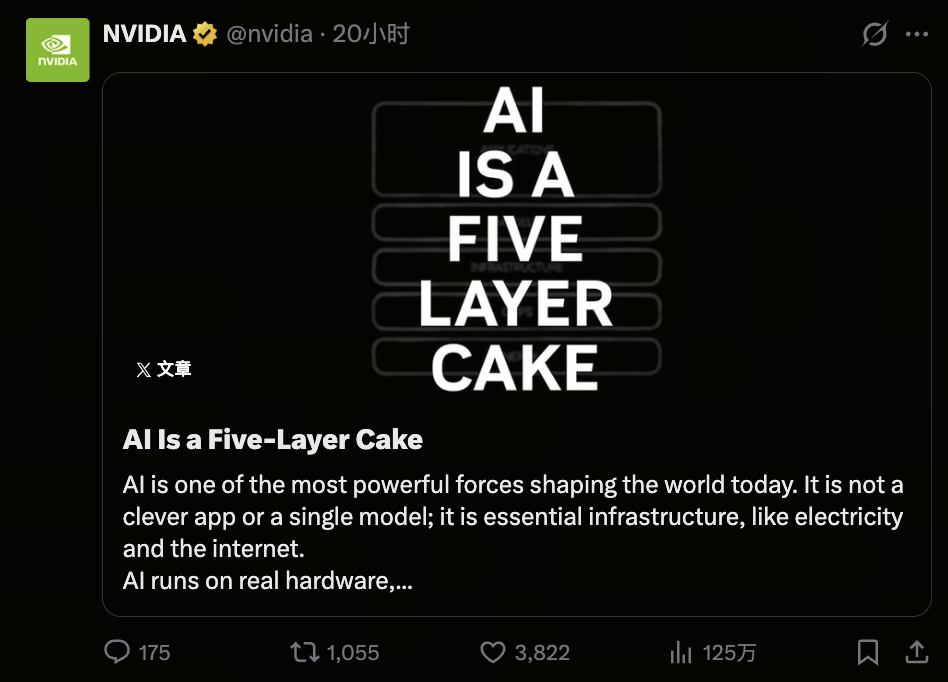 Image source: NVIDIA Official X Account
In his article “AI Is a Five-Layer Cake”, NVIDIA CEO Jensen Huang argues that AI is not merely an application or model but a new foundational infrastructure—on par with electricity or the internet in its significance.
Traditional software operates on a fixed model: developers write algorithms, computers execute instructions, and systems run according to predefined logic. This approach is known as “pre-recorded software.”
AI, however, functions fundamentally differently. Generative AI can interpret unstructured data—such as text, images, and audio—and generate responses in real time based on context. Each AI output can be a unique result, not just a static retrieval from a database.
This evolution demands a complete rethinking of the underlying computing architecture. From hardware and data centers to energy systems, the entire technology stack is being reengineered.
What Is the AI Five-Layer Architecture? Understanding the New Structure of the AI Industry
#
Jensen Huang introduces a clear and insightful framework in his article: the AI Five-Layer Architecture (Five-Layer Cake).
This architecture consists of five critical layers, from bottom to top:
Energy → Chips → Infrastructure → Models → Applications
In brief:
-
Energy: Supplies the electricity required for computation
-
Chips: Transform energy into computing power
-
Infrastructure: Data centers and compute systems
-
Models: AI algorithms and training models
-
Applications: AI products serving users and industries
This framework highlights a key insight: AI is, at its core, a complete industrial system—not just a software technology.
Energy: Why Electricity Is the Core Resource in the AI Era
At the foundation of the AI Five-Layer Architecture is energy.
Every inference and token generation in generative AI relies on real computational resources, all of which require electricity to power GPUs and servers.
In essence, AI operations follow a flow: electricity → computation → intelligent output.
As large models scale up, power demand surges. Major AI data centers may require tens of megawatts—or more—making energy a critical bottleneck for AI development.
Globally, nations are ramping up investments in data centers, power grids, and renewable energy infrastructure to meet the future AI industry's demand for compute power.
Chips: How AI Chips Shape Computing Power and Intelligence Costs
Above energy lies the chip layer.
AI chips are tasked with efficiently converting electricity into computational power. Unlike traditional CPUs, AI workloads demand massive parallel processing, high-bandwidth memory, and ultra-fast interconnects.
As a result, GPUs have become the backbone of AI computation, with companies like NVIDIA playing a pivotal role.
The pace of AI chip innovation directly impacts two crucial factors:
-
AI compute efficiency
-
The cost of intelligent generation
As chip efficiency improves, the costs of AI training and inference decline—spurring broader adoption of AI technologies across industries.
Infrastructure: Why AI Data Centers Are Called “AI Factories”
The third layer is AI infrastructure.
Traditional data centers primarily store data and run internet services, but AI data centers take on a new role: manufacturing intelligence.
Jensen Huang refers to these as AI factories.
Within these facilities, tens of thousands—or even hundreds of thousands—of GPUs are linked by high-speed networks and distributed systems to create massive compute platforms.
AI factories typically feature:
-
Large-scale GPU clusters
-
High-speed network interconnects
-
Liquid or air cooling systems
-
Power supply and energy management
-
Data storage and training systems
Their main purpose is not information storage, but the continuous production of intelligent outputs—such as model inference results or trained AI models.
Models: How Advances at the Model Layer Drive the AI Application Boom
The fourth layer is AI models.
Large language models (LLMs) have recently dominated headlines, but they represent just one category of AI models.
AI models are applied across diverse fields, including:
Open-source models play a significant role at this layer as well. For example, DeepSeek’s R1 inference model enables more developers to access advanced AI technology with lower barriers to entry.
As high-performance models become more open, innovation within the AI ecosystem accelerates dramatically.
Applications: How AI Applications Create Real Economic Value
At the top of the five-layer architecture sit AI applications. Only when AI technologies are deployed in real-world scenarios does true economic value emerge.
AI applications that have achieved product-market fit include:
-
Drug development platforms
-
Intelligent customer service systems
-
Software development assistants
-
Autonomous driving systems
-
Industrial robots
For example, autonomous vehicles are a form of “embodied AI application,” where AI is embedded in physical devices and directly engages in real-world decision-making and operations.
Looking ahead, AI applications are likely to expand into sectors such as manufacturing, healthcare, logistics, and finance.
The Industrial Significance of the AI Five-Layer Architecture: Trillion-Dollar Infrastructure Investment
The AI Five-Layer Architecture is not just a technical framework—it also signals where future industry investment will flow.
Unlike the internet, AI is a highly capital-intensive sector.
From energy infrastructure and chip fabrication to data center construction, every stage demands massive investment. As a result, the scale of AI infrastructure buildout could reach trillions of dollars.
Global trends are already emerging:
-
Accelerated construction of large-scale AI data centers
-
Continuous expansion of chip fabrication plants
-
Upgrades to power and energy systems
This may become one of the largest waves of digital infrastructure development in human history.
Open-Source Models and the AI Ecosystem: Why Models Like DeepSeek Are Changing the Industry’s Pace
Open-source models are becoming a major force propelling the AI industry. When advanced models are made open, developers can build new applications more easily, significantly expanding the reach of AI technologies. From an industry value chain perspective, this openness actually increases demand for foundational resources: more applications → more inference needs → more compute → more GPUs → more energy.
Thus, open-source AI does not diminish infrastructure companies—instead, it expands the entire AI industry.
Future Competition in the AI Era: Energy, Compute Power, and Intelligence Production Capacity
Taken together, the AI Five-Layer Architecture reveals the core logic of future technological competition. In the AI era, the true contest extends beyond model capabilities to encompass the construction of an entire industrial system, including:
AI has evolved from a pure software technology into a comprehensive industrial system. As nations worldwide ramp up investment in AI infrastructure, the sector’s development over the coming decades will profoundly reshape economic structures, employment patterns, and the trajectory of technological innovation.
AI is steadily becoming the foundational infrastructure of modern society—and this transformation is only just beginning.