As the multi-chain ecosystem continues to grow, networks like Ethereum, Arbitrum, Optimism, Base, Avalanche, Polygon, and BNB Chain are developing independent liquidity pools and user bases, making cross-chain communication a critical part of the Web3 infrastructure. [LayerZero](https://www.gate.com/learn/articles/what-is-layerzero-a-comprehensive-guide-to-the-working-principles-and-ecosystem-of-the-omnichain-interoperability-protocol/16970) leverages its **Ultra Light Node (ULN) architecture**, modular validation mechanisms, and a unified development framework to enable developers to build applications with consistent logic across multiple blockchains, significantly reducing both development and maintenance costs for cross-chain solutions.
From an industry perspective, LayerZero is paving the way for blockchains to evolve from isolated “multi-chain silos” to a true “omnichain network.” With standards like OFT (Omnichain Fungible Token) and ONFT (Omnichain NFT), assets, applications, and user states can operate seamlessly across multiple chains. This shift enables DeFi, gaming, NFT, and DAO applications to move beyond single-chain limitations, fostering a collaborative cross-chain Web3 network.
## LayerZero Omnichain Ecosystem: Expansion Status and Metrics
td {white-space:nowrap;border:0.5pt solid #dee0e3;font-size:10pt;font-style:normal;font-weight:normal;vertical-align:middle;word-break:normal;word-wrap:normal;}
| Ecosystem Dimension | Key Data / Status | Description |
| Number of Supported Blockchains | 50+ leading public chains and Layer2s | Including Ethereum, Arbitrum, Optimism, Polygon, BNB Chain, Avalanche, Base, and more |
| Cumulative Cross-Chain Messages | 100+ million | LayerZero’s core Omnichain Messaging powers cross-chain communication at the application level |
| Cumulative Cross-Chain Transaction Volume | Over $60 billion | Primarily contributed by DeFi liquidity protocols and asset bridges |
| Number of Integrated Applications | 200+ dApps | Spanning DeFi, NFT, GameFi, infrastructure, and more |
| OFT Standard Projects | Dozens of assets adopted | Omnichain Fungible Token enables unified token circulation across chains |
| ONFT Applications | Growth in gaming and NFT projects | Supports native NFT migration across chains |
| Representative DeFi Protocols | Stargate, Radiant, Pendle, Trader Joe | Pioneering omnichain liquidity and cross-chain lending models |
| NFT / Gaming Ecosystem | Heroes of Mavia, Omni X, Merkly, and more | Enabling omnichain NFT and gaming asset interoperability |
| Development Tools | LayerZero Endpoint, Omnichain SDK | Provides developers with cross-chain messaging and asset standards |
| Ecosystem Token | ZRO | Used for governance, protocol incentives, and ecosystem participation |
Since its debut, LayerZero has emerged as a leading protocol for cross-chain infrastructure, with ecosystem expansion accelerating markedly over the last two years.
LayerZero now supports **over 70 blockchain networks**, encompassing major public chains and Layer2s such as Ethereum, Arbitrum, Optimism, Polygon, Avalanche, BNB Chain, and Base. By utilizing a unified messaging layer, these blockchains achieve seamless cross-chain communication.
On-chain statistics show:
- LayerZero has processed **hundreds of millions of cross-chain messages**
- Supports **hundreds of application protocols**
- Reaches **millions of user addresses**
- Has facilitated **multi-billion-dollar cross-chain transaction volumes**
LayerZero's ecosystem spans several core sectors:
**DeFi Protocols**
- Stargate
- Radiant Capital
- Tapioca DAO
**NFTs and Gaming**
- Gh0stly Gh0sts
- OmniX
**Infrastructure**
- SushiSwap
- Hashflow
These protocols harness LayerZero’s cross-chain messaging to share liquidity and user states across different networks, laying the foundation for a robust omnichain application ecosystem.
## Dissecting LayerZero’s Core Technical Advantages for Omnichain Applications
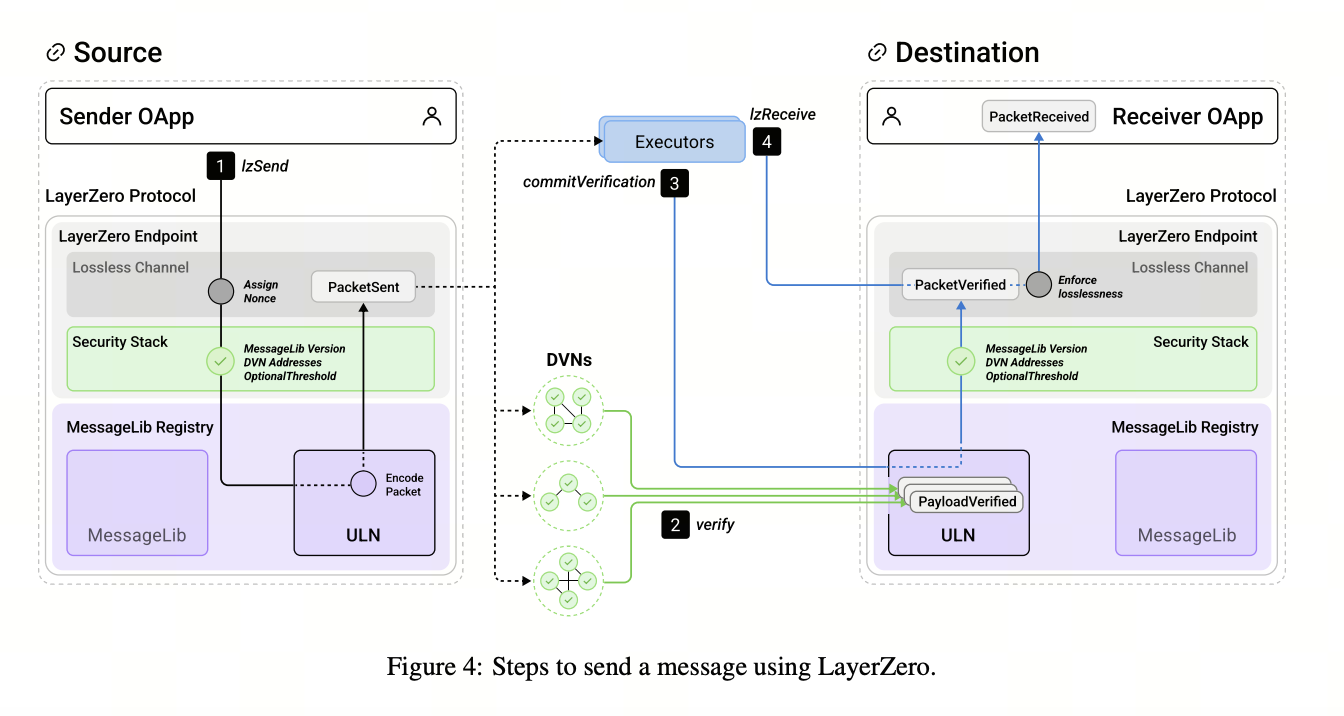
Source: LayerZero Official Documentation
LayerZero is engineered not as a conventional cross-chain bridge, but as a **Cross-Chain Messaging Protocol**. [Its architecture](https://www.gate.com/learn/articles/how-does-layerzero-enable-cross-chain-communication-a-detailed-look-at-its-architecture-and-security-mechanisms/16986) is built on three core components:
**1. Ultra Light Node (ULN)**
ULN represents a major LayerZero innovation. Unlike standard light nodes needing full remote state verification, ULN only validates essential block header information, drastically reducing on-chain costs.
Key benefits include:
- Lower gas costs for cross-chain verification
- Greater transaction efficiency
- Maintained high security
**2. Dual Validation: Oracle and Relayer**
LayerZero utilizes two independent roles for validating cross-chain messages:
- **Oracle:** Transmits block header data
- **Relayer:** Transmits transaction proofs
Only when both data sources align will a cross-chain message execute—effectively reducing single-point trust risks.
**3. Endpoint Smart Contracts**
Each LayerZero-supported blockchain deploys an Endpoint contract to send and receive cross-chain messages. Applications interact solely with the Endpoint for cross-chain operations.
This modular approach allows LayerZero to quickly scale to new blockchains.
## Use Cases: Asset Issuance Based on the LayerZero OFT Standard
OFT (Omnichain Fungible Token) is LayerZero’s cross-chain token standard for **omnichain asset issuance**.
Traditional cross-chain assets typically rely on a **Lock & Mint** model:
- Lock assets on the source chain
- Mint wrapped tokens on the destination chain
This often results in:
- Asset fragmentation
- Dispersed liquidity
- Bridge-related risks
OFT is designed to enable a single token supply across multiple chains.
The mechanism typically involves:
- Burning tokens on the source chain
- Minting tokens on the destination chain
This structure allows assets to move fluidly across chains while maintaining a unified supply. Notable adopters include:
- Stargate Finance
- Tapioca DAO
- Radiant Capital
These projects leverage OFT to facilitate cross-chain asset flows and unified liquidity.
## New DeFi Paradigms in an Omnichain World
With the advent of cross-chain protocols like LayerZero, DeFi is evolving from **single-chain applications** to **omnichain architectures**. Traditionally, each blockchain’s liquidity was isolated. For example:
- Lending protocols on Ethereum
- DEXs on Arbitrum
- Stablecoin markets on BNB Chain
This fragmentation stifles liquidity. LayerZero’s cross-chain messaging paves the way for new DeFi models:
**1. Omnichain Liquidity**
Users can access and share liquidity pools across different blockchains.
Example:
- Deposit on Arbitrum
- Borrow on Base
**2. Cross-Chain Lending**
Protocols can support collateralization and borrowing across chains.
For instance:
- Post collateral on Ethereum
- Borrow stablecoins on another chain
**3. Cross-Chain Trading**
DEXs can aggregate liquidity from multiple chains, boosting market depth. These innovations are reshaping DeFi’s liquidity landscape.
## ONFT Protocol: Unlocking Omnichain Interactivity for Web3 Gaming
Beyond DeFi, LayerZero extends cross-chain solutions to NFTs and gaming. ONFT (Omnichain NFT) enables NFTs to move natively between blockchains while preserving uniqueness. Unlike traditional cross-chain NFTs, ONFTs offer:
**1. Guaranteed NFT Uniqueness**
During cross-chain transfers, NFTs retain a unique ID via a burn-and-mint mechanism, avoiding wrapped versions.
**2. Cross-Chain Game Assets**
Game assets can be used seamlessly across games on different chains.
For example:
- Acquire NFTs on Polygon
- Use them on Avalanche
**3. Cross-Chain NFT Marketplaces**
NFTs can be traded across chain-specific marketplaces, enhancing liquidity. This design powers new Web3 gaming possibilities:
- Cross-chain characters
- Omnichain game assets
- Multi-chain game worlds
## Why Developers Choose LayerZero
LayerZero offers developers a robust cross-chain development toolkit.
Key advantages:
**1. Comprehensive Developer Tools:** Including:
- SDKs
- Documentation
- Cross-chain contract templates
Developers can rapidly launch omnichain applications.
**2. Multi-Chain Deployment**
Applications can be deployed across several blockchain networks at once.
**3. Flexible Security Model**
Developers can customize Oracle and Relayer combinations for tailored security. This modular security architecture delivers maximal flexibility.
## ZRO Token: The Backbone of the LayerZero Ecosystem
[ZRO](https://www.gate.com/trade/ZRO_USDT) is LayerZero’s native token, fundamental to protocol governance and incentives.
Core functions include:
**1. Protocol Governance**
Token holders can participate in LayerZero governance, including:
- Parameter adjustments
- Network upgrades
- Strategic ecosystem decisions
**2. Network Fees**
Some cross-chain messaging fees may be settled in ZRO in the future.
**3. Ecosystem Incentives**
ZRO can be used for:
- Developer incentives
- Supporting ecosystem projects
- Community growth
As LayerZero’s ecosystem expands, ZRO’s utility and use cases are expected to grow.
## Challenges and the Omnichain Future: What’s Next for LayerZero?
Despite LayerZero’s leading position in cross-chain infrastructure, the ecosystem faces several challenges.
**1. Cross-Chain Security Risks**
Cross-chain bridges remain a top target for Web3 attacks.
LayerZero’s dual validation mechanism enhances security, but cross-chain communication is still technically complex.
**2. Competition Among Multi-Chain Standards**
Several cross-chain solutions exist, including:
- Wormhole
- Axelar
- Cosmos IBC
Competition will continue to shape the ecosystem’s evolution.
**3. User Experience Hurdles**
Cross-chain usage remains complex due to:
- Gas fee discrepancies
- Transaction confirmation delays
- Wallet compatibility issues
Future cross-chain protocols must further streamline the user experience.
## Conclusion
LayerZero is accelerating blockchain’s evolution from fragmented multi-chain environments to a unified **Omnichain Network**. With its Ultra Light Node architecture, OFT and ONFT standards, and innovative cross-chain messaging protocol, LayerZero is establishing a new development framework for DeFi, NFT, gaming, and core blockchain infrastructure.
As more projects embrace LayerZero to build omnichain applications, the boundaries between liquidity and user bases across blockchains will continue to blur. While challenges around security, competition, and user experience persist, the shift toward omnichain applications is unmistakable—solidifying LayerZero’s role as one of the most influential cross-chain infrastructure technologies in the market today.







