As DeFi gradually shifts toward the financialization of Bitcoin, a key question has emerged: how can BTC participate in on-chain yield generation while maintaining its security properties? Lombard introduces LBTC as an intermediate asset form, enabling BiAs DeFi gradually shifts toward the financialization of Bitcoin, a key question has emerged: how can BTC participate in on-chain yield generation while maintaining its security properties? Lombard introduces LBTC as an intermediate asset form, enabling Bitcoin to be used in higher-frequency DeFi scenarios, while BARD serves as the coordination layer for incentives and value distribution.
From a broader blockchain evolution perspective, BARD functions not only as a governance or incentive token but as the core of an economic system built around BTC liquidity. By integrating asset mapping, yield distribution, and governance mechanisms into a unified token framework, Lombard is attempting to build a more scalable BTC DeFi infrastructure.
Core Functions and Utility of the BARD Token
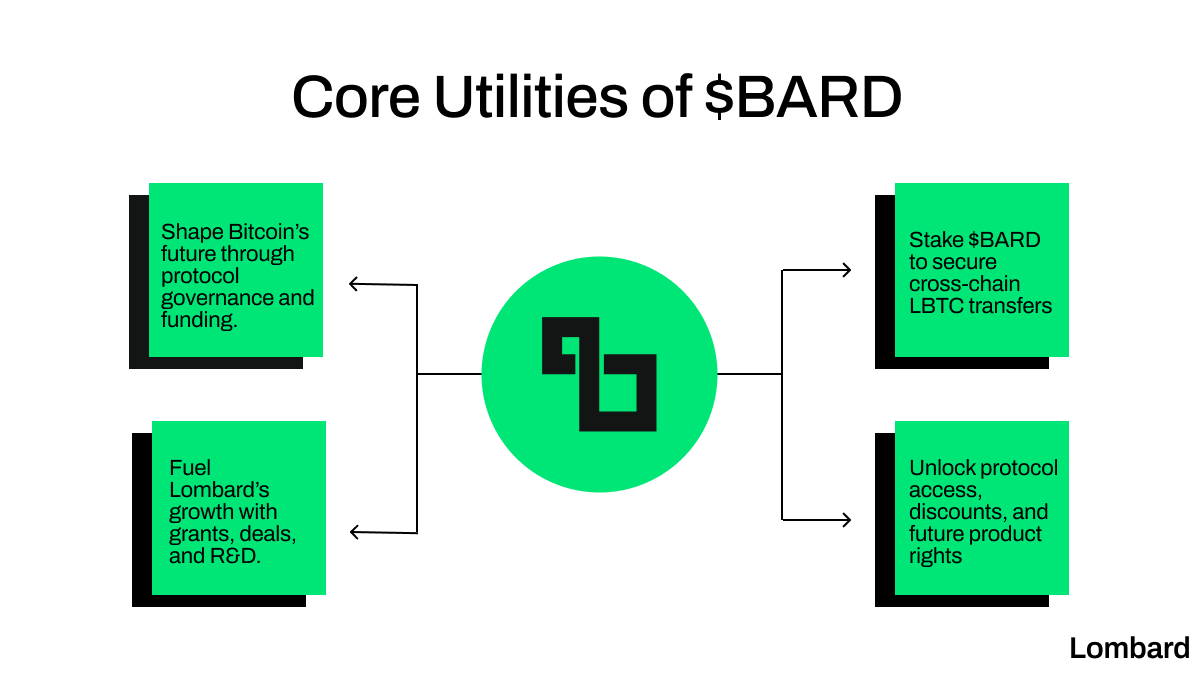
Within the Lombard protocol, BARD is not designed for a single function. Instead, it performs three core roles simultaneously: incentive tool, governance instrument, and value capture medium.
-
Incentive layer: BARD is used to reward participants in the LBTC ecosystem, including liquidity providers, strategy operators, and protocol users. This mechanism addresses a fundamental challenge in early-stage protocols: attracting sufficient liquidity and user participation.
-
Governance layer: BARD holders have decision-making power over key protocol parameters, including yield distribution ratios, collateral requirements, and risk settings. This makes BARD a central component of decentralized governance rather than a simple utility token.
-
BARD also acts as an intermediary asset in value circulation. As LBTC usage expands across DeFi scenarios, BARD becomes increasingly embedded in the protocol’s value cycle, linking incentives and governance within a unified system.
Overall, BARD’s design reflects a multi-role structure, distinguishing it from more narrowly defined DeFi tokens.
BARD Supply Model and Distribution Incentive Mechanism
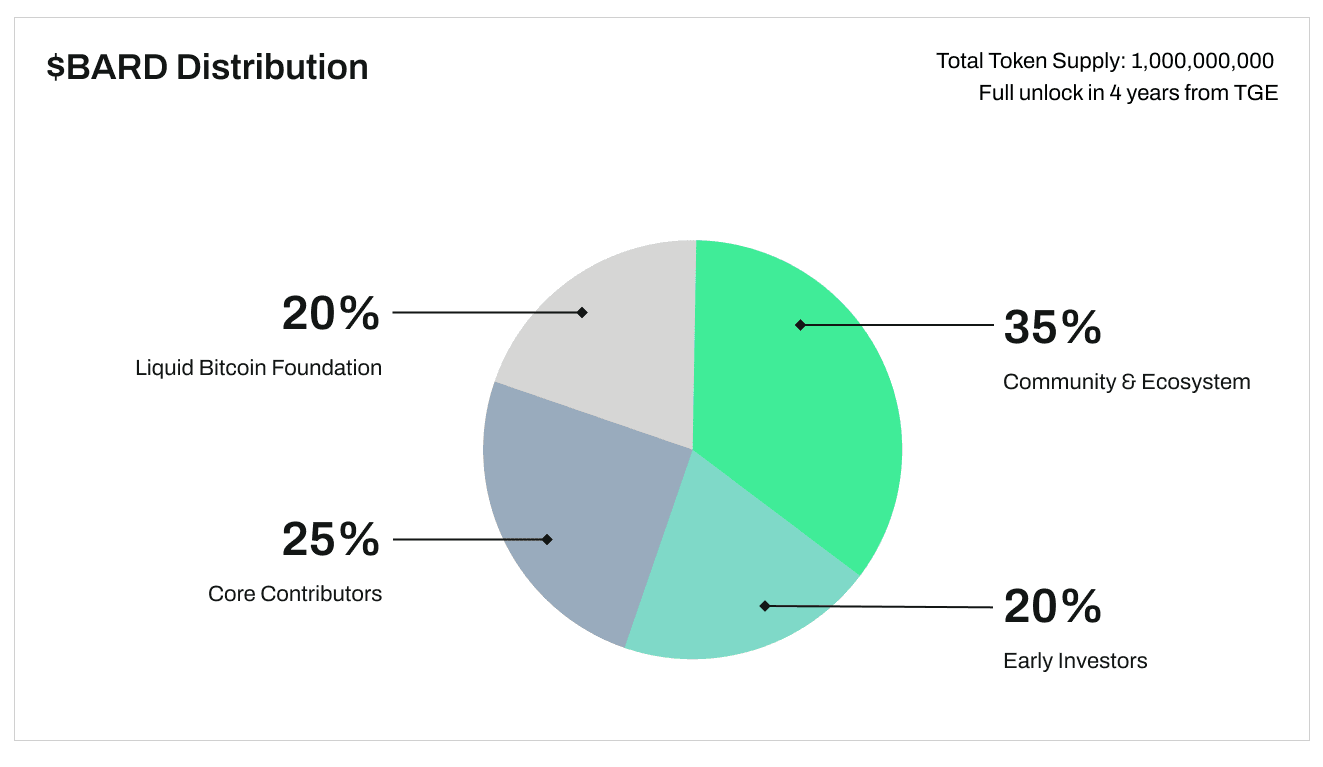
BARD adopts a fixed supply model with a total supply of 1 billion tokens (1,000,000,000 BARD). Approximately 22.5% of the supply is released into circulation at TGE, while the remaining tokens are unlocked gradually over a 48-month period. This “low initial circulation plus long-term release” structure balances early-stage incentives with long-term value stability.
From a distribution perspective, BARD is clearly oriented toward ecosystem growth:
-
Ecosystem and community: 35%, allocated to airdrops, incentive programs, and user growth
-
Core contributors: 25%, subject to a 48-month vesting period with a 12-month cliff
-
Liquid Bitcoin Foundation: 20%, used for research, development, and ecosystem resource allocation
-
Early investors: 20%, also under long-term vesting arrangements
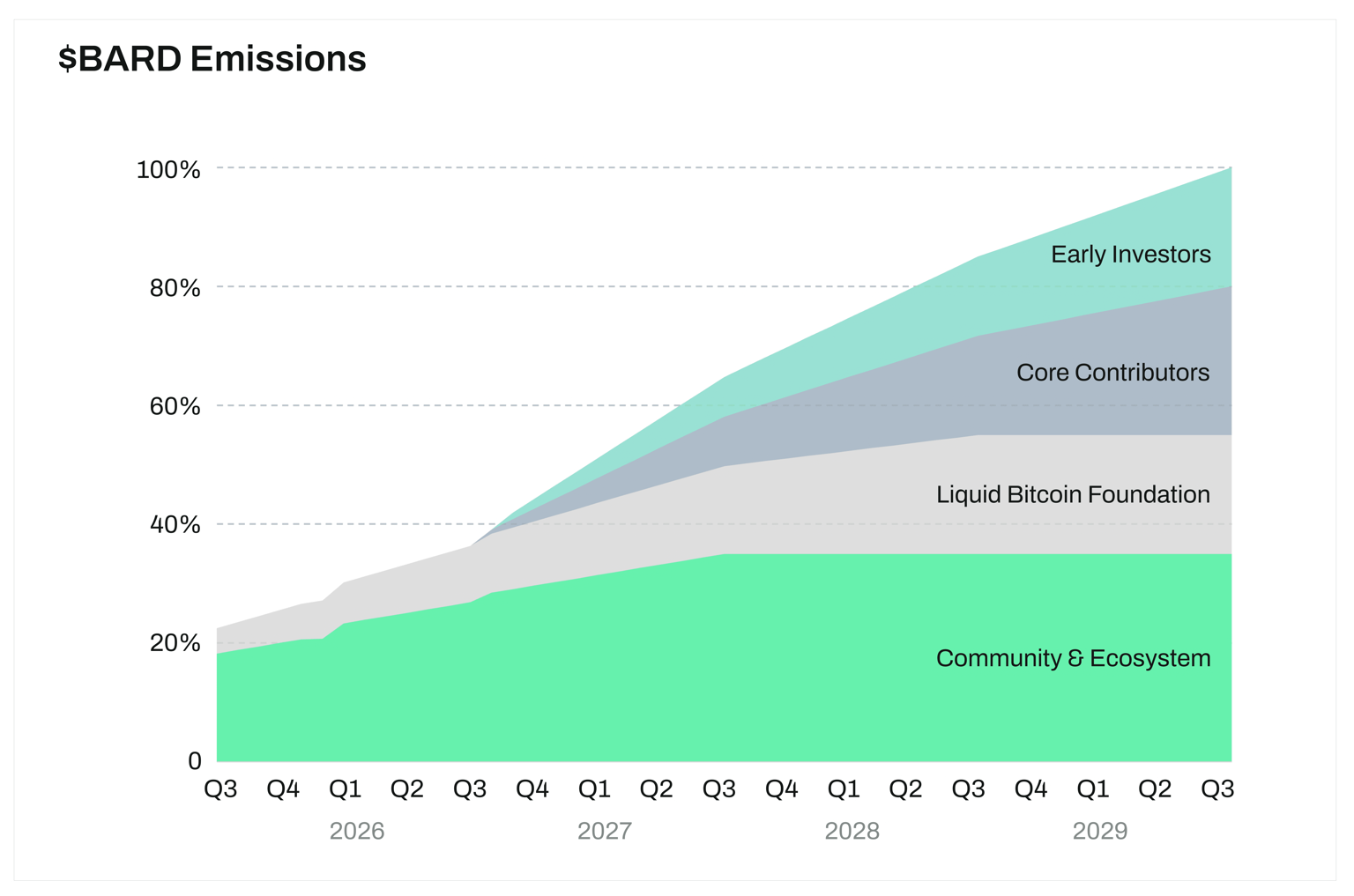
The ecosystem allocation is further divided into airdrops, ecosystem activation, community sales, and long-term development funds. This structure combines immediate incentives after TGE with linear release over 12 to 24 months, forming a dual approach of short-term activation and long-term growth.
In terms of incentives, BARD is not only distributed as rewards but also embedded into the protocol’s security and yield systems. Users can stake BARD to receive stBARD, whose value increases automatically with accumulated rewards, enabling compounding returns. These rewards are sourced from LBTC staking yields, vault fees, and protocol revenue.
More importantly, BARD staking also serves a security function. By integrating with Chainlink CCIP and the Symbiotic network, staked assets help ensure the correctness of LBTC cross-chain transfers, with penalty mechanisms triggered in case of anomalies. This positions BARD as a cryptoeconomic security layer within the protocol.
Overall, BARD’s token model creates three key linkages: release schedules tied to time, incentive distribution tied to user behavior, and security mechanisms tied to staking scale. Together, these elements form an economic system that balances growth, stability, and security.
Governance Structure: Weighted Decision-Making and Parameter Adjustment
BARD governance follows a token-weighted voting model, meaning that voting power increases with token holdings.
In practice, governance decisions typically cover several key areas:
-
Adjustments to collateral ratios and liquidation mechanisms
-
Optimization of yield distribution and fee structures
-
Introduction of new assets or strategies
-
Configuration of risk management parameters
This governance model offers advantages in efficiency and flexibility. Compared with traditional financial systems, on-chain governance allows parameter adjustments to be implemented quickly in response to market conditions.
However, weighted governance also introduces potential challenges:
-
Large holders may exert disproportionate influence
-
Short-term incentives may affect long-term decision-making
-
Low participation rates may reduce decentralization
To address these issues, some protocols introduce additional mechanisms such as vote-escrowed tokens or delegated governance to balance power distribution and efficiency.
Value Capture: Feedback Loop Between LBTC Ecosystem Expansion and BARD
The core of BARD’s value does not lie in a single function but in its feedback relationship with the LBTC ecosystem.
As a derivative asset of Bitcoin, LBTC is used in scenarios such as:
As LBTC usage increases across these scenarios, the protocol’s total value locked and overall yield levels grow accordingly. This growth feeds back into BARD through multiple pathways:
-
A portion of protocol revenue may be used for buybacks or distribution
-
Increased incentive demand drives higher BARD usage
-
Governance value rises as the ecosystem expands
This closed-loop dynamic of asset expansion, yield growth, and token value appreciation forms the core logic of BARD’s economic model.
Structurally, this model converts BTC liquidity into on-chain yield and redistributes it through token mechanisms, enabling value capture within the system.
Market Value and Long-Term Potential of BARD
The long-term value of BARD depends on two key variables: the adoption of LBTC and the protocol’s position within the DeFi ecosystem.
If LBTC becomes a widely used foundational asset in BTC DeFi, BARD may benefit from stronger demand. Conversely, limited adoption of LBTC could constrain its growth potential.
From a broader market perspective, the financialization of Bitcoin is accelerating, creating opportunities for protocols like Lombard. At the same time, competition is intensifying, including:
-
Alternative BTC staking and mapping solutions
-
Cross-chain asset bridging protocols
-
Centralized financial alternatives
As a result, BARD’s value depends not only on its internal mechanisms but also on Lombard’s competitiveness within the broader BTC DeFi landscape.
Risks and Challenges of Investing in BARD
Despite its structural advantages, BARD faces several types of risk.
First, smart contract risk remains a fundamental concern. Like all DeFi protocols, vulnerabilities or exploits could directly affect user assets.
Second, economic model risk may arise if incentive mechanisms are not properly balanced, potentially leading to excessive inflation, rapid liquidity outflows, or increased price volatility.
Third, market competition risk is significant. As the BTC DeFi sector becomes more crowded, Lombard must continue to innovate to maintain its position.
In addition, regulatory uncertainty may affect related assets, particularly those involving Bitcoin-derived instruments.
Conclusion
Lombard (BARD) represents more than a token model. It forms a complete economic system centered on BTC liquidity. By integrating incentives, governance, and value capture within a unified framework, BARD aims to balance asset utilization efficiency with protocol growth.
In the long term, its success depends on whether LBTC can establish a meaningful role within the DeFi ecosystem and whether the protocol can continue expanding its use cases in a competitive environment. In this process, BARD functions both as a driver of growth and as the primary medium of value within the system.







