Within Layer2 networks, tokens do more than facilitate payments—they're integral to resource allocation and governance design. Whether users are transacting, engaging with protocols, or providing liquidity, token interactions are central, making them a critical lens for understanding how the network functions.
Key issues span fee mechanisms, incentive structures, and governance systems—collectively shaping MNT’s role in the Mantle ecosystem.
What is the MNT Token?
MNT serves as the native utility token of the Mantle network, designed to connect network usage with economic incentives.
From a functional standpoint, MNT is used to pay transaction fees, participate in governance voting, and distribute ecosystem incentives. Every interaction on the network may involve the use or transfer of MNT.
Structurally, MNT is more than a payment instrument—it operates as both a value transfer medium and a governance tool. Its architecture makes it an essential part of the network’s operation, not just an ancillary asset.
This design positions Mantle as a token-driven economic system that seamlessly integrates technical infrastructure and economic incentives.
How is MNT Used for Transaction Fees?
The most straightforward application of MNT is transaction fee payment.
When users submit transactions on the Mantle network, they pay MNT as gas fees, compensating for execution layer resources like computation, storage, and bandwidth.
Mantle’s fee model resembles Ethereum’s, but Layer2 execution and a separate data availability layer typically result in lower costs. Fees are calculated based on transaction complexity and network conditions.
This approach manages resource consumption, maintains network stability, and provides economic incentives to participants.
How Do Incentive Mechanisms Drive Network Operations?
Incentive mechanisms are essential for network participation and long-term stability.
MNT rewards network participants—including infrastructure providers, ecosystem projects, and contributors—drawing from transaction fees or ecosystem funds.
The incentive structure aligns with Mantle’s modular architecture, distributing rewards based on each role’s contribution. For example, execution-layer resource providers and ecosystem developers occupy distinct positions in the incentive model.
This framework uses economic rewards to attract and retain participants, enhancing network activity and functional diversity.
What Role Does MNT Play in Governance?
MNT functions as a key governance instrument.
Holders of MNT participate in governance votes, influencing protocol upgrades, parameter changes, and fund allocations—decisions that are typically executed on-chain.
Governance usually operates through a DAO structure, where voting power is proportional to token holdings. This model decentralizes decision-making across the community.
With this system, Mantle sustains ongoing evolution in a decentralized environment while ensuring transparency in the decision process.
How Does the Treasury Operate in Mantle?
The Treasury is Mantle’s central vehicle for fund management.
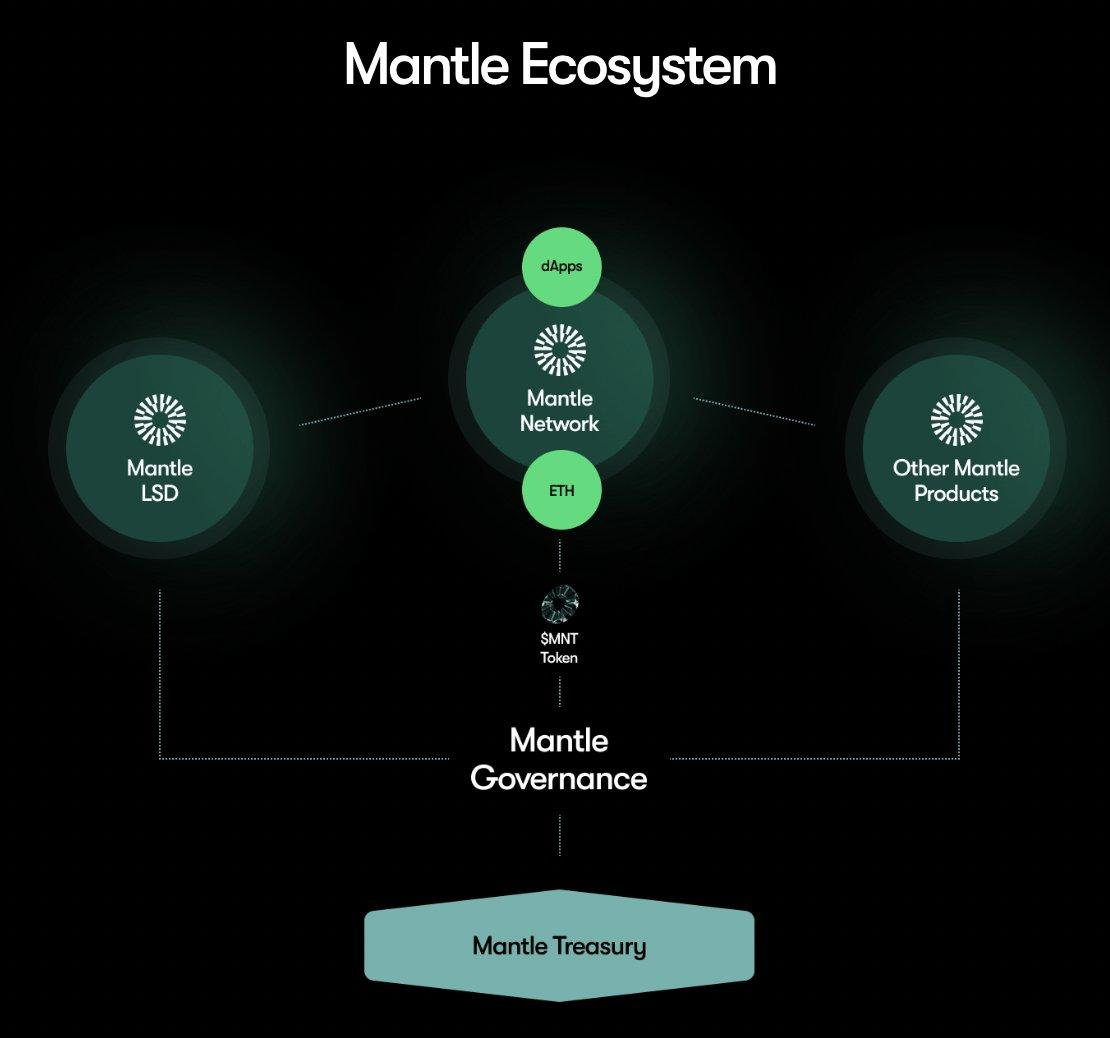
Governed by the community, the Treasury funds ecosystem development, project grants, and long-term initiatives. Its resources come from token allocations and network-generated revenue.
The Treasury is tightly integrated with governance—fund usage is subject to community votes, ensuring transparent and auditable resource allocation.
| Component |
Function |
| Fund Pool |
Stores ecosystem capital |
| Governance Mechanism |
Determines fund utilization |
| Project Grants |
Fuels ecosystem development |
| Revenue Sources |
Fees and token allocations |
This structure ensures enduring ecosystem support while preventing resource centralization.
How Are MNT’s Total Supply and Distribution Structured?
MNT’s supply model directly shapes its economic design and long-term incentive alignment.
MNT is capped at a fixed supply of 6,219,316,795 tokens, established by Mantle’s initial allocation and ecosystem integration.
Distribution is heavily weighted toward community governance and ecosystem growth, with the Mantle Treasury as the principal beneficiary for long-term funding and resource management.
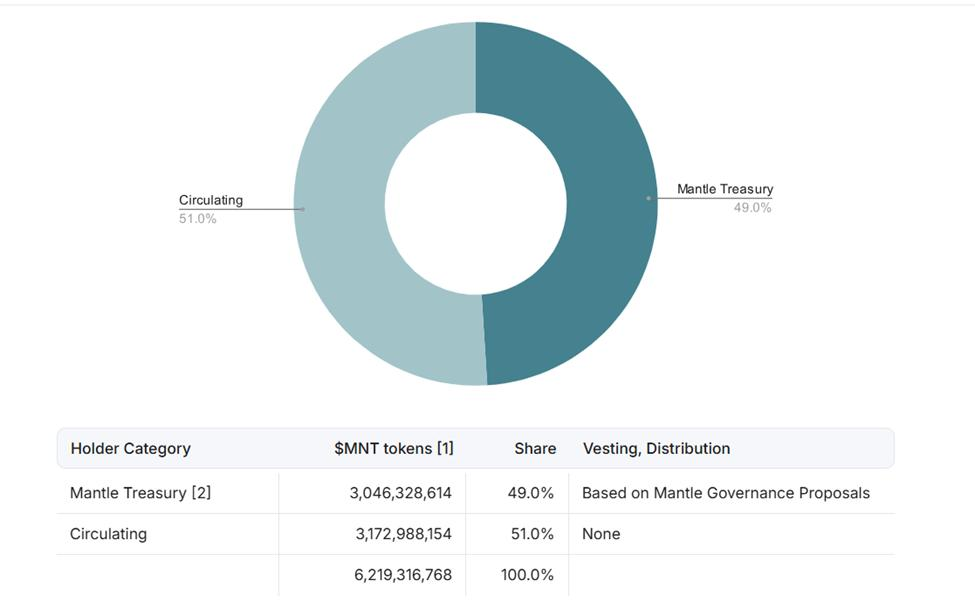
This model concentrates the majority of resources in the Treasury, allowing for dynamic, governance-driven allocation rather than one-time dispersal.
What Are the Use Cases for MNT in the Ecosystem?
MNT is utilized across multiple layers of the ecosystem.
Beyond fee payments, MNT is used in DeFi, liquidity provision, and protocol interactions. In lending, trading, and yield strategies, MNT can serve as both a medium of exchange and an incentive asset.
Its circulation connects users, protocols, and infrastructure—facilitating synergy among ecosystem components.
This versatility gives MNT multiple functional roles, enhancing its utility and the ecosystem’s overall cohesiveness.
Summary
MNT underpins Mantle’s economic system through fee payments, incentive distribution, and governance—supported by a Treasury-centric allocation model.
FAQ
What is the total supply of MNT tokens?
The total supply is approximately 6.219 billion tokens under a fixed-supply model.
Where is the largest share of MNT allocated?
Nearly half of all MNT is allocated to the Mantle Treasury, which supports ecosystem development and governance.
Will MNT become inflationary?
MNT currently operates under a fixed supply, with liquidity regulated through allocation and release mechanisms.
How can I obtain MNT?
You can acquire MNT through trading, ecosystem participation, or incentive programs.
How is MNT used in DeFi?
MNT is used for liquidity provision, collateralized lending, and protocol rewards, among other DeFi applications.