NEXO and similar tokens circulate on public blockchains like Ethereum. Multi-chain deposits and network interactions depend on robust node infrastructure and interface capabilities, enabling the platform to strike a practical engineering balance between scalable operations and access to multi-chain asset ecosystems.
Nexo has previously disclosed its partnership with Chainstack for multi-chain node and data services, and has adopted solutions such as CockroachDB at the infrastructure level to enhance high availability and resilience. Around February 2026, Bakkt announced a collaboration with Nexo, providing trading and licensing infrastructure support for Nexo’s compliant expansion into the US market. These kinds of external partnerships are also key variables for understanding the platform’s technical roadmap and the boundaries of product usability. The following analysis breaks down Nexo’s architecture, Smart Contract positioning, multi-chain support, risk control, and future directions in detail.
Nexo’s Decentralized Lending Architecture and Technology
Under the strict industry definition, “decentralized lending” refers to permissionless, on-chain liquidity pools, on-chain liquidation, and composability driven by Smart Contracts. Nexo’s core offering is more often categorized as CeFi or hybrid delivery—user assets are held and tiered by partners within a compliance framework, while core lending and asset management logic is executed by the platform’s backend business systems, risk models, and pricing engines. This is not equivalent to a fully on-chain, transparently auditable “protocol-level lending” solution.
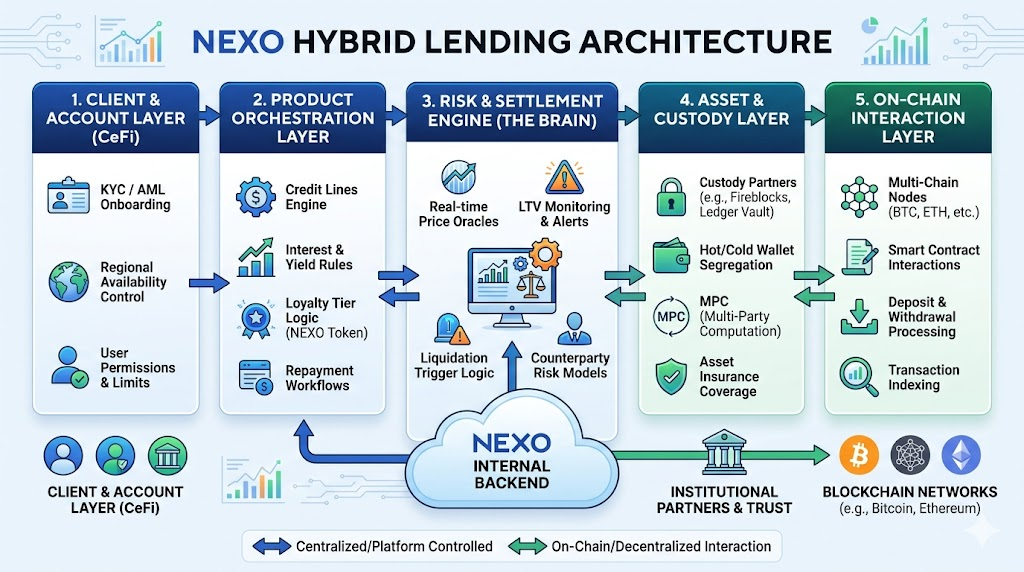
From an engineering perspective, the actual architecture is layered as follows (from user access to the underlying infrastructure):
- Client and account layer: KYC/AML, regional availability, permissions, and limits determine whether users can access lending, return, or swap modules.
- Product orchestration layer: Integrates savings, credit lines, swap, and card payment capabilities into sellable product workflows (including workflow logic, fee rates, interest calculation, and repayment rules).
- Asset and custody layer: Assets are stored using hot/cold separation and a multi-custodian model (with public references to partners like Ledger Vault and Fireblocks), and insurance provisions are added (actual coverage is subject to official legal and disclosure documents).
- Risk control and clearing/settlement layer: Dynamically manages margin calls, interest rates, and available lending limits based on collateral ratios, volatility, liquidity, and partner counterparty data.
- On-chain interaction layer: Handles on-chain requests for tokens and multi-chain deposits/transfers, node connectivity, and data indexing services.
Thus, the core technology for “user lending and asset management” is not a single “decentralized application Smart Contract package,” but a financial service pipeline built on compliance, custody, and system resilience: centralized engineering for delivery, multi-chain and tokens for ecosystem connectivity.
How Smart Contracts Enhance Lending Security and Efficiency
Within Nexo’s framework, Smart Contracts are primarily used to support on-chain tokens and standard interactions, rather than migrating the entire lending, clearing, and settlement process on-chain. Key examples include:
- ERC-20 standards and on-chain transfers for tokens like NEXO: Adhering to universal Token Standards on Ethereum enables tokens to be used in Wallets, exchanges, and various on-chain services, enhancing interoperability and liquidity. However, this does not automatically mean “fully on-chain verifiable lending contracts.”
- On-chain or hybrid governance and voting processes (depending on implementation): The token economic system can include proposals, snapshots, voting, and similar mechanisms, providing entry points for rule changes; the boundaries and effectiveness of these processes are defined by official governance documentation.
- Efficiency: For most users, if core lending does not require every action to be on-chain, the platform can perform high-frequency interest calculations, credit adjustments, and risk evaluations off-chain, resulting in lower failure rates and a more consistent user experience.
Objectively, the security of on-chain assets depends primarily on contract code audits, standard implementation, and Private Key or custody security. Nexo’s overall security is more closely tied to its custody architecture, internal controls, monitoring systems, insurance provisions, and organizational-level disaster recovery capabilities (such as multi-active databases and zero-downtime maintenance, as highlighted by public technical partners).
Smart Contracts are an important component, but not the sole definition of Nexo’s full-stack lending infrastructure.
Nexo’s Multi-Chain Asset Management and Cross-Chain Solutions
Nexo’s multi-chain capabilities typically fall into two categories:
- Multi-chain network support / multi-chain deposit and withdrawal: Provides deposit, transfer, and related service interfaces across multiple mainstream networks. High on-chain activity requires reliable nodes, archive queries, and API performance. Public disclosures indicate that, through partnerships with infrastructure providers like Chainstack, Nexo has achieved scalable operations for multi-chain node requests, archival data, and cost efficiency (the scale of requests per chain is based on public sources and subject to official disclosures).
- Pragmatic boundaries of “cross-chain”: In marketing, “cross-chain” is often interpreted as atomic swaps or bridging. In the context of custodial platforms, it typically means integrated access to multi-chain asset ecosystems and multi-network settlement within a unified account experience. Users are primarily concerned with whether withdrawals and deposits cover their target networks, confirmation times, and trading fee structures—not Smart Contract-level composability of cross-chain DEX.
How Nexo Simplifies Digital Asset Lending and Risk Control
For users, “simplification” comes from productized packaging: consolidating complex operations from traditional collateralized lending (such as coin selection, collateral ratio calculation, margin calls, cross-coin swaps, repayments, and interest rollovers) into a Unified Account with unified credit lines and a streamlined interest and repayment interface.
Risk control is the foundation of this simplified experience. Nexo’s focus areas include:
- Multi-custodian model and geographically distributed storage strategies: Engineering trade-offs between availability and security.
- Insurance and terms disclosure (as defined by official documentation): Understanding coverage exclusions is more important than memorizing marketing slogans.
- High availability and data resilience: At the infrastructure level, Nexo uses horizontally scalable distributed databases (such as CockroachDB) to support peak trading and maintenance strategies.
- Compliance models: Changes in regional policies affect product availability and risk control boundaries, making compliance a core part of the technology stack.
Future Development and Optimization Directions for Nexo’s Technology
Based on recent public information, Nexo’s optimization focus is on three main areas: compliance infrastructure, regional expansion, and engineering resilience.
- Market side: In February 2026, Bakkt announced a partnership with Nexo, highlighting the use of US market trading and licensing capabilities to support Nexo’s compliant service expansion. This will further prioritize consistent delivery within the licensing framework, deposit/withdrawal pathways, and compliance module integration.
- Infrastructure side: Multi-chain data and node services remain critical constraints for scalability and cost management. Partnerships with node providers and internal cost optimization will continue.
- Product integration: More unified accounts, higher availability, and enhanced risk control observability are crucial for custodial platforms to stay competitive.
Regarding the question of “greater decentralization,” the more relevant issue is whether the platform is improving verifiable disclosures, auditability, and user awareness of risk and permission boundaries. This is a more meaningful standard for long-term technical evolution than marketing slogans.
Summary
Nexo’s core technology path is centered on custodial digital asset financial services, with accounts, compliance models, third-party custody, risk control, and backend systems at its core—not a single on-chain lending contract as a replacement for full-stack financial infrastructure. Smart Contracts play a greater role in token standards, on-chain transfers, and certain governance or equity processes, and expectations for “fully on-chain auditable lending” should be adjusted to fit the actual boundaries.
Multi-chain capabilities: Nexo excels at multi-network access and engineering scalability, but this does not automatically equate to on-chain composable decentralization. In practice, “cross-chain” for users means integrated multi-chain deposit and settlement.
Future variables: US market infrastructure partnerships around 2026 represent a significant new external constraint and opportunity, but also signal that compliance engineering will continue to be a major focus for R&D resources.