Unlike protocols that rely solely on on-chain yield farming, NEXO’s growth is more closely tied to the availability of platform products by region, compliance communications, partner infrastructure, and genuine user engagement frequency. As a result, it’s essential to monitor both on-chain supply and circulation, as well as the effects of off-chain delivery and rule changes on demand dynamics.
According to public disclosures, Nexo emphasizes growth, loyalty, and transparency in its strategic plans around 2025. In February 2026, Bakkt announced a partnership with Nexo, providing transaction and licensing infrastructure to support Nexo’s compliance pathway in the US market. This type of market expansion and product integration will directly influence NEXO’s utility reach and the realization of tiered user benefits.
The growth logic of NEXO centers on aligning users’ asset structures (the share of NEXO in their portfolios) with the platform’s core business functions—savings, lending, swap, and payments. By increasing their NEXO allocation, users often benefit from better fee rates and higher rewards, which in turn extends asset retention on the platform and boosts cross-selling opportunities. Simultaneously, the platform may adjust incentive models via governance proposals, seeking new equilibrium among regulatory boundaries, funding costs, and user expectations.
At its core, NEXO tokenomics drives “growth and engagement” through three key mechanisms:
- Lowering usage friction: Incentivizing trading, lending, and other activities by offering discounts, rewards, and reduced overall costs.
- Raising switching costs (soft lock-in): Making the opportunity cost of leaving the platform explicit through tiered benefits, thereby enhancing user retention.
- Making major rule changes subject to voting: Leveraging governance to align community expectations with platform iteration, reducing the trust deficit from unilateral rule changes.
It’s important to note that these mechanisms do not guarantee a linear relationship between token price and platform revenue; actual outcomes depend on regional accessibility, transparency of terms, and secondary market liquidity.
Core Functions and Use Cases of the NEXO Token
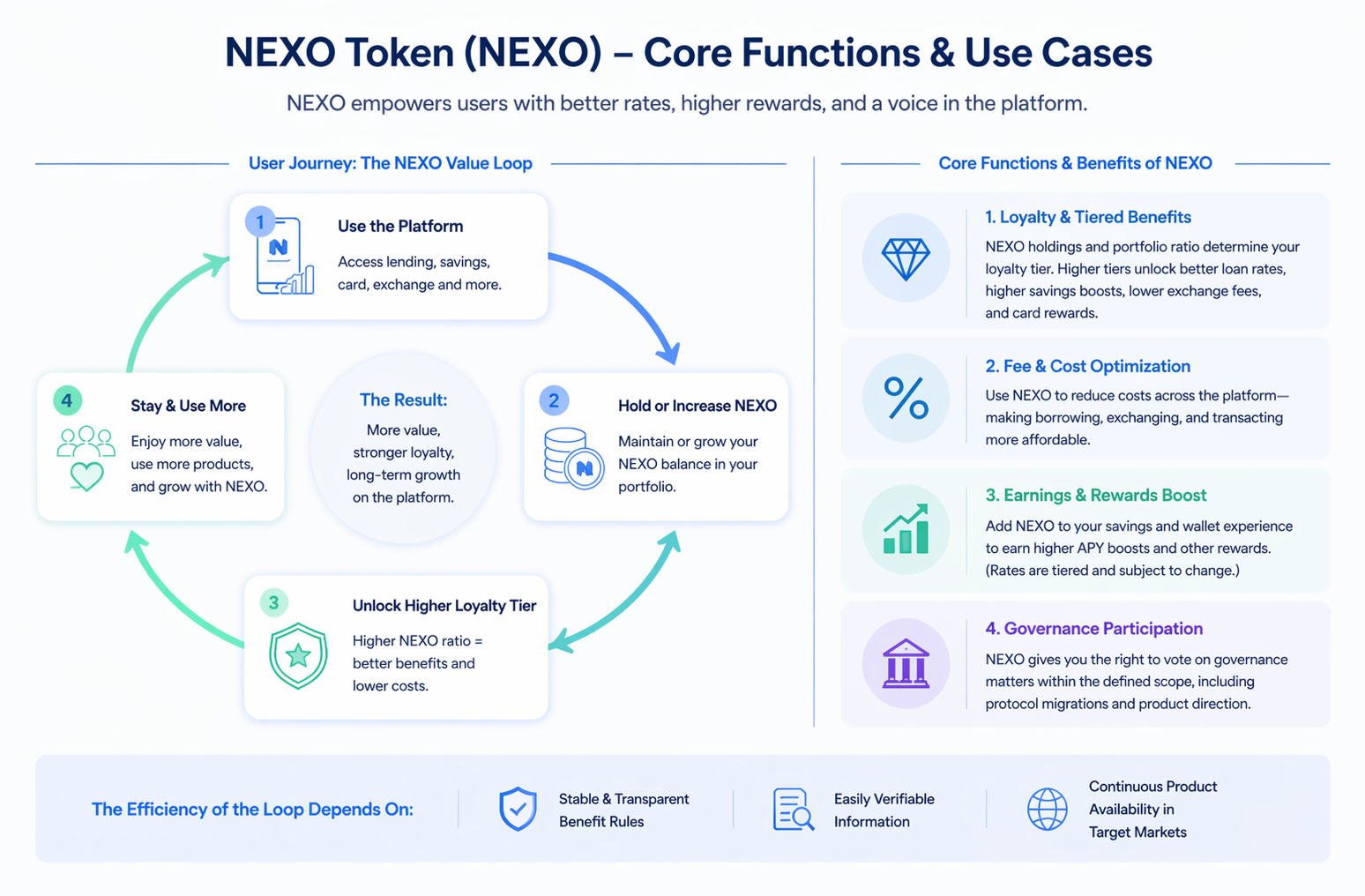
NEXO’s primary use cases fall into four categories, which together create composite account-level benefits:
- Loyalty tiers: The proportion of NEXO in a user’s portfolio determines their benefit tier. Higher tiers unlock better borrowing rates, higher savings bonuses, lower swap fees, and card-based spending rewards (subject to official product pages and regional terms).
- Fee and cost optimization: NEXO serves as leverage for more cost-effective platform usage, enhancing both frequency and retention.
- Enhanced returns and rewards: NEXO can be incorporated into savings or wallet scenarios to boost returns (typically expressed as tiered APY in public materials, subject to actual rule changes).
- Governance participation: Users can vote on mechanism changes and certain product directions within a defined scope.
From a user journey perspective, a typical closed loop is: use the platform → accumulate or hold NEXO → unlock higher tiers → become more willing to stay and expand product usage. The effectiveness of this loop depends on the stability and verifiability of benefit rules, as well as ongoing product availability in target markets.
Token Issuance, Allocation, and Incentive Mechanisms
Issuance and supply structure (industry standard):
- Maximum supply: 1 billion tokens.
- Minting: One-time pre-mint at genesis, with no ongoing PoW-style mining.
- Circulation changes: Driven by secondary market trading, potential buyback and burn (if executed and disclosed), and historical lock-up/unlock schedules (third-party data often indicates major unlocks are complete, but verification with on-chain data and official announcements is recommended).
Allocation modules (for understanding incentive focus; breakdowns may vary by disclosure):
- Investor share
- Reserve funds
- Team and founders
- Community and ecosystem
- Advisors and marketing
Key features of the incentive mechanism:
- Focus on account behavior: Balance size, transaction frequency, product mix, and NEXO holdings are linked via tiering and activity rules.
- Distinct from permissionless mining: Growth is driven more by product delivery and compliance-driven regional expansion than by increasing on-chain emissions.
According to Nexo’s public blog statements regarding 2025 growth and loyalty, the market is also closely watching the roadmap for new NEXO utilities (such as new listings, swap experience enhancements, and loyalty program updates). If these plans are implemented, they will alter demand dynamics but also introduce uncertainty in both redemption timing and rule changes.
How to Participate in NEXO Decentralized Governance
Nexo’s governance is best described as limited-scope token governance: holders vote on proposals through official channels, and results guide specific parameter or mechanism adjustments. However, key operational matters—such as custodian selection, licensing, and risk management—remain under company governance and compliance frameworks.
To participate, follow these steps (subject to the official governance page for specifics):
- Confirm holdings and snapshot rules: Determine voting eligibility (on-chain snapshot, account holdings, minimum balance, etc.).
- Review proposal materials: Focus on impacts to user funding costs (borrowing rates/returns), platform fee structure, and regional compliance.
- Vote during the designated period: Submit your vote via the supported on-chain or platform process.
- Track results and implementation: Monitor updates to savings, lending, swap, and other product rules.
A robust analytical approach maps each proposal to three variables: user funding costs, platform revenue and fee structure, and compliance/regional strategy. If incentive changes are involved, assess their secondary effects on liquidity and sell pressure in the secondary market.
NEXO Token Market Value and Long-Term Potential
NEXO’s price typically reflects crypto beta, platform business outlook, and regulatory risk premium. On the business side, public disclosures may reveal operational scale (e.g., interest distributions, lending volumes), helping gauge whether platform engagement aligns with expanding token utility.
Externally, the February 2026 Bakkt-Nexo partnership is seen as Nexo leveraging compliant infrastructure to expand bundled services—returns, credit, swap, and payments—in the US. If more users consistently adopt integrated products, the marginal value of NEXO’s tiered benefits for real users may increase, boosting the share of utility-driven holders.
For a sound assessment of long-term potential, consider:
- Product penetration: Is user growth driven by sustainable product experience rather than short-term marketing?
- Compliance cost curve: Are regional strategies actionable and predictable?
- Competitive landscape: With CeFi and DeFi coexisting, how high are user switching costs and how strong are alternatives?
- Rule credibility: Are loyalty, burn, and buyback mechanisms transparent and verifiable?
Risk and Return Analysis for NEXO Investment
Potential returns (not commitments):
- Growth in users and trading volume may raise the discounted value of tiered benefits.
- More sustainable incentives may reduce the risk of extreme rule changes.
- As risk appetite returns to the industry, the token may capture additional beta upside.
Key risks (to be proactively identified):
- Regulatory and enforcement uncertainty: Changes in product structure or regional availability can reshape demand.
- Custodian and counterparty risk: Carefully review terms, exceptions, and insurance coverage.
- Model risk: Adjustments to loyalty ratios, fees, rewards, or burn mechanisms can trigger repricing of holding incentives.
- Market and liquidity risk: Depth and volatility affect the cost of large transactions.
- Information disclosure risk: Language and regional differences may exist; legal documents take precedence.
This content is for framework discussion only and does not constitute investment advice. Make decisions independently based on your risk tolerance, investment horizon, and compliance requirements.
Summary
NEXO’s tokenomics translates platform growth metrics into actionable account-level benefits and leverages governance to update rules at key inflection points. Functionally, it focuses on loyalty tiers, fee and reward optimization, savings returns, and governance participation; on the supply side, it is primarily hard-capped and pre-minted; on the incentive side, it is driven by user behavior.
Market value and long-term potential require ongoing monitoring of business expansion (including US infrastructure partnerships around 2026) and risk premiums. Risks and returns are not symmetrical—only by considering regulation, custody, rule changes, and liquidity within a unified framework can NEXO’s role in platform growth be objectively understood.