In blockchain systems, Smart Contracts cannot directly access off-chain financial market data, so they depend on Oracles to bridge this gap. Pyth Network was developed to address this need, aiming to deliver high-frequency, low-latency, and reliable Market Price information.
Unlike conventional oracles, Pyth sources data directly from exchanges, market makers, and financial institutions—the first-party providers—rather than scraping from secondary markets. This structure closely mirrors actual market formation, making Pyth especially well-suited for Derivative pricing and High Frequency trading scenarios.
Pyth Network’s Operational Framework
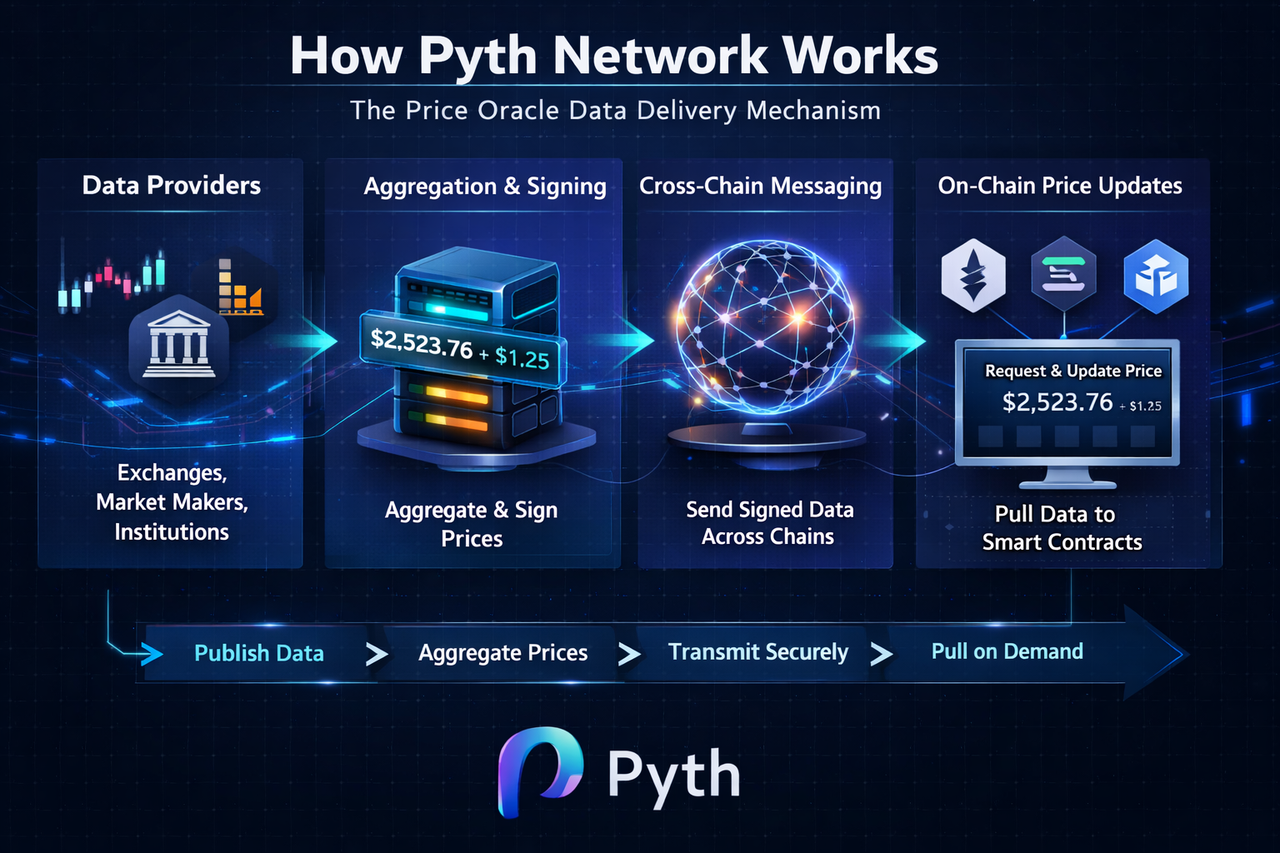
Pyth’s architecture follows a three-layer model: "data generation → data processing → data distribution." This workflow is not confined to a single blockchain; instead, it leverages both off-chain and on-chain operations.
Multiple independent institutions submit Asset prices and their fluctuation ranges directly. These inputs are processed in the network’s aggregation layer, producing a unified standard price that can be delivered to various blockchains for Smart Contract integration.
A key design principle is the decoupling of price generation from price consumption.
Pyth Network is built on a multi-source data input mechanism. Exchanges, market makers, and financial institutions participate by submitting Real Time Market Price data directly to the network.
Each data entry includes both the price and a "confidence interval," which quantifies the expected price fluctuation. This approach ensures the system remains robust even when data quality varies.
Because the data originates from direct trading participants, Pyth achieves lower latency and greater authenticity, making it more reflective of real market conditions than traditional aggregated oracles.
Pyth Network Data Aggregation: From Decentralized Offers to Unified Prices
When multiple providers submit prices, the system standardizes this information off-chain through processes such as outlier filtering, weighted computation, and confidence interval integration.
The result is a unified Market Price and its corresponding fluctuation range. This data is recorded in Pyth Network’s operational state and serves as the authoritative source for subsequent on-chain calls.
This stage is pivotal in transforming "multiple market perspectives" into "a single trusted price."
Pyth Network’s Core Mechanism: Pull Oracle Operation
Pyth Network’s defining feature is its Pull Oracle mechanism.
Unlike traditional oracles that continuously push data on-chain, Pyth retains high-frequency prices within its off-chain system. Smart Contracts request the Last Price only when needed, triggering the on-chain update.
This model shifts on-chain updates from "continuous cost" to "on-demand cost," dramatically reducing Gas consumption and enabling higher-frequency updates off-chain.
In practice, a transaction typically accomplishes two actions simultaneously: retrieving the Last Price and executing logic based on that price.
Pyth Network Data Transmission Path: From Off-Chain to Multi-Chain Systems
Pyth’s data transmission utilizes a cross-chain distribution structure, not a single-chain process.
Prices are continuously updated and aggregated off-chain, then packaged, signed, and distributed to multiple blockchain networks—such as Ethereum or Solana—via cross-chain communication.
When Smart Contracts call for price data, the system verifies the Signature and retrieves the latest price, completing the data usage cycle.
This mechanism enables Pyth to serve as a "multi-chain shared data layer," rather than a single-chain service module.
Distinguishing Push and Pull Models in Pyth Network
Traditional oracles typically use a Push model, broadcasting price updates on-chain at regular intervals. While straightforward, this approach incurs high on-chain costs, especially in high-frequency scenarios.
Pyth’s Pull model shifts the update logic to the user side, allowing data retrieval only when needed. Off-chain updates can occur at extremely high frequencies, while on-chain interactions are limited to essential moments.
This architecture delivers clear advantages in scalability and cost control.
Pyth Network’s Role in the DeFi Ecosystem
Pyth’s high-frequency price data is widely used in Decentralized Finance (DeFi) applications, including Derivative pricing, collateral valuation for lending, and Auto liquidation mechanisms.
In these settings, price latency can directly impact Risk Control logic, making Real Time data critical. Pyth’s design reduces on-chain latency, enabling Smart Contracts to make decisions based on actual Market Price.
Summary
Pyth Network’s core innovation lies in shifting oracle architecture from "continuous data push" to "off-chain high-frequency updates plus on-chain on-demand reads." This design lowers on-chain costs, increases update frequency, and enhances cross-chain scalability.
By combining data collection, off-chain aggregation, Signature verification, and cross-chain distribution, Pyth delivers a high-performance financial data infrastructure for multi-chain ecosystems, serving as a vital price information layer in DeFi applications.
FAQ
How is price formed on Pyth Network?
Prices are aggregated and calculated off-chain from data submitted by multiple independent financial institutions, with a confidence interval provided to measure volatility.
Why does Pyth use the Pull mechanism?
The Pull mechanism avoids the high costs of continuous on-chain updates and allows for more frequent off-chain data refreshes, boosting overall system efficiency.
Is Pyth’s data Real Time?
Off-chain data updates occur nearly in Real Time, but on-chain reads depend on when users initiate transactions, resulting in "on-demand Real Time."
How does Pyth ensure data reliability?
Pyth enhances data consistency and security through multi-source cross-verification, outlier filtering, and Signature validation mechanisms.
What distinguishes Pyth from traditional oracles?
Key differences include the data distribution model (Push vs Pull), cost structure, and cross-chain scalability.
Does Pyth support multi-chain usage?
Yes, Pyth’s data can be validated and utilized across multiple blockchain networks through cross-chain mechanisms.