As the blockchain ecosystem has shifted from single-chain to multi-chain architectures, the need for enterprises to share data and assets across different blockchains has grown steadily. Traditional cross-chain solutions typically focus on asset bridging, while Quant has developed a unified interoperability layer that allows enterprises to operate applications across systems without migrating or restructuring their existing technology stacks.
From a broader fintech perspective, Overledger is more than just a cross-chain technology—it is part of a multi-ledger financial infrastructure. Centered around the MApps Multi-Chain Application Mechanism, the Multi-Ledger Rollup Architecture, and the Network of Networks Model, Quant is building a new framework for cross-chain financial systems.
Fundamental Concepts of the Overledger Network
Overledger, the core technology platform of Quant, is designed to connect various blockchains and traditional financial systems. Unlike conventional blockchains, Overledger is not a standalone chain—it operates as an interoperability layer across multiple blockchains.
Overledger offers a unified API framework, enabling developers to build cross-chain applications without delving into the technical specifics of each blockchain. This approach lowers barriers for development, allowing enterprises to deploy blockchain applications faster and achieve seamless system integration.
Overledger also supports multi-chain application models, enabling a single application to connect to multiple blockchains—for example, executing transactions on a public chain while storing data on a private chain. This architecture gives applications greater flexibility and accelerates the evolution of multi-chain financial system architectures.
As enterprise demand for blockchain interoperability grows, Overledger is becoming an essential technology layer linking traditional finance and blockchain networks.
Source: Medium
Quant’s Multi-Layer Blockchain Architecture
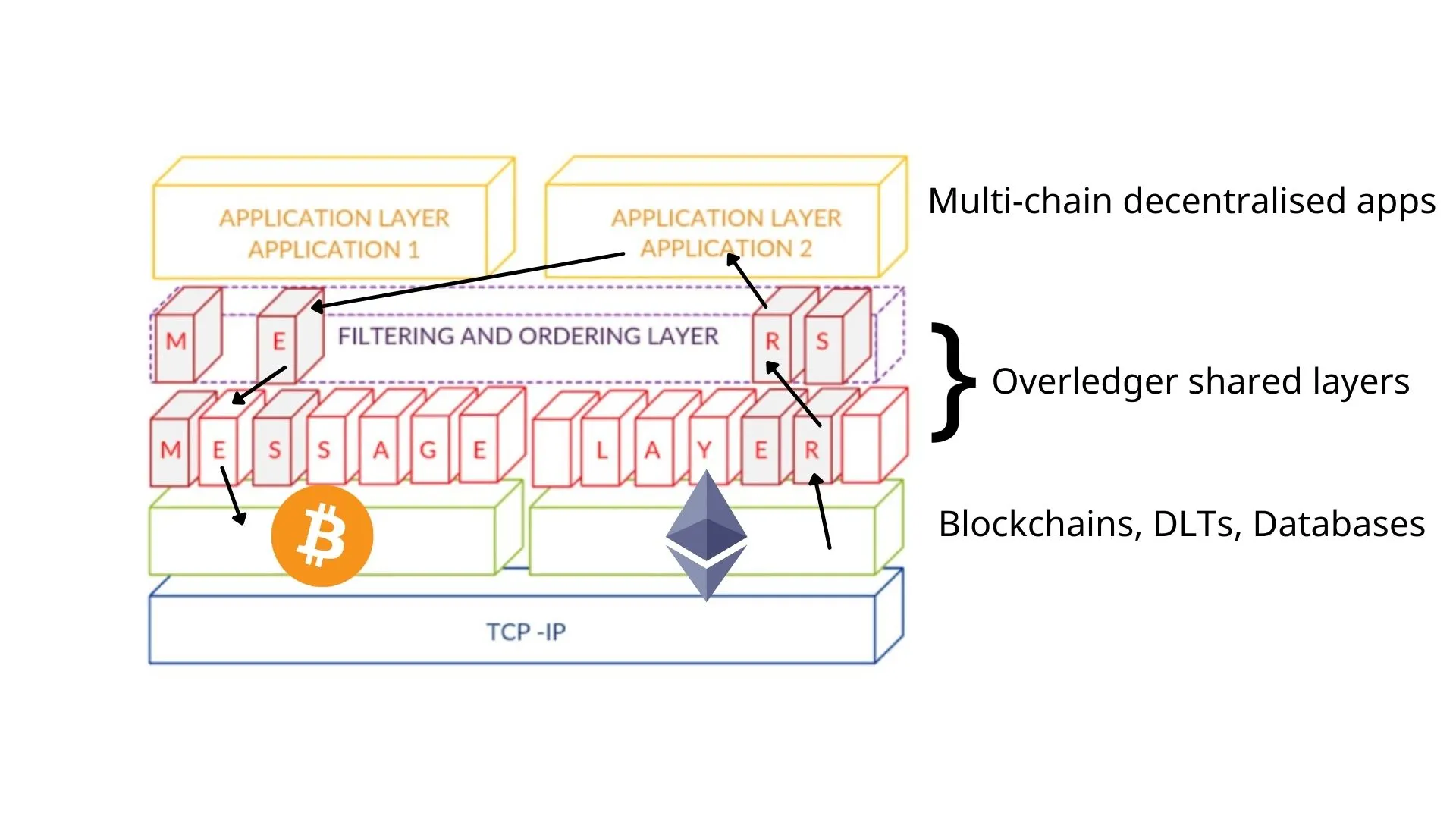
Quant’s technical architecture features a multi-layer design that enables different systems to operate collaboratively. The architecture consists of the application layer, interoperability layer, and blockchain layer.
At the application layer, enterprises can deploy financial applications such as payment systems, asset tokenization platforms, or multi-chain DeFi solutions. These applications connect to various blockchain networks through Overledger.
The interoperability layer, powered by Overledger, manages cross-chain communication and data transformation. This layer standardizes data formats between blockchains and executes cross-chain operations.
The blockchain layer encompasses multiple public and private chains, including internal ledgers for financial institutions, public networks, or enterprise systems. With this multi-layer approach, Quant has built a multi-ledger interoperability network that allows different systems to operate within a unified environment.
This structure is especially important for financial institutions, as banks often need to interact with multiple systems and networks simultaneously.
How Overledger Connects Different Blockchains
Overledger links different blockchains and enterprise systems via an API gateway. When an application sends a request, Overledger interprets it and routes it to the appropriate blockchain.
Unlike conventional bridges, Overledger does not require asset lock-ups or wrapped tokens. Instead, it enables data and logic interoperability, thereby reducing cross-chain risk. This method is particularly well-suited for enterprise environments.
Overledger also supports cross-chain transaction execution. For example, one application can execute a Smart Contract on one chain while storing data on another—an approach known as the multi-ledger execution model.
By connecting systems in this way, Quant enables cross-chain communication while maintaining the independence of each blockchain, enhancing overall scalability.
MApps Multi-Chain Application Mechanism
Quant introduces MApps (Multi-Chain Applications), allowing applications to run across multiple blockchains. Unlike single-chain apps, MApps can simultaneously access resources from several blockchains.
For example, a financial application can store assets on a highly secure chain while executing trades on a high-performance chain. This structure enhances both efficiency and security.
MApps also support enterprise-grade financial applications. Banking systems, for instance, can connect to multiple payment networks and blockchains, delivering unified financial services.
As the multi-chain ecosystem expands, MApps have become a core component of Quant’s architecture, fueling the growth of cross-chain applications.
Overledger vs. Traditional Bridges
Traditional bridges are primarily used for asset transfers, while Overledger emphasizes system interoperability. Bridges usually require asset lock-ups and the creation of wrapped tokens, which introduce security risks.
Overledger connects blockchains through API-based interoperability, eliminating the need for asset lock-ups. This design improves system security and is better suited for enterprise applications.
Additionally, bridges typically link only a limited number of blockchains, whereas Overledger can connect a wide range of systems, including enterprise and financial networks.
As a result, Overledger functions as enterprise-grade interoperability infrastructure, while bridges are mainly asset transfer tools.
Enterprise Access to Overledger
Quant provides a suite of enterprise-grade products that allow institutions to access the Overledger network, including:
Quant Flow
Quant Flow is an API platform for programmable payments, enabling banks and payment providers to automate financial workflows. The system supports event-triggered payments, risk management, and compliance controls.
Quant Flow also automates account processes, allowing institutions to manage complex fund flows and boosting overall financial system efficiency.
QuantNet
QuantNet is designed for tokenized asset settlement. Financial institutions can use QuantNet to transfer digital assets between different systems.
QuantNet adopts the ISO 20022 standard, so various financial systems can use a unified message format. This reduces integration costs.
Quant Fusion
Quant Fusion is Quant’s next-generation interoperability architecture, created to connect public chains and permissioned networks. Fusion has two main components:
Multi-Ledger Rollup
Multi-Ledger Rollup is an advanced rollup architecture that supports simultaneous execution and settlement across multiple Layer1 blockchains, combining:
-
Public chain transparency and decentralization
-
Private chain privacy and performance
-
Enterprise-grade access control
This structure enables multiple blockchains to operate in a unified environment, supporting multi-chain financial systems.
Network of Networks
Network of Networks lets users connect their own blockchains or nodes and join the Fusion network. Participants can set access permissions and control data sharing scopes.
This model creates a modular blockchain network, allowing different systems to interconnect while preserving privacy and security.
Fusion also supports:
These features further expand Quant’s interoperability ecosystem.
PayScript
PayScript is a financial automation tool from Quant that allows enterprises to define fund flow rules.
PayScript supports:
-
Auto payments
-
Conditional transactions
-
Complex fund management
With PayScript, enterprises can implement automated financial logic without complex programming.
Summary
Quant’s Overledger network is an enterprise-grade cross-chain interoperability layer that connects multiple blockchains and financial systems through APIs. With products like Quant Flow, QuantNet, and Quant Fusion, Quant has built a robust multi-chain financial infrastructure.
As the multi-chain ecosystem matures, the need for interoperability continues to rise. Quant’s Overledger offers a unified solution, enabling enterprises to run applications across multiple blockchains and accelerating the evolution of digital financial systems.
FAQ
Is Overledger a blockchain?
No, Overledger is not a blockchain—it is an interoperability layer that connects multiple blockchains.
What is the relationship between Quant Fusion and Overledger?
Fusion is a multi-chain execution framework built on top of Overledger.
What are MApps?
MApps are multi-chain applications that run across several blockchains.
Does Quant support enterprise systems?
Yes, Quant specializes in enterprise-grade interoperability solutions.
What is the purpose of the QNT token?
QNT is used to pay network fees and for node staking.







