Unlike traditional fixed inflation models, Fabric has introduced a dynamic emission logic: the production of ROBO depends entirely on the volume of Verified Tasks within the network. Combined with a protocol fee-burn mechanism similar to EIP-1559 and veROBO governance staking, the ecosystem achieved a preliminary supply-demand equilibrium by early 2026. As multiple leading global humanoid robot manufacturers integrate the OM1 operating system, ROBO is evolving from a mere incentive tool into a “hard currency” anchored to global automated productivity.
In the long run, the value of ROBO lies in its paradigm innovation of “Asymmetric Value Capture.” It breaks the monopoly of traditional AI profits by a few tech giants, allowing hardware owners, algorithm developers, and data providers to fairly share in the dividends of automation through a decentralized labor market.
The Role of ROBO Within the Network
Within the Fabric Protocol ecosystem, ROBO serves multiple essential functions that keep the robotic network operating smoothly.
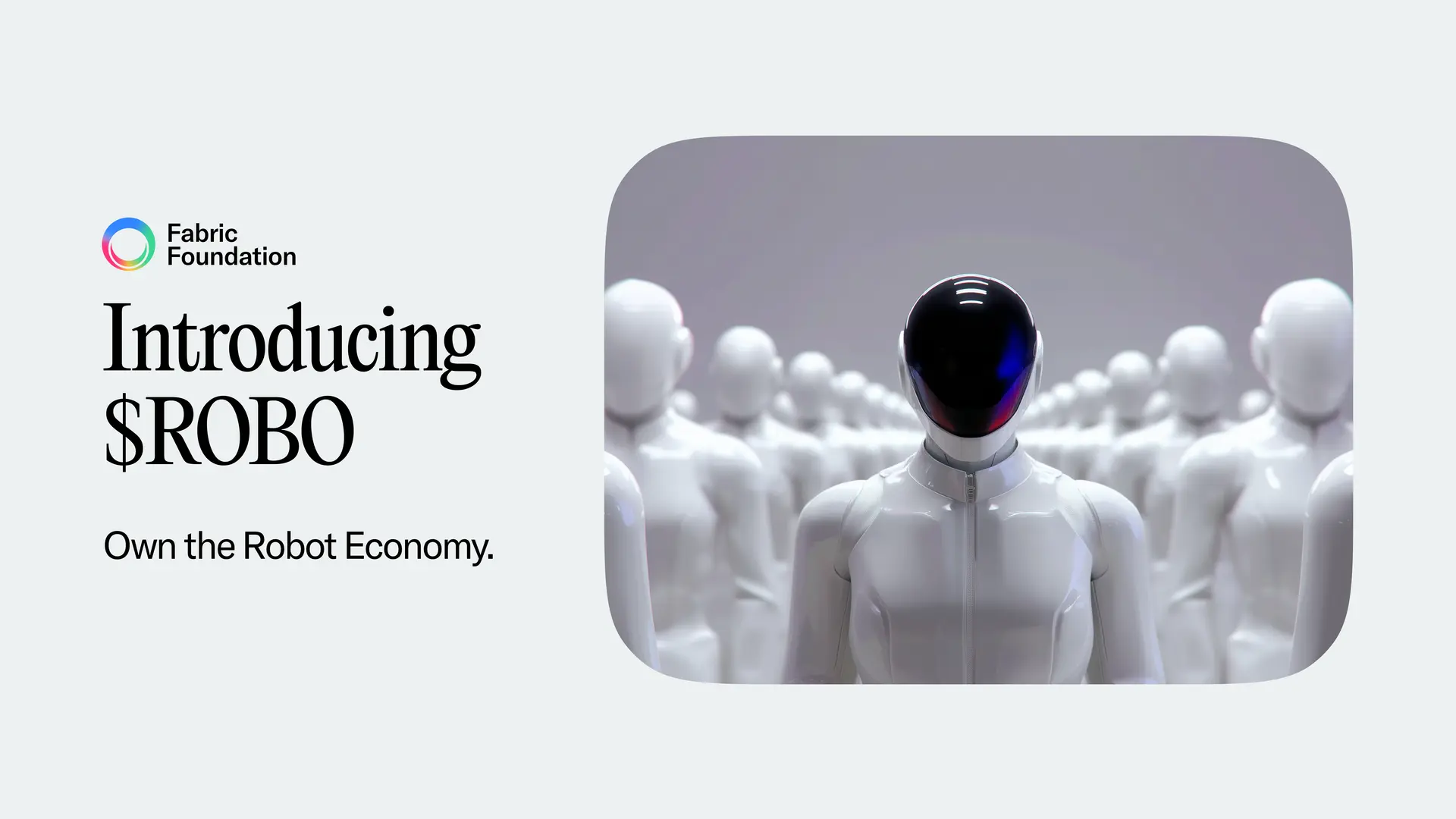
- It is used to pay network fees, including transaction costs, identity verification, and task confirmation. All data exchanges and API calls between robots are settled in ROBO.
- It supports staking mechanisms. Users or developers can stake ROBO to access coordination features such as robot task allocation and priority services.
- It acts as a governance tool. By locking ROBO into veROBO, holders can participate in decision making and influence fee adjustments and protocol upgrades.
- Developers building dApps must hold ROBO to obtain skill chips or access delegated system permissions.
Together, these functions form a closed loop: tasks generate costs → ROBO circulation → staking incentives to participate. In effect, ROBO operates like the lifeblood of the ecosystem, continuously driving network activity.
ROBO Supply and Allocation Logic
ROBO is the native token of Fabric Protocol and is designed to coordinate economic relationships among robots, developers, and ecosystem participants. Its structure enables robots to pay fees on-chain, verify identity, participate in network coordination, and earn rewards by completing tasks. This creates a sustainable economic loop for machine driven activity.
The total supply of ROBO is capped at 10 billion tokens. The detailed allocation breakdown is as follows:
| Allocation |
Percentage (%) |
Release Schedule |
| Investors |
24.30% |
12-month cliff, followed by 36-month linear vesting |
| Team and Advisors |
20.00% |
12-month cliff, followed by 36-month linear vesting |
| Foundation Reserve |
18.00% |
30% released at TGE, remaining portion linearly vested over 40 months |
| Ecosystem and Community |
29.70% |
30% released at TGE, remaining portion linearly vested over 40 months; includes Proof of Robotic Work rewards |
| Community Airdrop |
5.00% |
100% released at TGE |
| Liquidity Provision and Bootstrapping |
2.50% |
100% released at TGE |
| Public Sale |
0.50% |
100% released at TGE |
ROBO Token Functions and Use Cases
As the core functional asset within the Fabric Protocol ecosystem, ROBO supports network payments, identity verification, coordination mechanisms, and governance decisions. It is not only the operational fuel of the protocol but also a foundational credential for participating in the ecosystem.
ROBO is designed to align economic incentives and collaboration between robots and human participants in a decentralized environment, supporting the long term sustainability of open robotic infrastructure.
Network Fees and Settlement
ROBO functions as the native payment instrument for all on chain interactions within the Fabric network. It is used for robot identity registration, transaction fees, task coordination, and validation costs. Since robots cannot open bank accounts or hold traditional identities like humans, an on chain payment mechanism is essential for enabling cooperation and service exchange. This gives ROBO intrinsic settlement value within the protocol.
Coordination Mechanisms and Node Participation
The protocol’s decentralized coordination system relies on ROBO staking to participate in robot network initialization and task distribution. Token holders gain weighted priority by staking ROBO, qualifying them to engage in robot deployment, task allocation, and access to protocol features. During both the initial operational phase and long term collaborative tasks, staking serves as a key mechanism for coordination and contribution ranking.
Ecosystem Access and Developer Participation
As the Fabric network and robot adoption expand, developers and other ecosystem participants must acquire and stake ROBO to enter the ecosystem, access robot teams, build applications, and utilize protocol resources. This structure tightly aligns participants with the protocol’s success while providing incentives such as task completion rewards, data contribution compensation, and skill development rewards.
Decentralized Governance
ROBO also grants holders the right to participate in protocol governance. This includes proposing and voting on fee structures, operational policies, and ecosystem parameters. Governance ensures that protocol rules evolve through collective decision making among decentralized participants, preserving openness and transparency while preventing any single entity from dominating the network’s direction.
Potential Market Dynamics
A portion of protocol revenue may be used to repurchase ROBO on the open market, potentially supporting token demand. As ecosystem activity and robot interactions increase, this dynamic could contribute to sustained demand. However, it ultimately depends on overall network adoption and economic activity.
How Do Incentives Drive Robotic Network Growth?
The incentive framework ties rewards to real contributions through Proof of Robotic Work, encouraging sustainable network expansion.
- Users stake ROBO to coordinate robot tasks and receive ROBO rewards after successful verification.
- Developers who contribute skill chips, such as engineering or medical modules, gain allocation weight within the ecosystem.
How Does Tokenomics Influence Protocol Governance?
ROBO’s economic model shapes protocol decisions through the veROBO governance system. By locking ROBO into veROBO, participants gain voting power, with longer lock periods granting greater influence.
- Holders vote on fee rates, network parameters, security safeguards, and skill standards. Staking requirements align participants’ interests with the network.
- Adaptive issuance responds to usage levels, and governance can adjust controller thresholds to maintain a dynamic balance between supply and demand.
How to Buy and Trade ROBO Tokens?
ROBO has announced listings on centralized exchanges such as Coinbase, Kraken, and Gate. If you plan to purchase and trade ROBO on Gate, you can follow these steps:
- Open the Gate platform and log into your account. If you have not registered, complete registration and basic security setup first.
- On the Gate trading page, enter “Fabric Protocol” in the search bar and select the relevant project page.
- Review the ROBO project overview, official documentation, platform announcements, and risk disclosures.
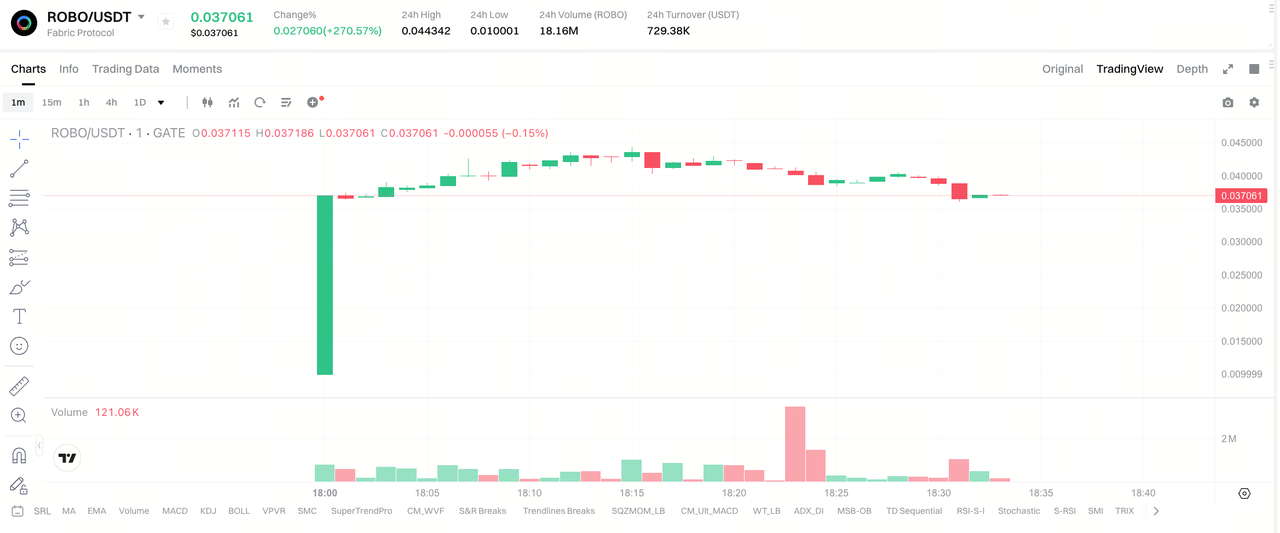
- Scroll down to view market data, including price trends, trading volume, and historical performance.
- Enter the spot or futures trading interface for the token, confirm the trading rules, and decide whether to participate. Specific features are subject to the actual Gate platform interface.
Potential Risks of ROBO
As a token tied to an emerging protocol, ROBO faces several uncertainties.
- The network depends on robot adoption. If hardware integration or developer ecosystem growth slows, usage demand may fall short, leading to fluctuations in fee revenue.
- While adaptive issuance offers flexibility, parameter adjustments rely on accurate governance decisions. Misconfigured thresholds could amplify supply instability.
- Technical risks include smart contract vulnerabilities, identity verification failures, or cross chain migration issues, such as transitions from Base to L1. Proof of Robotic Work mechanisms must also guard against fraudulent contributions.
- Fabric Protocol remains in its early stages. Initial token liquidity driven by community airdrops may introduce volatility.
- The protocol’s real world deployment depends on off chain activity rather than purely on chain mechanisms. External factors such as hardware failures or market sentiment may pose additional risks.
Conclusion
Overall, the ROBO token supports the decentralized operation of the Fabric Protocol robotic network through its multifunctional design, adaptive supply structure, and governance incentives. Its architecture deeply integrates machine economies with blockchain infrastructure: payments drive task settlement, staking secures coordination priority, and veROBO enables long term governance, forming a sustainable economic loop.
ROBO emphasizes real contributions over fixed emissions. With a total supply of 10 billion tokens allocated in a community oriented structure, including 29.7% for ecosystem development and 5% for airdrops, and rewards distributed through Proof of Robotic Work, the protocol aims to move from data monopolization toward open collaboration.
FAQs
What Is ROBO?
ROBO is the native utility token of Fabric Protocol. It is used for payments, staking, and governance within the robotic network, supporting on-chain identity verification and task coordination.
What Is the Total Supply of ROBO?
The total supply of ROBO is fixed at 10 billion tokens. Circulating supply adjusts dynamically through adaptive issuance mechanisms based on network usage.
What Are ROBO’s Main Functions?
ROBO is used to pay network fees, stake for access to coordination mechanisms, lock into veROBO for governance participation, and obtain developer skill chips.
How Does Fabric Protocol Allocate ROBO?
According to the official announcement, in the distribution of ROBO tokens, the ecosystem and community account for 29.7% (30% of TGE released), investors account for 24.3% (12-month cliff), the team accounts for 20%, and 5% of TGE is airdropped, emphasizing a community-oriented approach.