Within Web3 data infrastructure, both Sentio and The Graph play important roles in processing on-chain data, but they are built with different goals in mind. The Graph focuses more on structured queries for blockchain data, while Sentio emphasizes real time data indexing and monitoring. That difference shapes how each is positioned in terms of use cases and developer experience.
For protocols that need to respond to on-chain events immediately, indexing speed and monitoring capabilities are critical. For applications that need to query historical data or aggregate information, flexible data interfaces matter more. That is why Sentio and The Graph, although both are Web3 data protocols, are designed for different types of data needs.
Sentio vs The Graph: Positioning and Core Differences
As a Web3 focused real time on-chain data infrastructure platform, Sentio mainly provides real time data indexing, visual analytics, and automated alerting. Its core goal is to help developers capture on-chain events quickly and turn raw data into actionable information, supporting scenarios such as protocol monitoring, risk warning, and operational analysis.
Compared with traditional on-chain data protocols, Sentio’s biggest distinguishing feature is its emphasis on real time performance. In other words, when an on-chain event occurs, the system can quickly complete the listening, parsing, and output process, then sync the result to a visualization panel or alerting system.
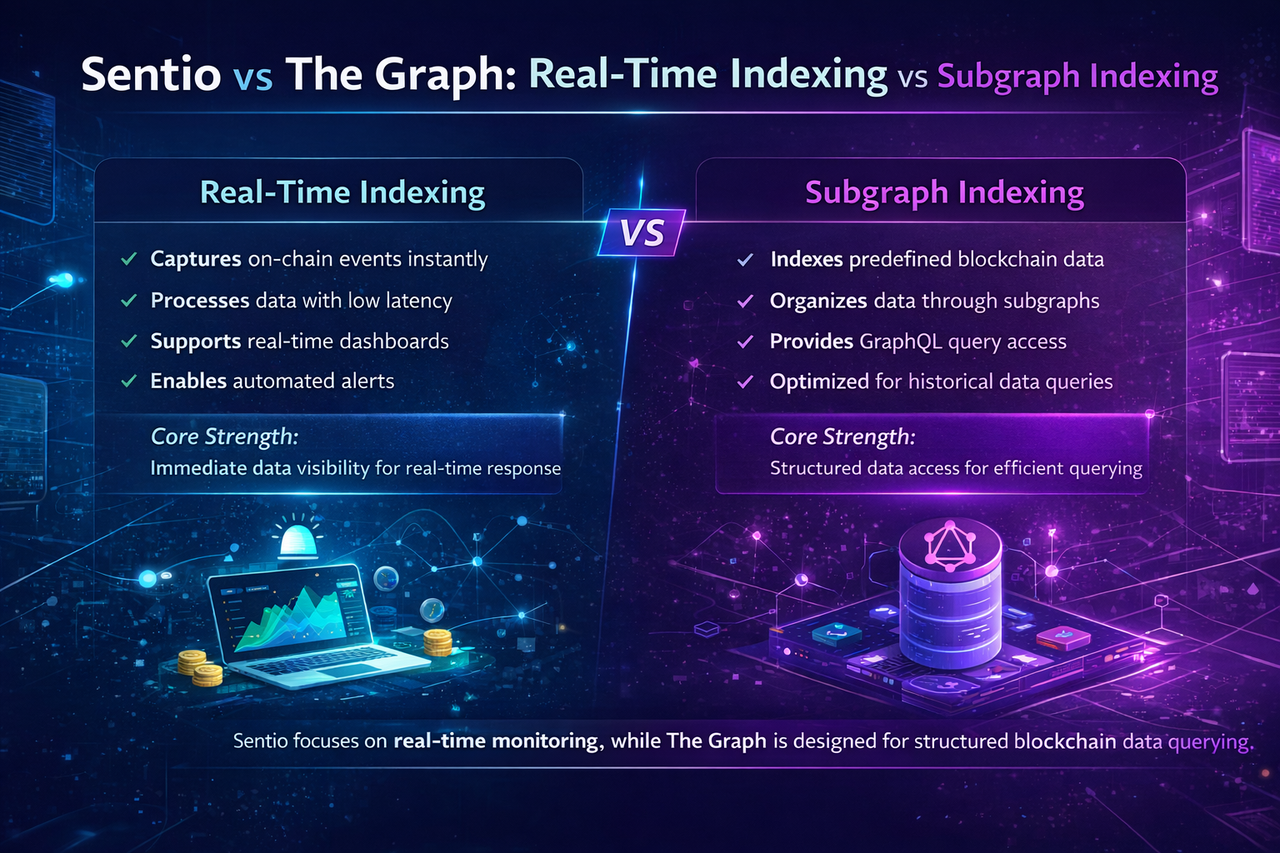
As a decentralized data indexing protocol, The Graph allows developers to define and query on-chain data through subgraphs. Its main objective is to structure complex blockchain data and provide it to decentralized applications through a unified interface, reducing the difficulty of reading on-chain data.
In The Graph ecosystem, developers need to define in advance which events and data structures should be indexed. The system then organizes the data according to those rules and provides query services through a GraphQL interface.
| Comparison Dimension |
Sentio |
The Graph |
| Core mechanism |
Real time indexing |
Subgraph indexing |
| Data response |
Real time |
Delayed synchronization |
| Query method |
Real time monitoring |
GraphQL queries |
| Visualization capability |
Built in support |
Requires external implementation |
| Automated alerts |
Supported |
Not supported |
| Use cases |
Real time monitoring and warning |
Data querying and aggregation |
From an overall positioning perspective, Sentio is better suited as a real time monitoring tool, while The Graph is better suited as an on-chain data query protocol. They are not direct replacements for each other, but rather serve different layers of data needs.
What is the difference between real time indexing and subgraph indexing?
The core difference between Sentio and The Graph lies in how they process data.
Sentio’s real time indexing mechanism is centered on on-chain event listening. When a transaction or state change occurs on-chain, the system immediately captures the relevant event, parses and processes the data, and quickly outputs it to the monitoring system. This means developers can receive feedback soon after an event occurs, which supports real time monitoring and automated warning.
By contrast, The Graph’s subgraph indexing mechanism places more emphasis on structured data organization. Developers must first define the subgraph rules, after which the system indexes on-chain data according to those rules, stores it in the query layer, and ultimately provides access through GraphQL. This approach has strengths in data querying and aggregation, but real time response is not its primary goal.
At its core, Sentio focuses on “immediate processing after an event occurs,” while The Graph focuses on “efficient querying after data has been organized.”
Real time performance is one of the most notable differences between Sentio and The Graph.
Sentio’s real time data indexing mechanism can process on-chain events quickly after they occur and sync the results to a visualization panel or alerting system. This capability is especially important in DeFi protocol monitoring and risk warning scenarios. For example, when a protocol experiences a large fund movement or unusual transaction behavior, Sentio can detect the change promptly and trigger an alert.
The Graph, on the other hand, typically relies on subgraph synchronization in its indexing workflow, which creates a certain time gap before updated data becomes available through the query interface. For historical data queries and data aggregation scenarios, this delay usually does not have a major impact. However, for applications that require immediate response, limited real time performance may reduce its effectiveness.
As a result, Sentio has the edge in low latency monitoring scenarios, while The Graph is more suitable when data querying is the primary requirement.
Sentio vs The Graph: How does the developer experience differ?
From a developer experience standpoint, The Graph provides a data query infrastructure. Developers need to define the subgraph schema, configure indexing logic, and deploy the subgraph, then retrieve the required data through GraphQL queries. This model offers strong flexibility, but it also comes with some setup and maintenance costs.
Sentio is more oriented toward a real time monitoring platform. Developers can configure on-chain event listening logic and directly use built in visualization panels to observe data changes, without having to build a monitoring interface separately. This integrated capability lowers the barrier to building real time monitoring systems and allows development teams to get feedback faster.
Because of this, The Graph is better suited for building data query interfaces, while Sentio is better suited for quickly deploying real time monitoring capabilities.
Sentio vs The Graph: How do their use cases differ?
Because their design goals are different, Sentio and The Graph also differ significantly in their use cases.
The Graph is better suited as an on-chain data query layer, for example by providing data interfaces for decentralized applications, aggregating historical on-chain data, or building API services. It is particularly strong at solving data reading and organization challenges, which is why it is often used in scenarios that require frequent querying of on-chain state.
Sentio is better suited for scenarios that require immediate response, such as DeFi protocol operations monitoring, security risk warning, and real time operational analysis. In these situations, on-chain data not only needs to be read, it also needs to be processed and acted on as soon as an event occurs. That is exactly where Sentio’s core strength lies.
Conclusion
Sentio and The Graph are both important parts of Web3 data infrastructure, but they solve different problems. The Graph uses a subgraph mechanism to provide developers with structured data query capabilities, making it more suitable as an on-chain data interface layer. Sentio, meanwhile, supports real time monitoring and risk warning through real time indexing, visual analytics, and automated alerts.
As Web3 applications continue to demand greater real time responsiveness from data infrastructure, the importance of real time indexing protocols is growing. Understanding the differences between Sentio and The Graph helps developers choose the data infrastructure solution that best fits their actual business needs.
FAQs
What is the core difference between Sentio and The Graph?
Sentio emphasizes real time data monitoring and automated alerting, while The Graph mainly provides on-chain data querying and aggregation capabilities.
Why is Sentio better suited for real time monitoring?
Because Sentio can process data quickly after an on-chain event occurs and output the results promptly, it is better suited for scenarios that require immediate response.
Does The Graph support real time data?
The Graph can index on-chain data, but because it depends on a subgraph synchronization mechanism, its real time performance is generally not as strong as Sentio’s.
Can Sentio replace The Graph?
They serve different roles. Sentio is more suitable for real time monitoring, while The Graph is more suitable for data querying, so they are not in a fully substitutable relationship.







