Unlike assets with a fixed supply cap, Dogecoin employs a perpetual inflation issuance model. This characteristic ensures constant liquidity and makes it naturally suited for social media micro-tipping and daily retail payments, fostering a decentralized, community-driven clearing network.
Today, the Dogecoin narrative has leaped from pure meme culture into a dual dimension of “politics and finance.” With the continuous administrative exposure of the Department of Government Efficiency (D.O.G.E.) led by Elon Musk, the brand consensus of the coin has been unprecedentedly strengthened worldwide. Simultaneously, discussions regarding a Dogecoin spot ETF and the official launch of the payment-focused Such App mark DOGE’s transition from a speculative asset to a “digital dollar” with substantial utility value.
The Origins of Dogecoin (DOGE)
In late 2013, an image featuring a Shiba Inu dog accompanied by broken English phrases such as “Much Wow” was circulating widely on the internet. Software engineers Billy Markus and Jackson Palmer cleverly captured this cultural symbol and designed an asset that felt more approachable than Bitcoin.

The birth of Dogecoin marked a shift in cryptocurrencies from purely technical experiments to mainstream internet culture.
As the original pioneer of the Meme Coin category, Dogecoin’s core value lies not only in its technical parameters, but also in its large and highly cohesive community culture.
Unlike the serious atmosphere of early Bitcoin communities, the Dogecoin community, which refers to itself as “Shibes,” promoted the value of “Do Only Good Everyday” from the very beginning. This culture has been reflected in several landmark events.
- Charitable fundraising: The community once raised approximately 50,000 USD worth of DOGE to sponsor the Jamaican bobsled team’s participation in the Winter Olympics, and also funded a clean water project in Kenya through Doge4Water.
- Tipping mechanisms: On platforms such as Reddit, DOGE became a popular online tipping tool due to its low transaction fees.
Although it originated as internet humor, Dogecoin has gradually evolved into one of the most important assets in the cryptocurrency market.
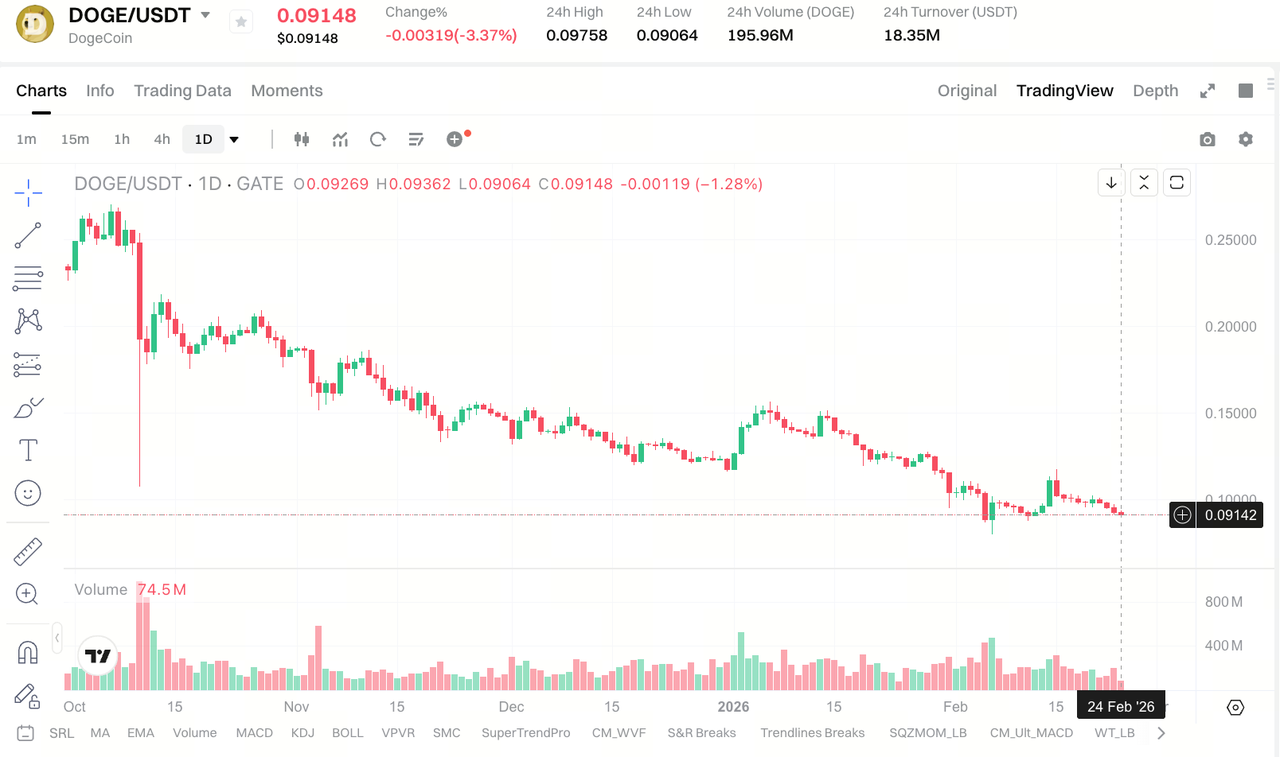
As of February 2026, DOGE has a market capitalization of approximately 15 billion USD, ranking around tenth among global cryptocurrencies, and remains the largest meme coin by market value.
How Does Dogecoin Work?
Dogecoin’s operational logic largely inherits Bitcoin’s decentralized principles, while introducing specific optimizations in efficiency and consensus mechanisms.
Dogecoin uses a Proof of Work consensus mechanism and adopts the Scrypt algorithm as its hashing function. This memory intensive design was originally intended to make Dogecoin mining more accessible to ordinary CPUs and GPUs, rather than relying exclusively on specialized ASIC hardware.
- Block time: Dogecoin produces a new block approximately every minute, significantly faster than Bitcoin’s ten minute block time. This improves transaction responsiveness.
- Auxiliary Proof of Work (AuxPoW): To enhance security, Dogecoin introduced merged mining in 2014. Miners can mine Dogecoin while mining Litecoin, which greatly reduces the risk of a 51 percent attack.
DOGE Token Design and Value
Unlike Bitcoin’s fixed supply of 21 million coins, Dogecoin adopts an inflationary model with unlimited supply.
- Initial supply: The initial supply was set at 100 billion coins.
- Fixed issuance: Approximately 5 billion new tokens are issued each year. While this results in token dilution, a stable and relatively low inflation rate can, over the long term, support liquidity and position the token more as a medium of exchange rather than a purely hoarded asset.
Primary Use Cases and Applications of Dogecoin
With the increasing adoption of cryptocurrency payment gateways, Dogecoin’s use cases have expanded far beyond community tipping.
- Payments and settlement: An increasing number of merchants accept DOGE as a payment method. For example, some electric vehicle companies and sports merchandise stores have integrated it into their checkout systems.
- Micropayments: Due to its low unit price and fast transfers, DOGE has a natural advantage in digital content micropayments.
- Narrative driven finance: Public endorsements from Elon Musk, such as referring to Dogecoin as “the people’s currency” on social media, have significantly influenced its market narrative.
Dogecoin vs Shiba Inu
When researching Dogecoin, it is common to compare Dogecoin with the later emerging Shiba Inu (SHIB). Although both use the Shiba Inu image, their underlying logic differs significantly:
| Feature |
Dogecoin (DOGE) |
Shiba Inu (SHIB) |
| Underlying Architecture |
Independent Layer 1 blockchain (Litecoin fork) |
Ethereum-based ERC-20 token |
| Consensus Mechanism |
Proof of Work (PoW) (Scrypt algorithm) |
Proof of Stake (PoS) (via Ethereum) |
| Functional Expansion |
Primarily a payment/tipping currency; limited smart contracts. |
Supports DeFi, NFTs, and the Shibarium Layer 2. |
| Supply Model |
Infinite supply; fixed annual inflation (~5B DOGE). |
Capped supply with active burn mechanisms. |
Narrative Shifts and Token Performance
In recent years, Dogecoin’s narrative has been shifting from a purely meme driven asset toward a more institutionalized asset.
This narrative shift has been driven largely by Elon Musk’s public support and the emergence of Dogecoin exchange traded funds.
Elon Musk’s Endorsement
Musk has actively promoted Dogecoin on social media and has also integrated it into payment scenarios across his companies. His influence has become a key external factor affecting DOGE price volatility.
The Emergence of Dogecoin ETFs
As cryptocurrency regulation has become clearer, spot Dogecoin ETFs were approved in several major markets between 2025 and 2026.
In November 2025, Grayscale launched the first spot Dogecoin ETF in the United States under the ticker GDOG. Around the same time, Bitwise introduced a similar product under the ticker BWOW. This marked Dogecoin’s formal entry into the view of traditional finance investors, improving both regulatory clarity and liquidity.
How to Buy and Trade DOGE?
As one of the top ten cryptocurrencies by market capitalization, DOGE is listed on most major centralized exchanges and decentralized trading platforms, including Binance, Coinbase, and Gate.
What Risks Should You Consider When Holding Dogecoin?
Although Dogecoin is a globally recognized cryptocurrency, its status as a meme coin means it still carries significant volatility, competitive pressure, and structural risks.
- High volatility exposure: As a meme driven asset, DOGE is highly sensitive to social media sentiment and celebrity statements, leading to sharp short term price swings.
- Structural risks: Although AuxPoW improves security, mining power concentration remains a topic of discussion compared with Bitcoin.
- Competitive pressure: Thousands of new meme coins continue to emerge, diluting community attention that once belonged almost exclusively to Dogecoin.
Summary
As a cryptocurrency that combines cultural symbolism, community spirit, and low barrier payments, Dogecoin (DOGE), created in 2013, stands as the original meme coin. It uses a Proof of Work consensus mechanism with the Scrypt algorithm, supports merged mining with Litecoin, and features fast block times of approximately one minute with low transaction fees, making it widely used for tipping, charity, and retail payments.
Unlike Bitcoin, Dogecoin adopts an inflationary model with a fixed annual issuance of 5 billion coins, prioritizing liquidity over scarcity. Supported by a strong community culture, endorsements from Elon Musk, and the launch of spot ETFs, Dogecoin has evolved from a joke asset into an institutionalized cryptocurrency ranked among the global top ten by market capitalization.
Despite its high liquidity, investors should remain aware of its significant price volatility and intense competition within the meme coin sector.
FAQs
Does Dogecoin have a maximum supply?
No. Dogecoin issues a fixed 5 billion new coins each year. This design aims to encourage circulation rather than locking tokens in wallets due to scarcity.
How can Dogecoin be stored?
DOGE can be stored in hardware wallets that support Scrypt based assets, mobile wallets such as Dogecoin Core, or regulated cryptocurrency exchanges.
Why is Dogecoin called the original meme coin?
Because in 2013 Dogecoin was the first project to demonstrate that an internet meme could be transformed into a financial asset with real market value and strong community support.
Is mining Dogecoin still profitable?
Most miners earn DOGE through merged mining with Litecoin. For individual users, joining a mining pool is generally the more practical option.
What are the main differences between Dogecoin and Bitcoin?
The key differences include the consensus algorithm (Scrypt versus SHA 256), block time (one minute versus ten minutes), and supply model (unlimited versus a 21 million coin cap).