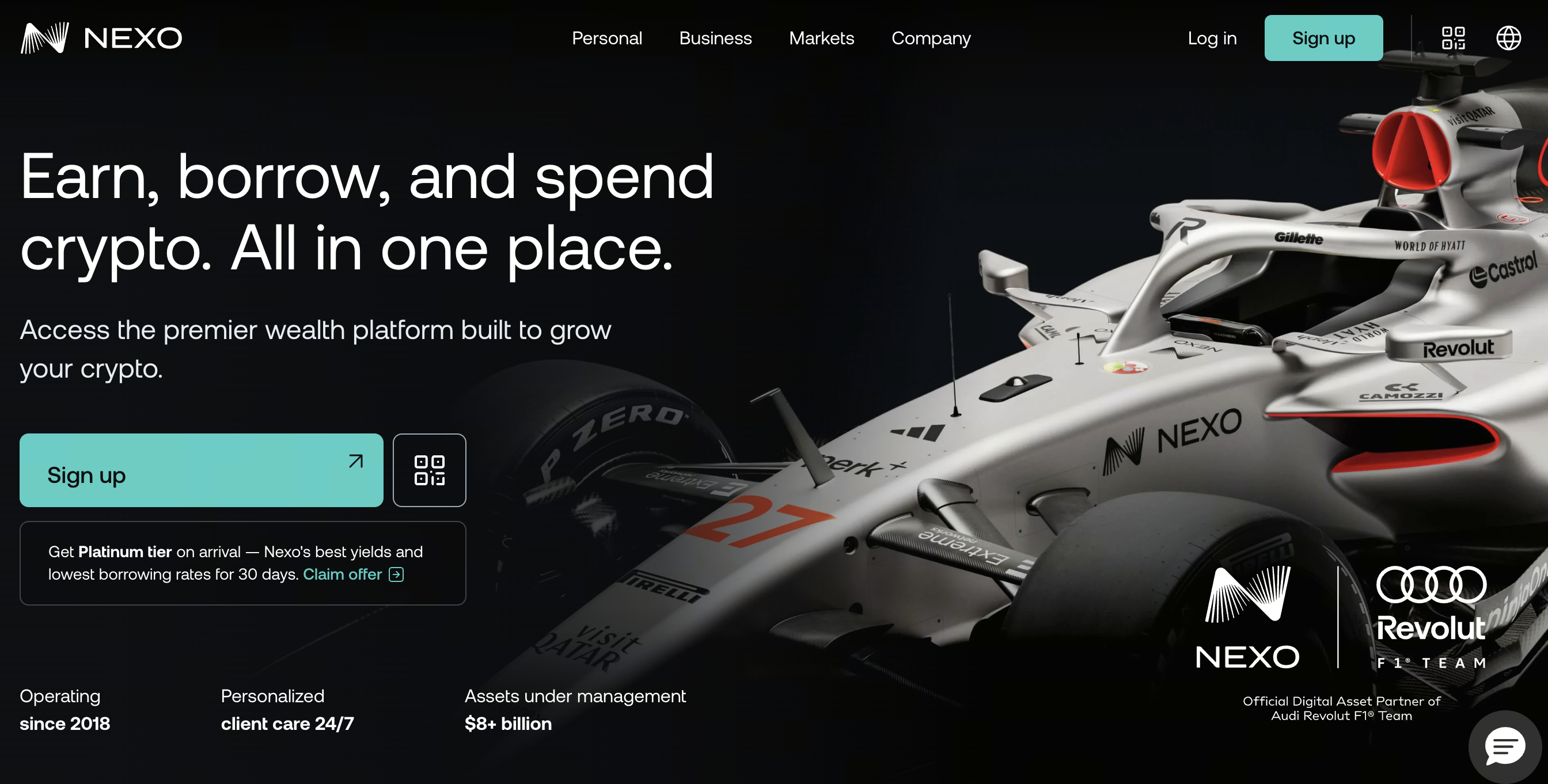
Image credit: NEXO Official Website
Unlike traditional crypto products that focus solely on "trade matching," Nexo has positioned itself from the outset as a provider of "crypto-native banking capabilities." Within a robust custody and risk management framework, Nexo offers users yield accounts for stablecoins and major assets, collateral-backed credit lines, and integrated card payment and swap features. The NEXO token acts as an "equity instrument" in this ecosystem, bundling fee rates, yield enhancements, and partial governance rights into a tradable, composable digital asset—aligning platform growth and user retention through a unified incentive structure.
From a market context, the crypto industry experienced the post-ICO downturn and exchange landscape reshaping from 2017 to 2019, driving users to prioritize sustainable cash flow tools and transparent risk controls. Nexo entered the market around 2018 with lending and savings products, continuously expanding its offerings. Simultaneously, regulatory scrutiny—especially in the US—intensified around whether "yield-bearing crypto products" constitute securities offerings. In 2023, Nexo settled with the SEC over unregistered crypto asset lending products, paying approximately $45 million in fines without admitting or denying the charges, and subsequently adjusted its US strategy. By February 2026, Bakkt announced a partnership with Nexo, leveraging its US trading infrastructure and licenses to enable Nexo’s compliant re-entry into the US market—offering yield programs, crypto-backed credit lines, integrated swaps, fiat on/off-ramps, and card services. This timeline is crucial for understanding NEXO’s "platform beta" characteristic: the token’s value is closely tied to regulatory boundaries, regional availability, and the depth of partner infrastructure.
From an industry evolution perspective, Nexo exemplifies a "hybrid on-chain token + off-chain compliant delivery" model: core settlement, collateral valuation, risk management, and certain liquidity functions occur on the platform, while token circulation, governance voting, and composable rights are handled on-chain. This is distinct from fully on-chain, self-custodied DeFi, but often provides superior user experience, fiat connectivity, and institutional compliance. The following sections cover tokenomics, technical architecture, governance, use cases, differences from pure DeFi, investment risks, future potential, and FAQs for structured reference.
NEXO Tokenomics and Distribution
The NEXO token has a hard cap of 1 billion, all pre-minted at genesis, with no ongoing mining or inflation. Circulating supply varies with unlocks, buybacks and burns (if any), secondary market trading, and platform allocations. Typical initial distributions include investor shares, reserves, team and founders, community and ecosystem, advisors, and marketing (exact ratios may differ across sources—always refer to the latest official announcements and on-chain data).
NEXO’s core utilities focus on three areas:
- Loyalty tiers: Determine yield enhancements, borrowing rate discounts, and swap fee reductions.
- Governance voting: Decide on key product parameters or strategic directions.
- Platform incentives: Link user activity and token holding to boost retention and capital stickiness.
A key milestone was the community-driven transition of incentive mechanisms: for example, early debates around "dividend-style returns" versus "daily interest" were resolved through governance, moving toward models better aligned with regulatory and operational sustainability (specific APY subject to prevailing rules and regions).
For researchers, evaluating tokenomics involves: (1) determining if circulation and unlocks are largely complete (many projects reach a "low incremental sell pressure" phase after several years), (2) assessing the transparency and verifiability of buyback and burn policies, and (3) judging whether utility strengthens or dilutes as the product line expands (e.g., do tiered benefits become more attractive after new regional launches or infrastructure partnerships).
Nexo’s technology is not about building a proprietary blockchain to replace Ethereum, but rather about integrating financial engineering, risk management systems, compliance processes, and third-party infrastructure. User assets are managed within custody and insurance frameworks (varying by product and region), prices and LTVs are calculated in real time by risk engines, liquidation and margin call processes are governed by operational rules, and on-chain token rights are mapped but decoupled from these processes.
The architecture can be broadly divided into:
- Client layer (App / Web / API)
- Account and compliance layer (KYC / AML, regional restrictions, risk rating)
- Asset and fund layer (hot/cold wallet strategies, partner custodians, liquidity providers)
- Product and pricing layer (yield curves, borrowing rates, swap depth)
- On-chain interaction layer (NEXO issuance and transfers, on-chain governance voting or snapshot mechanisms)
This layered structure positions Nexo as a "crypto-native wealth management FinTech," rather than a single smart contract protocol.
Key security and continuity metrics include: collateral valuation frequency, stress test disclosures, third-party audits and proof of reserves (if available), and liquidation depth and slippage management during extreme market conditions. When reviewing security and compliance statements, distinguish between "marketing claims" and "verifiable commitments" (such as insurance coverage, exceptions, and regional applicability).
Nexo Governance and Community Participation
Nexo’s governance is best described as "limited on-chain/off-chain co-governance by token holders over platform parameters," not a fully decentralized protocol where all decisions are locked in code. Participation includes: voting on proposals under announced rules, discussing proposal backgrounds in community channels, and earning higher weights or priority rights via loyalty tiers (details per the official governance page).
The value of governance is in opening "product roadmap decisions" to long-term holders, reducing the trust cost of unilateral platform changes. However, boundaries are clear: core operations like custody, risk management, partner selection, and compliance remain under company governance. Effective community engagement involves understanding the second-order impact of proposals on fees, incentives, and capital costs via disclosure documents—not just headlines.
Nexo’s Role in Decentralized Finance
Strictly speaking, Nexo’s main products are more CeFi (centralized finance) or CeDeFi hybrids; however, from a broader "open finance" perspective, it connects with DeFi in several ways: users might transfer assets earned in DeFi to Nexo for more stable returns, or hold NEXO on-chain for tiered benefits while providing liquidity or hedging on DEXs.
Common use cases include: yield allocation for stablecoins and major assets, BTC/ETH-backed credit lines, cross-asset swaps and payments, and using the platform as a liquidity management tool for institutions or high-net-worth clients. Critically, availability, rates, and risk disclosures vary widely by jurisdiction, so a "global unified DeFi experience" does not apply.
Compared to Aave, Compound, MakerDAO, and other on-chain lending protocols, Nexo’s main differences are:
- Custody model (do users self-custody private keys)
- Transparency mechanism (on-chain verifiability vs. periodic audit disclosures)
- Regulatory path (licensing, settlement history, regional strategies)
- Product structure (integrated wealth management vs. single composable modules)
- Risk structure (platform and insurance terms vs. smart contract and oracle risks)
For professionals, the choice is not "better or worse," but reflects risk preferences: those prioritizing composability and permissionless access prefer pure DeFi; those valuing fiat on/off-ramps, customer support, and compliance may lean toward Nexo. NEXO’s risk profile is thus a "platform equity beta + regulatory beta" hybrid, not just a smart contract governance token.
Key Risks When Investing in NEXO
Regulatory and compliance risk: Crypto lending and yield products may be classified as securities or other regulated activities in various jurisdictions; past settlements do not preclude future enforcement or rule changes.
Counterparty and custody risk: When assets are held by the platform or partners, review bankruptcy segregation, exception clauses, and incident handling procedures.
Market and liquidity risk: NEXO’s secondary market depth and volatility affect the cost of large transactions.
Model and incentive risk: Changes to yields, tiered rights, or burn mechanisms can impact token demand.
Disclosure risk: Different language versions and regional product pages may differ—always refer to legal documents.
Nothing herein constitutes investment advice.
Nexo (NEXO) Future Outlook and Market Potential
Recent disclosures show Nexo’s strategy is shifting toward "compliance infrastructure partnerships + regional expansion + product integration." The 2026 Bakkt partnership provides a regulatory and transactional anchor for re-entering the US market, emphasizing yield, lending, swap, and payment integration under regulatory oversight. Medium- and long-term potential depends on:
- Sustained product licensing and user growth in key markets;
- Maintaining healthy asset-liability and risk metrics through rate and market cycles;
- Whether NEXO utility forms a stable closed loop with real paid usage (fee discounts, tiered rights), not just short-term marketing.
Market potential is not linear—regulatory shifts, banking partnerships, stablecoin policies, and macro liquidity can all change the growth curve. For researchers, robust indicators include asset quality, bad debt and liquidation data (if available), and the sustainability and coverage of partner infrastructure.
Summary
Nexo (NEXO) combines a "global digital asset wealth management platform" with a "native token rights system": the platform provides custodial financial services, while the blockchain layer enables token circulation and governance.
- Tokenomics features a hard cap and pre-minting, with utility focused on tiered rights and governance.
- Technology and architecture emphasize risk control, compliance, and third-party integration.
- Compared to pure DeFi, the main differences are in custody, transparency, and regulatory approach.
For investors, pay close attention to regulatory history, counterparty structure, and liquidity. Looking forward, the 2026 US market re-entry is a key strategic milestone, but long-term value will depend on compliance and sustainable product growth.
FAQs
Q1: Is NEXO a DeFi token?
More accurately, NEXO is the native ecosystem token for the Nexo platform, whose main products are custodial CeFi/hybrid solutions. It may interact with DeFi in governance and circulation, but is not a fully on-chain, self-custodial protocol token.
Q2: Will NEXO’s supply increase?
Public information indicates a hard-capped, pre-minted maximum supply with no ongoing mining or inflation. Circulating supply may change due to burns, buybacks, unlocks, and trading. Always rely on the latest official disclosures and on-chain data.
Q3: Can US users access Nexo now?
Refer to news around February 2026, when Bakkt announced a partnership to support Nexo’s compliant US offerings. Specific products, eligibility, and terms are subject to the Nexo US website and legal documents, and may change with regulation.
Q4: Can NEXO still participate in governance?
Generally yes, via the official governance process and snapshot rules. Governance scope does not equal full operational control—major compliance and custody remain with company governance.
Q5: What’s the biggest uncertainty in investing in NEXO?
The main uncertainty is regulatory change and the potential liquidity impact of counterparty events. Changes in platform incentives and fee policies can also affect token demand.