In traditional financial systems, salary payments, subscriptions, and treasury management often depend on delayed settlement cycles. This reduces capital efficiency, limits liquidity, and introduces intermediary costs. Zebec transforms payments from discrete events into continuous processes by enabling real-time settlement on-chain.
From a blockchain perspective, Zebec represents more than a payment optimization tool. By embedding payment logic into smart contracts and combining it with high-performance networks and cross-chain capabilities, it turns cash flow into a programmable and composable on-chain resource that can support DeFi, enterprise finance, and Web3 applications.
How Zebec's Real-Time Payment and Cash Flow Architecture Works
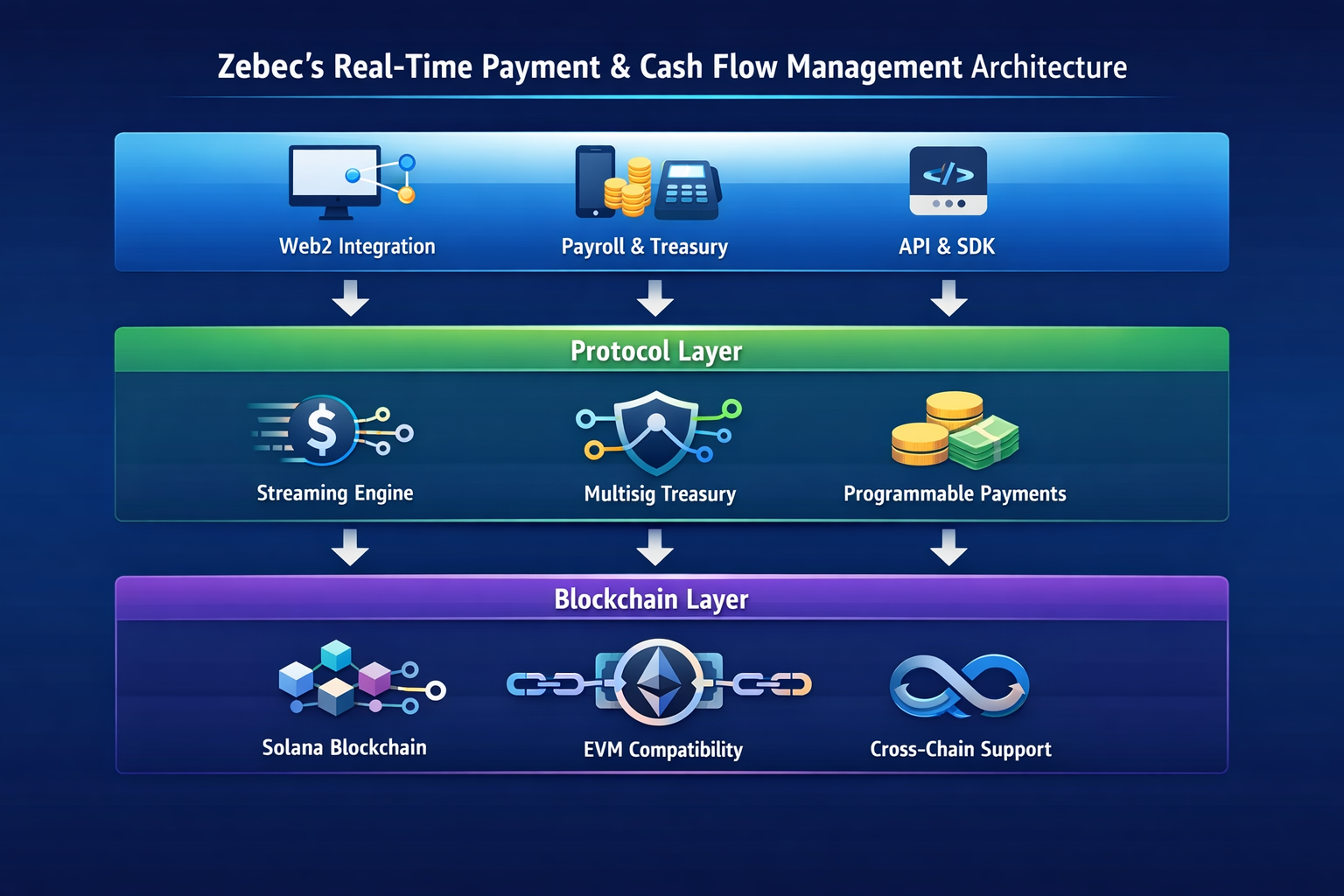
Zebec’s core technical architecture is built around a continuous settlement protocol. Its fundamental approach is to break down fund transfers into continuous micro-payment streams rather than one-time transactions. According to official technical materials, Zebec adopts a multi-layered structure, including the blockchain base layer, protocol layer, and middleware abstraction layer, designed to connect Web2 systems with Web3 infrastructure.
Within this architecture, the key capabilities include:
-
Streaming Engine:
-
Supports second-level fund release
-
Allows real-time adjustment of payment rates
-
Enables pausing, resuming, and terminating payment streams
-
Treasury and Payroll Module:
-
Enables real-time allocation of funds for enterprises
-
Supports automated salary distribution and cash flow management
-
Provides multi-signature tools for secure fund management
-
Middleware Abstraction Layer:
-
Connects Web2 systems with blockchain infrastructure
-
Supports integration through APIs and SDKs
-
Provides multi-chain compatibility
This architecture positions Zebec not just as a payment protocol, but as an on-chain cash flow operating system capable of supporting enterprise-level financial management and real-time financial use cases.
How Blockchain and Smart Contracts Enable Zebec
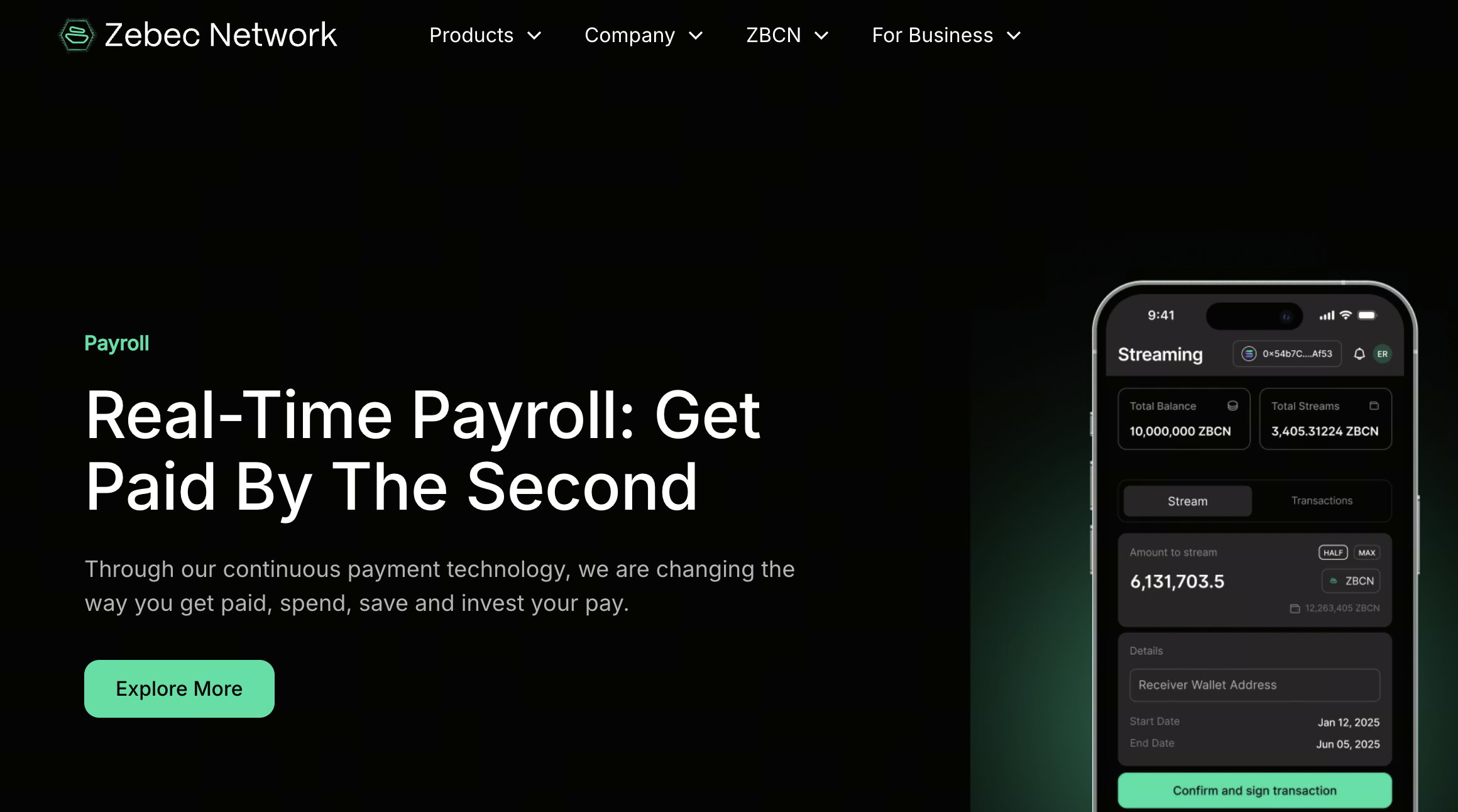 Image source: Zebec official website
Zebec is built on a high-performance blockchain infrastructure, primarily leveraging Solana for its high throughput and low transaction costs. This allows continuous micro-payments to operate efficiently.
At the smart contract level, Zebec implements several key functions:
-
Streaming payment contracts: Define how funds are released over time
-
Multisignature treasury systems: Provide secure management of funds
-
Token standard integration: Ensure compatibility with supported digital assets
Zebec also introduces programmable payment logic, allowing transactions to be executed based on time, conditions, or predefined events. This approach, often described as payment as code, gives the system composability similar to DeFi protocols.
Advantages and Innovation in Decentralized Payments
Compared to traditional payment systems, Zebec introduces several structural improvements:
-
Real-time settlement: Funds can be delivered instantly or streamed continuously, improving capital efficiency.
-
Reduced intermediaries: Blockchain-based settlement removes the need for banks and payment processors, lowering costs and delays.
-
Programmability: Payment logic can be embedded into smart contracts, enabling automated distribution and dynamic adjustments.
-
Transparency and auditability: Transactions are recorded on-chain, making them verifiable and traceable.
These features improve both user experience and enterprise financial operations, such as real-time budgeting and dynamic fund allocation.
How Zebec Simplifies Cross-Border Payments
Cross-border payments often involve high costs, slow settlement, and complex processes. Zebec addresses these challenges by enabling value transfer directly on blockchain networks.
Funds can be settled globally in near real time without relying on traditional systems such as SWIFT or intermediary banks. Support for stablecoins and multi-chain environments allows users in different regions to transact within a unified system.
Through APIs and SDKs, enterprises can integrate Zebec into their existing systems, enabling automated cross-border payments.
In practical terms, this allows:
-
Real-time salary payments for global teams
-
Pay-as-you-use service billing
-
Reduced costs in international transactions
Security and Privacy Mechanisms in Zebec
Security is a key component of Zebec's technical design.
Its main safeguards include:
-
Blockchain security: Leveraging network consensus and finality to ensure transaction integrity
-
Multisignature treasury systems: Reducing single points of failure in fund management
-
Smart contract audits: Improving reliability and reducing vulnerability risks
-
Data separation and privacy protection: Combining on-chain transparency with off-chain data protection mechanisms
This multi-layered approach allows Zebec to maintain decentralization while meeting enterprise-level security requirements.
Future Development of Zebec Technology
As demand for Web3 payments grows, Zebec is evolving toward a broader financial infrastructure.
Key areas of development include:
-
Multi-chain expansion: Extending beyond Solana to support additional networks and improve interoperability
-
Enterprise financial tools: Enhancing treasury management systems for more complex use cases
-
Integration with real-world assets: Applying streaming payments to salaries, subscriptions, and financial instruments
-
Ecosystem expansion: Supporting more applications, devices, and payment scenarios
-
Performance optimization: Improving efficiency and reducing costs for users
These directions indicate a transition from a payment protocol to a foundational layer for on-chain financial systems.
Conclusion
Zebec introduces a shift from discrete payment models to continuous, programmable cash flow systems. By enabling streaming payments and real-time settlement, it improves capital efficiency and transparency.
Its architecture, built on high-performance blockchain infrastructure and smart contracts, supports real-time financial operations while connecting Web3 systems with real-world use cases.
From a broader perspective, Zebec represents a structural upgrade in financial infrastructure. As cross-border payments, enterprise finance, and DeFi continue to evolve, real-time finance may become a foundational capability in the Web3 economy.







