What Is Alchemy Pay (ACH)?
Alchemy Pay refers to a payment gateway and settlement network that bridges fiat currencies and cryptocurrencies. Its native utility token, ACH, is issued on Ethereum. Alchemy Pay connects “fiat” (government-issued currencies like USD, EUR) with “cryptocurrencies” (such as tokens on Ethereum), streamlining the process for merchants to accept payments and for users to buy or spend crypto assets.
From a network perspective, one side integrates traditional payment channels like bank cards and e-wallets, while the other connects to on-chain wallets and applications. ACH serves as a fee payment token, incentive and discount mechanism, and can also be used for staking and risk management within the ecosystem to drive participation.
What Are the Current Price, Market Cap, and Circulating Supply of Alchemy Pay (ACH)?
As of 2026‑01‑19 (source: provided market data), ACH’s latest price is approximately $0.011518, with a circulating market cap around $115.18 million and a 24-hour trading volume of about $1.67 million. The circulating supply is roughly 4.944 billion tokens, with a total and maximum supply of 10 billion ACH. The fully diluted market cap is about $115.18 million. In terms of short-term performance: 1 hour +1.69%, 24 hours +3.16%, 7 days +2.54%, 30 days +47.63%. ACH’s market dominance is approximately 0.0035%.
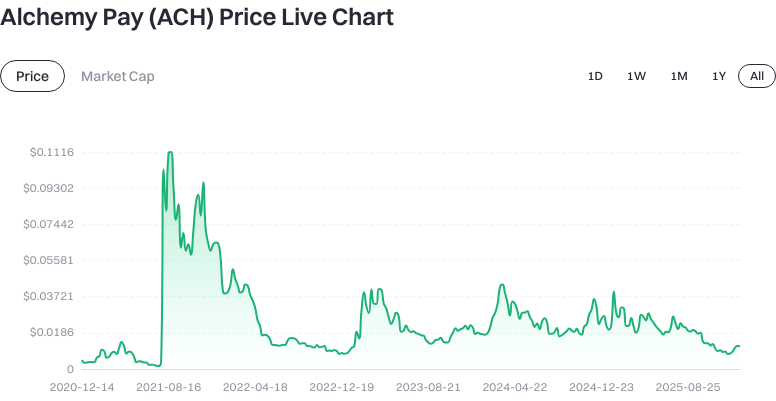
Click to view the latest ACH price
“Fully diluted market cap” represents the theoretical market value if the maximum token supply were in circulation at current prices. “Circulating supply” refers to the number of tokens currently available for trading on the market. These metrics help assess the scale and potential dilution of a token.
Who Founded Alchemy Pay (ACH) and When?
Alchemy Pay was established in Singapore in 2018, positioning itself as a payment solution provider connecting fiat and crypto economies. Its utility token, ACH, launched on September 7, 2020, as an ERC‑20 asset on Ethereum. The project has partnered with payment channels and merchants across multiple countries, supporting both online and offline scenarios. It provides on/off-ramp services in dozens of countries and continuously expands merchant reach and developer capabilities.
How Does Alchemy Pay (ACH) Work?
At its core, Alchemy Pay operates as a gateway: one end connects to traditional payment channels for fiat deposits and withdrawals, while the other interfaces with blockchains for token payments and on-chain settlement. This allows users to purchase crypto assets using bank cards or other fiat tools, while merchants can seamlessly convert crypto payments into fiat settlements.
ACH, as an ERC‑20 token, serves three main functions:
- Fees & Discounts: Used for paying network transaction fees or enjoying discounted rates.
- Incentives & Partnerships: Acts as an incentive or rebate for merchants or channel integrations to encourage ecosystem participation.
- Risk Management & Staking: Serves as collateral or risk reserves in certain business scenarios to align participant behavior.
ERC‑20 is Ethereum’s universal token standard, ensuring broad compatibility with wallets and smart contracts.
What Can You Do With Alchemy Pay (ACH)?
For consumers, Alchemy Pay enables quick purchases of popular crypto assets via fiat channels, which can then be spent at supported merchants; the gateway handles currency conversion and settlement. Merchants can accept crypto payments through integrated cashier systems, choosing to settle in fiat or retain a portion of crypto assets. Developers can leverage payment SDKs and APIs to enable in-app crypto purchases (“on-ramp”) and sales (“off-ramp”), reducing friction for users entering Web3.
For example, if a user pays $100 via bank card to purchase on-chain assets, the gateway processes the payment and compliance check, then transfers equivalent tokens to the user’s Ethereum wallet. In reverse, users spending crypto at a merchant can trigger fiat settlement for the merchant—providing stability in cash flow.
Wallets and Extensions in the Alchemy Pay (ACH) Ecosystem
Since ACH is an ERC‑20 token on Ethereum, it is supported by most mainstream Ethereum wallets—including browser extension wallets and hardware wallets. Browser wallets offer convenience for daily transactions and DApp interaction; hardware wallets enhance security by keeping private keys offline. Private keys are cryptographic credentials controlling asset ownership—loss or exposure can result in permanent asset loss.
For merchants and developers, integration typically occurs via SDKs, APIs, or admin portals for onboarding, reconciliation, and settlement configuration. On the user side, common extensions include anti-fraud checks, address book management, and network selection prompts—mitigating operational risks. When withdrawing or depositing ACH, always select the “Ethereum (ERC‑20)” network to avoid cross-chain transfer errors that could lead to asset loss.
Key Risks and Regulatory Considerations of Alchemy Pay (ACH)
First is market risk: as a freely traded token, ACH’s price is influenced by supply-demand dynamics, macro liquidity conditions, and industry events—leading to high volatility. Next is compliance risk: fiat channels are subject to local payment regulations and anti-money laundering rules; regional policy changes may impact channel availability or fees.
There are also counterparty and operational risks—issues with payment partners or merchant systems can affect user experience. Technically, smart contract vulnerabilities or Ethereum network congestion may cause increased gas fees or transaction delays. For individuals, safeguarding private keys and avoiding phishing scams are crucial—always enable security features and verify URLs, contract addresses, and networks before transacting.
How to Buy and Safely Store Alchemy Pay (ACH) on Gate
Step 1: Register an account and complete KYC. KYC (Know Your Customer) is an identity verification process required for regulatory compliance and enhanced account security—follow prompts to submit ID documents and facial verification.
Step 2: Fund your account. Purchase stablecoins like USDT via fiat channels or deposit available assets—note fees and processing times.
Step 3: Search for “ACH” on the trading page. Go to the spot trading interface for ACH, check trading pairs and price charts, verify contract details to avoid counterfeit tokens.
Step 4: Place your buy order. Beginners can use market orders for instant execution at current prices; experienced users may prefer limit orders at target prices. Enter the desired amount, submit your order, then check your order history.
Step 5 (Optional): Withdraw to a self-custody wallet for long-term holding or on-chain activity. Select the “Ethereum (ERC‑20)” network; start with a small test withdrawal before transferring larger amounts. Always account for network gas fees.
Step 6: Enhance your security settings. Enable two-factor authentication (2FA—commonly via dynamic codes), set up anti-phishing codes, avoid entering account info on unfamiliar links, and regularly review your login and withdrawal records.
How Does Alchemy Pay (ACH) Compare to XRP (Ripple)?
Underlying Technology: ACH is an ERC‑20 token on Ethereum—its security and performance depend on Ethereum’s infrastructure. XRP operates on the independent XRP Ledger with its own consensus mechanism, optimized as a high-throughput value transfer network.
Business Focus: Alchemy Pay specializes in fiat-to-crypto ramps and merchant acquiring—bridging traditional payment systems with blockchain assets. XRP is designed mainly for institutional cross-border settlements and liquidity bridging—serving banks and payment providers in value transfer scenarios.
Tokenomics & Supply: ACH has a maximum supply of 10 billion tokens used for fees, incentives, and ecosystem growth; XRP’s initial supply was much higher with distinct issuance and lock-up structures. Their price drivers and demand patterns differ significantly.
Regulatory Exposure & Ecosystem Priorities: Alchemy Pay must adapt to various countries’ acquiring and AML requirements—channel accessibility and fees are shaped by regional policies; XRP’s prospects are more closely tied to developments in cross-border payments and institutional adoption. Each project has distinct regulatory focuses—they are not directly interchangeable.
Summary of Alchemy Pay (ACH)
Alchemy Pay bridges fiat currencies with crypto networks—offering unified solutions for buying crypto, spending it at merchants, and settling payments; ACH enables fee payments, incentives, and ecosystem participation. As of January 19th, 2026 data shows clear supply structure and scale; however, price volatility and channel availability are subject to market trends and regulatory shifts. Alchemy Pay is worth considering for users or developers interested in real-world payment adoption, fiat onramps, or merchant acquiring scenarios. For best practices: follow each step when purchasing on Gate; choose the Ethereum (ERC‑20) network; enable 2FA; securely store your private key; diversify funds; monitor regulatory updates—and you can leverage its benefits while managing risks effectively.
FAQ
Is There Any Connection Between ACH Token and Traditional Bank Transfers Called ACH?
No direct connection exists. The ACH token belongs to Alchemy Pay’s crypto ecosystem—it should not be confused with the traditional US banking system’s ACH transfer method (Automated Clearing House). The latter handles interbank electronic transfers in fiat currency; ACH token incentivizes validators and liquidity providers within Alchemy Pay’s network. Despite sharing a name, one facilitates fiat transfers while the other is a crypto asset.
What Are the Benefits of Holding ACH Tokens?
Holders can participate in staking, network governance, and earn rewards within the Alchemy Pay ecosystem—including sharing protocol fees or voting on major proposals. For up-to-date information on earning models or tokenomics adjustments, refer to official documentation.
Where Should Beginners Buy ACH Tokens?
ACH tokens are available on leading exchanges such as Gate. Newcomers should open an account on Gate, complete identity verification, then acquire ACH via fiat deposits or by swapping other cryptocurrencies. After purchasing, transfer your tokens to a secure wallet—avoid long-term storage on exchanges.
Does ACH Have High Price Volatility? What Are the Investment Risks?
As with most crypto assets, ACH’s price fluctuates widely due to market dynamics, regulatory developments, or project progress—posing significant investment risk. Understand the fundamentals before investing; never exceed your risk tolerance; study the project thoroughly before participating.
Which Blockchain Networks Support ACH?
ACH primarily operates on Ethereum but is also deployed on other public blockchains like Polygon and BNB Chain. Each network has its own token contract address—verify you’re using the correct network when transferring tokens to avoid permanent loss. For cross-chain conversions use only official bridge tools.
Glossary of Key ACH Terms
- Token Supply: Refers to circulating supply, total supply, and maximum supply—measures scarcity/inflation expectations.
- Market Cap: The product of token price and circulating supply—indicates relative size within the crypto market.
- Price Change (%): Percentage change over specific periods—reflects short/mid-term market sentiment.
- Trading Volume: Total value traded over 24 hours—shows liquidity/activity level.
- Fully Diluted Market Cap: Market cap calculated using maximum supply—assesses theoretical value if all tokens are unlocked.
- Market Dominance: Percentage of total crypto market cap represented by this token—signals its relative importance.
References & Further Reading on Ach Coin (ACH)
-
Official Website / Whitepaper:
-
Developer Docs / Technical Resources:
-
Media Coverage / Research: