What Are AI Crypto Tokens?
AI crypto tokens are blockchain-based digital assets designed for artificial intelligence networks and applications. They facilitate payment for services, incentivize contributors, and enable decentralized governance. Unlike traditional digital “app credits,” AI crypto tokens can be freely transferred and traded on-chain.
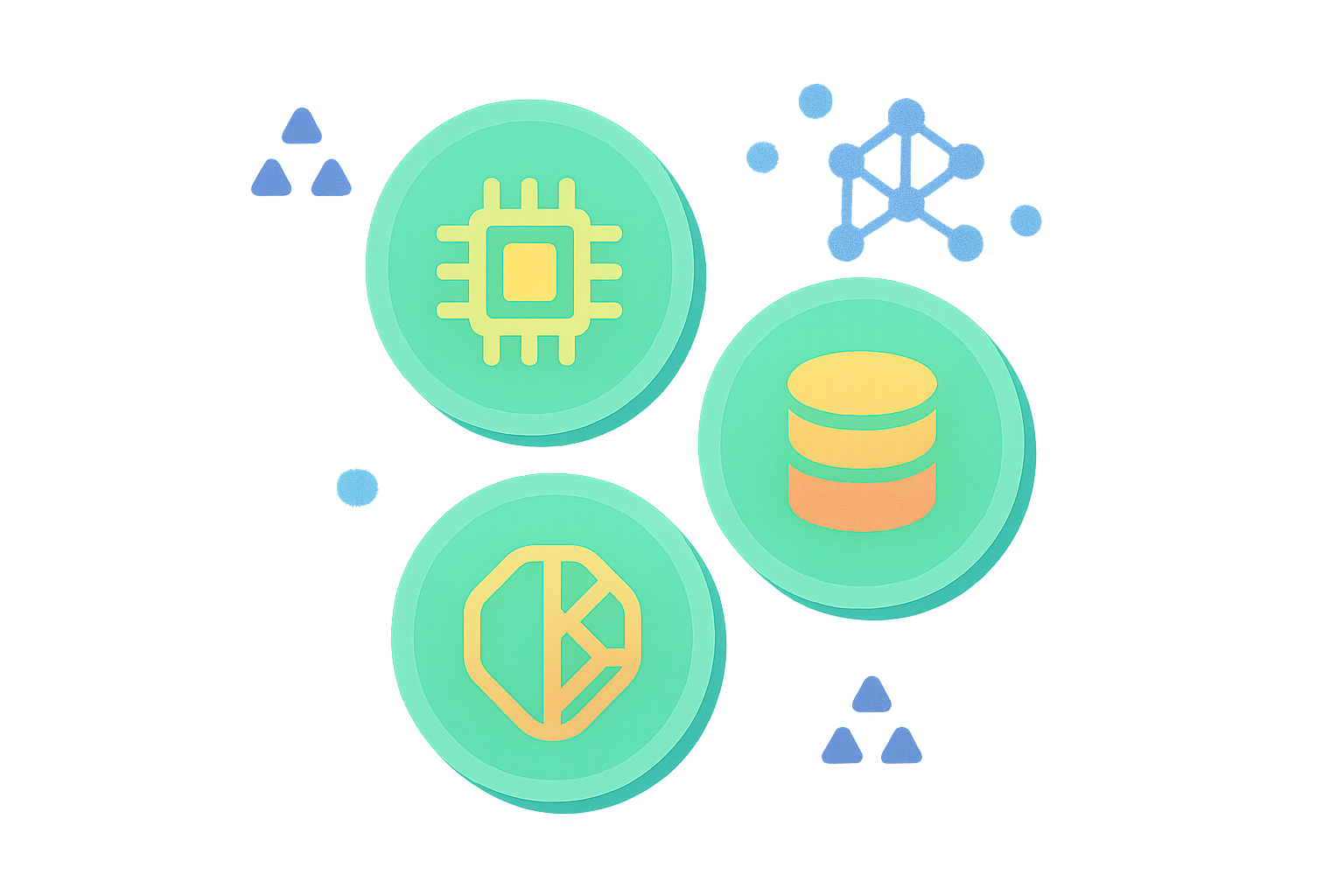
The term “crypto token” refers to tokens issued and operated on a blockchain, while “smart contracts” are automated protocols deployed on-chain that handle reward distribution and payment settlements according to predefined rules. AI crypto tokens circulate around three main resources—computing power, data, and AI models—connecting providers and users, and allowing networks to operate without a centralized platform.
Why Did AI Crypto Tokens Emerge?
AI crypto tokens were created to address the challenges of resource coordination and incentive alignment in the AI ecosystem, making it easier for supply and demand of computing power, data, and models to match and settle efficiently in an open network. They link contributor income directly to actual network usage.
Traditional AI services typically rely on centralized platforms where computing power and data are controlled by a few organizations, leading to non-transparent pricing and limited access. AI crypto tokens use token incentives to encourage more individuals and institutions to share GPU computing power, contribute data, and publish models, with transparent settlements governed by public smart contracts, enhancing availability and transparency.
How Do AI Crypto Tokens Work?
AI crypto tokens operate through tokenomics and smart contracts: users pay service fees with tokens, providers complete tasks and receive rewards or revenue shares via automated contract settlements. Tokenomics refers to the design of token supply, emission schedules, and utility scenarios.
For example, in a computing network, computing power (like GPU time) is made available by nodes. Task publishers submit inference or training jobs and lock in a token budget; nodes supply computing power and return results; smart contracts verify outputs and handle payments. In a data marketplace, dataset providers package and sell or rent out data, while buyers use tokens to unlock access. On model platforms, usage fees are charged per API call or throughput, with tokens automatically distributed on-chain to model creators and infrastructure providers.
Common Categories of AI Crypto Tokens
AI crypto tokens generally fall into several categories: computing networks, data and annotation marketplaces, model and agent platforms, and DePIN (Decentralized Physical Infrastructure Network) projects that integrate real-world hardware. DePIN leverages tokens to incentivize participation from physical devices.
Tokens for computing networks are used to rent and reward GPU nodes. Data and annotation marketplace tokens facilitate purchasing data access rights and incentivize high-quality contributions. Model and agent platform tokens allow developers to publish models and earn a share of usage fees. DePIN-related tokens incentivize distributed devices to come online and operate reliably, creating decentralized pools of edge computing power and bandwidth.
How Are AI Crypto Tokens Used?
AI crypto tokens can be used for payment and settlement of AI services, network governance participation, or gaining access rights. For regular users, the most direct use case is paying for model usage or renting computing power.
Developers use AI crypto tokens to publish tasks, incentivize testing and feedback, or connect models to platforms for revenue sharing. Data providers sell data access or subscription updates using these tokens. Some projects support staking—locking up tokens to earn network rewards or additional privileges—though users should pay attention to lock-up periods and associated risks.
How to Invest in AI Crypto Tokens?
Investing in AI crypto tokens requires a step-by-step approach and risk management. Here are practical steps for safer participation:
- Assess Use Cases and Mechanisms: Understand the problem the token solves, whether its services have real users, and the specific roles of the token in payment, revenue sharing, or governance.
- Review Team & Code: Examine the team’s background, whether the project is open-source, if there are independent audits or vulnerability fixes, and whether contract addresses are actively used on-chain.
- Evaluate Data & Costs: Track the number of tasks, active nodes, fee/revenue ratios, and whether there are genuine transactions in computing power or data rather than just hype.
- Trade on Gate: You can buy AI crypto tokens on Gate’s spot market, set price alerts and risk limits; beginners should start with small amounts and avoid high leverage.
- Monitor Early Opportunities: Pay attention to new project launches in Gate’s Startup section and their token lock-up requirements—always evaluate emission schedules and liquidity risks.
- Regularly Reassess: Periodically review your investment logic and on-chain data; if actual usage drops or token utility weakens, reduce your position promptly.
What Are the Risks of AI Crypto Tokens?
AI crypto tokens carry multiple risks—technical, economic, and regulatory. Any financial operations should be handled with caution.
Technical risks include smart contract vulnerabilities, malicious nodes, and difficulties verifying results. Economic risks involve excessive token issuance, rapid supply release, or insufficient demand causing price pressure. Regulatory risks center around data privacy, copyright issues, and inconsistent local regulations. Market risks include narrative-driven volatility, liquidity shortages, and failed project governance. Watch out for “empty whitepapers,” projects without real users, or scam airdrops.
How Do AI Crypto Tokens Differ from Traditional AI Stocks?
AI crypto tokens focus on network-level functions and settlement; traditional AI stocks represent company ownership and corporate control—they operate in different dimensions. The value of AI crypto tokens depends on on-chain usage and incentive design; stocks rely on company revenue and cash flow.
Liquidity and risk structures also differ: AI crypto tokens trade 24/7 with higher price volatility; stocks trade under regulatory frameworks with financial disclosures. In terms of governance, AI crypto tokens typically adjust parameters via voting or smart contract rules; stocks are managed by boards of directors and shareholder meetings.
What Are the Trends for AI Crypto Tokens?
Public data shows that between 2023-2024, AI crypto tokens gained rapid attention with growth in computing networks and model service projects—the ecosystem now prioritizes real usage and cash flow. There has been notable collaboration and mergers among AI/data projects in 2024, reflecting resource integration trends.
Key directions include: stronger verification/audit mechanisms for results; embedding practical fee rates and revenue sharing into smart contracts; combining with DePIN for expanded edge computing; more granular model usage metering; cross-chain integration and modular infrastructure for improved performance. On the regulatory side, data compliance and privacy protection requirements are tightening—compliant projects now focus more on identity verification, permissions, and auditability.
Key Takeaways for AI Crypto Tokens
The essence of AI crypto tokens is connecting trading of computing power, data, and models within the AI ecosystem using tokens—public settlement and incentives are managed via smart contracts. To evaluate their value, focus on real usage cases and whether the token clearly facilitates payment, revenue sharing, or governance functions. In practice: start by reviewing use cases/mechanisms; monitor on-chain data/cost structures; participate with small amounts in compliant environments like Gate; always prioritize technical diligence and capital risk management.
FAQ
How Do AI Tokens Differ from Regular Cryptocurrencies?
AI tokens are cryptocurrencies tied to artificial intelligence technologies—the core distinction lies in their application scenarios and technical foundation. Regular cryptocurrencies mainly serve value transfer or payments; AI tokens are often linked to AI model training, data processing, or specific AI services. For example, some AI tokens incentivize users to supply training data or act as settlement tools for AI computing platforms.
AI crypto tokens can be purchased on major exchanges such as Gate. To buy them, register an account, complete identity verification, then select the appropriate trading pair (e.g., AI token/USDT) to place an order. Beginners are advised to start on Gate’s platform to get familiar with the interface and risk management tools before increasing trade volume.
What Basic Risks Should I Know Before Investing in AI Tokens?
As emerging assets within the crypto sector, AI tokens carry technology risk (algorithm updates may impact prices), market risk (low liquidity can lead to sharp price swings), and policy risk (regulatory approaches to AI crypto projects are still evolving globally). Always conduct thorough research before investing—and only use capital you can afford to lose.
How Can I Evaluate Whether an AI Crypto Project Is Worth Attention?
Focus on four aspects: team background (do core members have expertise in AI/blockchain?), technical solution (is the whitepaper clear/feasible?), application scenario (does it solve real problems?), ecosystem development (community activity/cooperation partners). Platforms like Gate provide basic project info and trading stats; monitor official announcements for project updates.
What Drives the Price of AI Tokens?
AI token prices are influenced by fundamentals (project tech progress/application adoption), market dynamics (overall crypto market sentiment/liquidity), and policy factors (regulatory news). Additionally, industry trends—such as periods when ChatGPT was booming—can boost related token prices. Investors should track these factors holistically to avoid speculative short-term trading.