What is Beldex?
Beldex is a blockchain ecosystem focused on privacy protection, designed to minimize the traceability of personal information during online activities such as messaging, browsing, and fund transfers. Its native token, BDX, is used for paying on-chain gas fees (the cost of submitting transactions), incentivizing network nodes (computers that participate in running and validating the network), and staking (locking tokens to earn network rewards and governance rights).
What are the current price, market cap, and circulating supply of Beldex (BDX)?
As of January 20, 2026 (based on provided data): The latest price is approximately $0.101840; circulating market cap is around $1.012 billion; circulating supply stands at about 7,605,407,739.53 BDX; total supply is around 9,935,707,839.10 BDX; market cap dominance is roughly 0.031%; 24-hour trading volume is about $12,380.95. Price changes for 1 hour, 24 hours, 7 days, and 30 days are -0.27%, -0.36%, -0.64%, and -3.58% respectively. The maximum supply field shows ∞, while the "is supply unlimited" field states "No," indicating a discrepancy—refer to official documentation and launch announcements for clarity (timestamp: 2026-01-20). The low 24-hour volume suggests limited liquidity; traders should watch for slippage and price spreads.
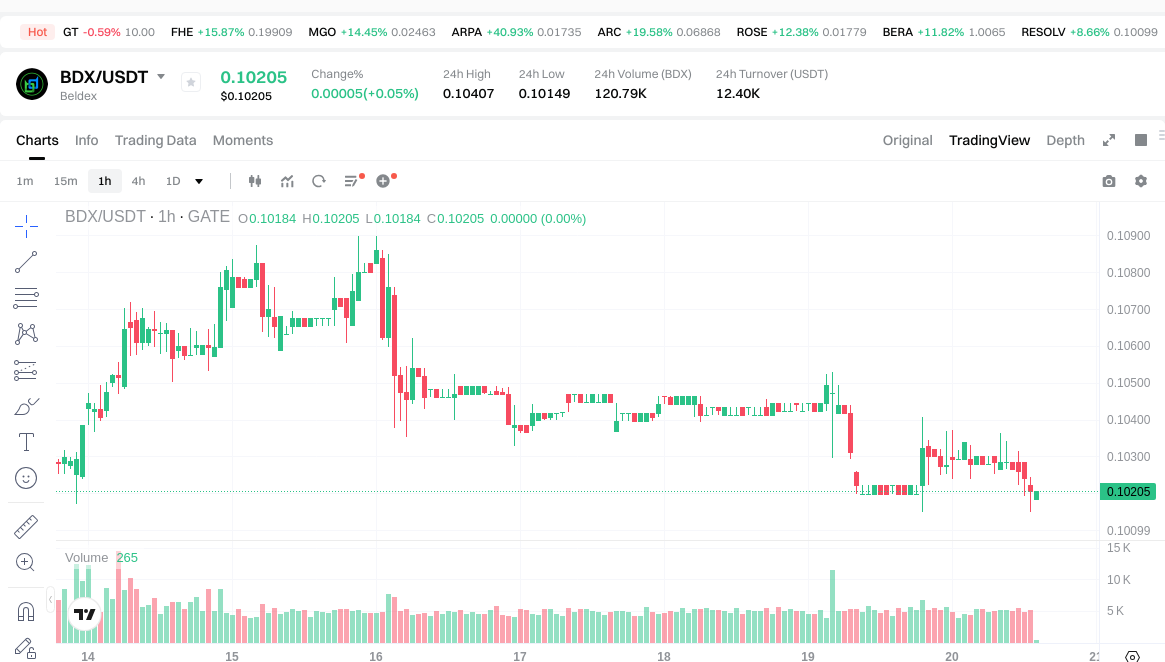
Click to view BDX USDT Price
Who created Beldex (BDX) and when?
Beldex launched on June 7, 2019. It has since expanded its ecosystem to include privacy-focused tools such as BChat, BelNet, browser solutions, protocols, and bridging components. Public sources describe it as a “confidential dApp ecosystem,” a suite of decentralized applications prioritizing minimal data exposure and user identifiability.
How does Beldex (BDX) work?
Beldex records transactions on its blockchain with a design philosophy of "verifiable yet difficult to link." Common privacy coin mechanisms include:
- Stealth addresses: Each payment generates a one-time address, reducing the chance of linking addresses to identities.
- Input/output mixing and aggregation: Obscures the flow of funds so external observers cannot easily determine sources or destinations.
- Zero-knowledge proofs or ZK-like solutions: Allow transactions to be validated without revealing specific values.
Network nodes bundle and validate transactions; users pay fees in BDX to prioritize their transactions. Those who participate in staking (locking BDX to support network operations) may earn rewards. Details of algorithms and parameters are governed by project technical documentation and future updates.
What can you do with Beldex (BDX)?
At the network layer, BDX is used for transaction fees and node incentives; at the application layer, it enables:
- Paid actions or premium features within BChat, supporting end-to-end encrypted messaging and reducing metadata exposure.
- Accessing content via BelNet while masking IP addresses to enhance browsing privacy.
- Settling assets across chains and applications through the Beldex protocol and bridging solutions for cross-chain interoperability.
Example: For private transfers to a friend, initiate a BDX transaction in the Beldex wallet; if concerned about network traceability, use BelNet and BChat for secure communication and payment confirmation.
What wallets and extensions exist in the Beldex (BDX) ecosystem?
- BChat: Decentralized chat tool focused on private messaging and unlinkable communication.
- BelNet: Privacy-centric browsing solution that hides IP and routing data for anonymous internet access.
- Beldex Browser: An optimized gateway for discovering and using dApps within the Beldex ecosystem.
- Beldex Protocol & Bridge: Facilitates cross-network interactions and asset transfers to support ecosystem connectivity.
Wallet options include custodial exchange accounts, software wallets, and hardware wallets. Software wallets offer convenience for everyday use, while hardware wallets provide higher security via offline private key storage (the secret string that controls assets). Choice depends on transaction frequency and individual security needs.
What are the main risks and regulatory considerations for Beldex (BDX)?
Privacy policy risk: Some jurisdictions impose strict regulations on privacy coins, which may lead to delisting or trading restrictions.
Liquidity & slippage risk: Low trading volume can result in significant slippage and widened spreads for large orders.
Price volatility risk: Crypto assets are highly volatile; short-term price moves may diverge from fundamentals or be sentiment-driven.
Technical & network risk: Protocol upgrades, node disruptions, or cross-chain bridge vulnerabilities could pose asset risks.
Custody & key management risk: Exchange accounts are subject to platform controls; self-custody requires careful backup of seed phrases and private keys—loss may be irreversible.
Compliance & taxation: Users should familiarize themselves with local regulatory obligations and tax requirements before participating.
How do I buy and securely store Beldex (BDX) on Gate?
Step 1: Register a Gate account and complete KYC. KYC is the identity verification process required for compliance and enhanced account privileges.
Step 2: Deposit or purchase USDT via fiat channels. You can transfer USDT from another wallet or buy USDT using fiat options on Gate to swap for BDX in the spot market.
Step 3: Search for “BDX/USDT” in the spot market. Review order book depth, recent 24-hour volume, and current price—watch for potential slippage.
Step 4: Choose your order type. Limit orders let you set your desired price for controlled execution; market orders execute instantly at prevailing prices—ideal for small amounts or fast trades. Consider splitting purchases over several orders to average costs.
Step 5: Enhance account security. Enable two-factor authentication (2FA), set withdrawal whitelists, and activate anti-phishing codes in your security center to lower theft risk.
Step 6: Withdraw to a self-custody wallet (optional). For long-term holding, transfer BDX to your own wallet. Confirm withdrawal network details, minimum amounts, and fees; test with small amounts before large transfers. Backup seed phrases and private keys offline—never screenshot or store them online.
Note: Always verify contract codes or trading pairs before placing orders ("BDX") and check the bulletin board for deposit/withdrawal maintenance or compliance updates.
How does Beldex (BDX) compare with Monero (XMR)?
Positioning & Ecosystem: Both projects focus on transaction privacy. Beldex emphasizes a "privacy app ecosystem" with tools like BChat and BelNet; Monero is dedicated mainly to "currency-layer privacy."
Technical approach: While both employ technologies such as ring signatures, stealth addresses, and amount hiding, their implementation details differ—including default privacy levels, optional transparency features, and auditability trade-offs.
Consensus & economic model: Differences exist in issuance schedules, reward distribution, staking mechanisms, and node roles—impacting inflation rates and long-term incentive structures.
Compliance & listings: Privacy coins face regulatory uncertainty; however, each project has varied acceptance across markets and listing histories.
Liquidity & market cap: Monero historically enjoys broader liquidity and reach; Beldex relies more on its ecosystem-driven usage demand. Investors should choose based on individual needs and liquidity preferences.
Summary of Beldex (BDX)
Beldex (BDX) is a public blockchain ecosystem centered on privacy, supporting daily communication and transfers through tools like BChat and BelNet. BDX serves as the fee token, incentive mechanism, and settlement asset within the network. As of January 20, 2026 data shows established price levels, market cap, and supply structure—but low trading volume suggests liquidity constraints, with discrepancies noted in maximum supply reporting (refer to official disclosures). For users valuing private communication and transactions, Beldex offers a robust toolchain; for investors, diversification across compliance environments, technical progress, liquidity options, and self-custody practices is recommended—follow Gate’s step-by-step process for trading and secure storage.
FAQ
What’s the difference between BDX and Bitcoin?
BDX (Beldex) is a privacy-focused cryptocurrency; Bitcoin is the earliest public blockchain asset. The main difference lies in privacy—BDX uses ring signatures and stealth addresses to ensure high transaction anonymity; Bitcoin’s ledger is fully transparent with all transactions publicly traceable on-chain. Additionally, BDX targets privacy application scenarios while Bitcoin is often viewed as digital gold and a store of value.
What do I need to buy BDX?
To buy BDX, you need an account on a platform supporting it (such as Gate) with completed identity verification. Prepare your payment method (fiat or crypto), then search for BDX trading pairs on Gate to make your purchase. For maximum asset security, transfer your holdings to a self-custody wallet after buying.
Are BDX’s privacy features truly secure?
BDX leverages ring signatures and stealth addresses—cryptographically validated technologies offering robust privacy protection. However, no cryptographic system is entirely foolproof; real-world privacy depends on how users manage their wallets—for instance, avoiding links between anonymous wallets and known identities. Before buying or holding BDX, research its privacy mechanism principles and limitations thoroughly.
How do I assess whether BDX is worth investing in?
Evaluate BDX based on ecosystem growth (the range of privacy applications), technical innovation (ongoing improvement of privacy algorithms), community engagement, and market liquidity. Also consider regional regulatory pressures facing privacy coins that could affect long-term prospects. Check historical data and the project whitepaper via Gate or other sources—and match your investment decision to your own risk tolerance.
What practical use cases does BDX offer?
BDX’s core use case is privacy-preserving transactions and anonymous transfers—ideal for users seeking financial confidentiality. The ecosystem also includes privacy browsers for secure online activity. Always ensure legal compliance when using privacy features; do not use them for illicit purposes.
Quick Reference Glossary for Bdx (BDX)
- Private transaction: Uses cryptographic methods to hide sender, receiver, and amount details.
- Ring signature: A privacy technology that mixes the transaction initiator among a group of users—making it hard to trace the real sender.
- Proof-of-Work (PoW): A consensus mechanism where miners solve computational puzzles to validate transactions and earn rewards.
- Blockchain: Distributed ledger technology recording all transaction data secured by cryptography.
- Mining: The process where miners compete to package transactions into blocks—generating new tokens as rewards.
- Privacy coin: Cryptocurrencies using privacy tech so transaction details remain invisible to external observers.
Further Reading & References for Beldex (BDX)